How Far? The Extent Of Chemical Change
플레이하며 배우기
이 문제들을 풀어 에너지를 얻은 뒤 낚시하고 탐험하세요. 계정이 필요 없어요.
수업 노트
Reversible Reactions and Dynamic Equilibrium
- Some reactions go to completion, where reactants are used up to form products and the reaction stops.
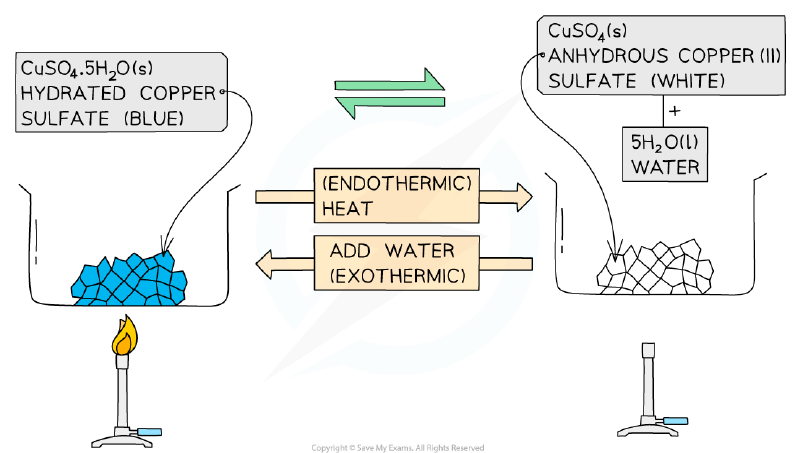
- In reversible reactions, products can react to reform the original reactants; this is shown using two opposing half arrows: ⇌.
- In a dynamic equilibrium, the rate of the forward reaction is the same as the rate of the backward reaction in a closed system.
- The concentrations of reactants and products remain constant, but they are not necessarily equal.
- There is no change in macroscopic properties such as colour and density because these depend on concentration.
- Dynamic equilibrium can be reached starting with either reactants or products.
A reversible reaction at equilibrium
Closed and Open Systems
- A closed system is one in which none of the reactants or products escape from the reaction mixture.
- In an open system, some matter is lost to the surroundings.
- When a reaction takes place entirely in solution, equilibrium can be reached in open flasks.
- If the reaction involves a gas, equilibrium can only be reached in a closed system.
- Dynamic equilibrium can also occur in physical systems, such as the equilibrium between liquid ethanol and ethanol vapour in a sealed bottle.
The Equilibrium Law and the Equilibrium Constant Expression
- The equilibrium law explains how the equilibrium constant, K, can be found from the stoichiometry of the reaction.
- For the general reaction aA + bB ⇌ cC + dD, the equilibrium constant expression is: K = [C]c [D]d / ([A]a [B]b).
- [A] and [B] are equilibrium reactant concentrations in mol dm⁻³; [C] and [D] are equilibrium product concentrations in mol dm⁻³.
- Solids are ignored in equilibrium constant expressions.
- The equilibrium constant, K, is specific to a given equation.
- In equilibrium constant expressions, square brackets must be used as they represent concentrations.
Interpreting the Magnitude of K
- The size of K tells us how the equilibrium mixture is made up with respect to reactants and products.
- If K << 1, the reaction hardly proceeds, the equilibrium lies far to the left, and the mixture contains mostly reactants.
- If K < 1, the reaction favours the reactants and the equilibrium lies to the left-hand side.
- If K = 1, there are significant amounts of both reactants and products, and the equilibrium is balanced between the two sides.
- If K > 1, the reaction favours the products and the equilibrium lies to the right-hand side.
- If K >> 1, the reaction goes almost to completion, the equilibrium lies far to the right with mostly products present.
The Equilibrium Constant and Temperature
- K is a constant at a specified temperature.
- Since temperature can affect the position of equilibrium, K is dependent on temperature.
- For an endothermic reaction, an increase in temperature increases the value of K.
- For an exothermic reaction, an increase in temperature decreases the value of K.
- Changes in concentration or pressure do not affect the value of K, provided temperature remains constant.
Relationship Between K Values for Reverse Reactions
- The equilibrium constant expression depends on the specific reaction.
- For a reaction and its reverse, the equilibrium constants are reciprocals of each other at the same temperature: K' = 1/K.
- For example, if the equilibrium constant for a forward reaction is 7.1 × 10³², the equilibrium constant for the reverse reaction is 1.41 × 10⁻³³.
Le Chatelier's Principle: Concentration Changes
- Le Chatelier's principle states that if a change is made to a system at dynamic equilibrium, the position of equilibrium moves to minimise this change.
- Increasing the concentration of a reactant shifts the equilibrium to the right, producing more product.
- Decreasing the concentration of a reactant shifts the equilibrium to the left.
- Increasing the concentration of a product shifts the equilibrium to the left.
- Decreasing the concentration of a product shifts the equilibrium to the right.
- Changes in concentration do not affect the value of K.
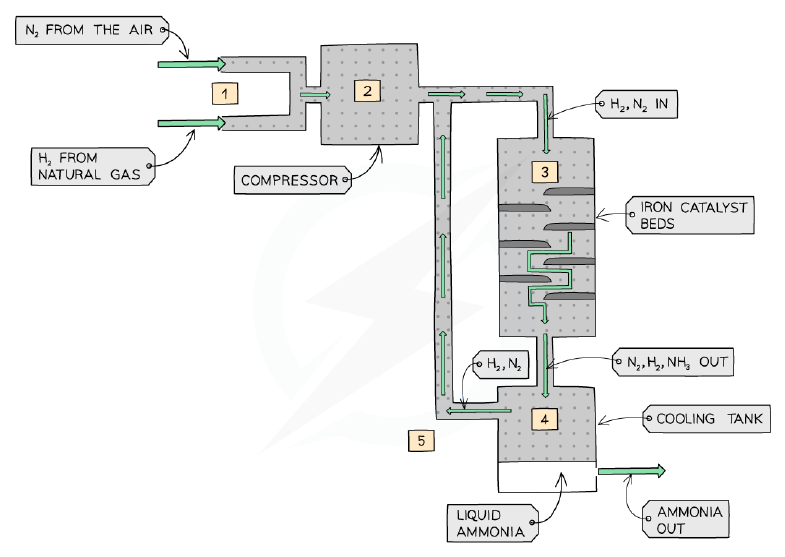
Equilibrium and the Haber process
Le Chatelier's Principle: Pressure Changes
- Changes in pressure only affect reactions where reactants or products are gases.
- Increasing the pressure shifts the equilibrium in the direction that produces the smaller number of gas molecules.
- Decreasing the pressure shifts the equilibrium in the direction that produces the larger number of gas molecules.
- If there are the same number of gas molecules on both sides, changes in pressure do not change the position of equilibrium.
- Changes in pressure do not affect the value of K.
Le Chatelier's Principle: Temperature Changes
- Increasing the temperature shifts the equilibrium in the endothermic direction, absorbing energy.
- Decreasing the temperature shifts the equilibrium in the exothermic direction, releasing energy.
- Changes in temperature change the value of K.
- For an endothermic reaction, increasing temperature increases K.
- For an exothermic reaction, increasing temperature decreases K.
Catalysts and Heterogeneous Equilibria
- A catalyst increases the rate of a chemical reaction by increasing the rate of the forward and reverse reactions equally.
- Catalysts only cause a reaction to reach equilibrium faster; they have no effect on the position of equilibrium or on the value of K.
- Le Chatelier's principle can also be applied to heterogeneous equilibria.
- In a fizzy drink bottle, an equilibrium exists between dissolved CO₂ and gaseous CO₂: CO₂(g) ⇌ CO₂(aq).
- When the bottle is opened, some CO₂(g) escapes, the equilibrium shifts to the left, and bubbles of CO₂(g) are observed.
슬라이드
연습 문제
무료 미리 보기 — 56개 중 8개 문제. 가입하면 전부 볼 수 있어요.
1.Which statement describes a closed system?
Easy- AOnly matter can be transferred across the boundary
- BOnly energy can be transferred across the boundary
- CEnergy and matter can be transferred across the boundary
- DEnergy and matter cannot be transferred across the boundary
2.Dinitrogen tetraoxide, N2O4, and nitrogen dioxide exist in equilibrium according to the equation: 2NO2(g) ⇌ N2O4(g) ΔH = –57 kJ mol–1. Which conditions give the greatest percentage of NO2 at equilibrium?
Medium- Ahigh pressure and high temperature
- Blow pressure and high temperature
- Chigh pressure and low temperature
- Dlow pressure and low temperature
3.Which statement below best describes a dynamic equilibrium?
Easy- Athe rate of the forward reaction is equal to the backwards reaction, and the concentrations of reactants and products is constant
- Bthe rate of the forward reaction is equal to the backwards reaction in a closed system, and the concentrations of the reactants and products are equal
- Cthe rate of the forward reaction is equal to the backwards reaction in a closed system, and the concentrations of the reactants and products is constant
- Dthe rate of reaction changes in either direction to counteract a change in conditions
4.Ethanol is manufactured by reacting steam with ethene: C2H4(g) + H2O(g) ⇌ C2H5OH(g) ΔH = –45 kJ mol–1. Which changes would increase the equilibrium yield of ethanol? (select all that apply)
Medium- AAdding a catalyst
- BIncreasing the pressure
- CDecreasing the temperature
- DIncreasing the temperature
- ERemoving ethanol as it forms
5.Propyl ethanoate is formed in an esterification reaction: CH3CH2CH2OH(l) + CH3COOH(l) ⇌ CH3COOCH2CH2CH3(l) + H2O(l) ΔH = –10 kJ mol–1. How can the value of the equilibrium constant Kc be increased?
Medium- Aincreasing the temperature
- Badding a catalyst
- Cincreasing the pressure
- Dlowering the temperature
6.An equilibrium is established at 450 °C when gaseous, purple iodine reacts with colourless hydrogen to form colourless hydrogen iodide: H2(g) + I2(g) ⇌ 2HI(g). The reaction is exothermic. Which change in conditions will cause the purple colour of the equilibrium mixture to become paler?
Medium- Adecrease in pressure
- Bdecrease in temperature
- Cincrease in pressure
- Dincrease in temperature
7.Nitrosyl chloride decomposes into nitrogen monoxide and chlorine according to the following equation: 2NOCl(g) ⇌ 2NO(g) + Cl2(g). What is the correct expression for Kc?
Medium- A[NOCl]2 / ([NO]2 [Cl2])
- B[NO] [Cl2] / [NOCl]
- C2[NO] [Cl2] / 2[NOCl]
- D[NO]2 [Cl2] / [NOCl]2
8.An equilibrium is established in the reaction: AB(aq) + CD(aq) ⇌ AC(aq) + BD(aq) ΔH = +180 kJ mol–1. Which factors would affect the value of Kc in this equilibrium?
Medium- Achange in temperature in the absence of a catalyst
- Bchange in pressure in the presence of a catalyst
- Cincreasing the concentration of AB
- Dincreasing the concentration of AC