Forces & Momentum
플레이하며 배우기
이 문제들을 풀어 에너지를 얻은 뒤 낚시하고 탐험하세요. 계정이 필요 없어요.
교육자를 위해: Forces & Momentum(Physics, HL)을(를) 위한 바로 쓸 수 있는 수업 슬라이드, 복습 노트 — 수업에 사용하거나, 학습자들이 실시간 게임으로 즐기는 인터랙티브 클래스 활동으로 진행하세요.
수업 노트
Free-Body Diagrams
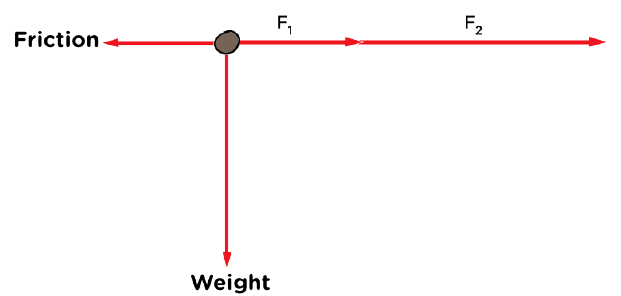
- A free-body diagram shows all the forces acting on a single object, represented as a point particle at its centre of mass.
- Each force is drawn as an arrow: the length gives the magnitude and the direction gives the direction of the force.
- Only forces acting on the object are included; forces the object exerts on other things are not shown.
- Common forces to include: weight (Fg) always towards the surface of the planet, tension (FT) always away from the mass, normal reaction force (FN) perpendicular to a surface, and friction (Ff) opposite to motion.
- Arrows should be roughly to scale so that relative magnitudes are clear.
- The resultant force (net force) is the vector sum of all forces acting on the body.
- In one dimension, combine forces by adding them with direction signs; in two dimensions, use Pythagoras and trigonometry to find the resultant.
Forces on an object
Newton's First Law
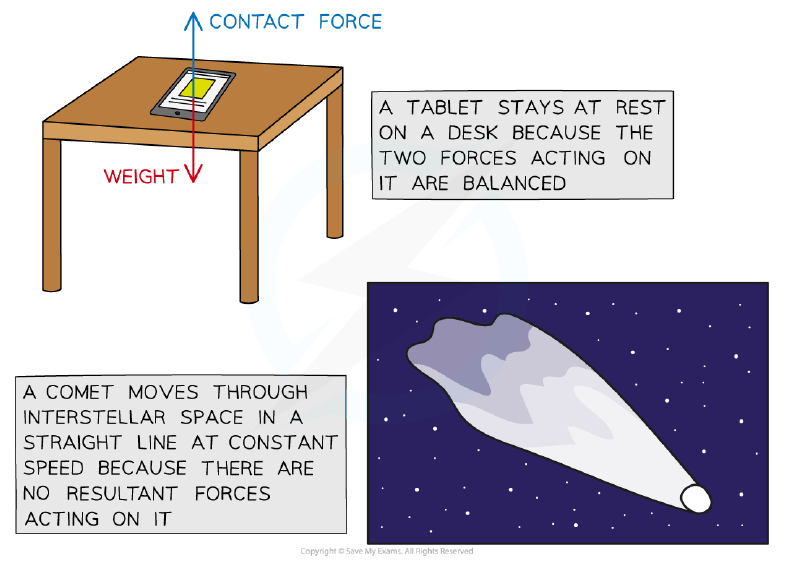
- Newton's first law: a body will remain at rest or move with constant velocity unless acted on by a resultant force.
- If the resultant force on an object is zero, it is in translational equilibrium.
- In equilibrium, forces to the left equal forces to the right, and upward forces equal downward forces.
- A resultant force changes an object's motion by speeding it up, slowing it down, or changing its direction.
- An object moving at constant velocity has balanced forces and zero acceleration.
Examples of Newton's First Law
Newton's Second Law
- Newton's second law: the resultant force on an object is directly proportional to its acceleration, F = ma.
- The acceleration always acts in the same direction as the resultant force.
- If the resultant force acts along the direction of motion, the object speeds up; if it opposes motion, the object decelerates.
- If the resultant force acts at an angle to the direction of motion, the object changes direction.
- Newton's second law can also be written as F = Δp/Δt: the resultant force equals the rate of change of momentum.
- For a falling object with no drag, acceleration is independent of mass.
Newton's second law in action

Newton's Third Law
- Newton's third law: if Object A exerts a force on Object B, then Object B exerts a force on Object A that is equal in magnitude but opposite in direction.
- Forces in a third-law pair must: be the same type, have the same magnitude, act in opposite directions, and act on different objects.
- A free-body diagram showing two forces on one object is not a third-law pair; it is an example of Newton's first law.
- Example: a foot pushes the ground backwards, and the ground pushes the foot forwards with an equal and opposite normal contact force.
Contact and Non-Contact Forces
- A contact force acts between objects that are physically touching.
- Examples of contact forces: friction, fluid resistance (viscous drag), tension, and normal (reaction) force.
- A non-contact force acts at a distance due to a field, without physical contact.
- Examples of non-contact forces: gravitational force, electrostatic force, and magnetic force.
- Gravitational force is always attractive; electrostatic and magnetic forces can be attractive or repulsive.
Frictional Forces
- Friction opposes motion and can prevent a stationary object from moving or reduce the speed of a moving object.
- Friction transfers energy by heating, raising the thermal energy of the objects and surroundings.
- Static friction acts when a body is stationary; dynamic friction acts when a body is in motion.
- Static friction increases in magnitude until movement begins; its maximum value is larger than dynamic friction.
- For a constant pushing force, dynamic friction is constant.
- Static friction: Ff ≤ μsFN; dynamic friction: Ff = μdFN.
- The coefficient of friction is a number between 0 and 1 (not including those values).
Hooke's Law
- Hooke's law: the extension of a material is directly proportional to the applied force up to the limit of proportionality.
- Hooke's law equation: FH = −kx, where FH is the elastic restoring force, k is the spring constant, and x is the extension.
- The spring constant k measures stiffness; a larger k means a stiffer material.
- Extension is the difference between stretched and unstretched length: extension = stretched length − unstretched length.
- On a force-extension graph, the Hooke's law region is a straight line through the origin; the gradient of this region equals the spring constant k.
Stoke's Law and Buoyancy
- Viscous drag is the frictional force between an object and a fluid that opposes relative motion.
- Stoke's law: Fd = 6πηrv, where η is fluid viscosity, r is the radius of the sphere, and v is its velocity.
- The drag force depends on the speed, size, and shape of the object.
- Viscosity is a measure of a fluid's resistance to flow; fluids with low viscosity are easy to pour, high viscosity are difficult to pour.
- The rate of flow of a fluid is inversely proportional to its coefficient of viscosity.
Momentum, Impulse, and Collisions
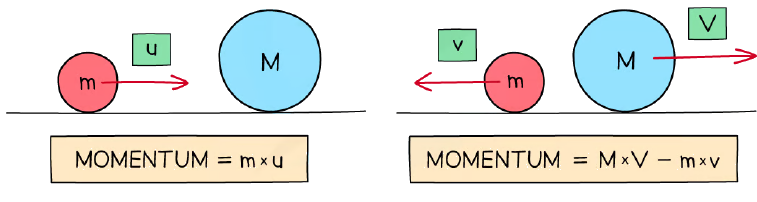
- Momentum is the product of mass and velocity: p = mv; it is a vector quantity.
- The fundamental SI units of momentum are kg m s⁻¹ (or N s).
- Impulse is the change in momentum: Impulse = FΔt = Δp.
- The principle of conservation of linear momentum: total momentum before a collision equals total momentum after, provided no external forces act.
- In an elastic collision, both momentum and kinetic energy are conserved.
- In an inelastic collision, momentum is conserved but kinetic energy is not.
- In explosions, momentum is conserved; the total momentum before is zero if the system is initially at rest.
- Crumple zones increase the impact time, which reduces the force exerted on the car during a collision.
Conservation of momentum
Circular Motion
- Angular velocity ω is the rate of change of angular displacement, measured in rad s⁻¹.
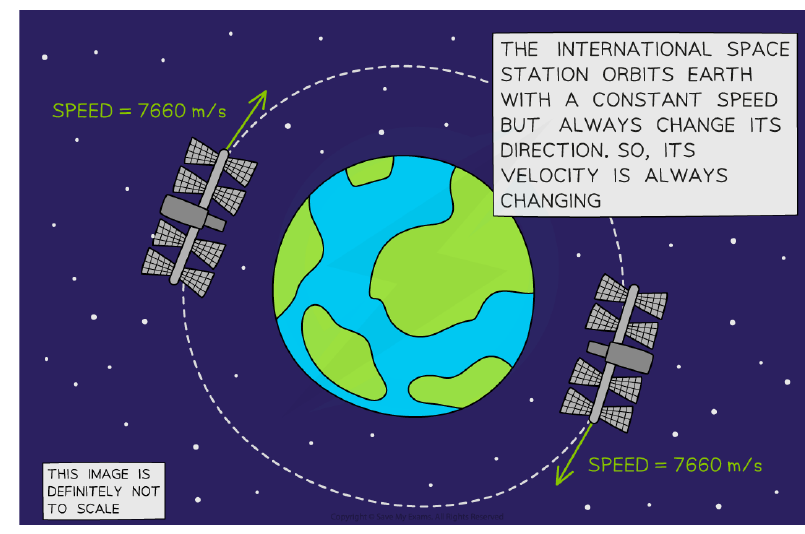
- For an object moving in a circle at constant speed, the velocity is constantly changing direction, so it is accelerating.
- Centripetal acceleration is directed towards the centre of the circle: a = v²/r = ω²r.
- Centripetal force is the resultant force directed towards the centre: F = mv²/r = mω²r.
- In non-uniform circular motion, the speed changes as well as the direction, so there is both a centripetal and a tangential component of acceleration.
Circular motion of the International Space Station
슬라이드
연습 문제
무료 미리 보기 — 53개 중 8개 문제. 가입하면 전부 볼 수 있어요.
1.Which of the following is the correct definition of a contact force?
Easy- AA force which acts between objects that are physically touching
- BA force which acts at a distance without physical contact
- CA force that only acts on objects at rest
- DA force that always opposes motion
2.Which of the following is a non-contact force?
Easy- AFriction
- BTension
- CNormal reaction force
- DGravitational force
3.A non-contact force acts at a distance, without any physical contact between bodies.
EasyTrue or false?
4.Which of the following is the correct equation for dynamic friction?
Easy- AFf = μs FN
- BFf = μd FN
- CFf = μd / FN
- DFf = FN / μd
5.Which of the following are examples of contact forces? (select all that apply)
Medium- AFriction
- BTension
- CGravitational force
- DNormal reaction force
- EMagnetic force
6.Static friction increases in magnitude until movement begins.
EasyTrue or false?
7.A ball is suspended from a cable and is in translational equilibrium. What does this mean?
Medium- AThe resultant force on the ball is zero
- BThe ball is accelerating
- CThe ball is moving at constant speed in a circle
- DThe forces on the ball are unbalanced
8.A box is sliding down a slope. Which of the following correctly describes the direction of the frictional force acting on the box?
Medium- AParallel to the slope, in the opposite direction to the motion
- BPerpendicular to the slope
- CVertically upwards
- DParallel to the slope, in the same direction as the motion
기출 문제
이 주제의 기출 문제 연습이 곧 나와요.
곧 출시