Work, Energy & Power
플레이하며 배우기
이 문제들을 풀어 에너지를 얻은 뒤 낚시하고 탐험하세요. 계정이 필요 없어요.
수업 노트
Principle of Conservation of Energy
- Energy cannot be created or destroyed; it can only be transferred from one form to another.
- The total amount of energy in a closed system remains constant, although the amount in each form may change.
- A system is an object or a group of objects; defining it narrows the focus to what is relevant.
- When a system is in equilibrium, nothing changes and nothing happens; a change means energy is transferred.
- Kinetic energy, gravitational potential energy and elastic potential energy are collectively known as mechanical energy types.
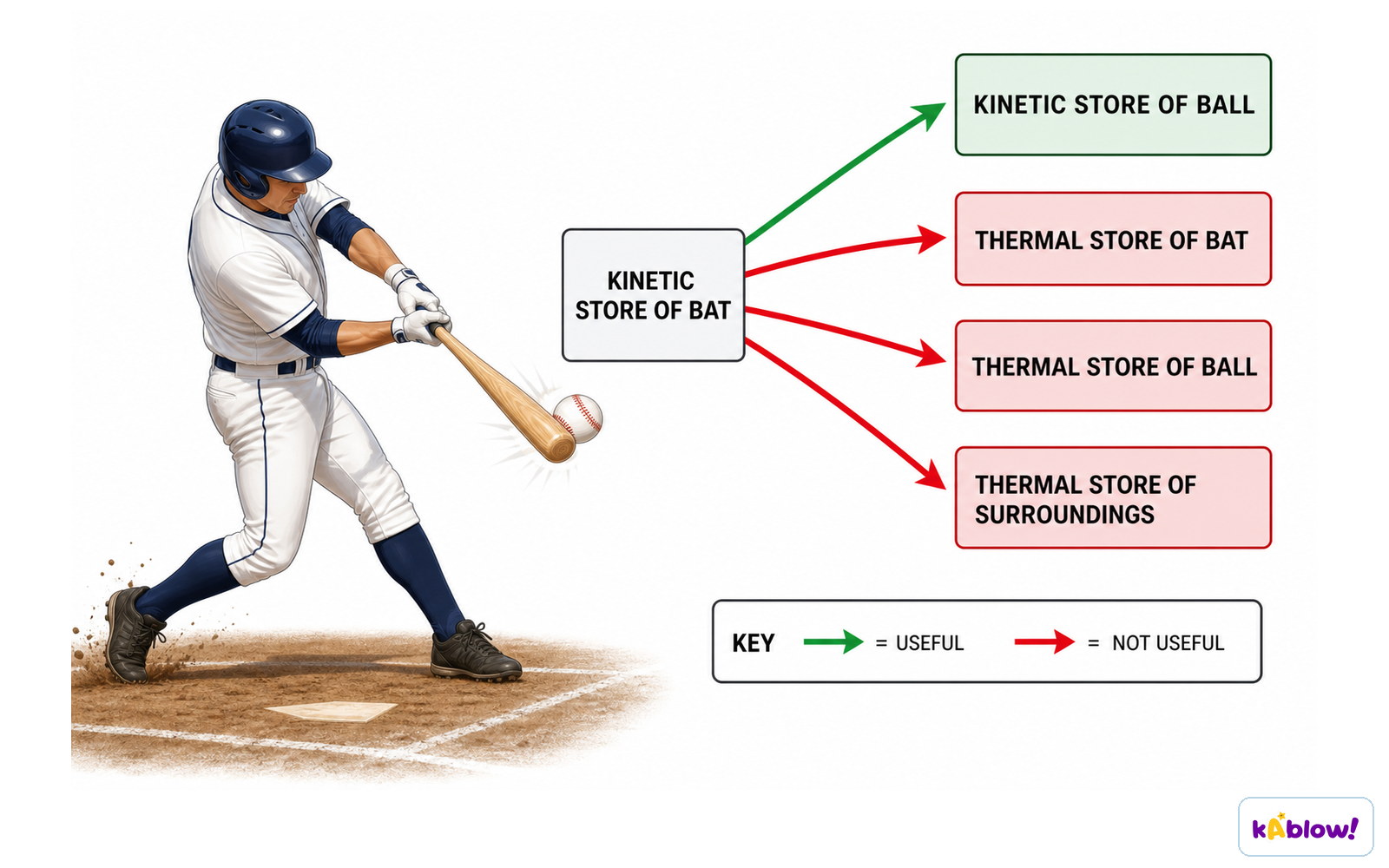
- No energy transfer is 100% efficient — some energy is always dissipated to the surroundings.
- Dissipated energy usually ends up as thermal energy transferred to the surroundings and is regarded as wasted energy.
Energy transfer and conservation
Energy Transfers and Dissipation
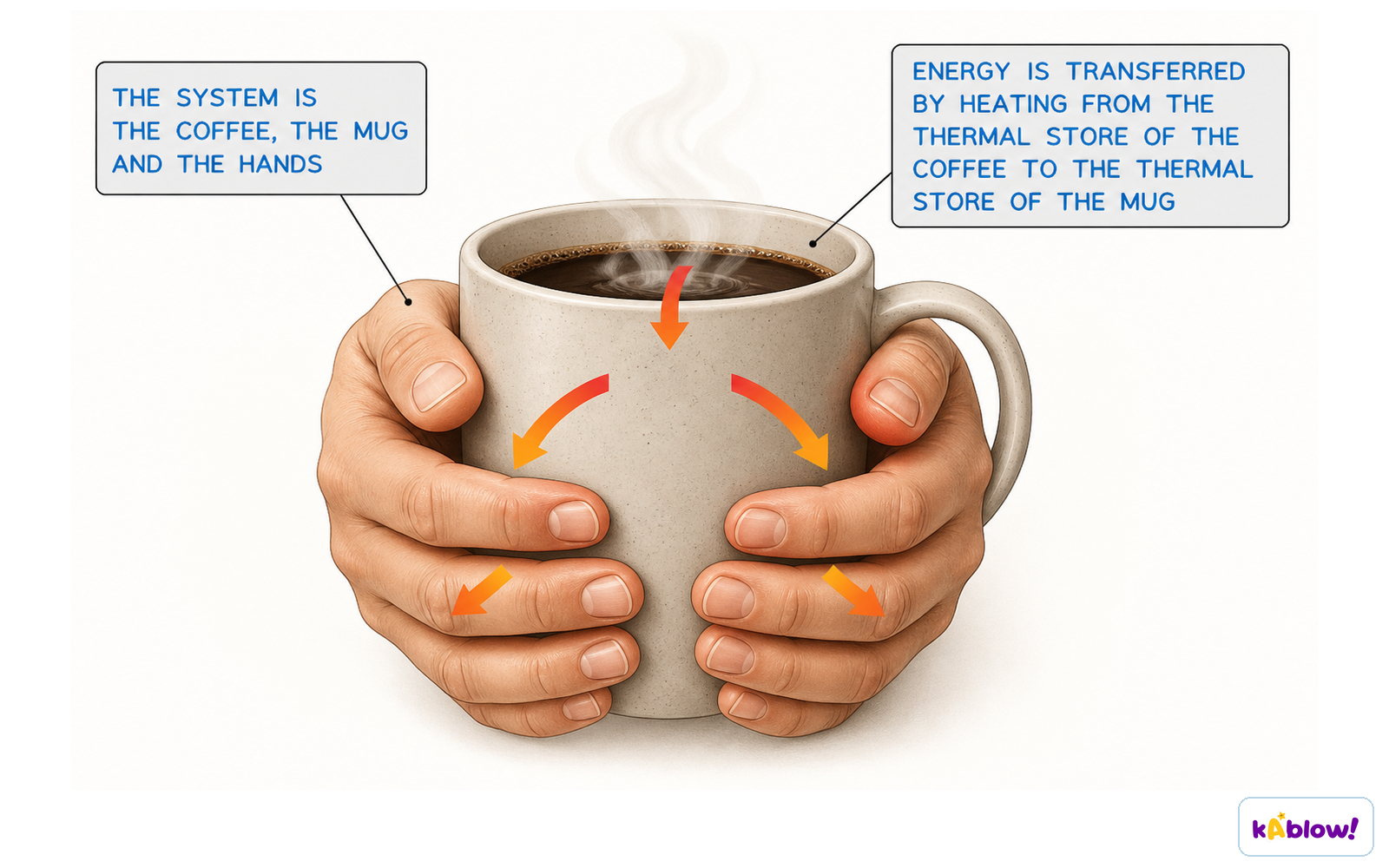
- In a kettle, electrical energy is transformed into thermal energy in the heating element, which is transferred to the water.
- Thermal energy transferred to the plastic casing or surrounding air is wasted energy; energy heating the water is useful.
- A falling object in a vacuum transfers gravitational potential energy into kinetic energy with no dissipation.
- A horizontal mass on a spring transfers elastic potential energy into kinetic energy.
- A battery or cell transfers chemical energy into electrical energy; a car transfers chemical energy from fuel into kinetic energy.
- A person bouncing on a trampoline transfers energy from elastic potential to kinetic to gravitational potential.
- If an object travels up a rough inclined surface: loss in kinetic energy = gain in gravitational potential energy + work done against friction.
Energy transfer by heating from a hot coffee mug to cold hands
Sankey Diagrams
- Sankey diagrams represent energy transfers using arrows whose width is proportional to the amount of energy going to each store.
- The arrow pointing to the right represents the useful energy output; arrows pointing down represent wasted energy.
- Conservation of energy gives: Total energy in = Useful energy out + Wasted energy.
- A more efficient light bulb has less wasted energy, shown by a smaller downward arrow representing energy transferred by heating.
- The same conservation principle applies to power: Total power in = Useful power out + losses + wasted power.
- When drawing a Sankey diagram, plan the widths of the input, useful output and wasted arrows before drawing, and mark the wasted arrow carefully.
Work Done
- Work done by a force is equivalent to a transfer of energy; its units are newton metres, where 1 N m = 1 J.
- The work done by a resultant force on a system equals the change in energy of that system.
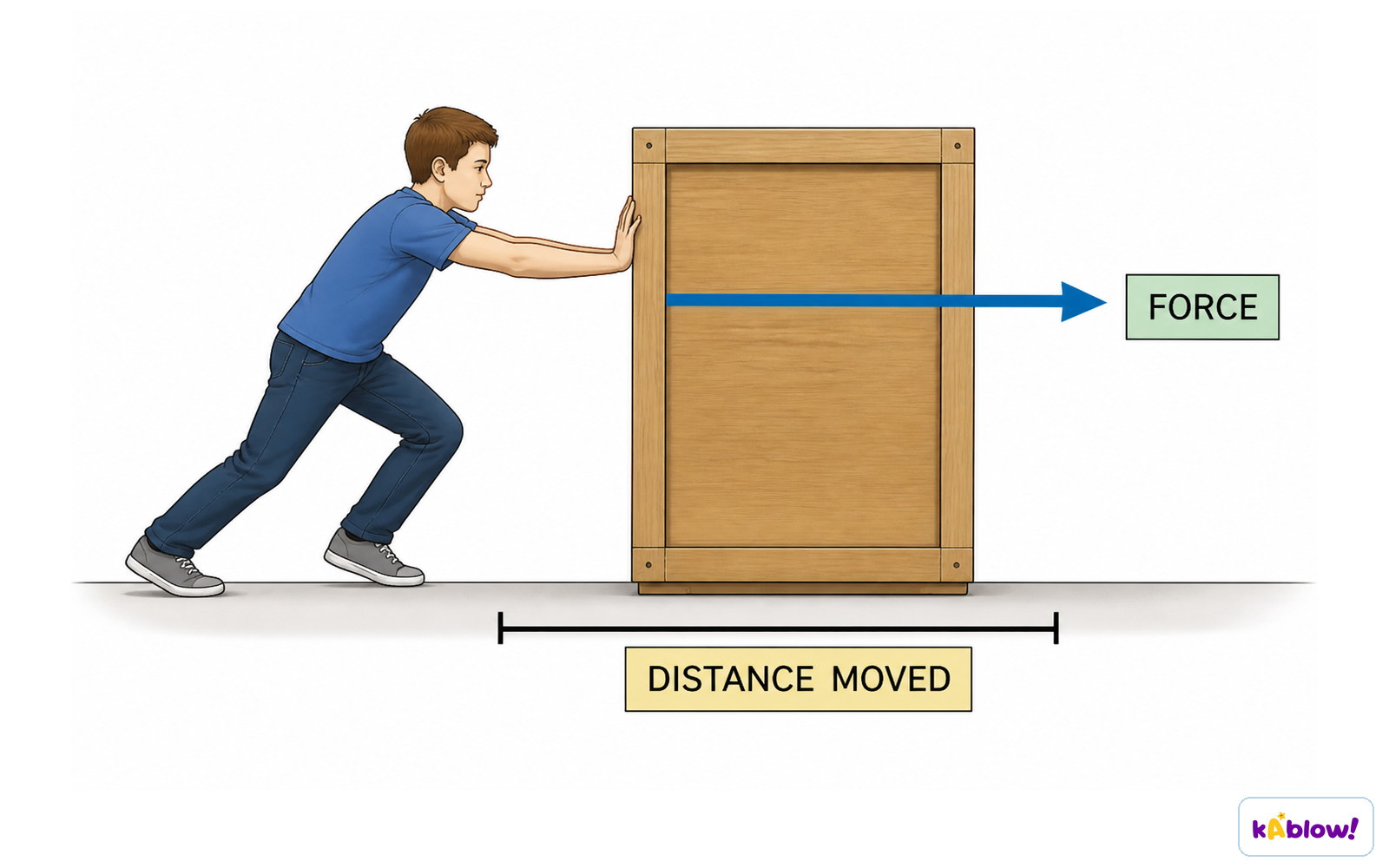
- Mechanical work is the transfer of energy when an external force causes an object to move over a certain distance.
- For a constant force parallel to the displacement: W = Fs, where W is work done (J), F is force (N) and s is displacement (m).
- If the force is at an angle θ to the displacement: W = Fs cos θ, where θ is the angle between the force and the motion.
- When θ = 0, cos θ = 1 and W = Fs; only the component of the force parallel to the displacement does work.
- For horizontal motion use cos θ; for vertical motion use sin θ — always consider the horizontal and vertical components of the force.
- On a graph of average force against displacement, the area under the graph equals the work done.
Work is done when a force is used to move an object over a distance
Kinetic Energy
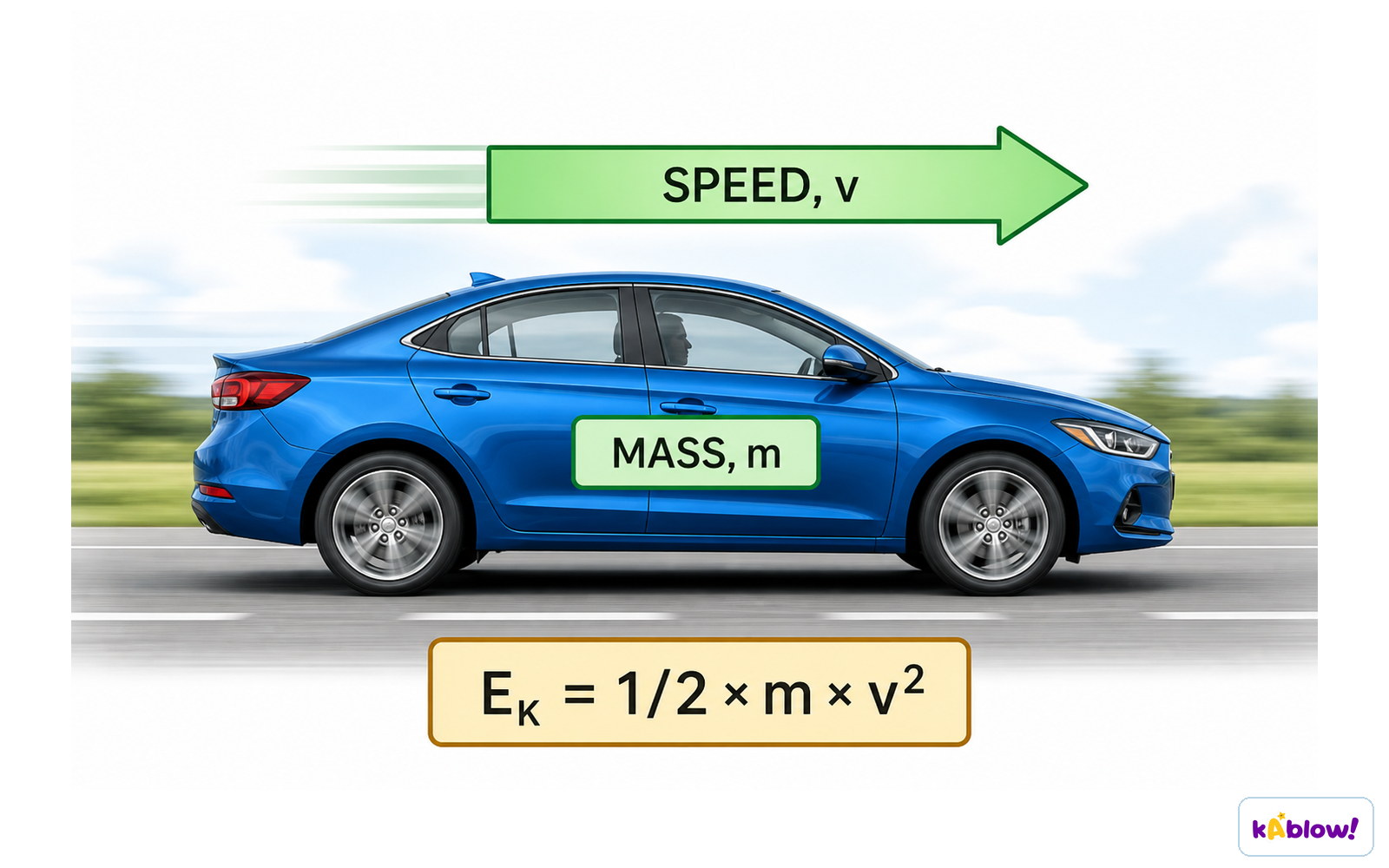
- Kinetic energy (Ek) is the energy an object has due to its motion; the faster it moves, the greater its kinetic energy.
- Kinetic energy is calculated using Ek = ½mv², where m is mass (kg) and v is velocity (m s⁻¹).
- Only the speed is squared, not the mass or the ½.
- When an object falls, it gains kinetic energy transferred from the gravitational potential energy it loses.
- An object maintains its kinetic energy unless its speed or mass changes.
- Kinetic energy can also be written in terms of momentum: Ek = p² / 2m, where p is momentum (kg m s⁻¹).
- The p²/2m form is very useful in particle physics when comparing momentum and kinetic energy.
- Energy is a scalar quantity, so a 'loss of kinetic energy' is stated without a negative sign.
Kinetic energy of a moving car
Gravitational Potential Energy
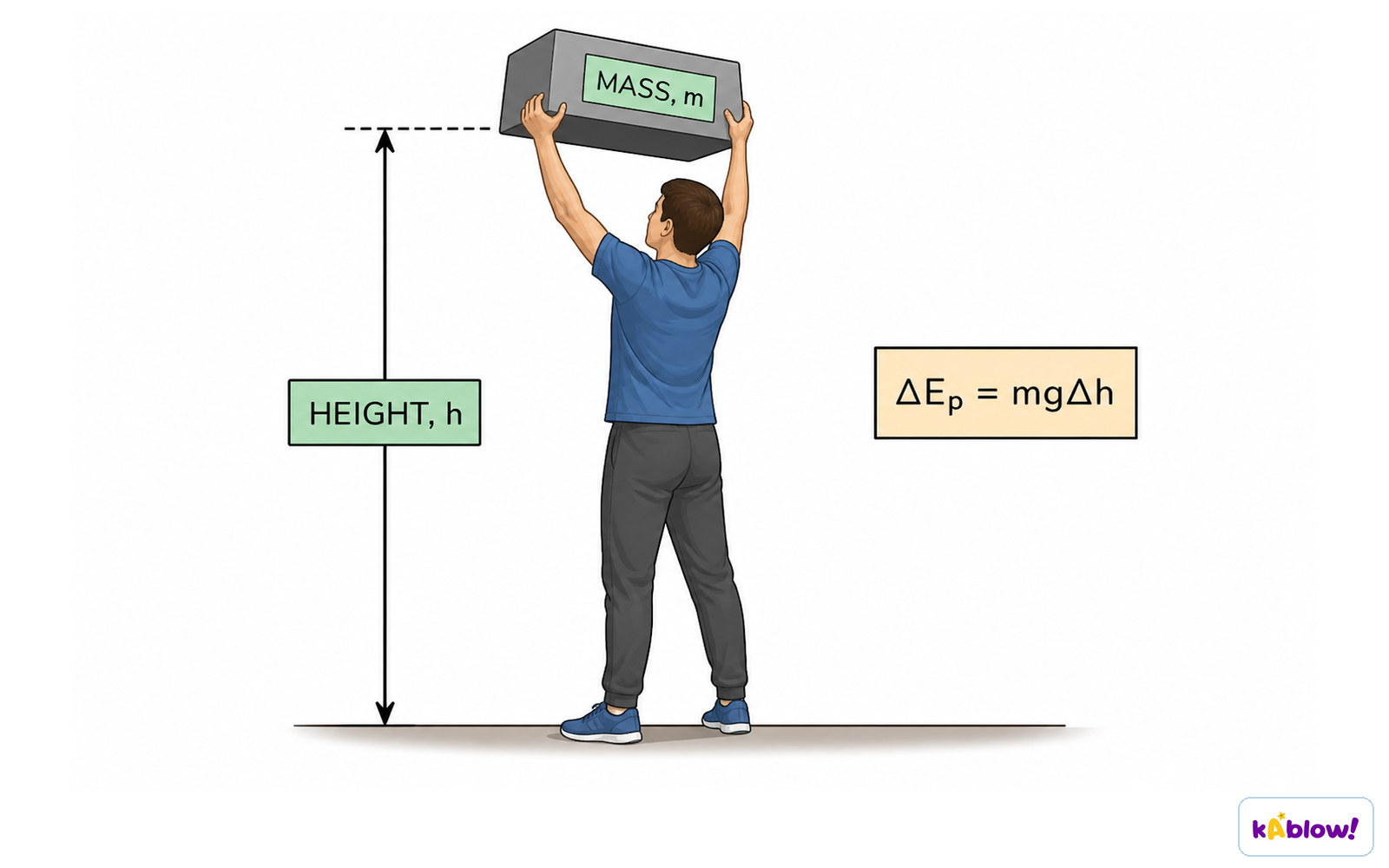
- Gravitational potential energy (GPE) is the energy stored in a mass due to its position in a gravitational field.
- If a mass is lifted up it gains GPE; if it falls it loses GPE.
- Close to the Earth's surface: ΔEp = mgΔh, where g = 9.8 N kg⁻¹ and Δh is the change in height (m).
- The potential energy at ground level is usually taken as zero, but any position can be taken as zero when calculating a change in GPE.
- This equation is only relevant in a uniform gravitational field, such as near the Earth's surface.
- A different potential energy expression is used in the gravitational fields topic because the field is no longer uniform outside the Earth's surface.
- Gravitational potential energy and height have a linear relationship, shown by straight-line graphs of GPE against height or time.
Gravitational potential energy of a lifted mass
Elastic Potential Energy
- Elastic potential energy is the energy stored within a material (e.g. a spring) when it is stretched or compressed.
- For a material obeying Hooke's Law: EH = ½kΔx², where k is the spring constant (N m⁻¹) and Δx is the extension (m).
- It can also be written as EH = ½FΔx, where F is the restoring force given by F = kΔx.
- It is very dangerous if a wire under large stress suddenly breaks because its elastic potential energy is converted into kinetic energy.
- When all elastic potential energy becomes kinetic energy: ½kΔx² = ½mv², so v ∝ Δx.
- The greater the extension Δx, the greater the speed v of the wire when it breaks.
Conservation of Mechanical Energy
- Mechanical energy = Ek + ΔEp + EH — the sum of kinetic, gravitational potential and elastic potential energy.
- The change in total mechanical energy of a system is interpreted in terms of the work done by any non-conservative force, such as friction.
- In the absence of frictional or resistive forces, the total mechanical energy of a system is conserved throughout its motion.
- For a vertical spring oscillating, energy converts between EPE, KE and GPE while the total energy stays constant.
- Vertical spring positions: at maximum height GPE is maximum and KE is zero; at the equilibrium position KE is maximum; at maximum extension EPE is maximum and KE is zero.
- For a horizontal mass on a spring, GPE is constant and the spring only converts between kinetic and elastic potential energy.
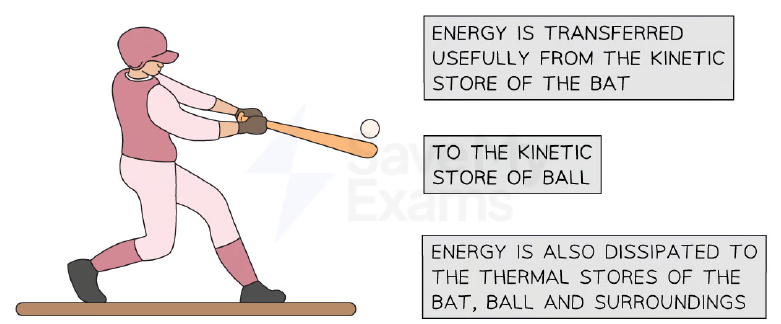
- Using conservation of energy with negligible drag: loss in gravitational potential energy = gain in kinetic energy.
- Examples of energy transfer include a swinging pendulum, objects in freefall, and sports involving falling such as skiing and skydiving.
The principle of conservation of energy applied to a bat hitting a ball
Energy & Power
- The power of a mechanical process is the rate at which energy is transferred, i.e. the rate of work done.
- Power is calculated using P = ΔW / Δt = Fv, where F is force (N) and v is velocity (m s⁻¹).
- The Fv form is only relevant where a constant force moves a body at constant velocity, with the force in the same direction as the velocity.
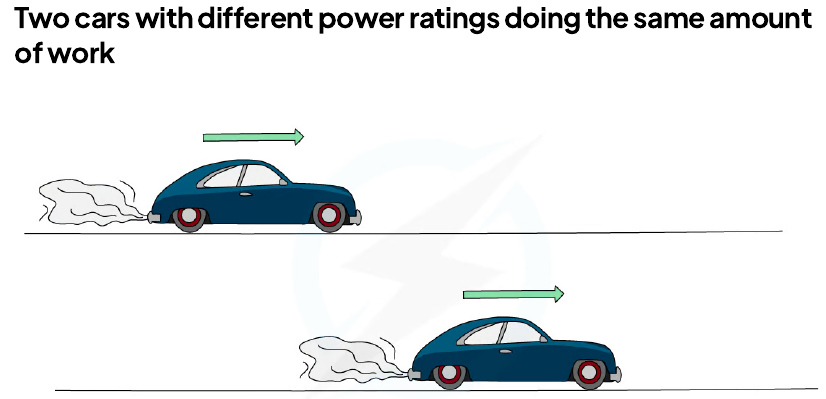
- Two cars may do the same work to accelerate, but the one with more power transfers that energy in a shorter time.
- Of two motors lifting the same weight by the same height, the one that lifts it faster has more power.
- Power is required to produce an acceleration.
- Power is measured in watts (W), where 1 W = 1 J s⁻¹ — a transfer of 1 joule of energy in 1 second.
- Appliances are given a power rating (e.g. 1000 W) indicating the energy transferred per second to the appliance.
Power and rate of energy transfer
Efficiency Formula
- Efficiency is a measure of how successfully energy is transferred in a system.
- It is defined as the ratio of the useful power or energy transfer output to the total power or energy transfer input.
- Efficiency is calculated using η = Eout / Ein = Pout / Pin.
- To express efficiency as a percentage, multiply the ratio by 100%.
- In words: η = useful work out / total work in = useful power out / total power in.
- High efficiency means most of the energy transferred is useful; low efficiency means most is wasted.
- Which energy is useful or wasted depends on the system — for a kettle, heating the water is useful, heating the casing and air is wasted.
- Efficiency has no units because it is a ratio of quantities with the same units; it can be given as a ratio (0 to 1) or a percentage (0% to 100%).
Energy Density
- A fuel is anything that can be burned to produce heat, which can be used for an engine to work.
- Energy density is a measure of the amount of energy per unit volume of a fuel, measured in J m⁻³.
- Different fuels contain different amounts of energy, making them suitable for certain uses, e.g. petrol for running vehicles.
- Example energy densities (MJ L⁻¹): coal 38, diesel 39, biodiesel 33, vegetable oil 30, liquid hydrogen 9, wood 3, methane 0.3.
- 1 litre = 0.001 m³.
- We can get more energy per unit volume of coal than of wood.
- Fuels are chosen for specific uses based on factors including energy density, safety of use and pollutants released in combustion.
슬라이드
연습 문제
무료 미리 보기 — 63개 중 8개 문제. 가입하면 전부 볼 수 있어요.
1.Which statement is the principle of conservation of energy?
Easy- AEnergy cannot be created or destroyed; it can only be transferred from one form to another
- BThe total amount of energy in a system always decreases over time
- CEnergy can be created when a force does work on an object
- DEnergy is always transferred as thermal energy
2.In a Sankey diagram, what does the width of each arrow represent?
Easy- AThe amount of energy going to each store
- BThe temperature of the energy store
- CThe speed at which energy is transferred
- DThe direction of the energy transfer
3.A constant force of 20 N is applied to a box at an angle of 45° to the horizontal, moving it 5 m horizontally. What is the work done on the box?
Medium- A71 J
- B100 J
- C50 J
- D35 J
4.A spring has a spring constant of 92 N m⁻¹ and is extended by 0.3 m. What is the elastic potential energy stored in the spring?
Medium- A4.1 J
- B8.3 J
- C27.6 J
- D13.8 J
5.A car engine exerts a thrust of 200 N while the car travels at a constant speed of 27 m s⁻¹. What is the power of the car?
Medium- A5400 W
- B7.4 W
- C200 W
- D2700 W
6.Which of the following are forms of wasted energy transfer when a petrol car's engine converts chemical energy? (Select all that apply)
Medium- ASound from the engine
- BThermal energy from the engine
- CKinetic energy of the car
- DElectrical energy from the battery
- ELight from the headlights
7.A ball is dropped from a height of 2 m on Jupiter, where the acceleration of free fall is 24.58 m s⁻². Which statements are correct? (Select all that apply)
Hard- AThe gravitational potential energy at the drop point equals the kinetic energy just before impact
- BThe speed just before impact is about 9.9 m s⁻¹
- CThe speed just before impact is about 4.9 m s⁻¹
- DThe relationship between GPE and KE is mgh = ½mv²
- EThe kinetic energy just before impact is greater than the gravitational potential energy at the drop point
8.In a closed system, the total amount of energy remains constant, but the amount of each form of energy may change.
EasyTrue or false?