Gravitational Fields
플레이하며 배우기
이 문제들을 풀어 에너지를 얻은 뒤 낚시하고 탐험하세요. 계정이 필요 없어요.
수업 노트
Newton's Law of Gravitation
- Newton's law of gravitation states that the gravitational force between two point masses is proportional to the product of their masses and inversely proportional to the square of their separation.
- The equation is: F = Gm₁m₂ / r², where F is the gravitational force (N), G is Newton's gravitational constant, m₁ and m₂ are the masses (kg), and r is the distance between their centres (m).
- The inverse square law means that if the separation is doubled, the force reduces by a factor of (½)² = ¼.
- The law applies to point masses, but planets and stars can be treated as point masses because their separation is much larger than their radius.
- When using the equation, ensure r is the distance between the centres of the masses, not the distance between their surfaces.
Gravitational Field Strength
- A gravitational field is a region of space where a test mass experiences a force due to the gravitational attraction of another mass.
- Gravitational field strength (g) at a point is defined as the force per unit mass experienced by a test mass at that point: g = F / m.
- The units of g are N kg⁻¹.
- The gravitational field strength depends only on the mass M of the body producing the field and the distance r from its centre: g = GM / r².
- On a planet's surface, g depends on the planet's mass (or density) and radius.
- An object's mass remains the same everywhere, but its weight (force due to gravity) changes with g.
- g is gravitational field strength, while G is Newton's gravitational constant; they are not interchangeable.
Gravitational Field Strength
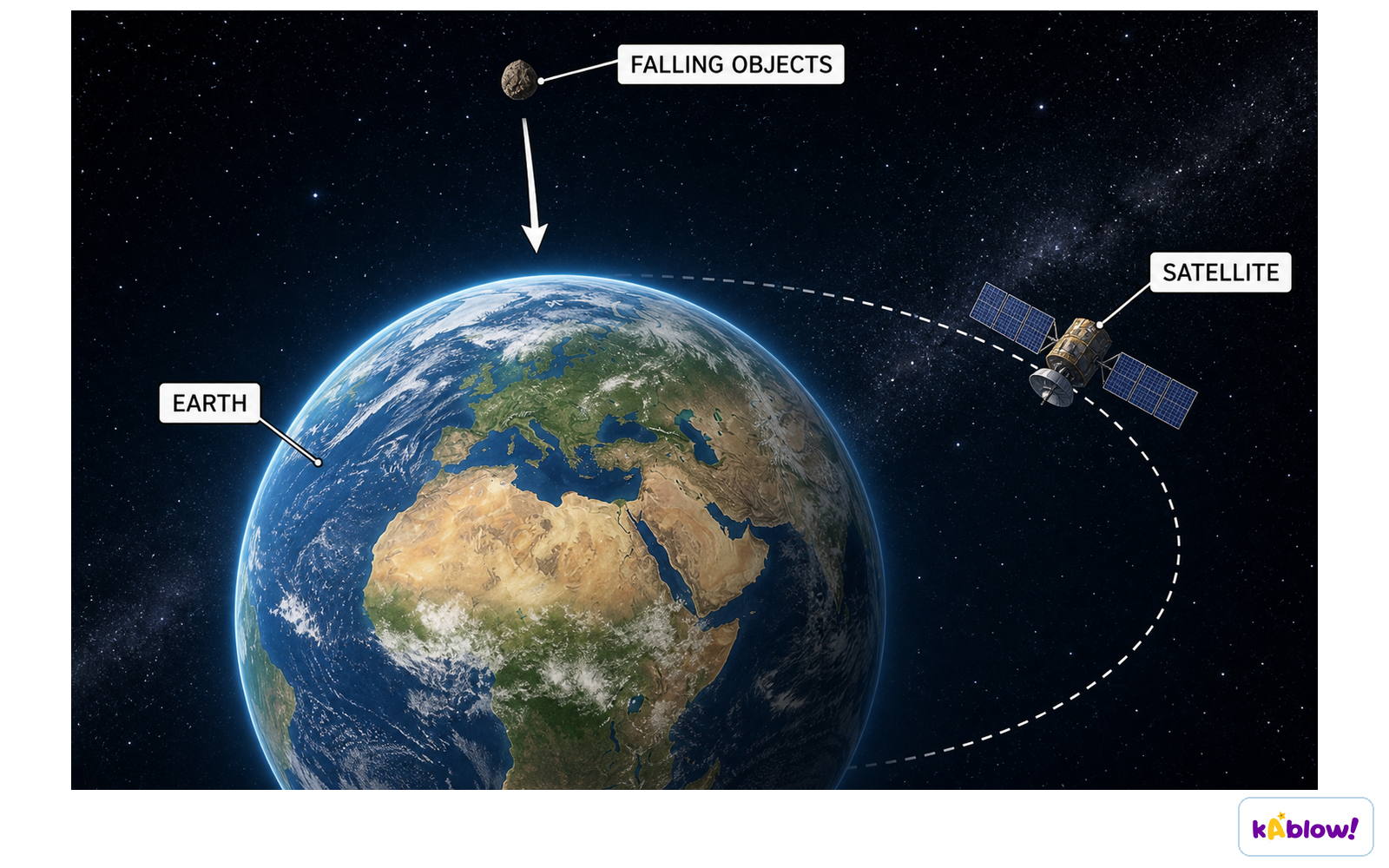
Gravitational Field Lines
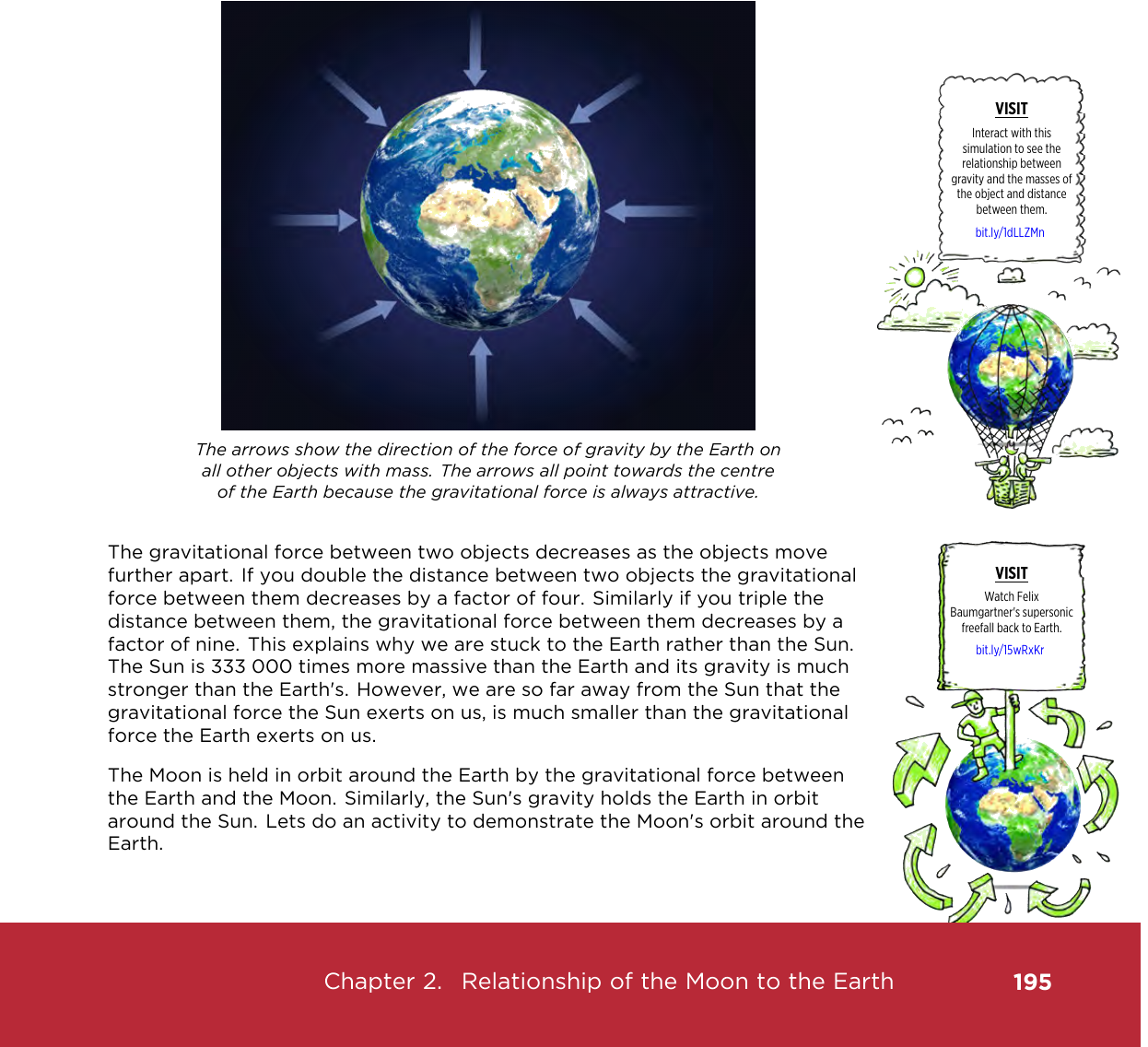
- Gravitational field lines show the direction of the gravitational force that would act on a mass placed at a point in the field.
- Gravitational field lines are always directed towards the centre of mass of the body producing the field, because gravitational forces are always attractive.
- The gravitational field around a point mass is radial, with field lines pointing inwards.
- A uniform gravitational field has equally spaced parallel field lines, and the field strength is the same at all points; for example, near the Earth's surface.
- Radial fields are non-uniform: the field strength changes with distance from the centre.
- For a uniform sphere, the field outside it is the same as if all its mass were concentrated at its centre (point mass approximation).
Kepler's Laws of Planetary Motion
- Kepler's first law: The orbit of a planet is an ellipse, with the Sun at one of the two foci.
- Kepler's second law: A line segment joining the Sun to a planet sweeps out equal areas in equal time intervals.
- A consequence of Kepler's second law is that planets move faster when nearer the Sun and slower when further away.
- Kepler's third law: For planets or satellites in circular orbits about the same central body, the square of the orbital period is proportional to the cube of the orbital radius: T² ∝ r³.
- The full equation for Kepler's third law is: T² = (4π² r³) / (GM), where M is the mass of the central body.
- A graph of log T against log r gives a straight line, because T² ∝ r³ implies 2 log T ∝ 3 log r.
Orbital Motion and Period
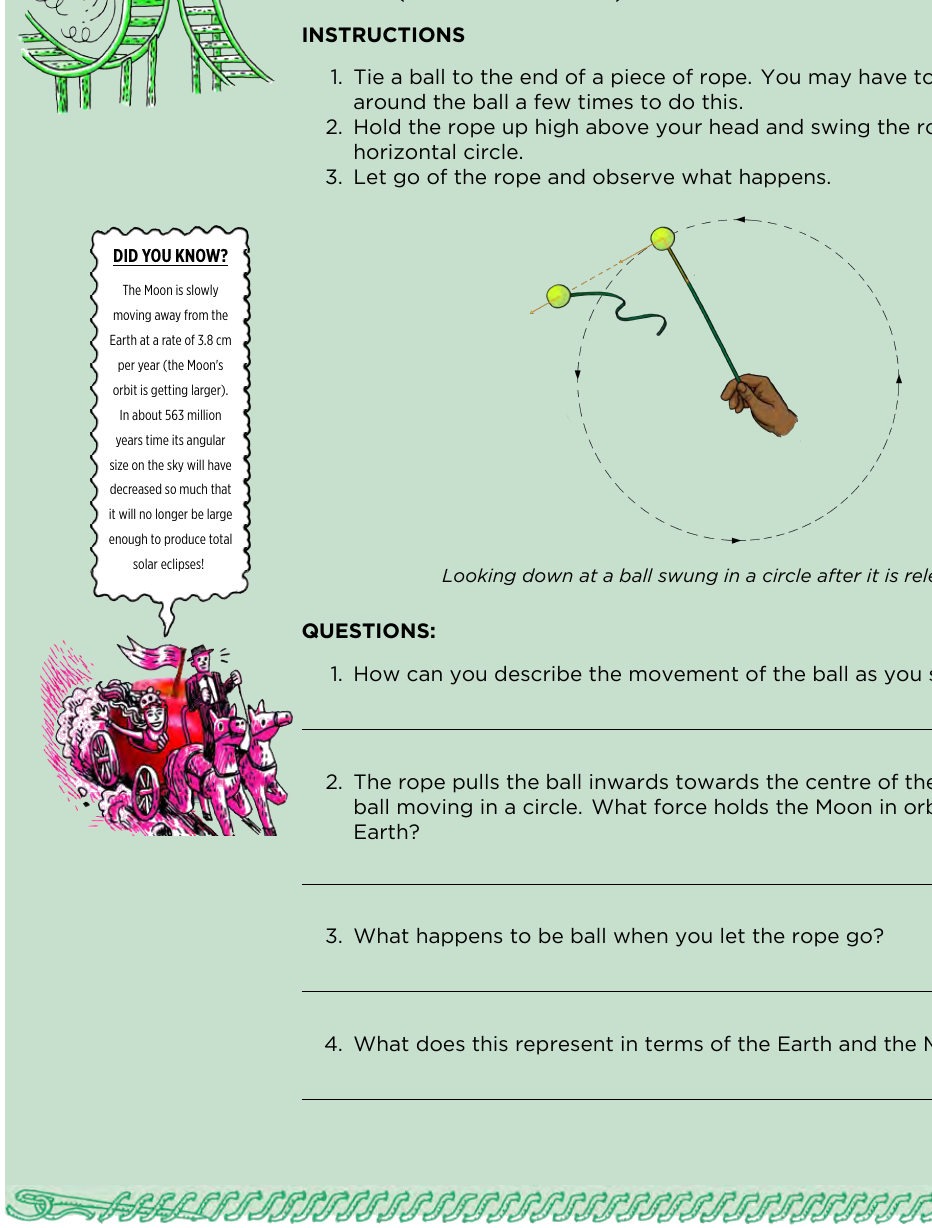
- For a satellite in a circular orbit, the gravitational force provides the centripetal force: GMm / r² = mv² / r.
- The orbital speed is related to the period by v = 2πr / T.
- Combining these gives T² = (4π² r³) / (GM), which shows that the period depends only on the orbital radius and the mass of the central body.
- The mass of the orbiting object does not affect its orbital period.
A hand swinging a ball on a rope in a circle, illustrating centripetal force and orbital motion.
Gravitational Field Strength and Density
- The gravitational field strength at the surface of a planet can be expressed in terms of its density ρ and radius r: g = (4/3)πGρr.
- This shows that g ∝ ρr for a planet of uniform density.
- If two planets have the same density, the one with the larger radius has a greater surface gravitational field strength.
- For a planet of mass M and radius r, the density is ρ = M / (4/3 π r³).
Gravitational Fields of Celestial Bodies
- The gravitational field strength at a distance r from the centre of a planet is g = GM / r².
- At the surface of a planet, r is the planet's radius R, so g = GM / R².
- The gravitational field strength decreases with distance from the planet's centre according to the inverse square law.
- The mass of a planet can be determined from its surface gravitational field strength and radius: M = gR² / G.
The direction of gravity
Key Definitions and Equations
- Newton's law of gravitation: F = Gm₁m₂ / r²
- Gravitational field strength: g = F / m
- Gravitational field strength due to a point mass or uniform sphere: g = GM / r²
- Kepler's third law: T² = (4π² r³) / (GM)
- Density: ρ = M / V, and for a sphere V = (4/3)πr³
슬라이드
연습 문제
무료 미리 보기 — 67개 중 8개 문제. 가입하면 전부 볼 수 있어요.
1.What is the definition of gravitational field strength at a point?
Easy- AThe force per unit mass experienced by a test mass at that point
- BThe force experienced by a test mass at that point
- CThe mass per unit force experienced by a test mass at that point
- DThe gravitational potential energy per unit mass at that point
2.Gravitational field lines are always directed towards the centre of mass of the body producing the field.
EasyTrue or false?
3.Which of the following is the correct equation for Newton's law of gravitation?
Medium- AF = G m1 m2 / r2
- BF = G m1 m2 / r
- CF = G m1 m2 r2
- DF = G (m1 + m2) / r2
4.Which of the following statements about gravitational fields are correct? (select all that apply)
Medium- AGravitational field strength is a vector quantity.
- BGravitational field lines can be repulsive.
- CThe gravitational field strength at a point depends on the mass of the test mass placed there.
- DThe gravitational field strength is inversely proportional to the square of the distance from the centre of the mass producing the field.
- EGravitational forces have an infinite range.
5.Match each term with its correct definition.
Medium- Gravitational field
- Gravitational field strength
- Newton's law of gravitation
- Kepler's first law
- A region of space where a test mass experiences a force due to the gravitational attraction of another mass
- The force per unit mass experienced by a test mass at a point
- The gravitational force between two point masses is proportional to the product of the masses and inversely proportional to the square of their separation
- The orbit of a planet is an ellipse, with the Sun at one of the two foci
6.A satellite orbits a planet at a distance r from the planet's centre. If the distance is doubled, by what factor does the gravitational force change?
Medium- AIt is reduced by a factor of 4
- BIt is reduced by a factor of 2
- CIt is increased by a factor of 2
- DIt is increased by a factor of 4
7.Which of the following best describes the gravitational field lines around a point mass?
Medium- ARadial and pointing inwards towards the mass
- BRadial and pointing outwards away from the mass
- CParallel and equally spaced
- DCircular around the mass
8.The gravitational field strength at the surface of a planet depends on both the mass and the radius of the planet.
EasyTrue or false?