Motion In Electromagnetic Fields
플레이하며 배우기
이 문제들을 풀어 에너지를 얻은 뒤 낚시하고 탐험하세요. 계정이 필요 없어요.
수업 노트
Magnetic Force on a Current-Carrying Conductor
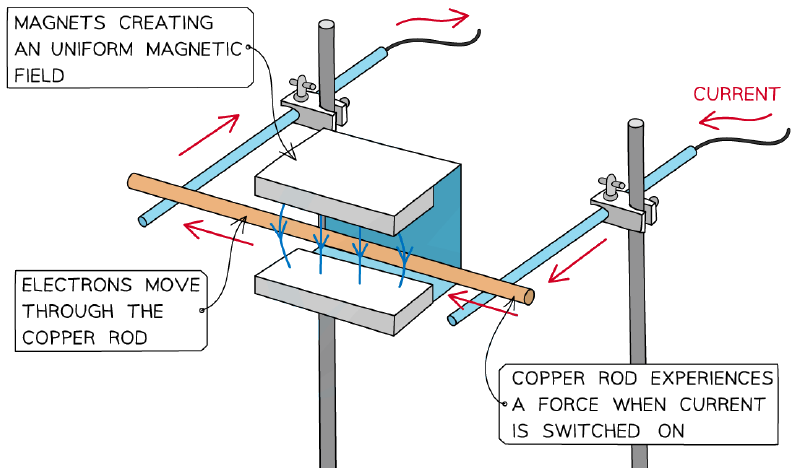
- A current-carrying conductor produces its own magnetic field and experiences a force when placed in an external magnetic field.
- The force is given by F = BIL sin θ, where B is magnetic flux density, I is current, L is the length of conductor in the field, and θ is the angle between the conductor and the B field.
- The force is maximum when the conductor is perpendicular to the field (θ = 90°, sin θ = 1), giving F = BIL.
- The force is zero when the conductor is parallel to the field (θ = 0°, sin θ = 0).
- The force can be increased by increasing the magnetic field strength, the current, or the length of the conductor in the field.
- The direction of the force is given by Fleming's left-hand rule: thumb = force (motion), first finger = magnetic field, second finger = conventional current.
Setup for demonstrating the force on a current-carrying conductor in a magnetic field.
Representing Magnetic Fields in 3D
- Dots (or circles with dots) represent a magnetic field directed out of the page.
- Crosses represent a magnetic field directed into the page.
- Remember: an arrow approaching head-on shows only its tip (dot); an arrow receding shows the cross of its feathers (cross).
- Conventional current flows from positive to negative, opposite to the direction of electron flow.
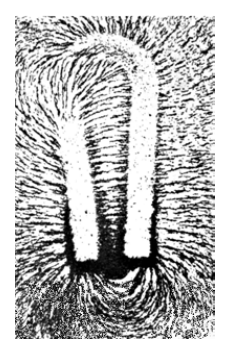
Magnetic field lines
Magnetic Force between Two Parallel Conductors
- Each current-carrying conductor produces a magnetic field around it, determined by the right-hand thumb rule.
- Parallel conductors with currents in the same direction attract each other.
- Parallel conductors with currents in opposite directions repel each other.
- The force per unit length between two parallel conductors is F/L = μ₀I₁I₂ / (2πr), where r is the separation and μ₀ = 4π × 10⁻⁷ N A⁻².
- The forces on the two wires are equal and opposite (Newton's third law).
Magnetic Force on a Moving Charge
- A moving charge produces its own magnetic field and experiences a force when in an external magnetic field.
- The force is given by F = Bqv sin θ, where q is the charge, v is the speed, and θ is the angle between velocity and the B field.
- The force is maximum when the charge moves perpendicular to the field (θ = 90°), giving F = Bqv.
- A charge moving parallel to the magnetic field experiences no force.
- The force is always perpendicular to both the velocity and the magnetic field.
- For a negative charge, the direction of conventional current is opposite to its motion; use Fleming's left-hand rule with the current direction.
Charged Particles in Magnetic Fields
- A charged particle moving perpendicular to a uniform magnetic field travels in a circular path because the magnetic force is always perpendicular to its velocity.
- The magnetic force provides the centripetal force: mv²/r = BQv.
- Rearranging gives the radius of the path: r = mv / (BQ).
- The radius increases with greater mass or speed, and decreases with greater charge or magnetic field strength.
- The centripetal acceleration is in the same direction as the magnetic force (Newton's second law, F = ma).
Charged Particles in Electric Fields
- A charged particle in a uniform electric field experiences a constant force and travels in a parabolic trajectory.
- A positive charge is deflected towards the negative plate; a negative charge towards the positive plate.
- An uncharged particle (e.g. a neutron) experiences no force and travels straight through.
- The amount of deflection depends on mass (greater mass → smaller deflection), charge (greater charge → greater deflection), and speed (greater speed → smaller deflection).
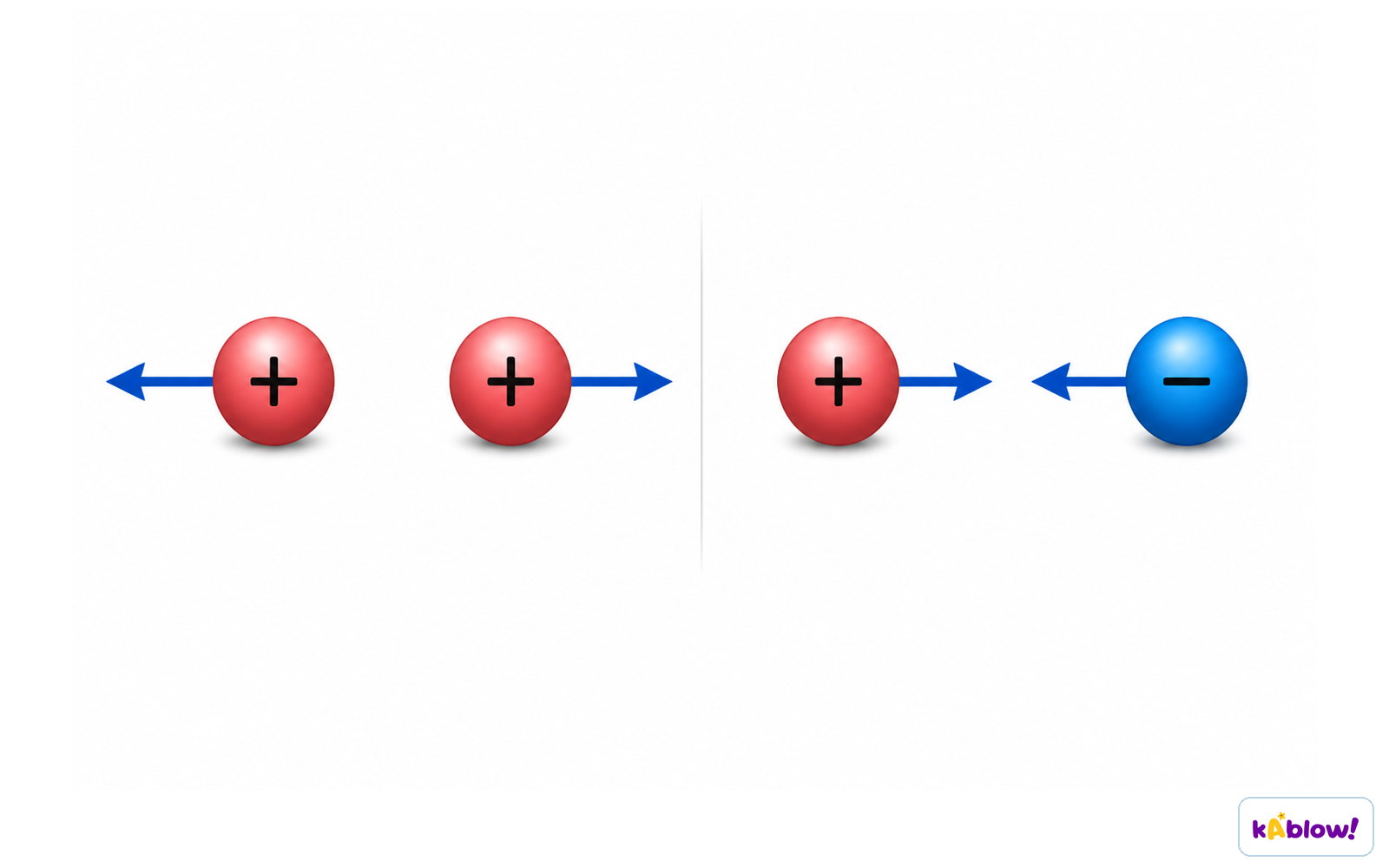
Attraction and repulsion of charge
Charged Particles in Electric & Magnetic Fields
- When electric and magnetic fields are perpendicular, a charged particle experiences an electric force parallel to E and a magnetic force perpendicular to B.
- For a positively charged particle, the electric and magnetic forces act in opposite directions; the same is true for a negatively charged particle, but with directions reversed.
- When the electric and magnetic forces are equal in magnitude, the particle moves in a straight line with constant speed.
- Equating the forces: qE = Bqv, which gives the speed v = E/B.
- This principle is used in velocity selectors and in J.J. Thomson's experiment to determine the charge-to-mass ratio of an electron.
Charge-to-Mass Ratio
- The charge-to-mass ratio is defined as Q/m.
- For an electron, e/mₑ = 1.76 × 10¹¹ C kg⁻¹; for a proton, e/mₚ = 9.58 × 10⁷ C kg⁻¹.
- J.J. Thomson used Helmholtz coils (uniform B field) and oppositely charged parallel plates (uniform E field) to determine e/mₑ.
- The speed of particles is found using perpendicular electric and magnetic fields: v = V / (Bd).
- The charge-to-mass ratio is then q/m = V / (rB²d), where r is the radius of the circular path when the electric field is switched off.
슬라이드
연습 문제
무료 미리 보기 — 63개 중 8개 문제. 가입하면 전부 볼 수 있어요.
1.What does the magnetic flux density B represent?
Easy- AThe force per unit current per unit length on a conductor perpendicular to the field
- BThe total magnetic force on a stationary charge
- CThe magnetic field strength measured in volts per metre
- DThe force per unit charge on a stationary charge
2.A straight wire of length 0.90 m carries a current of 1.5 A and is placed at 45° to a uniform magnetic field of flux density 0.20 T. What is the magnitude of the force on the wire?
Medium- A0.19 N
- B0.27 N
- C0.38 N
- D0.14 N
3.Which of the following changes would increase the magnitude of the force on a current-carrying wire in a magnetic field? (select all that apply)
Medium- AIncreasing the current in the wire
- BIncreasing the magnetic flux density
- CIncreasing the length of wire within the field
- DRotating the wire so it is parallel to the field
- EReversing the direction of the current
4.A current-carrying conductor experiences no magnetic force when it is placed:
Easy- Aat 90° to the magnetic field
- Bparallel to the magnetic field
- Cat 45° to the magnetic field
- Dperpendicular to the magnetic field
5.Which of the following is the fundamental SI unit of magnetic flux density?
Easy- ATesla (T)
- BWeber (Wb)
- CNewton per ampere (N A⁻¹)
- DVolt (V)
6.Two parallel wires carrying currents in the same direction attract each other.
EasyTrue or false?
7.A charged particle moving parallel to a uniform magnetic field experiences a magnetic force.
EasyTrue or false?
8.An electron enters a uniform magnetic field directed into the page, moving from left to right. In which direction does the magnetic force on the electron act?
Medium- AUpwards
- BDownwards
- CInto the page
- DOut of the page