Applications Of Electrolysis
플레이하며 배우기
이 문제들을 풀어 에너지를 얻은 뒤 낚시하고 탐험하세요. 계정이 필요 없어요.
교육자를 위해: Applications Of Electrolysis(Chemistry, CIE)을(를) 위한 바로 쓸 수 있는 수업 슬라이드, 복습 노트 — 수업에 사용하거나, 학습자들이 실시간 게임으로 즐기는 인터랙티브 클래스 활동으로 진행하세요.
수업 노트
What is Electroplating?
- Electroplating coats the surface of one metal with a layer of a different metal using electrolysis.
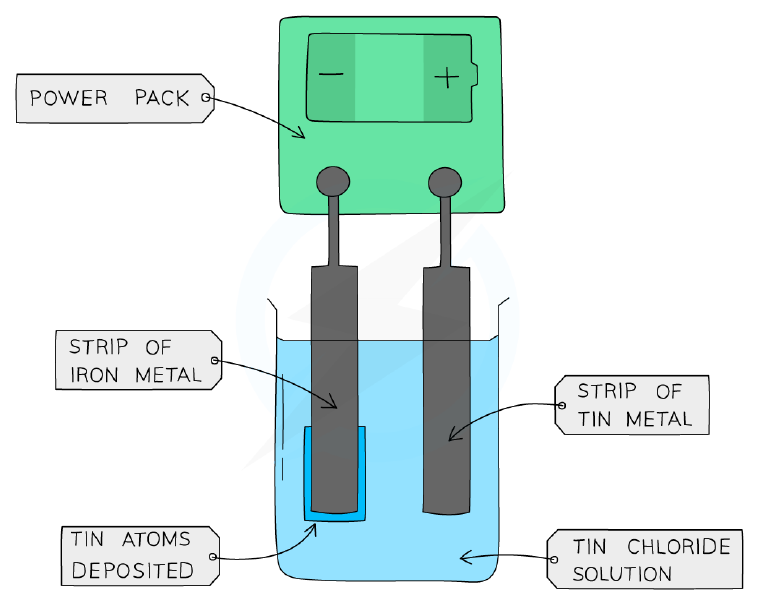
- The cathode (negative electrode) is the object to be plated.
- The anode (positive electrode) is made of the pure metal that will be plated onto the object.
- The electrolyte is an aqueous solution of a soluble salt of the anode metal (e.g., tin(II) chloride for tin plating).
- At the anode: metal atoms lose electrons (oxidation) and go into solution as ions.
- At the cathode: metal ions gain electrons (reduction) and deposit as metal atoms on the object.
- Example half-equations for tin plating: Anode: Sn(s) → Sn²⁺(aq) + 2e⁻; Cathode: Sn²⁺(aq) + 2e⁻ → Sn(s).
Uses of Electroplating
- To improve appearance – e.g., silver-plating cutlery and jewellery.
- To increase resistance to corrosion – e.g., chromium and nickel plating, galvanising (zinc coating on iron/steel).
- To reduce wear or provide a harder surface.
Electroplating Setup
- The object to be plated must be very clean and free of grease to ensure good adhesion.
- The anode must be the same metal as the plating layer (e.g., silver anode for silver plating).
- The electrolyte must contain ions of the plating metal (e.g., silver nitrate for silver plating).
- The power supply provides direct current; the object is connected to the negative terminal.
Electroplating a strip of iron with tin
Hydrogen Fuel Cells – Basics
- A fuel cell is an electrochemical cell that converts chemical energy from a fuel into electricity.
- In a hydrogen-oxygen fuel cell, hydrogen is the fuel and oxygen is the oxidant.
- The only product is water; no pollutants are produced.
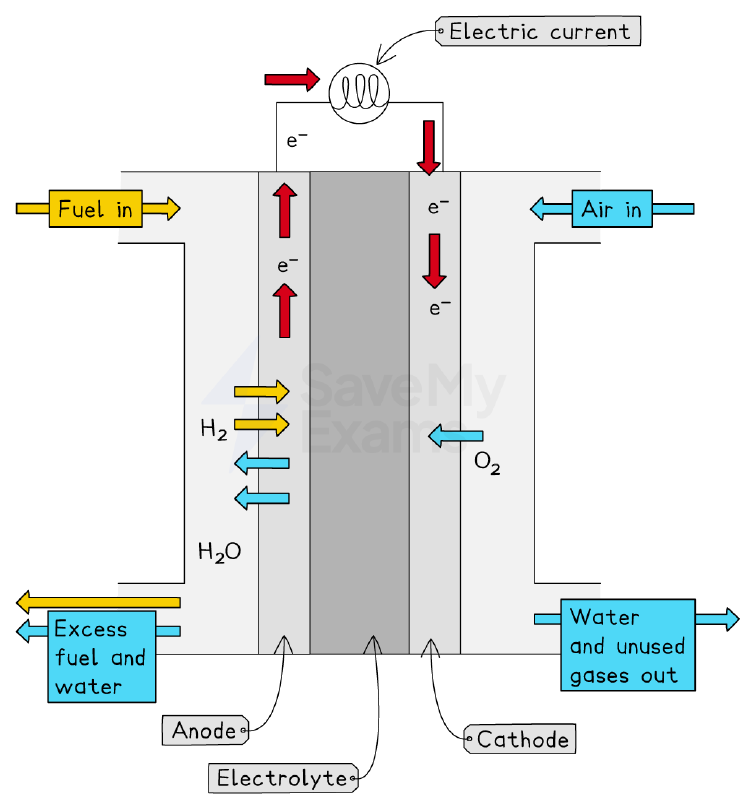
- Overall reaction: 2H₂ + O₂ → 2H₂O (hydrogen + oxygen → water).
- At the anode: H₂ → 2H⁺ + 2e⁻ (oxidation of hydrogen).
- At the cathode: O₂ + 4H⁺ + 4e⁻ → 2H₂O (reduction of oxygen).
- The electrolyte (e.g., potassium hydroxide solution) allows ion flow between electrodes.
Hydrogen-oxygen fuel cell
Advantages of Hydrogen Fuel Cells (Extended)
- No pollutants – only water is produced, unlike petrol engines which emit CO₂, NOₓ, and CO.
- High efficiency – more energy per kilogram than petrol or diesel.
- Renewable – hydrogen can be produced by electrolysis of water using renewable electricity.
Disadvantages of Hydrogen Fuel Cells (Extended)
- Hydrogen production – most hydrogen currently comes from fossil fuels (releases CO₂); electrolysis requires large amounts of electricity.
- Storage and safety – hydrogen is highly flammable and requires high-pressure tanks, making storage difficult and expensive.
- Cost and infrastructure – fuel cell materials are expensive; very few hydrogen filling stations exist.
슬라이드
연습 문제
무료 미리 보기 — 52개 중 8개 문제. 가입하면 전부 볼 수 있어요.
1.What is electroplating?
Easy- ACoating the surface of one metal with a layer of a different metal
- BExtracting metals from their ores using electricity
- CBreaking down a compound using heat
- DA method of sacrificial protection
2.In electroplating, the object to be plated is connected to which electrode?
Easy- AThe negative electrode (cathode)
- BThe positive electrode (anode)
- CThe electrolyte
- DThe power supply
3.What is the product of the reaction in a hydrogen fuel cell?
Easy- AWater
- BHydrogen peroxide
- COxygen
- DCarbon dioxide
4.Which half-equation represents the reaction at the cathode when electroplating an iron spoon with silver?
Medium- AAg⁺ + e⁻ → Ag
- BAg → Ag⁺ + e⁻
- CFe²⁺ + 2e⁻ → Fe
- DFe → Fe²⁺ + 2e⁻
5.Which substance is used as the electrolyte when electroplating an iron spoon with copper?
Easy- AAqueous copper nitrate
- BAqueous iron nitrate
- CCopper rod
- DIron rod
6.In a hydrogen fuel cell, what happens to hydrogen at the anode?
Medium- AHydrogen is oxidised to form H⁺ ions and electrons
- BHydrogen is reduced to form H⁻ ions
- CHydrogen combines with oxygen to form water
- DHydrogen is produced from water
7.Which of the following is a disadvantage of using hydrogen fuel cells in cars?
Easy- AHydrogen is difficult to store safely
- BThe only product is water
- CFuel cells are very quiet
- DHydrogen is a renewable fuel
8.Why does the concentration of metal ions in the electrolyte remain constant during electroplating?
Medium- AMetal ions are removed at the cathode and replenished at the anode at the same rate
- BThe electrolyte is continuously stirred
- CMetal ions are neither produced nor consumed
- DThe power supply is alternating current
기출 문제
이 주제의 기출 문제 연습이 곧 나와요.
곧 출시