Polymers
플레이하며 배우기
이 문제들을 풀어 에너지를 얻은 뒤 낚시하고 탐험하세요. 계정이 필요 없어요.
교육자를 위해: Polymers(Chemistry, CIE)을(를) 위한 바로 쓸 수 있는 수업 슬라이드, 복습 노트 — 수업에 사용하거나, 학습자들이 실시간 게임으로 즐기는 인터랙티브 클래스 활동으로 진행하세요.
수업 노트
Polymers: The Basics
- Polymers are large molecules made from many smaller monomers joined by covalent bonds.
- Examples: poly(ethene), PVC, nylon.
- Monomers are the repeating units that link to form the polymer chain.
Addition Polymerisation
- Addition polymerisation joins monomers containing a C=C double bond (alkenes).
- The C=C bond breaks, monomers add together, forming a long chain with only single bonds.
- Only one product is formed – the polymer itself.
- Example: ethene → poly(ethene).
- Polymer name: poly(monomer name), e.g., propene → poly(propene).
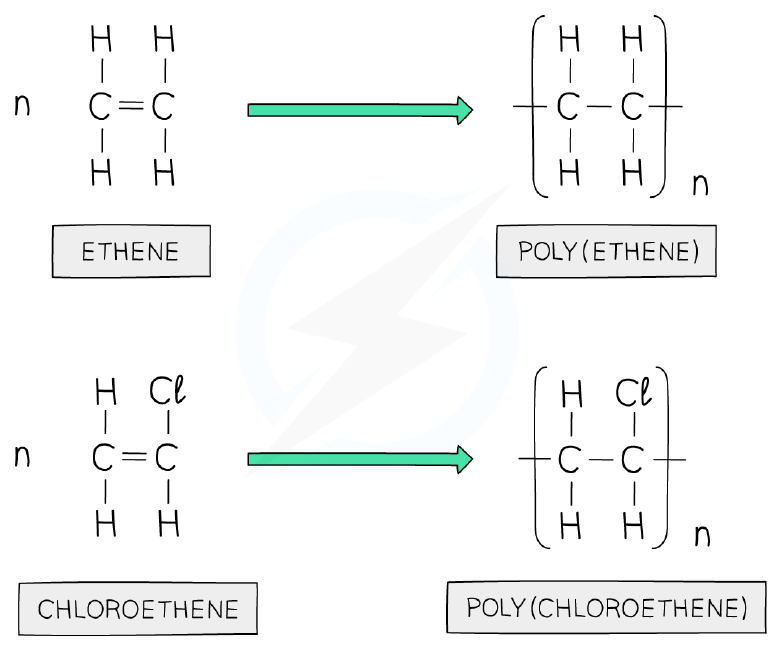
- To draw a repeat unit: change C=C to C–C, add continuation bonds, and write subscript n.
Addition polymerisation of ethene and chloroethene
Deducing Monomer from Polymer (Addition)
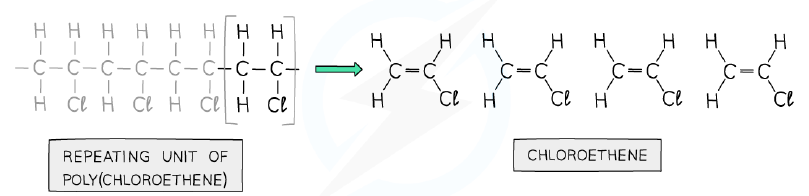
- Identify the repeat unit in the polymer chain.
- Change the single bond between repeat units to a double bond.
- Remove the continuation bonds to reveal the monomer structure.
Deducing the monomer from a repeat unit
Condensation Polymerisation
- Condensation polymerisation links two different monomers with the removal of a small molecule (usually water).
- Monomers have two functional groups (one at each end).
- Forms the polymer plus one water molecule per linkage.
- Examples: nylon (polyamide) and PET (polyester).
Nylon – A Polyamide
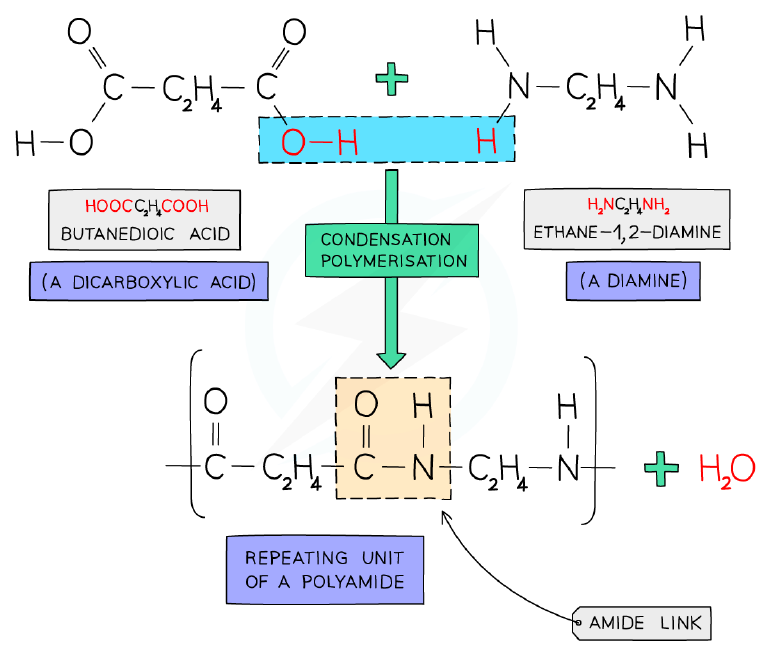
- Nylon is made from a dicarboxylic acid (–COOH at both ends) and a diamine (–NH₂ at both ends).
- Reaction forms an amide linkage (–CO–NH–) and releases water.
- Represented by boxes for carbon chains with amide links alternating.
Formation of a polyamide from a dicarboxylic acid and a diamine
PET – A Polyester
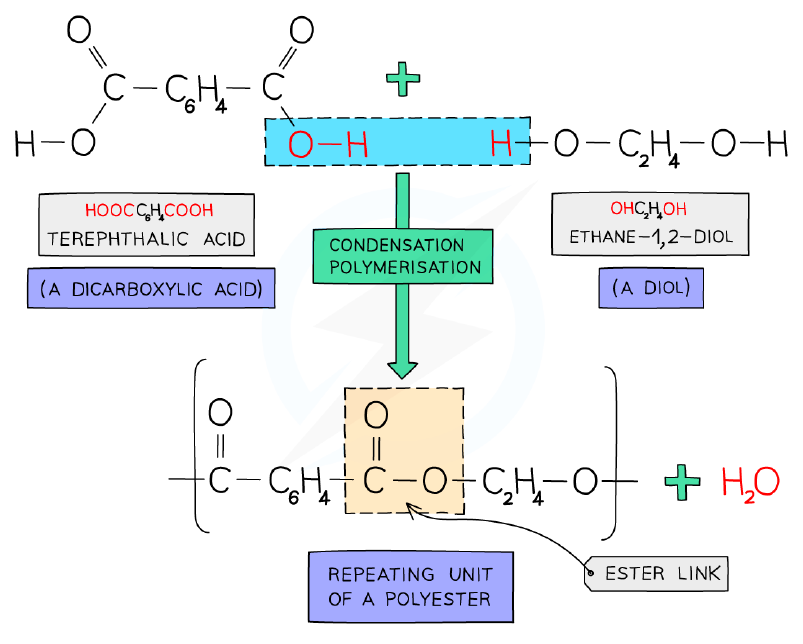
- PET (polyethylene terephthalate) is made from a dicarboxylic acid and a diol (–OH at both ends).
- Reaction forms an ester linkage (–COO–) and releases water.
- Also known as terylene; used in plastic bottles and synthetic fibres.
- Represented by boxes for carbon chains with ester links alternating.
Formation of PET from terephthalic acid and ethane-1,2-diol
Plastics & Their Disposal
- Many polymers are non-biodegradable – not broken down by microorganisms.
- Incineration: releases CO₂ (greenhouse gas), may produce toxic fumes (e.g., HCl from PVC) or CO if incomplete.
- Landfills: take up valuable land; non-biodegradable plastics accumulate.
- Ocean pollution: plastic waste harms marine life.
- PET recycling: can be depolymerised by enzymes or chemical catalysts under mild conditions, then re-polymerised – saves resources and energy.
Proteins – Natural Polyamides
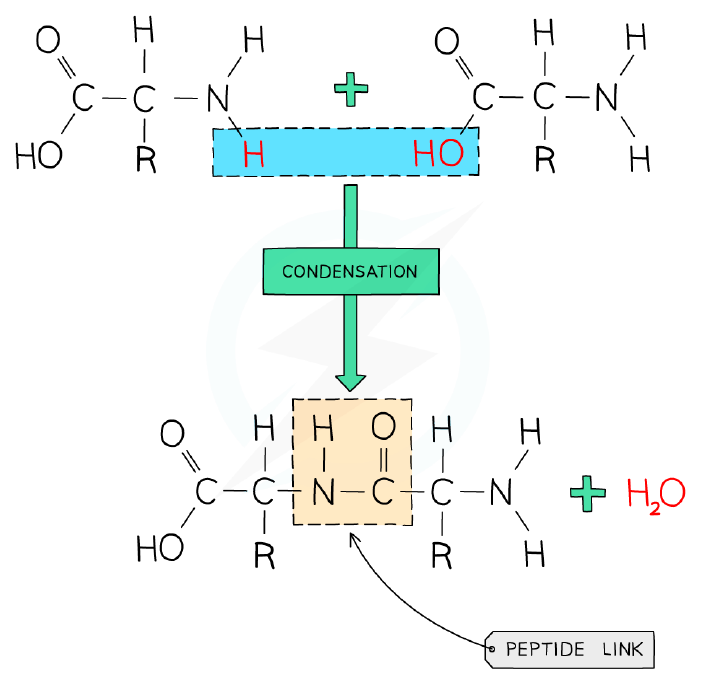
- Proteins are condensation polymers of amino acid monomers.
- Amino acids have both –NH₂ and –COOH groups; the amide link is called a peptide link.
- Proteins are natural polyamides; there are 20 common amino acids with different R groups.
- Represented by boxes for carbon chains with peptide links alternating.
Formation of a protein from amino acid monomers
슬라이드
연습 문제
무료 미리 보기 — 38개 중 8개 문제. 가입하면 전부 볼 수 있어요.
1.What is a polymer?
Easy- AA large molecule made from many smaller molecules called monomers
- BA small molecule used to make larger molecules
- CA molecule containing only carbon and hydrogen
- DA molecule that contains a carbon-carbon double bond
2.Which type of polymerisation forms poly(ethene) from ethene?
Easy- AAddition polymerisation
- BCondensation polymerisation
- CHydrolysis
- DCracking
3.What is a monomer?
Easy- AA small molecule that can join with others to form a polymer
- BA large molecule made from repeating units
- CA type of polymer
- DA catalyst used in polymerisation
4.Which of the following is an example of a polymer?
Easy- APoly(ethene)
- BEthene
- CCarbon dioxide
- DWater
5.What is the key difference between addition polymerisation and condensation polymerisation?
Medium- ACondensation polymerisation produces a small molecule, such as water, as a by-product; addition polymerisation does not
- BAddition polymerisation produces a small molecule as a by-product; condensation polymerisation does not
- CAddition polymerisation requires a catalyst; condensation polymerisation does not
- DCondensation polymerisation only occurs with alkenes; addition polymerisation occurs with any monomer
6.Which of the following monomers can undergo addition polymerisation?
Medium- AEthene
- BEthane
- CEthanol
- DEthanoic acid
7.What type of polymer is nylon?
Medium- APolyamide
- BPolyester
- CPolyalkene
- DPolypeptide
8.What is the name of the linkage formed in polyesters?
Medium- AEster linkage
- BAmide linkage
- CPeptide linkage
- DCovalent bond
기출 문제
이 주제의 기출 문제 연습이 곧 나와요.
곧 출시