Reversible Reactions & Equilibrium
플레이하며 배우기
이 문제들을 풀어 에너지를 얻은 뒤 낚시하고 탐험하세요. 계정이 필요 없어요.
수업 노트
Reversible Reactions
- In reversible reactions, products can react to reform reactants; the reaction occurs in both directions.
- The symbol ⇌ is used to indicate a reversible reaction.
- If the forward reaction is exothermic, the reverse reaction is endothermic (same amount of heat transferred).
- Example: N₂ + 3H₂ ⇌ 2NH₃ (forward exothermic, reverse endothermic).
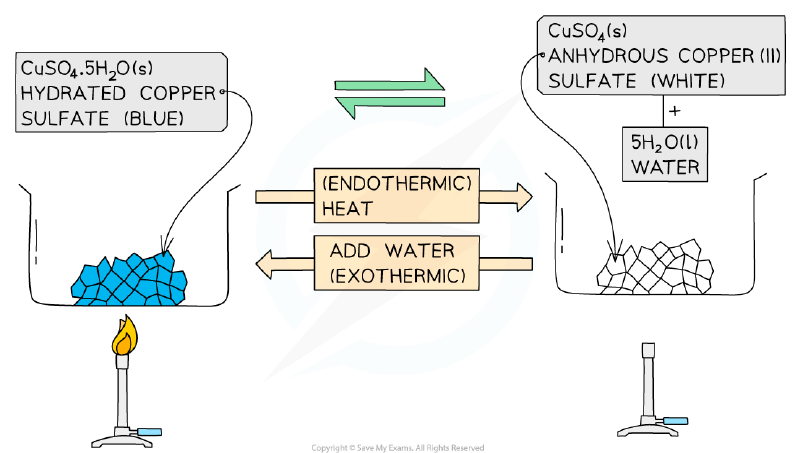
- Hydrated salts contain water of crystallisation; heating removes water to form anhydrous salts.
- Copper(II) sulfate: CuSO₄·5H₂O (blue) ⇌ CuSO₄ (white) + 5H₂O; forward endothermic, reverse exothermic.
- Cobalt(II) chloride: CoCl₂·6H₂O (pink) ⇌ CoCl₂ (blue) + 6H₂O; forward endothermic, reverse exothermic.
- These colour changes are used as tests for water (blue to pink for CoCl₂, white to blue for CuSO₄).
Hydrated copper(II) sulfate (blue) heated to anhydrous copper(II) sulfate (white); adding water reverses the change
Equilibrium (Extended Tier)
- A reversible reaction reaches equilibrium in a closed system (no reactants or products can escape).
- At equilibrium: rate of forward reaction = rate of reverse reaction; concentrations of reactants and products remain constant.
- Equilibrium is dynamic – molecules continuously interconvert at equal rates.
- Example: In the Haber process, initially forward rate is high; as reactants decrease and products increase, rates become equal.
Le Chatelier's Principle (Extended Tier)
- Le Chatelier's Principle: If a change is made to a system at equilibrium, the system moves to oppose the change.
- Temperature: Increase temperature favours the endothermic direction; decrease favours the exothermic direction.
- Pressure: Increase pressure shifts equilibrium to the side with fewer gas molecules; decrease shifts to side with more gas molecules.
- Concentration: Increase reactant concentration shifts equilibrium to the right (more products); increase product concentration shifts to the left.
- Catalyst does not affect the position of equilibrium – it speeds up both forward and reverse reactions equally, reaching equilibrium faster.
Le Chatelier's Principle: effect of conditions
The Haber Process (Extended Tier)
- Manufactures ammonia via N₂(g) + 3H₂(g) ⇌ 2NH₃(g) (forward exothermic).
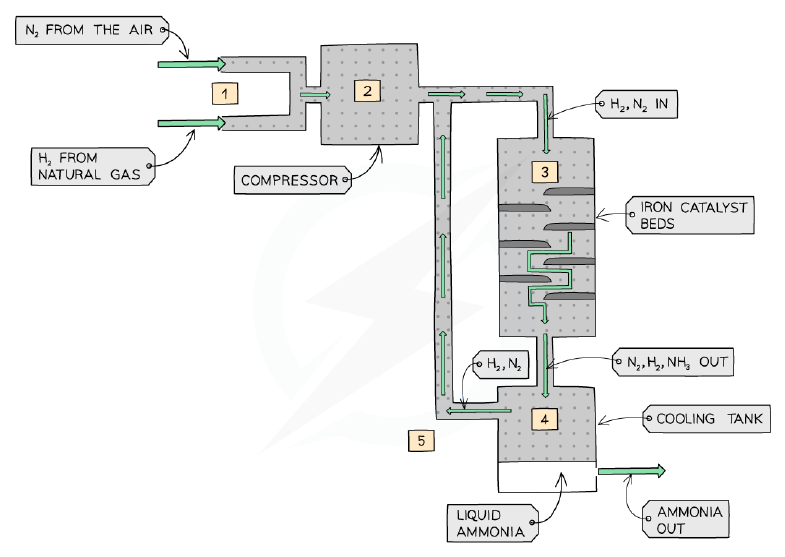
- Raw materials: Nitrogen from fractional distillation of liquid air; Hydrogen from natural gas (methane).
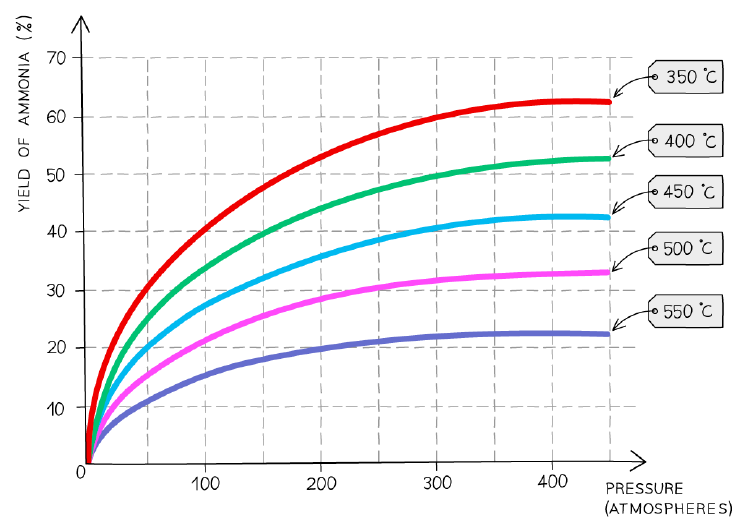
- Conditions: 450 °C, 200 atm, iron catalyst.
- Compromise conditions: Lower temperature favours yield but slows rate; higher pressure favours yield but is expensive and dangerous.
- Catalyst (iron) allows equilibrium to be reached faster, enabling a lower operating temperature.
- Process stages: Compress gases → react over catalyst → cool to liquefy ammonia → recycle unreacted N₂ and H₂.
- Yield increases with increasing pressure and decreasing temperature (see data tables).
The production of ammonia by the Haber process
The Contact Process (Extended Tier)
- Manufactures sulfuric acid via main stage: 2SO₂(g) + O₂(g) ⇌ 2SO₃(g) (forward exothermic).
- Catalyst: Vanadium(V) oxide (V₂O₅).
- Conditions: 450 °C, 2 atm (200 kPa).
- Compromise: Low temperature favours yield but slows rate; pressure is kept low (≈1 atm) because equilibrium already gives ~96% yield and high pressure would liquefy SO₂.
- SO₃ is absorbed into 98% sulfuric acid to form oleum (H₂S₂O₇), then diluted to give concentrated H₂SO₄.
- SO₃ is not absorbed directly into water to avoid forming a dangerous mist of sulfuric acid.
슬라이드
연습 문제
무료 미리 보기 — 45개 중 8개 문제. 가입하면 전부 볼 수 있어요.
1.What does the symbol ⇌ mean in a chemical equation?
Easy- AThe reaction is reversible
- BThe reaction goes to completion
- CThe reaction is exothermic
- DThe reaction is at equilibrium
2.When anhydrous cobalt(II) chloride is added to water, what colour change is observed?
Easy- ABlue to pink
- BPink to blue
- CWhite to blue
- DBlue to white
3.Which of the following is a condition needed for a reversible reaction to reach equilibrium?
Easy- AOpen system
- BClosed system
- CHigh temperature
- DPresence of a catalyst
4.In the Haber process, what is the source of nitrogen?
Easy- ANatural gas
- BAir
- CWater
- DAmmonia
5.For the reversible reaction N2(g) + 3H2(g) ⇌ 2NH3(g), the forward reaction is exothermic. Which change would increase the yield of ammonia at equilibrium?
Medium- AIncreasing the temperature
- BDecreasing the pressure
- CAdding a catalyst
- DDecreasing the temperature
6.In the Contact process, the main stage reaction is 2SO2(g) + O2(g) ⇌ 2SO3(g). The forward reaction is exothermic. What is the approximate temperature used for this stage?
Easy- A200 °C
- B450 °C
- C800 °C
- D1000 °C
7.Which statement is correct about a catalyst in a reversible reaction at equilibrium?
Medium- AIt increases the yield of products
- BIt speeds up the forward reaction only
- CIt increases the rate of both forward and reverse reactions equally
- DIt shifts the equilibrium to the right
8.Hydrated copper(II) sulfate is heated. Which statement describes this reaction?
Easy- AEndothermic, blue to white
- BExothermic, white to blue
- CEndothermic, white to blue
- DExothermic, blue to white