Separation & Purification
플레이하며 배우기
이 문제들을 풀어 에너지를 얻은 뒤 낚시하고 탐험하세요. 계정이 필요 없어요.
수업 노트
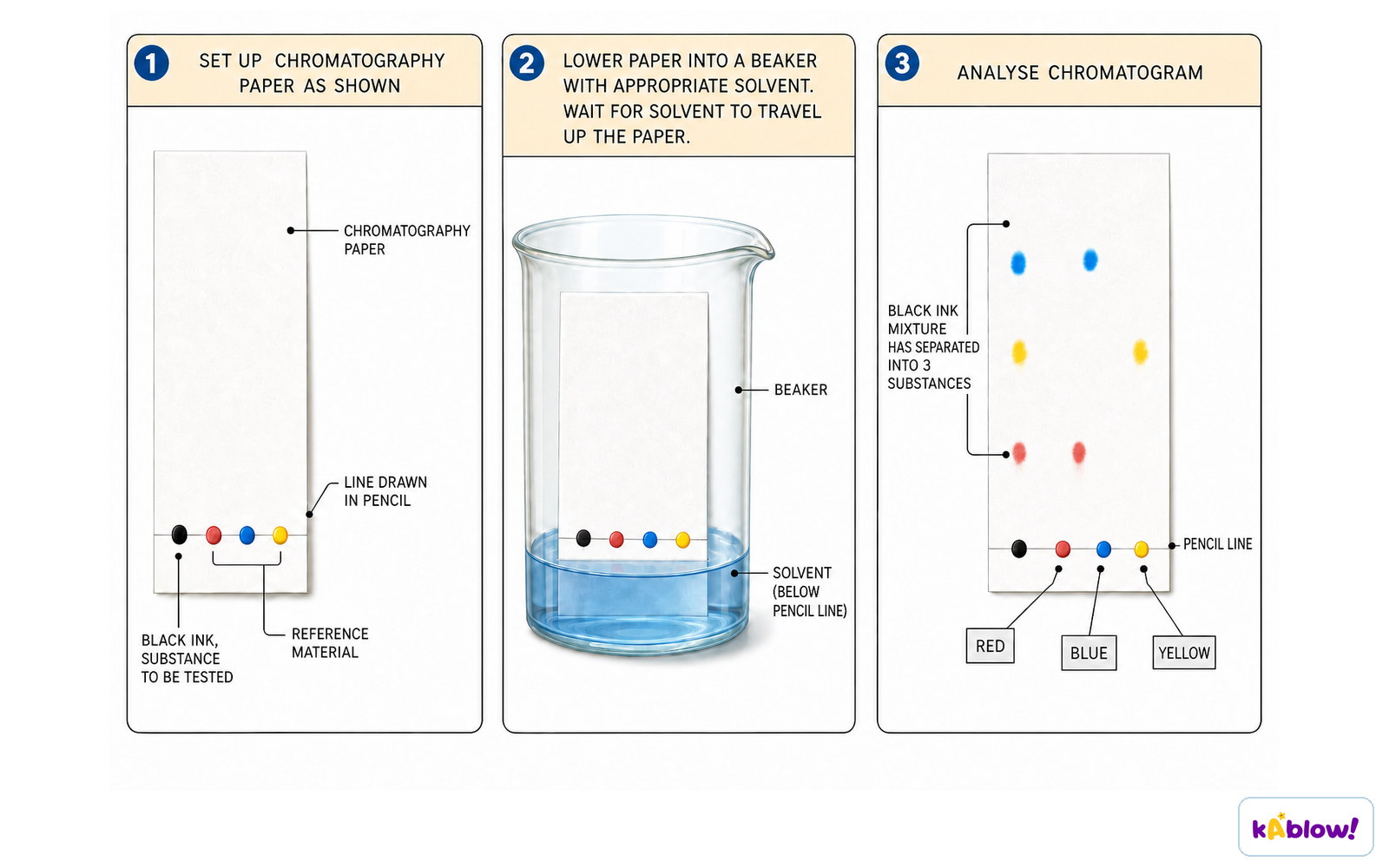
Paper Chromatography
- Chromatography separates substances based on different solubilities in a solvent.
- Draw a pencil line on chromatography paper (ink would run) and place sample spots on it.
- Lower paper into solvent so the pencil line is above the solvent to avoid washing samples off.
- Solvent travels up by capillary action, carrying substances at different rates.
- More soluble substances travel further up the paper.
- A pure substance produces one spot; an impure mixture produces multiple spots.
- Identical substances produce identical chromatograms (spots at same height).
Setting up and running paper chromatography
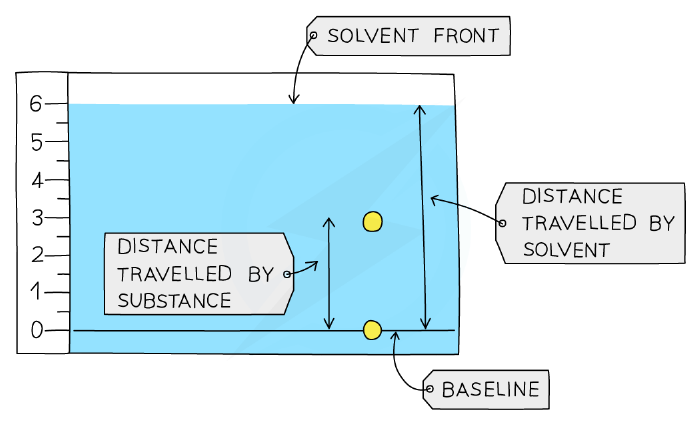
Locating Agents & Rf Values (Extended)
- Locating agents (e.g., ninhydrin) react with colourless substances like amino acids to form visible coloured spots.
- Apply locating agent after the chromatogram has run.
- Retention factor (Rf) = distance moved by substance ÷ distance moved by solvent.
- Rf is a ratio with no units, always less than 1.
- Rf value is constant for a given compound under the same solvent conditions.
- Compare Rf values to known substances to identify unknowns.
Measuring distances on a chromatogram
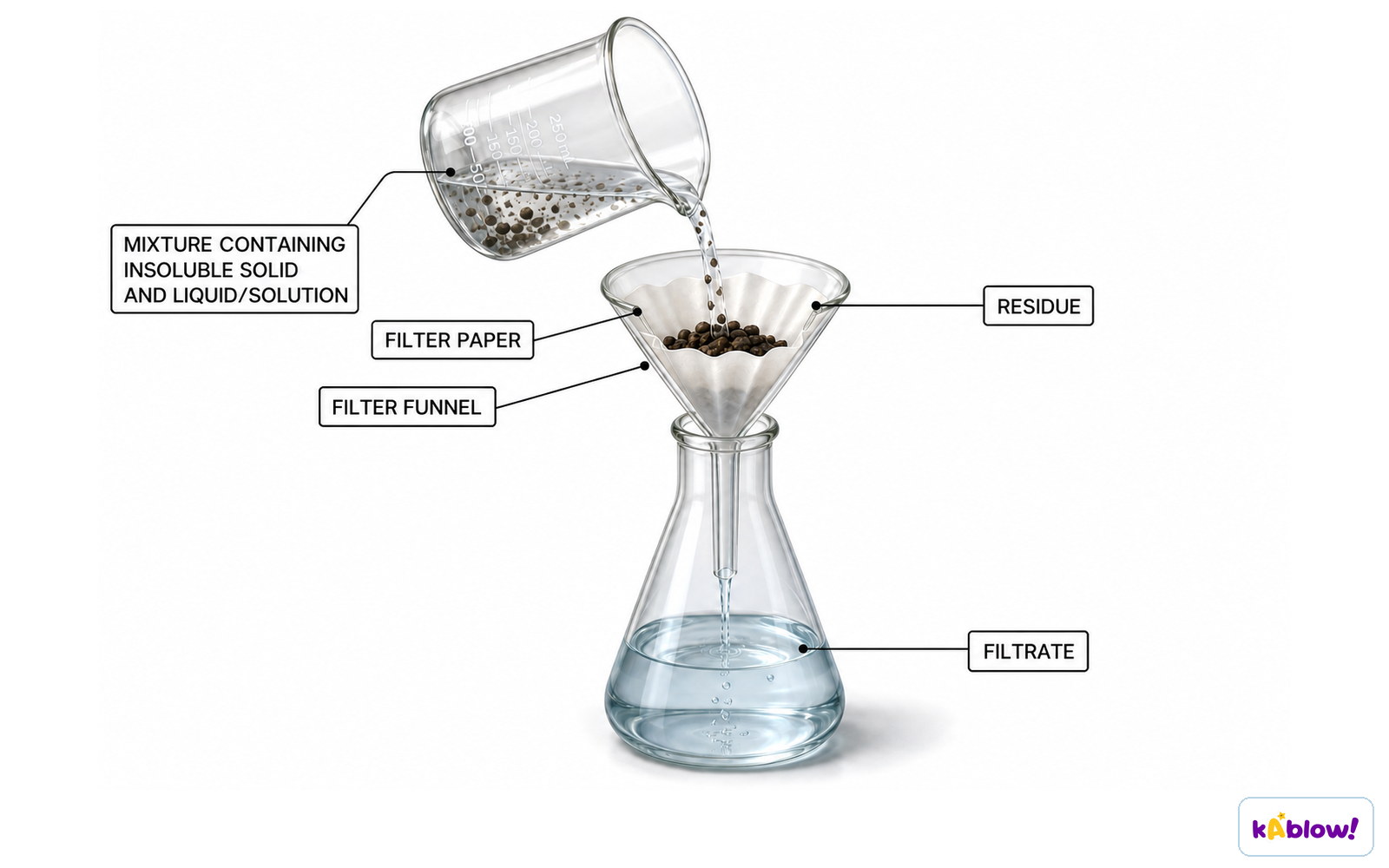
Filtration
- Separates an insoluble solid from a liquid (e.g., sand from water).
- Use filter paper in a funnel; liquid passes through as filtrate, solid remains as residue.
- Works because solid particles are too large to pass through filter paper pores.
- Also called centrifugation when using a centrifuge.
Filtration apparatus
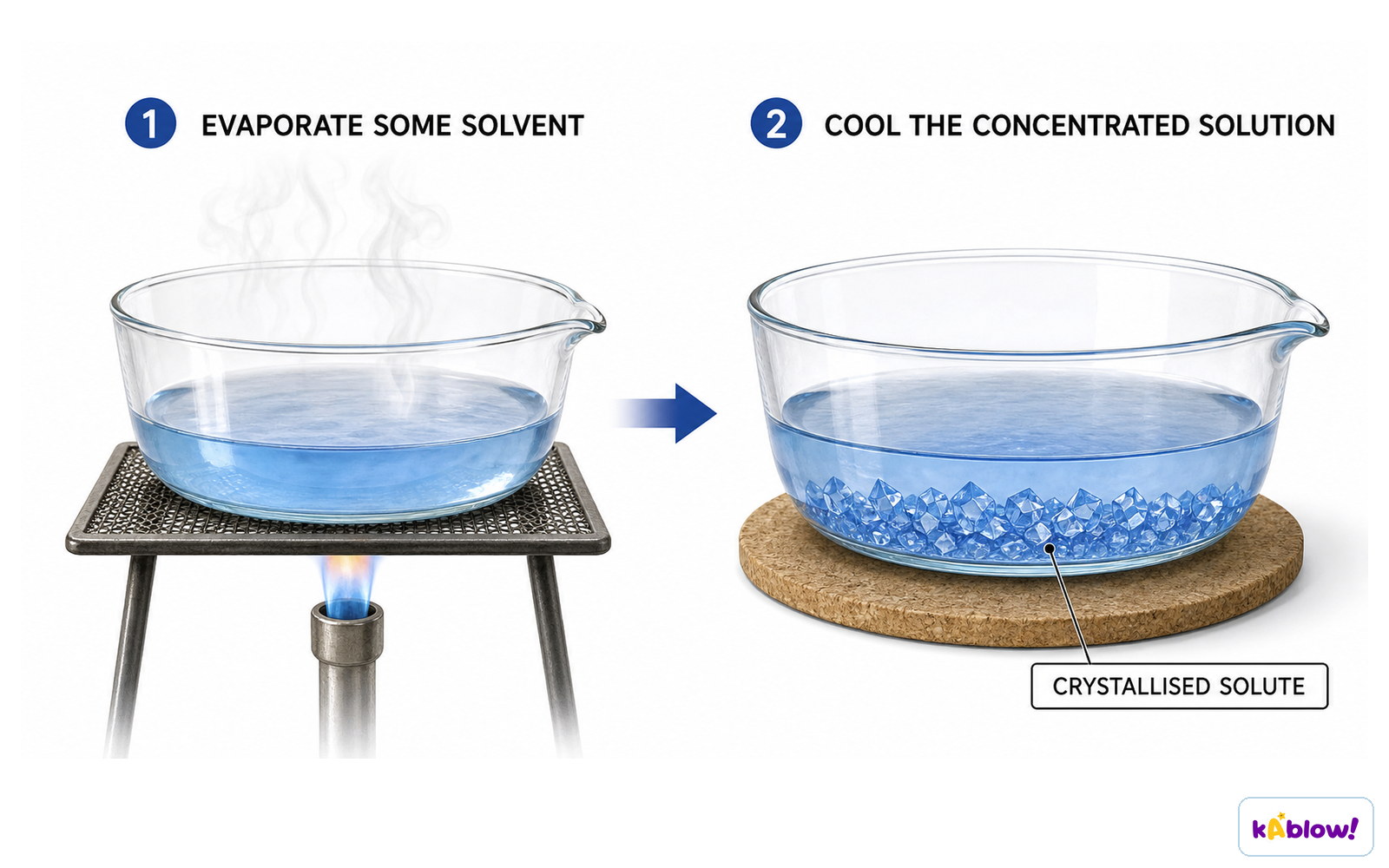
Crystallisation
- Separates a dissolved solid from a solution (e.g., copper(II) sulfate from water).
- Heat solution to evaporate solvent until saturated (test with cold glass rod – crystals form).
- Allow saturated solution to cool slowly; crystals form as solubility decreases.
- Collect crystals by filtration, wash with distilled water, and dry (e.g., between filter paper or in oven).
Crystallisation by evaporation and cooling
Simple Distillation
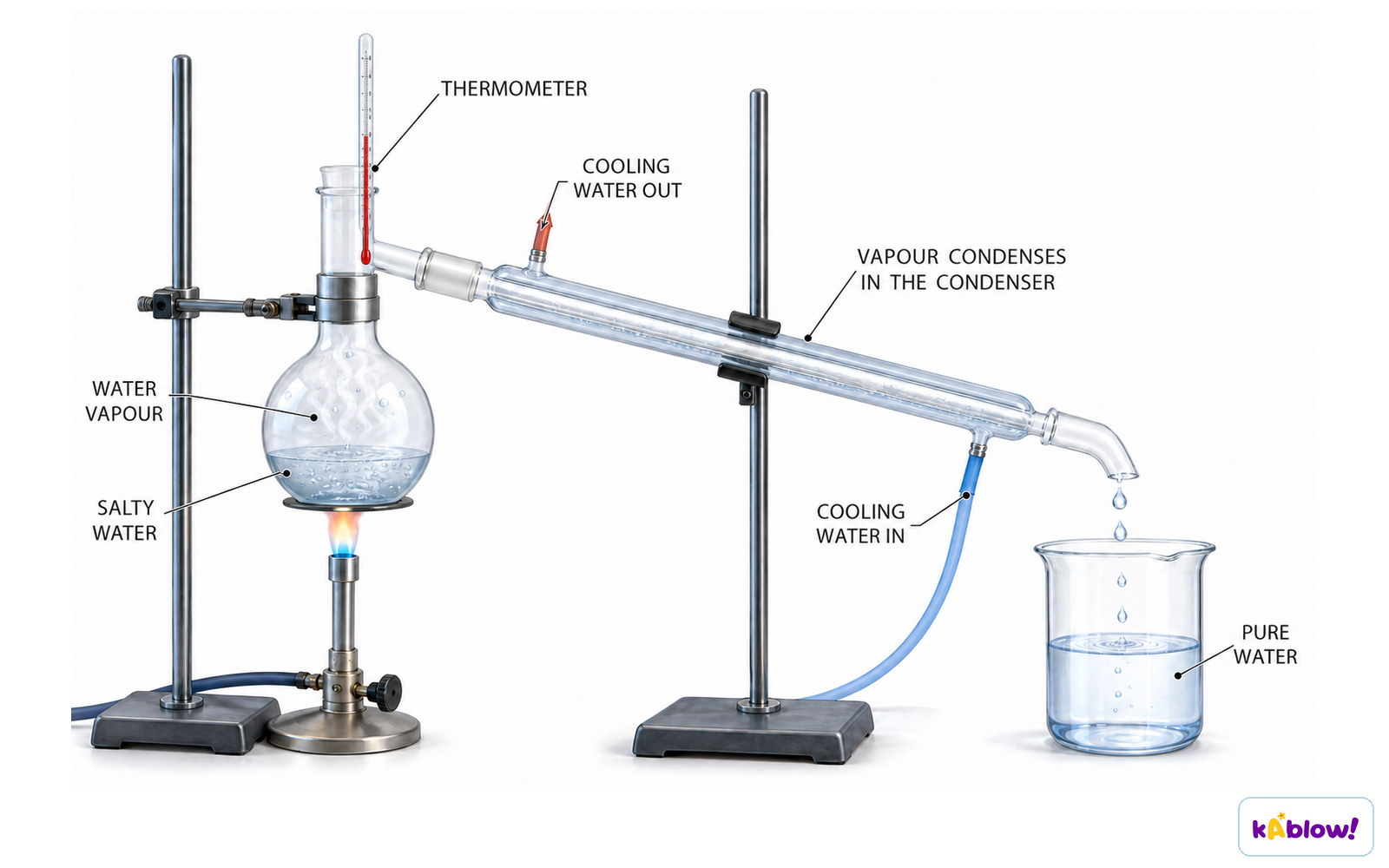
- Separates a liquid from a dissolved solid (e.g., water from salt solution) or a pure liquid from a mixture.
- Heat solution; liquid with lower boiling point evaporates first.
- Vapour passes through a condenser where it cools and condenses back to liquid.
- Collect distillate (pure liquid); solid remains in the flask.
Simple distillation apparatus
Fractional Distillation
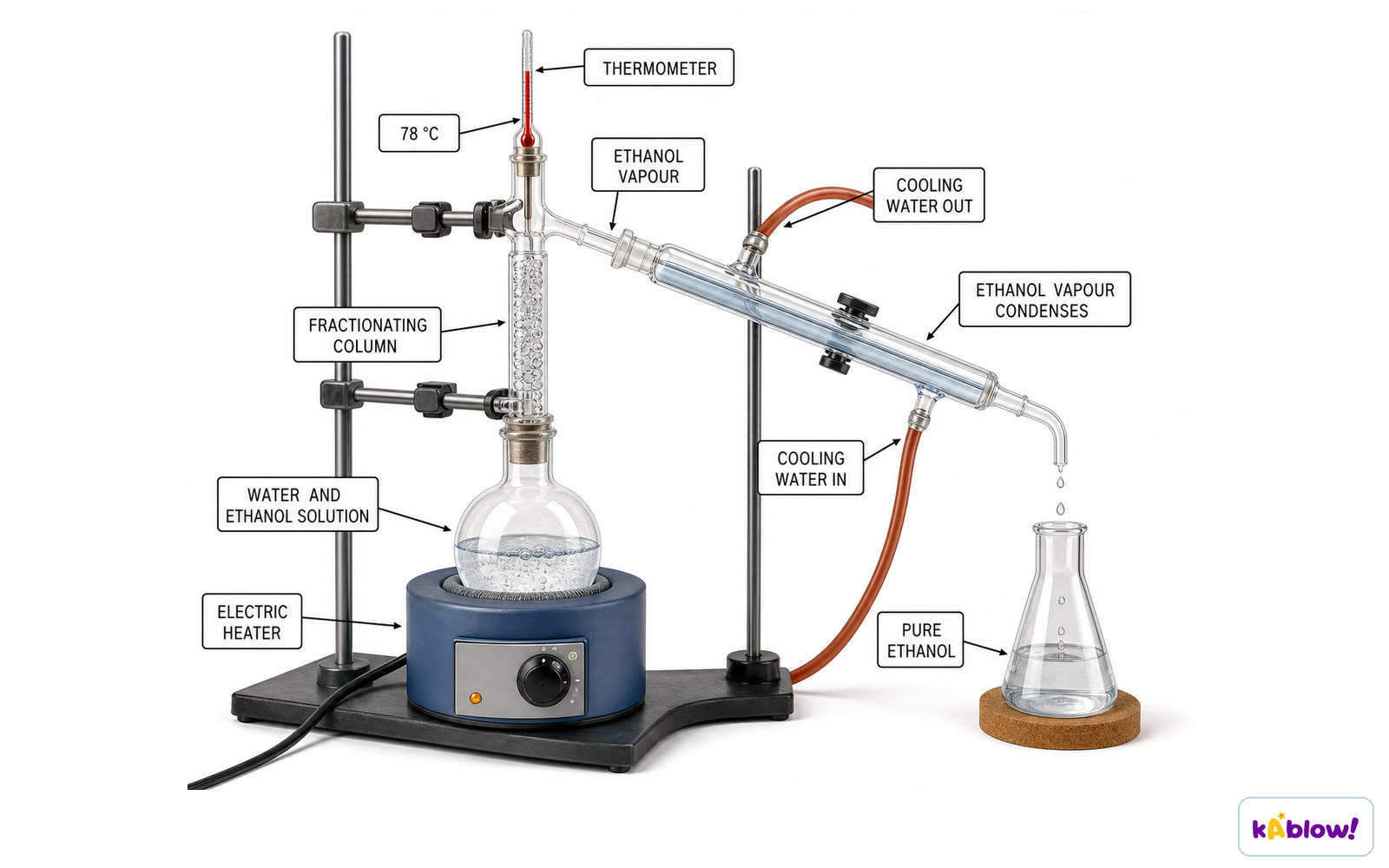
- Separates two or more miscible liquids with different boiling points (e.g., ethanol and water).
- Heat to the lowest boiling point; that substance evaporates first.
- Vapour passes through a fractionating column (or condenser) and is collected.
- Ethanol (b.p. 78°C) distils first; water (b.p. 100°C) remains.
- Used industrially for crude oil separation.
Fractional distillation apparatus
Assessing Purity
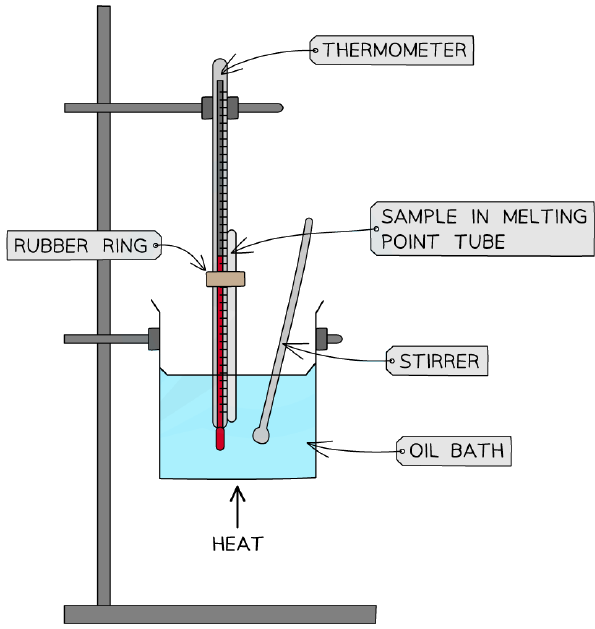
- Pure substances melt and boil at sharp, specific temperatures (e.g., water: 0°C, 100°C).
- Mixtures melt/boil over a range of temperatures.
- Impurities lower the melting point and raise the boiling point.
- Compare experimental melting/boiling points to literature values to check purity.
Melting point apparatus
슬라이드
연습 문제
무료 미리 보기 — 59개 중 8개 문제. 가입하면 전부 볼 수 있어요.
1.In paper chromatography, why is a pencil line used to mark the starting position instead of a pen?
Easy- APencil is insoluble in the solvent and will not run up the paper.
- BPencil marks are more visible than pen marks.
- CPen ink would react with the sample.
- DPencil is cheaper than pen.
2.What is the correct order of steps to separate a mixture of sand and salt to obtain pure salt crystals?
Medium- AFiltration, then crystallisation
- BCrystallisation, then filtration
- CDistillation, then filtration
- DFiltration, then distillation
3.Which separation technique would be most suitable to obtain pure water from a solution of salt water?
Easy- ASimple distillation
- BFractional distillation
- CCrystallisation
- DFiltration
4.In filtration, what is the name of the solid that remains on the filter paper?
Easy- AResidue
- BFiltrate
- CDistillate
- DPrecipitate
5.A student performs paper chromatography on a sample of black ink. The chromatogram shows three spots. What does this indicate about the black ink?
Easy- AIt is a mixture of at least three substances.
- BIt is a pure substance.
- CIt is a single compound.
- DIt contains only one pigment.
6.Which of the following is a physical property that can be used to separate mixtures?
Easy- ABoiling point
- BReactivity with acid
- CColour
- DTaste
7.The Rf value of a substance in paper chromatography is 0.6. The solvent front moved 10 cm. How far did the substance travel?
Medium- A6.0 cm
- B0.6 cm
- C16.7 cm
- D6.0 mm
8.A mixture of ethanol (boiling point 78 °C) and water (boiling point 100 °C) is separated by fractional distillation. Which liquid distils over first?
Easy- AEthanol
- BWater
- CBoth together
- DNeither