The Periodic Table & Trends
플레이하며 배우기
이 문제들을 풀어 에너지를 얻은 뒤 낚시하고 탐험하세요. 계정이 필요 없어요.
수업 노트
The Periodic Table
- Elements arranged in order of increasing atomic number.
- Vertical columns are groups (numbered 1–7 and Group 0); horizontal rows are periods (numbered 1–7).
- The period number equals the number of occupied electron shells.
- The group number (for Groups 1–7) equals the number of outer shell electrons.
- Group 0 elements have a full outer shell and are unreactive.
- Metals are on the left, non-metals on the right, separated by a zig-zag line.
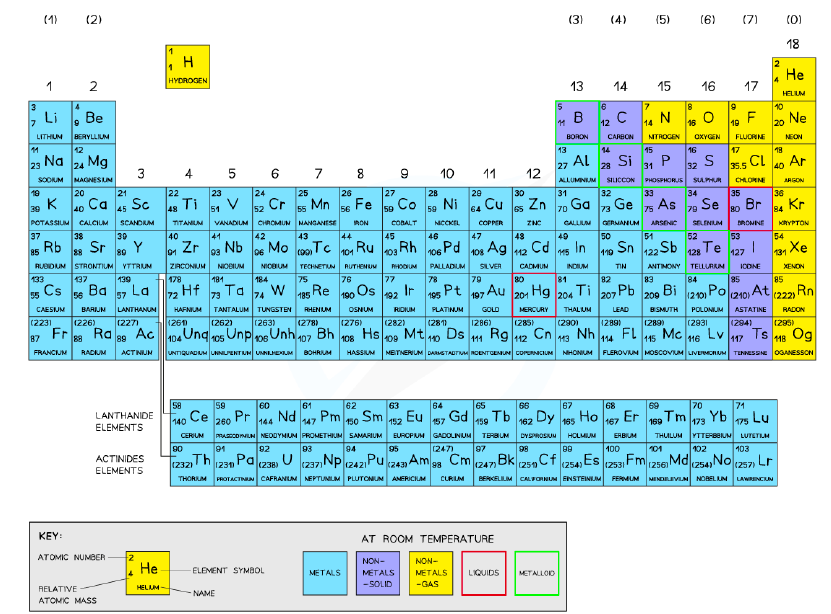
The Periodic Table: metals, non-metals, metalloids and liquids at room temperature
Electron Configuration & Position
- Electronic configuration shows the number of electrons in each shell (e.g., carbon: 2,4).
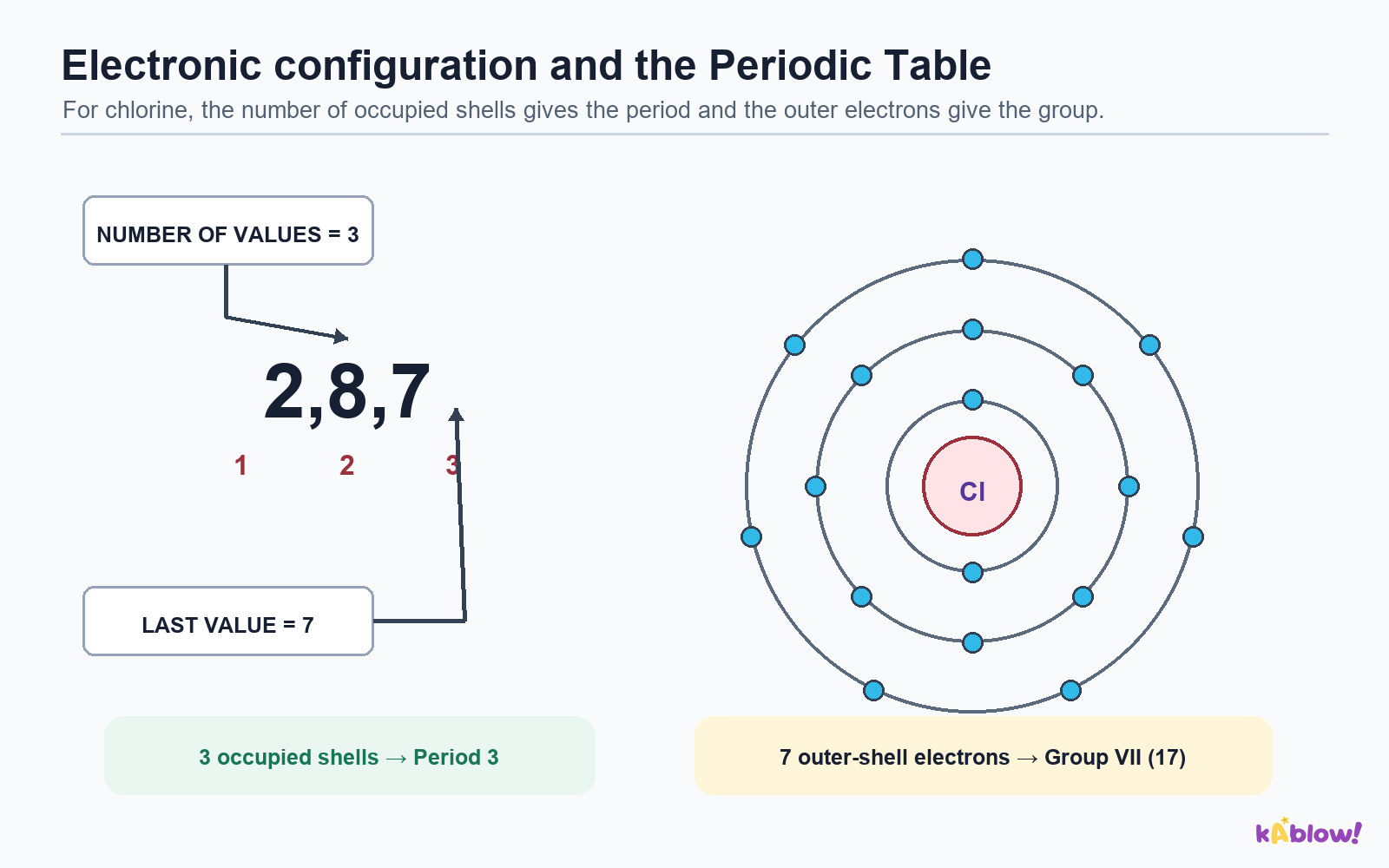
- The number of numbers in the configuration equals the period number.
- The last number equals the group number (for Groups 1–7).
- Example: chlorine (2,8,7) is in Period 3, Group 7.
- Elements in the same group have the same number of outer electrons → similar chemical properties.
Chlorine and its position in the periodic table
Metallic Character Trend
- Metallic character decreases across a period (left to right).
- Metallic character increases down a group.
- Metals have 1–3 outer electrons; non-metals have 4–7 outer electrons.
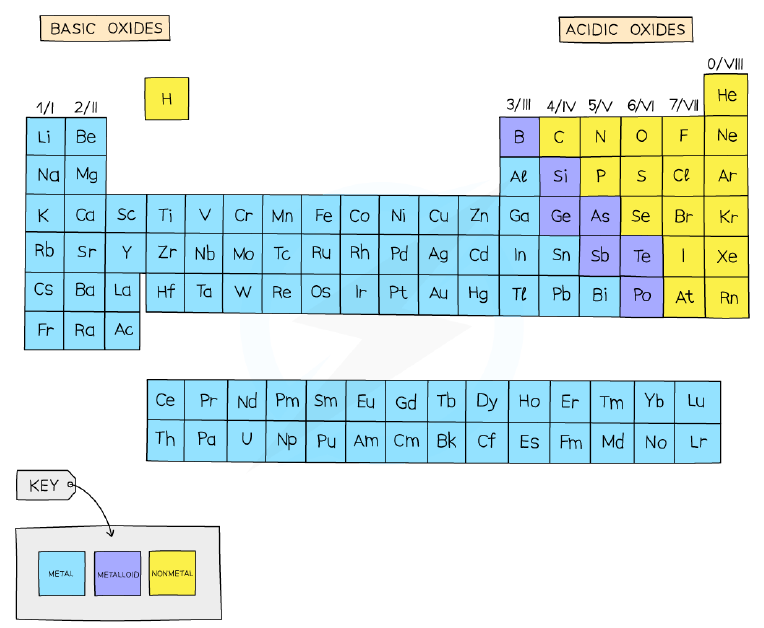
- Metals form basic oxides; non-metals form acidic oxides.
- Metals are good conductors of electricity; non-metals are poor conductors.
The metal/non-metal divide, with basic and acidic oxide regions
Group 1 (Alkali Metals) Trends
- Reactivity increases down the group (Li < Na < K < Rb < Cs < Fr).
- Melting point decreases down the group.
- They react with water to form a metal hydroxide and hydrogen gas.
- Observations: Li fizzes slowly; Na moves rapidly; K burns with a lilac flame; Rb explodes; Cs violent explosion.
Group 7 (Halogens) Trends
- Reactivity decreases down the group (F > Cl > Br > I).
- Density increases down the group (F and Cl are gases, Br is liquid, I is solid at room temperature).
- Halogens gain 1 electron to form ions with a 1– charge.
- They are non-metals: poor conductors, brittle, low melting/boiling points.
Group 0 (Noble Gases)
- All have a full outer shell of electrons (2 for He, 8 for others).
- They are unreactive (inert) and exist as monatomic gases.
- Used in lighting (neon signs) and as inert atmospheres (argon in welding).
Predicting Properties
- Trends down groups and across periods allow prediction of melting point, boiling point, density, and reactivity.
- Transition elements are denser than Group 1 elements.
- Given data for a group, arrange elements in order of position to identify trends.
- Francium is too reactive and rare to confirm predictions experimentally.
슬라이드
연습 문제
무료 미리 보기 — 40개 중 8개 문제. 가입하면 전부 볼 수 있어요.
1.Which one of the following names does not correspond to a group of elements on the Periodic table?
Easy- AAlkali
- BGroup VI
- CAlloys
- DHalogens
2.Which row describes how the elements are positioned on the Periodic table and the names used?
Easy- Aelements placed by atomic number; group = vertical column; period = horizontal row
- Belements placed by mass number; group = vertical column; period = horizontal row
- Celements placed by atomic number; group = horizontal row; period = vertical column
- Delements placed by mass number; group = horizontal row; period = vertical column
3.Which property of elements increases as you move across the Periodic table?
Easy- AThe number of outer shells increases.
- BThe number of outer shell electrons increases.
- CThe metallic character.
- DThe tendency to become oxidised.
4.Element Z forms an ion with a 2- charge. Which group of the Periodic Table is element Z found in?
Easy- A1
- B2
- C6
- D7
5.Element X is found in Group 7 of the Periodic Table. Which properties are typical of element X? 1. Poor conductor of electricity 2. Malleable 3. High melting points 4. Form acidic oxides
Easy- A1 and 2
- B1 and 4
- C2 and 3
- D3 and 4
6.The table shows the densities at room temperature of halogens W, X, Y and Z: W 0.0017 g/cm3, X 3.1 g/cm3, Y 0.0032 g/cm3, Z 4.93 g/cm3. Which row correctly identifies W, X, Y and Z?
Medium- AW=fluorine, X=chlorine, Y=bromine, Z=iodine
- BW=fluorine, X=bromine, Y=chlorine, Z=iodine
- CW=iodine, X=chlorine, Y=bromine, Z=fluorine
- DW=iodine, X=bromine, Y=chlorine, Z=fluorine
7.Potassium and krypton are elements in Period 4. Potassium is at the beginning of the period and is more metallic than krypton which is at the end of the period. What makes potassium more metallic than krypton?
Medium- AIt has less electrons than krypton.
- BIt has less protons than krypton.
- CIt has less electron shells.
- DIt has less outer shell electrons.
8.The elements of the Periodic table can be broadly classified into metals and nonmetals. Which statements are correct? 1. Magnesium is more metallic than silicon. 2. Boron is more metallic than lithium. 3. Carbon is less metallic than beryllium. 4. Sodium is less metallic than aluminium.
Medium- A1 and 3
- B1 and 2
- C2, 3 and 4
- D1, 2 and 4