Exothermic And Endothermic Reactions
플레이하며 배우기
이 문제들을 풀어 에너지를 얻은 뒤 낚시하고 탐험하세요. 계정이 필요 없어요.
교육자를 위해: Exothermic And Endothermic Reactions(Co-ordinated Sciences (Double Award) [CIE], Chemistry)을(를) 위한 바로 쓸 수 있는 수업 슬라이드, 복습 노트 — 수업에 사용하거나, 학습자들이 실시간 게임으로 즐기는 인터랙티브 클래스 활동으로 진행하세요.
수업 노트
Endothermic & Exothermic Reactions
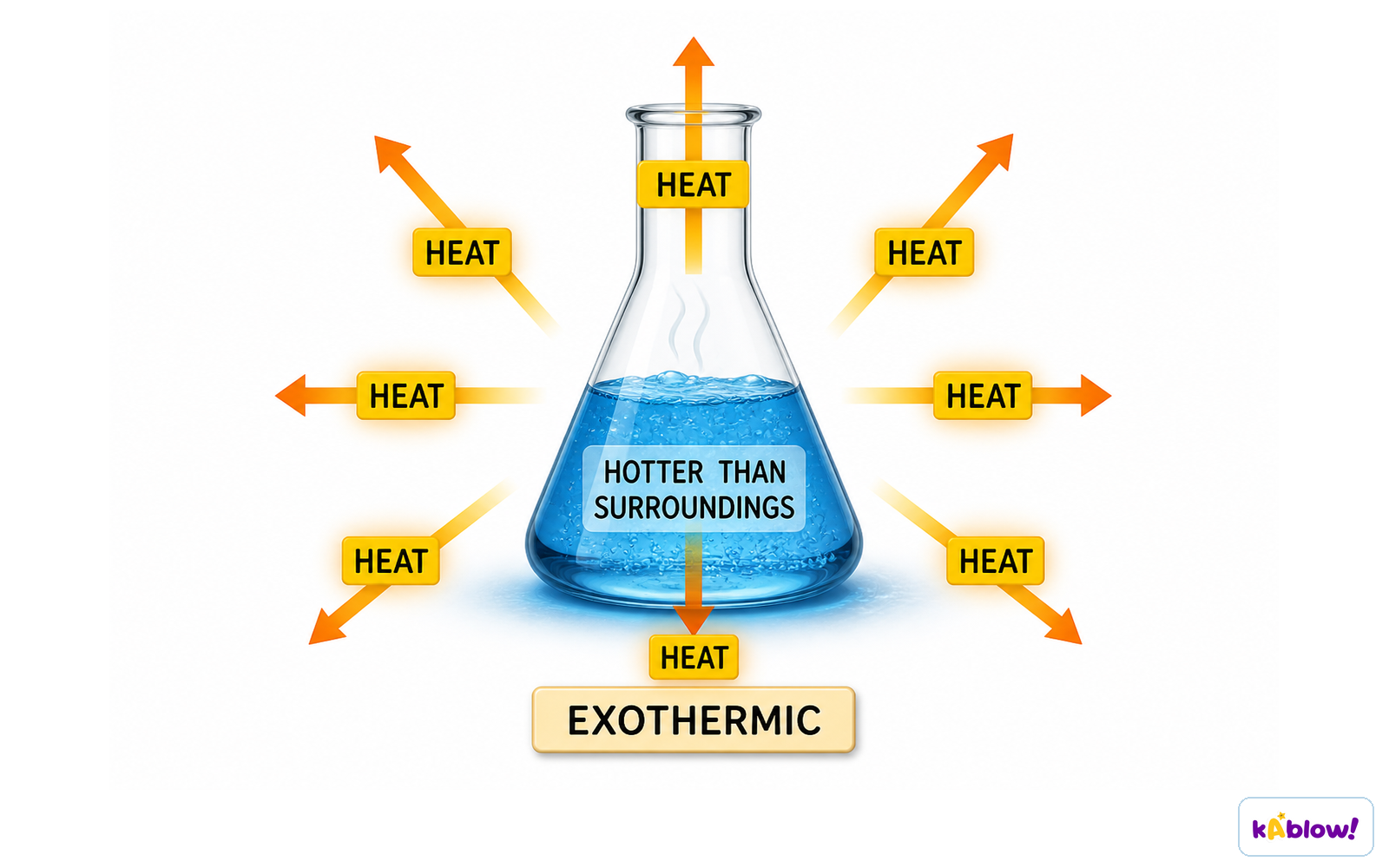
- In exothermic reactions, thermal energy is transferred from the system (reacting chemicals) to the surroundings; the temperature of surroundings increases.
- Exothermic reactions have a negative enthalpy change (ΔH < 0) because the system loses energy.
- Common examples: combustion, oxidation, neutralisation; also hand warmers and self-heating cans.
- In endothermic reactions, thermal energy is transferred from the surroundings to the system; the temperature of surroundings decreases.
- Endothermic reactions have a positive enthalpy change (ΔH > 0) because the system gains energy.
- Common examples: electrolysis, thermal decomposition, first stages of photosynthesis; also cold packs for sports injuries.
- Mnemonic: In Exothermic heat Exits; in Endothermic heat Enters.
Heat transfer outwards in an exothermic reaction
Enthalpy Change & Activation Energy
- Enthalpy change (ΔH) is the transfer of thermal energy during a reaction: negative for exothermic, positive for endothermic.
- Activation energy (Eₐ) is the minimum energy required for a successful collision between reactant particles.
- Reactions with higher activation energy need more energy to start.
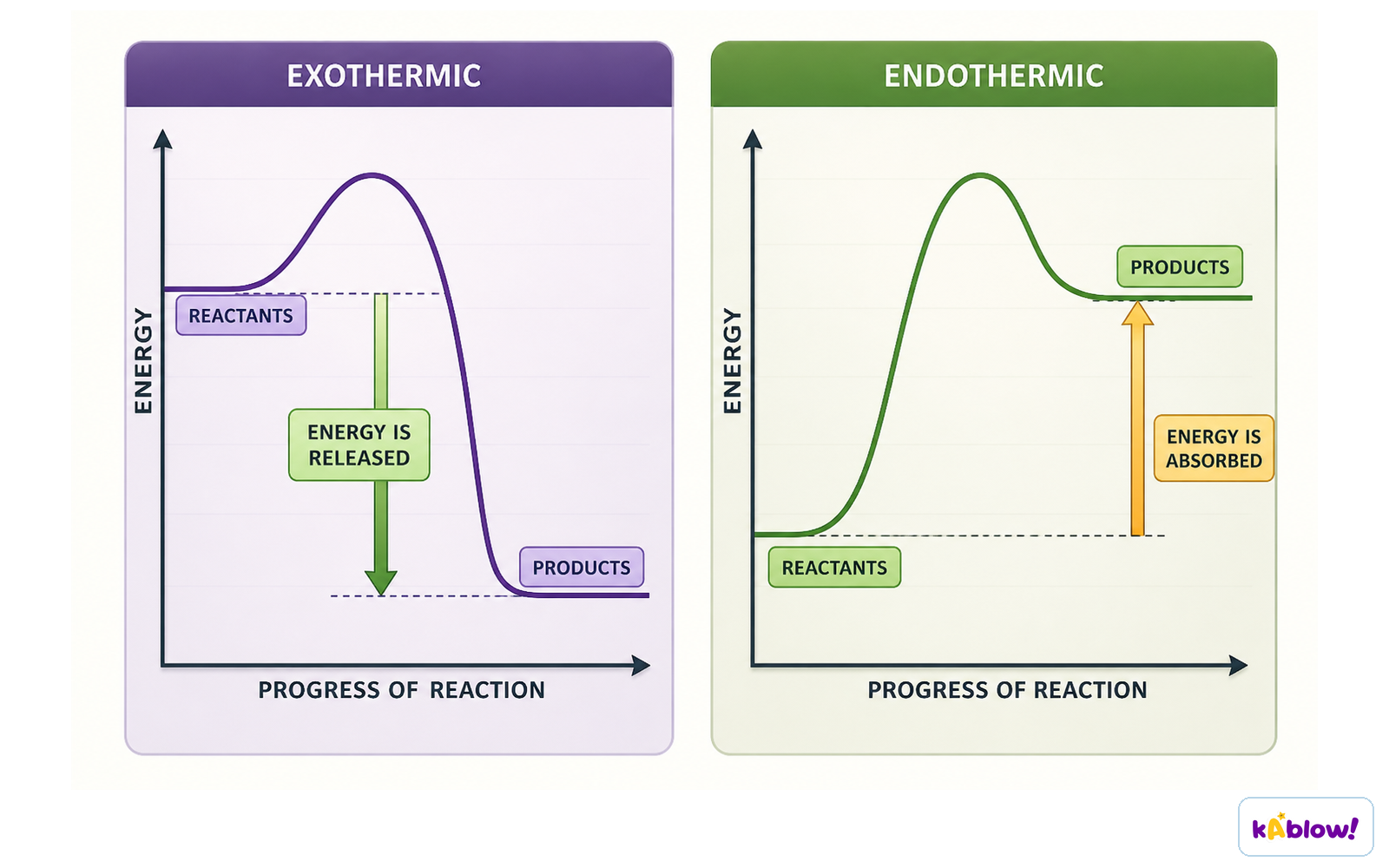
- Reaction pathway diagrams plot energy (y-axis) against progress of reaction (x-axis).
- For exothermic reactions: products have lower energy than reactants; ΔH is shown as a downward arrow.
- For endothermic reactions: products have higher energy than reactants; ΔH is shown as an upward arrow.
- Activation energy is the energy difference between reactants and the highest point on the curve.
Reaction pathway diagrams for exothermic and endothermic reactions
Bond Breaking & Bond Forming
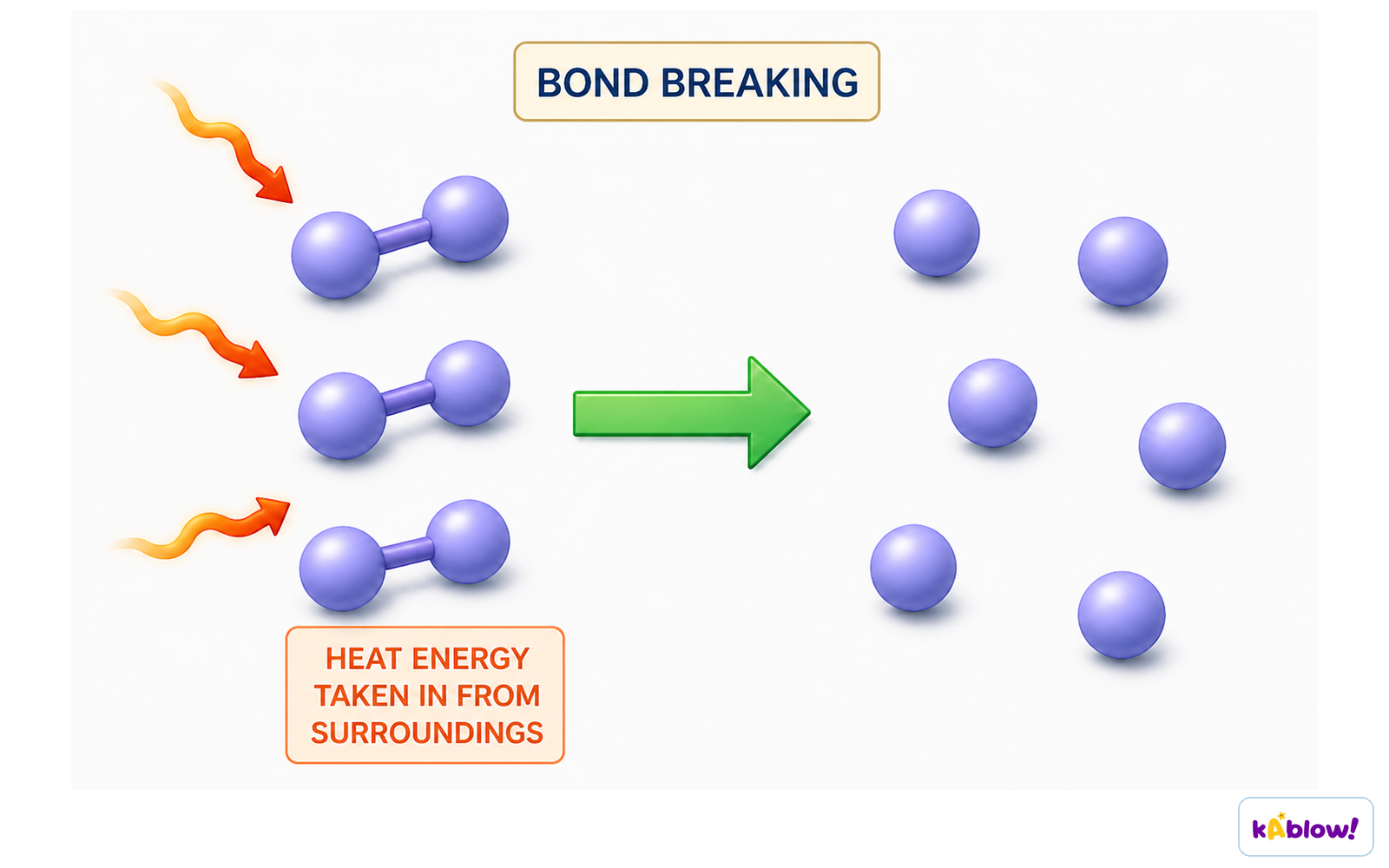
- Bond breaking is always endothermic (energy absorbed from surroundings).
- Bond making is always exothermic (energy released to surroundings).
- If more energy is released in bond making than absorbed in bond breaking, the overall reaction is exothermic (ΔH negative).
- If more energy is absorbed in bond breaking than released in bond making, the overall reaction is endothermic (ΔH positive).
- The overall enthalpy change is the difference between the energy needed to break bonds and the energy released when new bonds form.
Bond breaking is endothermic
슬라이드
연습 문제
무료 미리 보기 — 52개 중 8개 문제. 가입하면 전부 볼 수 있어요.
1.In an exothermic reaction, thermal energy is transferred from the surroundings to the system.
EasyTrue or false?
2.Bond breaking is an endothermic process.
EasyTrue or false?
3.Which of the following is an example of an endothermic reaction?
Easy- ACombustion
- BNeutralisation
- CThermal decomposition
- DOxidation
4.State the meaning of the symbol ΔH.
Easy5.Complete the sentence using the words 'system' and 'surroundings'.
EasyIn an endothermic reaction, thermal energy is transferred from the ____ to the ____.
6.Explain why a reaction with a positive ΔH value is endothermic.
Medium7.Which statement about activation energy is correct?
Medium- AIt is the energy difference between reactants and products.
- BIt is the minimum energy required for a successful collision.
- CIt is always negative for exothermic reactions.
- DIt is the same as the enthalpy change.
8.In an exothermic reaction, the energy of the products is higher than the energy of the reactants.
EasyTrue or false?
기출 문제
이 주제의 기출 문제 연습이 곧 나와요.
곧 출시