The Nucleus
플레이하며 배우기
이 문제들을 풀어 에너지를 얻은 뒤 낚시하고 탐험하세요. 계정이 필요 없어요.
교육자를 위해: The Nucleus(Co-ordinated Sciences (Double Award) [CIE], Physics)을(를) 위한 바로 쓸 수 있는 수업 슬라이드, 복습 노트, 다이어그램 — 수업에 사용하거나, 학습자들이 실시간 게임으로 즐기는 인터랙티브 클래스 활동으로 진행하세요.
수업 노트
Composition of the Nucleus
- The nucleus is composed of protons (positive charge) and neutrons (no charge).
- The nucleus has an overall positive charge due to the protons.
- Protons and neutrons are collectively called nucleons.
- Electrons orbit the nucleus and have a negative charge.
Bohr model of a helium atom
Proton Number (Z) and Nucleon Number (A)
- The proton number (Z) is the number of protons in an atom; it determines the element.
- The nucleon number (A) is the total number of protons and neutrons in the nucleus.
- Number of neutrons = nucleon number − proton number.
- In a neutral atom, the number of electrons equals the number of protons.
Nuclide Notation
- Nuclide notation is written as AZ X (e.g., 19779 Au).
- The top number A is the nucleon number; the bottom number Z is the proton number.
- A nuclide is a group of atoms with the same number of protons and neutrons.
Nuclide notation — lithium-7
Isotopes
- Isotopes are atoms of the same element with the same number of protons but different numbers of neutrons.
- Isotopes have the same proton number but different nucleon numbers.
- Some isotopes are radioactive and emit α, β, or gamma radiation.
- Examples: carbon-14, uranium-235, technetium-99m.
Relative Charge of Subatomic Particles
- Relative charge compares a particle's charge to the fundamental charge (1.6 × 10⁻¹⁹ C).
- Proton: relative charge +1.
- Neutron: relative charge 0.
- Electron: relative charge −1.
Relative charge of subatomic particles
Nuclear Charge (Extended Tier Only)
- Nuclear charge is the total relative charge of the nucleus.
- It equals the number of protons multiplied by +1.
- For example, a carbon nucleus (6 protons) has a nuclear charge of +6.
Nuclear Fission (Extended Tier Only)
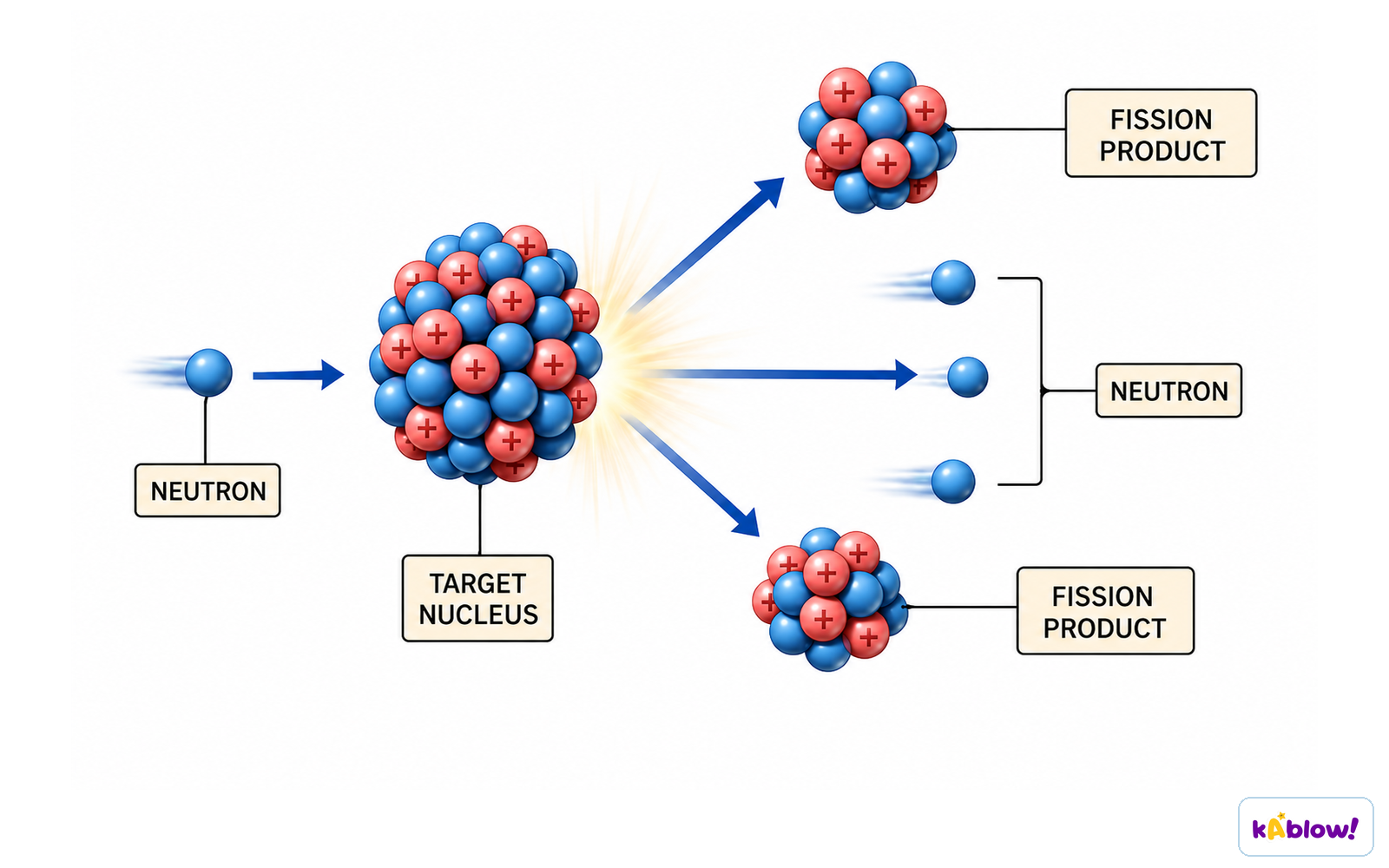
- Nuclear fission is the splitting of a large, unstable nucleus into two smaller nuclei.
- A neutron collides with the nucleus, causing it to split and release 2–3 neutrons and gamma rays.
- The products are daughter nuclei and neutrons with high kinetic energy.
- Example: fission of uranium-235.
Nuclear fission process
Nuclear Fusion (Extended Tier Only)
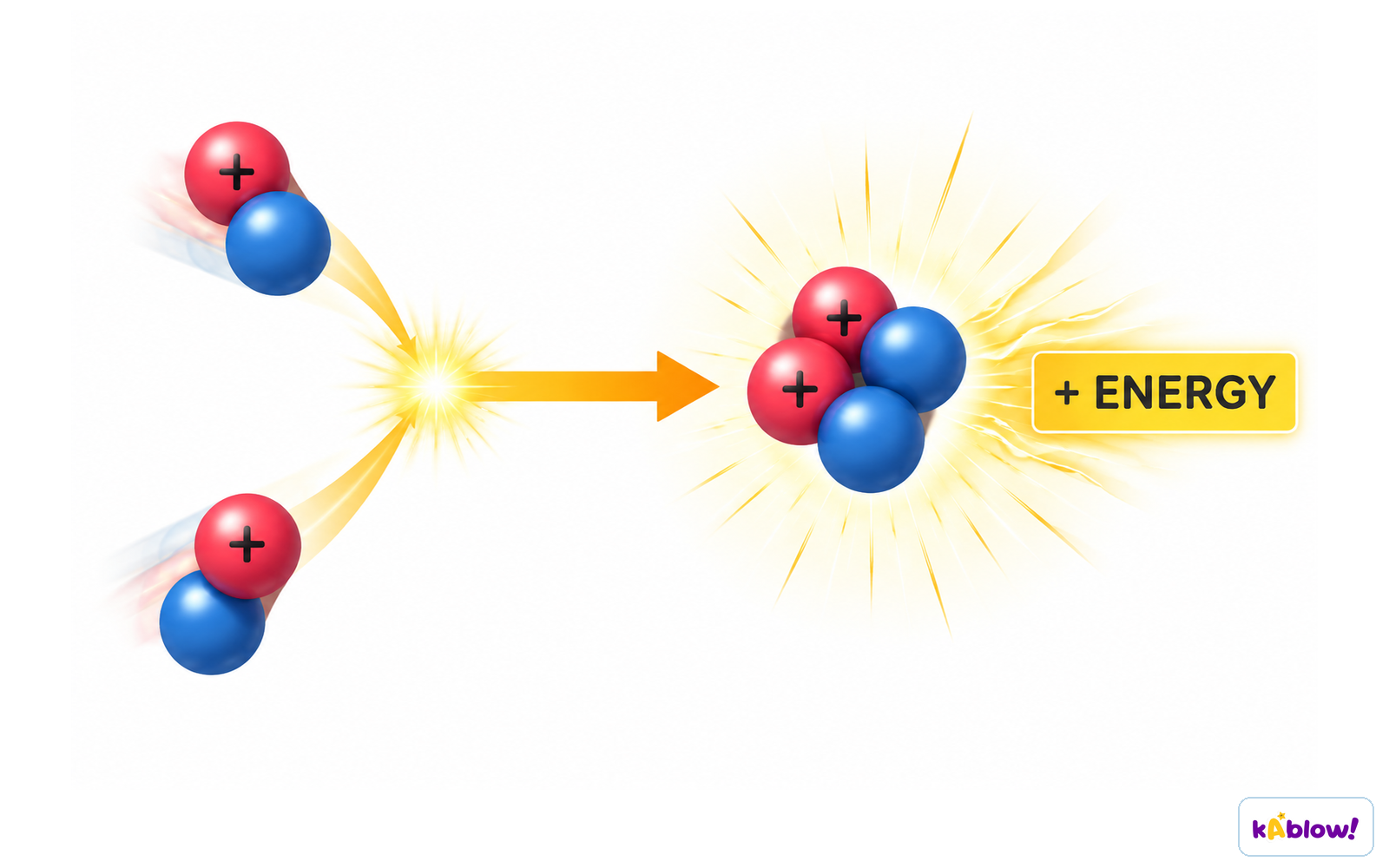
- Nuclear fusion is the joining of two light nuclei to form a heavier nucleus.
- In stars, hydrogen nuclei fuse to form helium, releasing huge amounts of energy.
- Fusion requires extremely high temperature and pressure.
- It is difficult to reproduce on Earth.
Nuclear fusion of hydrogen
슬라이드
연습 문제
무료 미리 보기 — 54개 중 8개 문제. 가입하면 전부 볼 수 있어요.
1.What particles are found in the nucleus of an atom?
Easy- AProtons and neutrons
- BProtons and electrons
- CNeutrons and electrons
- DProtons, neutrons, and electrons
2.How many neutrons are in a gold atom with mass number 197 and atomic number 79?
Easy- A130
- B142
- C118
- D106
3.What is the relative charge of a chromium nucleus with 24 protons?
Easy- A+24
- B+52
- C+1
- D0
4.The number of protons in an atom is equal to the number of electrons.
EasyTrue or false?
5.What is the term for atoms of the same element with different numbers of neutrons?
Easy6.Complete the sentence.
EasyIn nuclide notation, the top number A represents the ____ number.
7.Match each particle to its relative charge.
Easy- Proton
- Neutron
- Electron
- +1
- 0
8.Put the following steps of nuclear fission in the correct order.
Medium- A neutron collides with the nucleus
- The nucleus splits into two smaller nuclei and neutrons
- Gamma rays are emitted
- The nucleus becomes unstable
기출 문제
이 주제의 기출 문제 연습이 곧 나와요.
곧 출시