Computer Architecture
플레이하며 배우기
이 문제들을 풀어 에너지를 얻은 뒤 낚시하고 탐험하세요. 계정이 필요 없어요.
교육자를 위해: Computer Architecture(Computer Science, CIE)을(를) 위한 바로 쓸 수 있는 수업 슬라이드, 복습 노트 — 수업에 사용하거나, 학습자들이 실시간 게임으로 즐기는 인터랙티브 클래스 활동으로 진행하세요.
수업 노트
CPU & Microprocessors
- The CPU (Central Processing Unit) is the brain of the computer; its purpose is to fetch, decode, and execute instructions.
- A microprocessor is a single-chip integrated circuit that contains the CPU and may also include memory controllers and I/O interfaces.
- The CPU processes data by taking input, executing instructions, and producing output.
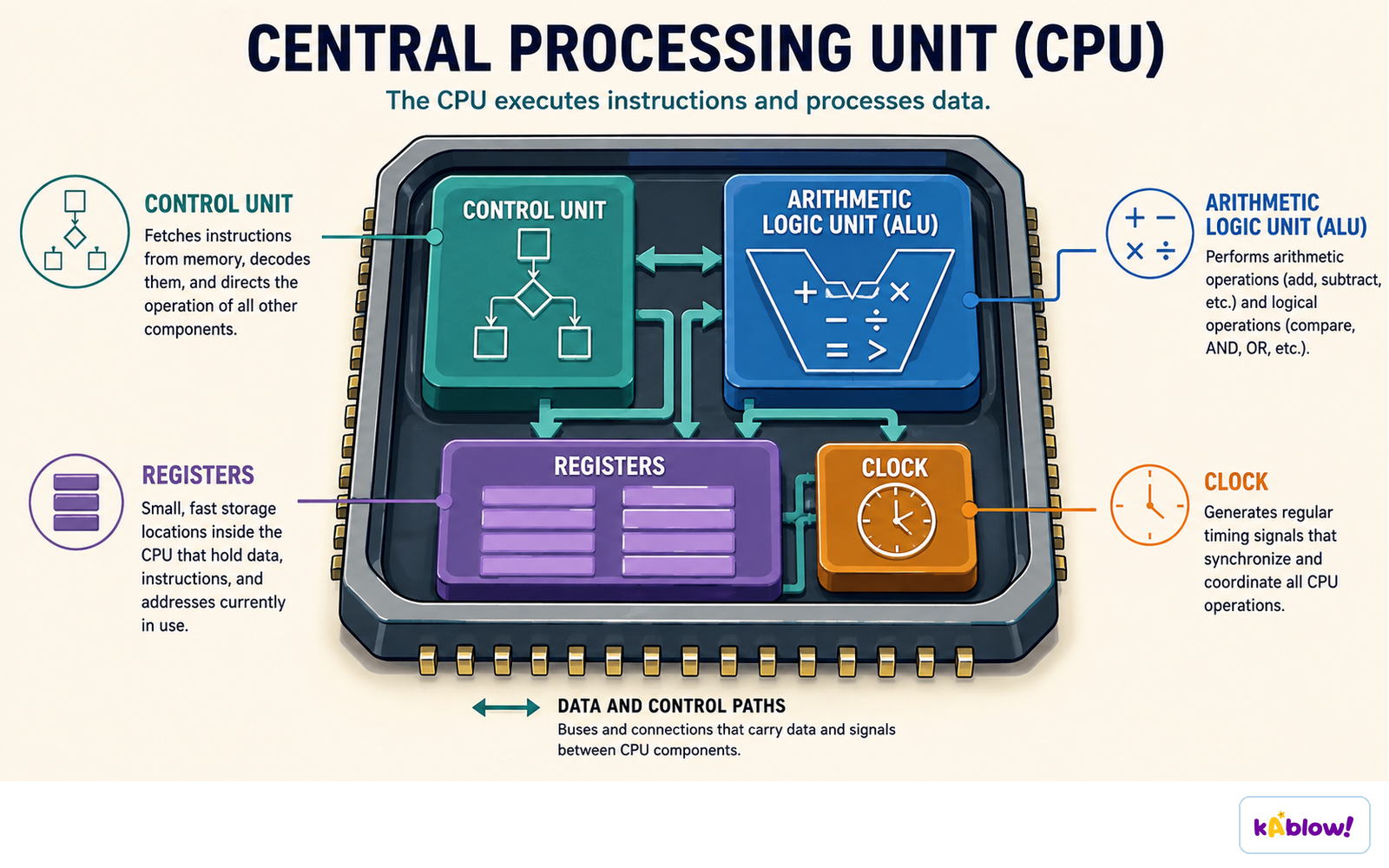
The control unit, ALU, registers and clock work together inside the CPU, connected by data and control paths.
Von Neumann Architecture
- Proposed by John Von Neumann in the 1940s; most general-purpose computers are based on this design.
- Key components: Control Unit (CU), Arithmetic Logic Unit (ALU), and registers.
- ALU performs arithmetic operations (e.g., ADD) and logical decisions (e.g., IF X > 5).
- CU coordinates data movement and decodes instructions fetched from memory.
- Registers are extremely small, fast memory inside the CPU; each has a specific purpose.
- Five main registers: PC, MAR, MDR, CIR, ACC.
- PC (Program Counter) holds the address of the next instruction to be executed; increments by 1 each cycle.
- MAR (Memory Address Register) holds the address of data/instruction to be fetched from memory.
- MDR (Memory Data Register) stores data/instruction fetched from memory.
- CIR (Current Instruction Register) stores the instruction currently being decoded/executed.
- ACC (Accumulator) stores results of calculations from the ALU.
Buses
- A bus is a set of parallel wires connecting components; transmits data/signals.
- Address bus – unidirectional; carries memory addresses (locations).
- Data bus – bidirectional; carries data or instructions.
- Control bus – bidirectional; carries commands/control signals (e.g., read/write).
Fetch-Decode-Execute Cycle
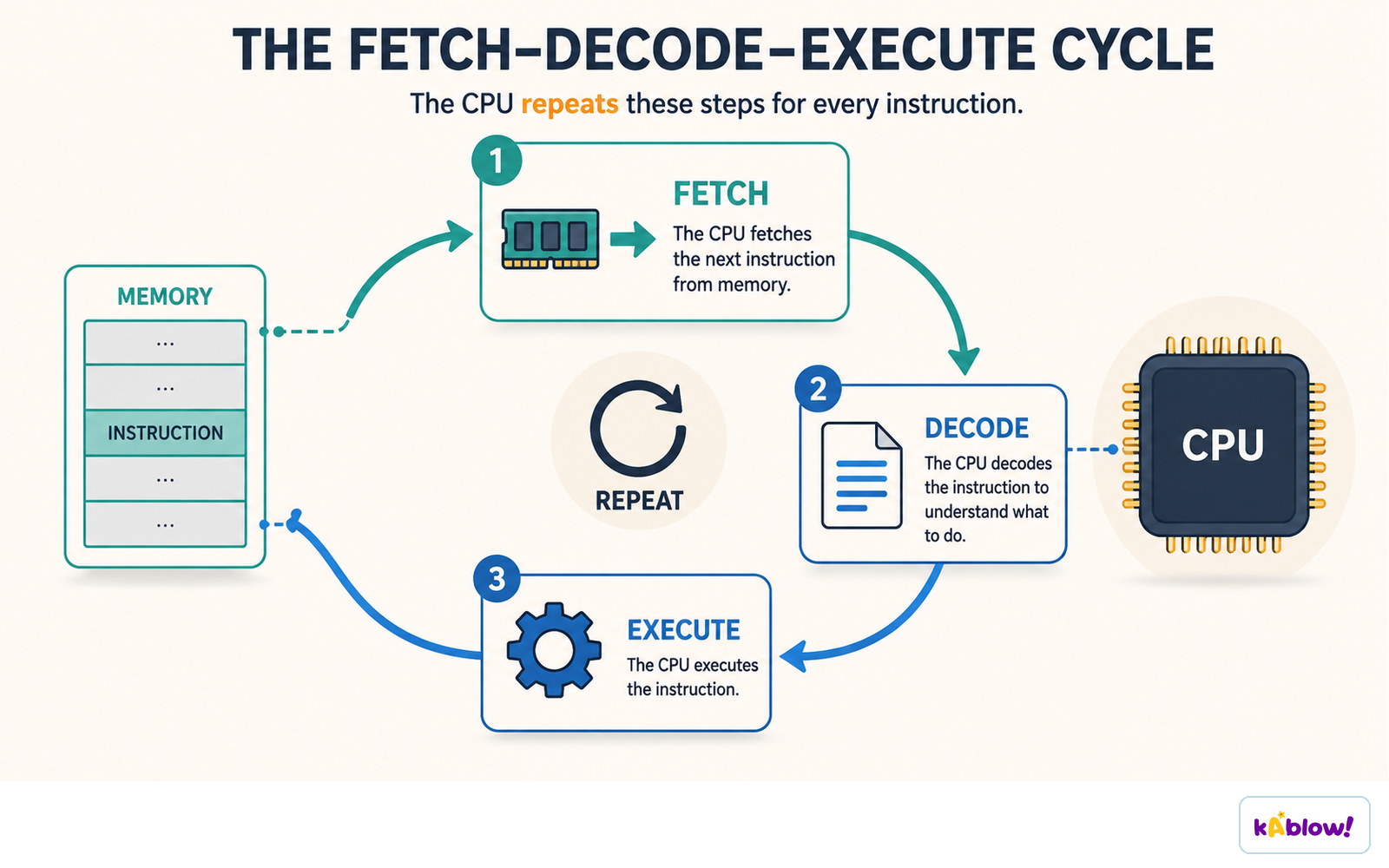
- The CPU repeats the fetch-decode-execute cycle billions of times per second.
- Fetch: PC address → MAR → address bus → memory → data bus → MDR → CIR; PC increments.
- Decode: CU splits instruction into opcode (what to do) and operand (data/address).
- Execute: CPU carries out the instruction (e.g., calculation, store result, fetch new data).
- The cycle then repeats with the next instruction.
The CPU repeats fetch, decode and execute for every instruction.
Characteristics of the CPU
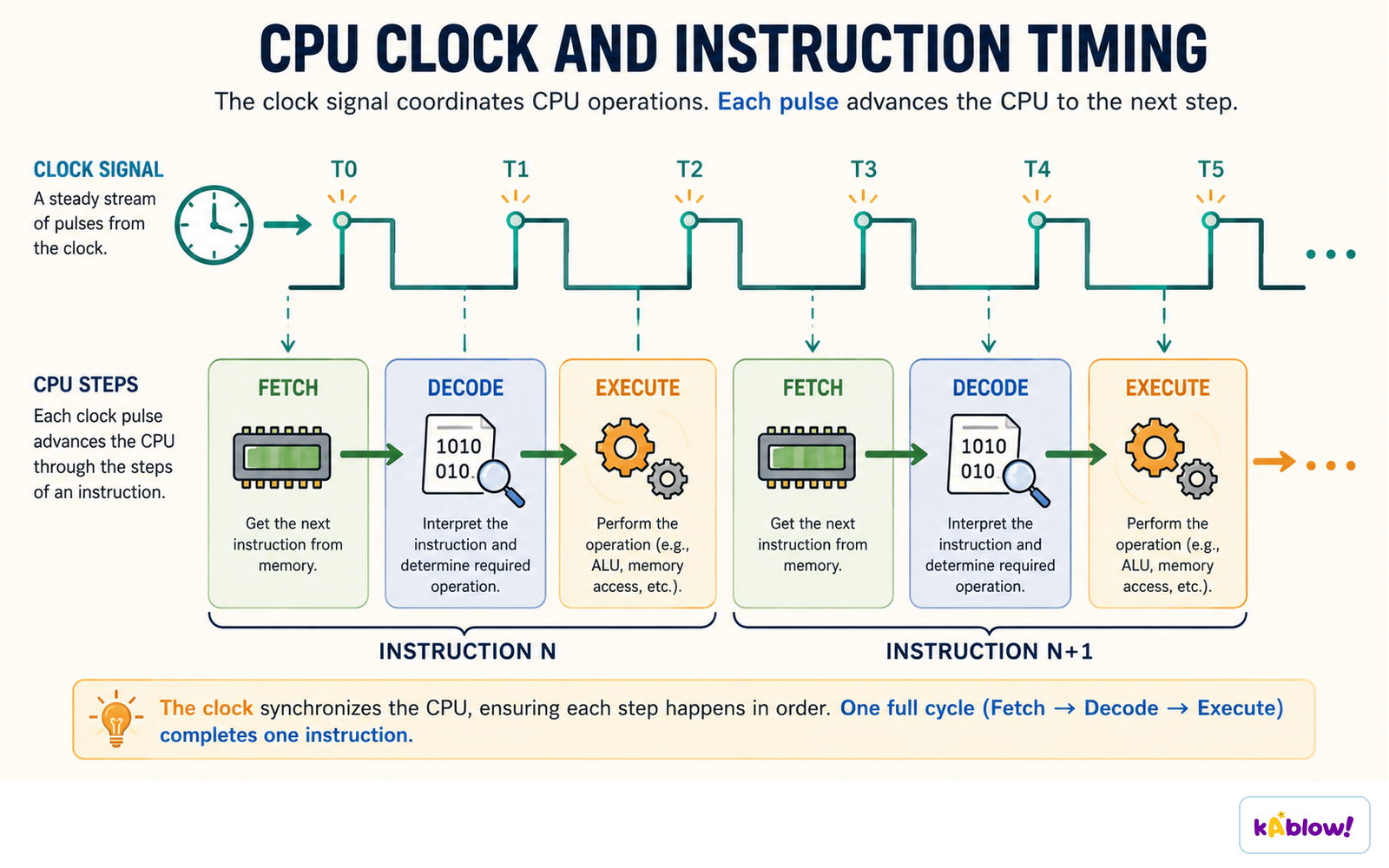
- Clock speed – measured in Hz (GHz); number of FDE cycles per second. Higher speed = more instructions per second.
- Cache size – small, fast memory on/near CPU; stores frequently used instructions/data. Larger cache reduces fetches from RAM, improving speed.
- Number of cores – each core is an independent processing unit. Multi-core CPUs can execute multiple instructions simultaneously (parallel processing).
- Example: Quad-core at 3 GHz can process up to 12 billion instructions per second.
Each clock pulse advances the CPU one step, so a full fetch-decode-execute cycle completes one instruction.
CPU Instruction Sets
- An instruction set is the list of all commands a CPU can execute; each command has a binary machine code.
- Instructions have a mnemonic (e.g., ADD, SUB, LDA, STA, HLT) and a binary code.
- After decoding, the CPU matches the instruction to its set to know the operation.
- Instruction sets are machine-specific; a program for one CPU (e.g., Intel) won't run on another (e.g., ARM).
Embedded Systems
- An embedded system is a computer system dedicated to a single function inside a larger mechanical unit.
- Examples: washing machines, car engine management systems, traffic lights, heating thermostats.
- Properties: small size, low power consumption, low cost.
- They are not general-purpose computers; they have a microprocessor and perform a specific task.
슬라이드
연습 문제
무료 미리 보기 — 69개 중 8개 문제. 가입하면 전부 볼 수 있어요.
1.What is the purpose of the Central Processing Unit (CPU)?
Easy- ATo fetch, decode and execute instructions
- BTo store data permanently
- CTo manage input and output devices only
- DTo provide a user interface
2.Which component of the Von Neumann architecture performs arithmetic operations and logical decisions?
Easy- AControl Unit (CU)
- BArithmetic Logic Unit (ALU)
- CMemory Address Register (MAR)
- DAccumulator (ACC)
3.During the fetch stage of the fetch-decode-execute cycle, what happens to the Program Counter (PC)?
Easy- AIt is decremented by 1
- BIt is incremented by 1
- CIt is reset to zero
- DIt remains unchanged
4.Which register holds the memory address of the next instruction to be fetched?
Easy- AMemory Address Register (MAR)
- BProgram Counter (PC)
- CMemory Data Register (MDR)
- DCurrent Instruction Register (CIR)
5.Which bus is unidirectional and carries only memory addresses?
Easy- AData bus
- BControl bus
- CAddress bus
- DSystem bus
6.What is the role of the control unit during the fetch stage?
Medium- AIt sends a signal on the control bus to start a read operation
- BIt places the instruction on the data bus
- CIt increments the Program Counter
- DIt stores the fetched instruction in the CIR
7.A computer has a quad-core processor running at 3 GHz. How many instructions can it theoretically execute per second?
Medium- A3 billion
- B12 billion
- C4 billion
- D7 billion
8.Which of the following is an example of an embedded system?
Easy- ALaptop
- BDesktop computer
- CWashing machine
- DSmartphone
기출 문제
이 주제의 기출 문제 연습이 곧 나와요.
곧 출시