Operations With Numbers And Decimals
플레이하며 배우기
이 문제들을 풀어 에너지를 얻은 뒤 낚시하고 탐험하세요. 계정이 필요 없어요.
교육자를 위해: Operations With Numbers And Decimals(Maths [CIE], Core)을(를) 위한 바로 쓸 수 있는 수업 슬라이드, 복습 노트, 다이어그램 — 수업에 사용하거나, 학습자들이 실시간 게임으로 즐기는 인터랙티브 클래스 활동으로 진행하세요.
수업 노트
Mathematical Symbols
- + : addition, plus, sum, total
- − : subtraction, minus, difference, take away
- × : multiplication, product, times
- ÷ : division, quotient, divide, share
- = : equal to; ≠ : not equal to; ≈ : approximately equal to
- > : greater than; < : less than; ≥ : greater than or equal to; ≤ : less than or equal to
- ( ) : brackets for grouping; ^ : powers (indices); √ : positive square root; ∛ : cube root
Order of Operations (BIDMAS/BODMAS)
- Operations must be done in order: Brackets, Indices (or Orders), Division and Multiplication (left to right), Addition and Subtraction (left to right)
- Fractions have invisible brackets around numerator and denominator, e.g. (2+5)/(7-2)
- Roots have invisible brackets under the root, e.g. √(9+16)
- When using a calculator, type the calculation exactly as written; older calculators may need extra brackets
- Always check your answer seems sensible (estimate first)
Addition & Subtraction
- Column method: line up digits by place value; add/subtract each column right to left
- Addition: carry tens to the next column if sum ≥ 10
- Subtraction: if top digit is smaller, borrow 10 from the next column to the left
- Alternative subtraction: counting up from the smaller number to the larger
- Estimate by rounding to check your answer (e.g., 4000+1000=5000 for 3985+1273)
Multiplication & Division
- Column method: multiply each digit of bottom number by each digit of top number, using zeros as placeholders for non-units columns
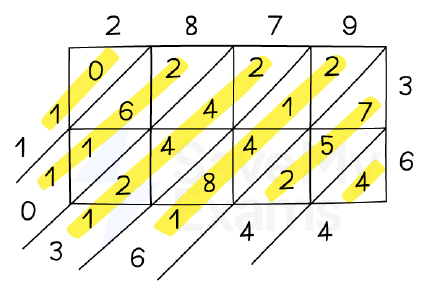
- Lattice method: draw grid with diagonals, multiply digit pairs, sum along diagonals
- Grid method: split numbers by place value, multiply each part, sum results
- Repeated addition (chunking): build up using simple multiples (×1, ×2, ×4, ×8, etc.)
- Short division (bus stop method): divide digit by digit from left, carry remainders
- Factorising/cancelling: treat division as a fraction and simplify before dividing
- Dividing by powers of 10 shifts digits to the right (e.g., 380÷10=38.0)
Lattice method for 2879 x 36
Operations with Decimals
- Add/subtract decimals: line up decimal points and use column method; write zeros as placeholders
- Multiply decimals: convert to integers by multiplying by powers of 10, multiply, then divide by the same powers; or ignore decimal points and use estimation to place the decimal
- Divide decimals: write as a fraction, multiply numerator and denominator by powers of 10 to make integers, divide, then undo the changes; or ignore decimals and use estimation
- Always estimate the answer first to check reasonableness (e.g., 1.57×0.78 ≈ 2×1=2, so answer is 1.2246)
슬라이드
연습 문제
무료 미리 보기 — 40개 중 8개 문제. 가입하면 전부 볼 수 있어요.
1.What is the value of 7 × (2 × 4 + 8) × (2 + 6)?
Easy- A448
- B336
- C560
- D224
2.A theatre has 1850 seats. If 967 seats have been sold, how many seats are still available?
Easy- A883
- B893
- C873
- D863
3.Calculate 3 + 2 × (8 - 6).
Easy- A7
- B10
- C5
- D13
4.Insert one pair of brackets to make the statement correct: 7 × 5 - 2 + 3 = 42.
Medium- A7 × (5 - 2) + 3
- B(7 × 5) - 2 + 3
- C7 × 5 - (2 + 3)
- D7 × (5 - 2 + 3)
5.Work out (9 + 22) - 4 × 2 + \√{144}.
Medium- A13
- B21
- C17
- D9
6.Insert one pair of brackets to make the statement correct: 3 + 2 × 12 - 4 = 19.
Medium- A3 + 2 × (12 - 4)
- B(3 + 2) × 12 - 4
- C3 + (2 × 12) - 4
- D(3 + 2 × 12) - 4
7.Insert one pair of brackets to make the statement correct: 16 ÷ 8 + 4 × 2 = 1.
Hard- A16 ÷ (8 + 4) × 2
- B(16 ÷ 8) + 4 × 2
- C16 ÷ 8 + (4 × 2)
- D16 ÷ (8 + 4 × 2)
8.Calculate 18 ÷ (10 - 4) - 11 × 4 + 9 × (6 + 1).
Hard- A28
- B34
- C22
- D16
기출 문제
이 주제의 기출 문제 연습이 곧 나와요.
곧 출시