Forming And Solving Equations
플레이하며 배우기
이 문제들을 풀어 에너지를 얻은 뒤 낚시하고 탐험하세요. 계정이 필요 없어요.
수업 노트
Forming Equations from Words
- Use x to represent an unknown value; translate phrases like '2 less than something' → x − 2, 'double something' → 2x, '5 lots of something' → 5x, '3 more than something' → x + 3, 'half of something' → x/2.
- Key words: sum/total/more than (+), difference/less than (−), product/lots of/times as many (×), shared/split/grouped (÷).
- Use brackets to keep order correct: 'something add 1, then multiplied by 3' → 3(x + 1); compare with 'something multiplied by 3, then add 1' → 3x + 1.
- Choose the unknown wisely: if Adam is 10 years younger than Barry, let Barry's age = x, Adam's = x − 10; if Adam's age is half Barry's, let Barry's = 2x, Adam's = x.
- An equation has an equals sign; insert 'is equal to' to place it. E.g., 'Lisa's age is double Aisha's and sum is 27' → 2x + x = 27.
- Always give the answer in context (e.g., 'Lisa is 18 years old').
Forming Equations from Shapes
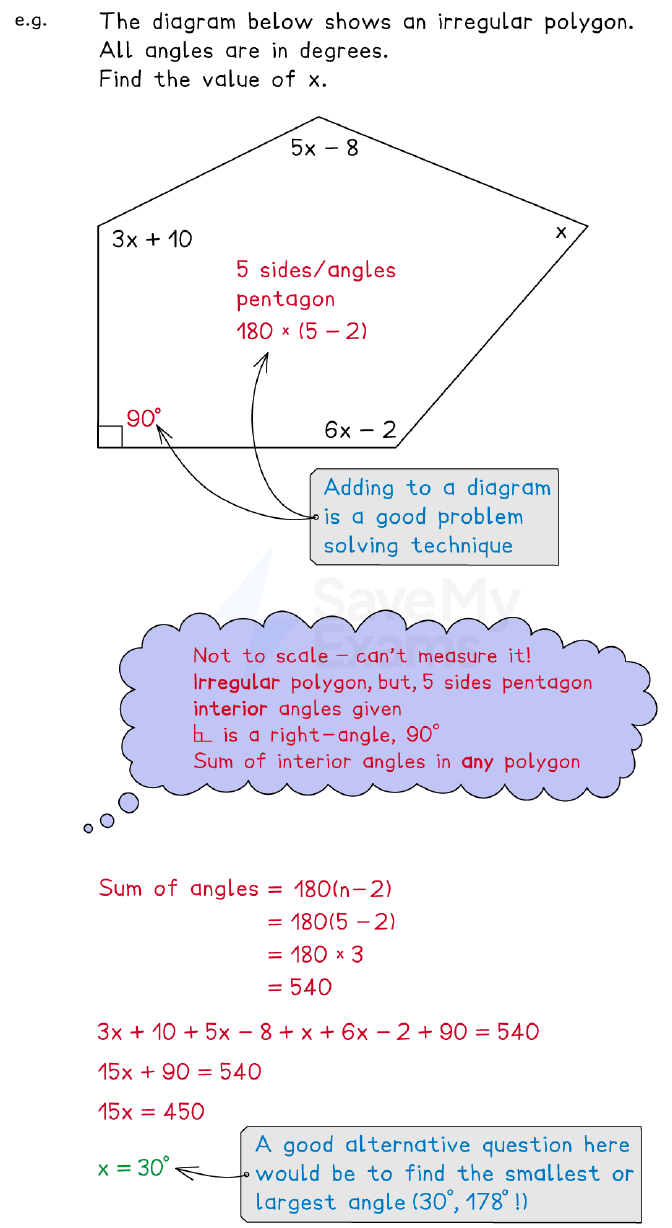
- Use all given information and shape properties: triangles (equilateral, isosceles, scalene, right-angled), quadrilaterals (square, rectangle, kite, rhombus, parallelogram, trapezium), polygons (sum of interior angles = 180(n − 2)), parallel lines (alternate, corresponding, co-interior).
- For perimeter, add all side lengths; for area, use appropriate formula (e.g., rectangle: length × width, triangle: ½ × base × height).
- For 3D shapes, volume = cross‑section area × length (prisms); surface area = sum of face areas.
- Sketch a diagram if none given; split irregular shapes into sum/difference of common shapes.
- Put brackets around algebraic expressions when substituting into formulas (e.g., perimeter = 2(3x + 1) + 2(2x − 5)).
- Read carefully: does the question ask for an angle, perimeter, area, or something else?
Interior angles of an irregular pentagon
Problem Solving with Equations
- Problem solving involves forming and solving equations from a real‑life or constructed situation; equations can be linear (e.g., 2(x + 4) = 3x) or quadratic (e.g., x² − 7x + 12 = 0).
- Answers must be given in context with correct units (e.g., 'The population density is 225 people per square km').
- To solve quadratic equations, bring all terms to one side to get '= 0'; choose method (factorising, quadratic formula, completing square).
- If two solutions arise, justify which is correct (e.g., length cannot be negative).
- Use algebra in other settings: percentages (P% = P/100), ratios (e.g., x : (x + 2) = 5 : 8 → x/(x+2) = 5/8), or unfamiliar equations (e.g., 12/x = 7 − x → multiply by x to get quadratic).
- If part (a) asks to prove an equation and part (b) uses it, you can still do part (b) without having done part (a).
Example: Forming Linear Equations from Words
- A flowerbed has red, yellow, and purple flowers. Yellow = 3 × red; purple = yellow + 5; difference (purple − red) = 29.
- Let red = x → yellow = 3x, purple = 3x + 5; equation: (3x + 5) − x = 29 → 2x + 5 = 29 → x = 12.
- Answer: yellow flowers = 3 × 12 = 36.
Example: Forming Equations from Shapes
- Rectangle length = (3x + 1) cm, width = (2x − 5) cm, perimeter = 22 cm.
- Perimeter = 2(3x + 1) + 2(2x − 5) = 6x + 2 + 4x − 10 = 10x − 8; set equal to 22 → 10x − 8 = 22 → x = 3.
- Area = length × width = (3×3 + 1) × (2×3 − 5) = 10 × 1 = 10 cm².
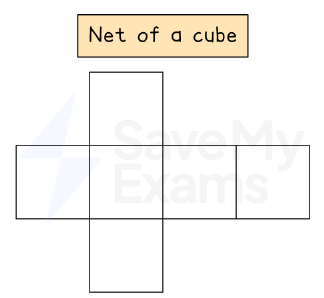
Example: Problem Solving with a Cube Net
- Cube net has 14 edges; perimeter = 14x cm. Net has 6 faces; area = 6x² cm².
- Volume of cube = x³ cm³. Difference (volume − surface area) = 8 × perimeter → x³ − 6x² = 112x → x³ − 6x² − 112x = 0.
- Factor out x (x ≠ 0): x(x² − 6x − 112) = 0 → x² − 6x − 112 = 0. Solve: x = 14 or x = −8 (reject). Volume = 14³ = 2744 cm³.
Net of a cube
Common Pitfalls & Tips
- Always read the question to see what is asked (angle, perimeter, area, etc.).
- For surface area/volume, check the formula sheet provided in the exam.
- When forming equations, double‑check that the algebraic expression matches the wording (e.g., '5 less than x' is x − 5, not 5 − x).
- If you get a quadratic, ensure you have '= 0' before solving; discard extraneous solutions based on context.
슬라이드
연습 문제
무료 미리 보기 — 32개 중 8개 문제. 가입하면 전부 볼 수 있어요.
1.Which expression represents '5 less than twice a number x'?
Easy- A2x - 5
- B5 - 2x
- C2(x - 5)
- D2x + 5
2.The perimeter of a rectangle is 30 cm. Its length is 9 cm. Which equation finds its width w?
Easy- A2(9 + w) = 30
- B9 + w = 30
- C2(9) + w = 30
- D9w = 30
3.The sum of three consecutive integers is 36. If the smallest is x, which equation represents this?
Easy- Ax + (x+1) + (x+2) = 36
- Bx + (x+1) + (x+3) = 36
- Cx + (x+2) + (x+4) = 36
- D3x = 36
4.A triangle has angles x°, (x+10)° and (x+20)°. Find x.
Medium- A50
- B60
- C70
- D40
5.The length of a rectangle is 3 cm more than its width. Its area is 40 cm². If the width is w cm, which equation finds w?
Medium- Aw(w+3) = 40
- Bw + (w+3) = 40
- C2w + 2(w+3) = 40
- Dw(w-3) = 40
6.Julie multiplies a number by 5 and adds 4. Liam subtracts the number from 10. Julie's answer is two thirds of Liam's answer. Find the number.
Medium- A8/17
- B1
- C2
- D4
7.A cuboid has dimensions x cm, (x+2) cm, and (x+3) cm. Its volume is less than 900 cm³. Show that x ≤ 5. Which inequality represents this?
Hard- Ax(x+2)(x+3) < 900
- Bx(x+2)(x+3) ≤ 900
- Cx + (x+2) + (x+3) < 900
- Dx(x+2)(x+3) > 900
8.If 3x + 7 = 22, what is the value of x?
Easy- A5
- B6
- C7
- D8