Transformations
플레이하며 배우기
이 문제들을 풀어 에너지를 얻은 뒤 낚시하고 탐험하세요. 계정이 필요 없어요.
수업 노트
Translations
- A translation moves a shape without changing its size or orientation; object and image are congruent.
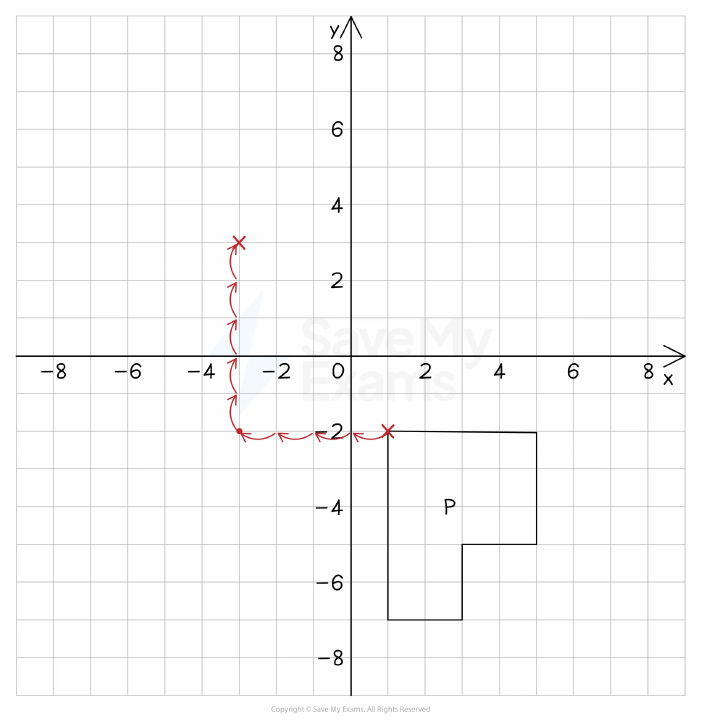
- Movement is described by a column vector \begin{pmatrix} x \\ y \end{pmatrix}: x = horizontal shift (right positive, left negative), y = vertical shift (up positive, down negative).
- To translate a shape, move each vertex by the vector and join the new vertices.
- To describe a translation, state it is a translation and give the vector (e.g., \begin{pmatrix} 2 \\ -3 \end{pmatrix}).
- To reverse a translation, use the same vector with both signs changed.
The object shape and its image after a translation
Reflections
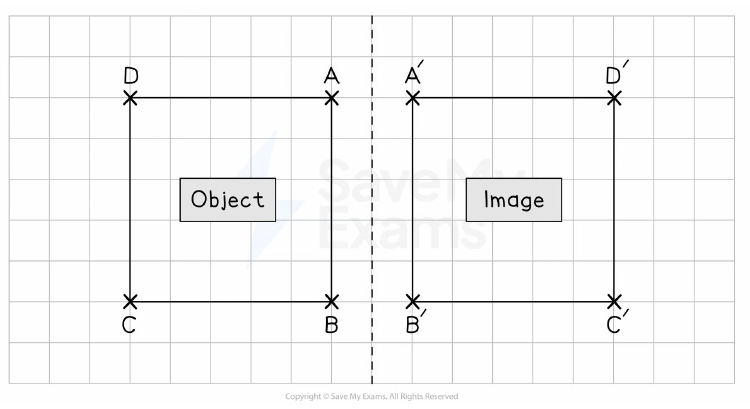
- A reflection flips a shape across a mirror line (line of reflection); object and image are congruent.
- Each point and its image are equidistant from the mirror line, measured perpendicularly.
- Points on the mirror line are invariant (do not move).
- Common mirror lines: vertical x = k, horizontal y = k, diagonal y = x or y = -x.
- To describe a reflection, state it is a reflection and give the equation of the mirror line.
- To reverse a reflection, apply the same reflection again.
Reflecting a shape in a mirror line
Rotations
- A rotation turns a shape about a fixed centre of rotation; object and image are congruent.
- You must specify the centre, angle (90°, 180°, 270°) and direction (clockwise or anticlockwise). For 180° direction is not needed.
- Use tracing paper: draw the shape, place pencil on centre, rotate by the given angle, then draw the image.
- To find the centre of rotation for 90° or 270°, use trial and error with tracing paper. For 180°, draw lines connecting corresponding vertices; they intersect at the centre.
- To reverse a rotation, rotate by the same angle in the opposite direction about the same centre.
Clockwise and anticlockwise rotation

Enlargements
- An enlargement changes the size of a shape by a scale factor (SF) about a centre of enlargement (CoE).
- If SF > 1, image is larger; if 0 < SF < 1, image is smaller (fractional enlargement).
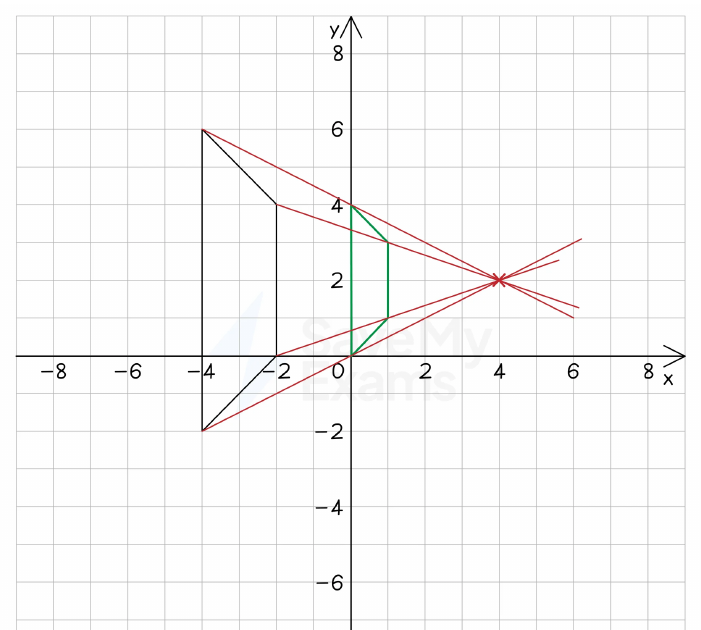
- For a positive SF, measure horizontal and vertical distances from CoE to a vertex, multiply by SF, and count from CoE to find the image vertex.
- For a negative SF, the image is rotated 180° and lies on the opposite side of the CoE; distances are multiplied by |SF|.
- To describe an enlargement, state it is an enlargement, give the SF and the coordinates of the CoE.
- To reverse an enlargement, use the reciprocal SF with the same CoE (sign stays for negative SF).
- Area scale factor = (linear SF)²; multiply original area by this to find image area.
Describing an enlargement
Combined Transformations
- When two or more transformations are applied sequentially, the final image can often be described by a single transformation.
- To find the single transformation, consider the net effect on position, orientation and size.
- Common combinations: rotation + translation can sometimes be a single rotation about a different centre; two reflections can be a rotation or translation.
슬라이드
연습 문제
무료 미리 보기 — 45개 중 8개 문제. 가입하면 전부 볼 수 있어요.
1.What is the name of the transformation that moves a shape without changing its size or orientation?
Easy- ATranslation
- BReflection
- CRotation
- DEnlargement
2.A shape is translated by the vector \begin{pmatrix} -3 \\ 5 \end{pmatrix}. What does this mean?
Easy- A3 left and 5 up
- B3 right and 5 down
- C3 left and 5 down
- D3 right and 5 up
3.What is the equation of the mirror line for a reflection that maps a point (2, 3) to (-2, 3)?
Easy- Ax = 0
- By = 0
- Cx = 2
- Dy = 3
4.A rotation turns a shape. Which of the following is NOT needed to fully describe a rotation?
Easy- AScale factor
- BCentre of rotation
- CAngle of rotation
- DDirection of rotation
5.An enlargement has scale factor 0.5. What does this do to the size of the shape?
Easy- AMakes it smaller
- BMakes it larger
- CKeeps it the same size
- DFlips it over
6.When describing a translation, what must you include?
Easy- AA column vector
- BA mirror line
- CA centre of rotation
- DA scale factor
7.Triangle A has vertices (1, 2), (3, 2), (1, 5). It is translated by vector \begin{pmatrix} -2 \\ 4 \end{pmatrix}. What are the coordinates of the image of vertex (1, 2)?
Medium- A(-1, 6)
- B(3, -2)
- C(-1, -2)
- D(3, 6)
8.A shape is reflected in the line y = 2. Which of the following points is invariant?
Medium- A(3, 2)
- B(2, 3)
- C(0, 0)
- D(1, 1)