Electromagnetic Effects
플레이하며 배우기
이 문제들을 풀어 에너지를 얻은 뒤 낚시하고 탐험하세요. 계정이 필요 없어요.
수업 노트
Electromagnetic Induction
- An e.m.f. is induced in a conductor when there is relative movement between the conductor and a magnetic field (conductor moves in stationary field OR conductor stationary in changing field).
- If the conductor is part of a complete circuit, an induced current flows.
- Lenz's law (Extended): The direction of the induced e.m.f. always opposes the change causing it (e.g., induced magnetic field repels approaching magnet).
- Right-hand dynamo rule (Extended): First finger = Field, thuMb = Motion, seCond = Current (direction of induced e.m.f.).
- Factors increasing induced e.m.f.: faster motion, more turns on coil, stronger magnet, larger coil area.
Demonstrating Induction
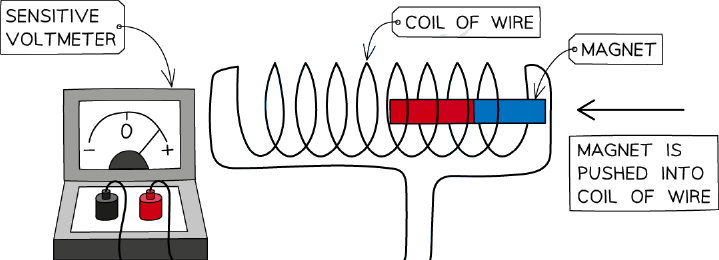
- Experiment 1: Move a bar magnet in/out of a coil connected to a sensitive voltmeter. Stationary → zero reading; moving in → deflection; moving out → opposite deflection.
- Experiment 2: Move a wire between magnetic poles, connected to a voltmeter. Stationary → zero; moving → deflection; reverse direction → opposite deflection.
- Induced e.m.f. only occurs while there is relative motion (cutting field lines).
- Factors increasing induced e.m.f.: faster movement, more turns, stronger magnet, longer wire (for wire experiment).
Setup for demonstrating electromagnetic induction with a coil, magnet, and sensitive voltmeter.
The A.C. Generator
- An a.c. generator converts mechanical energy to electrical energy using a rotating coil in a magnetic field.
- Components: permanent magnet, rotating coil, slip rings and carbon brushes to connect to external circuit.
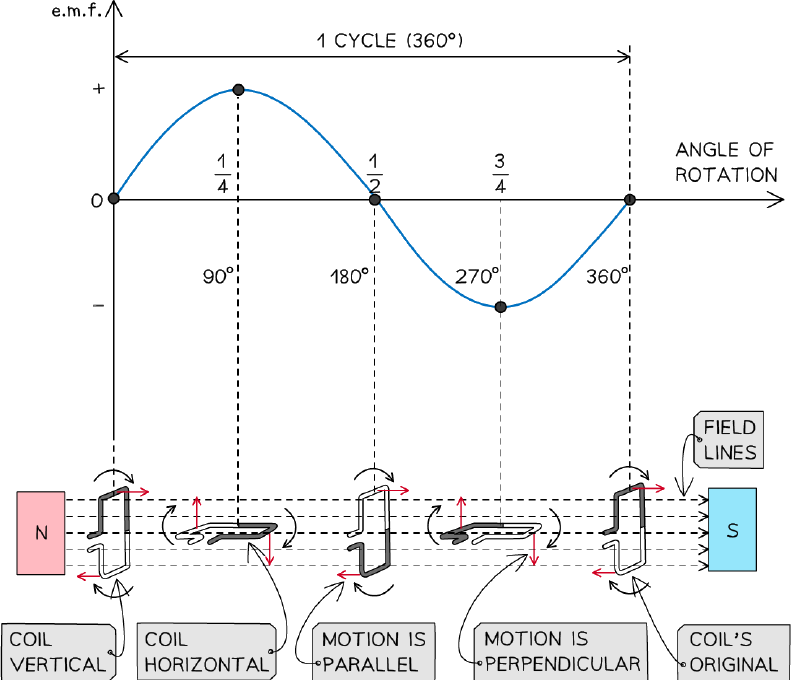
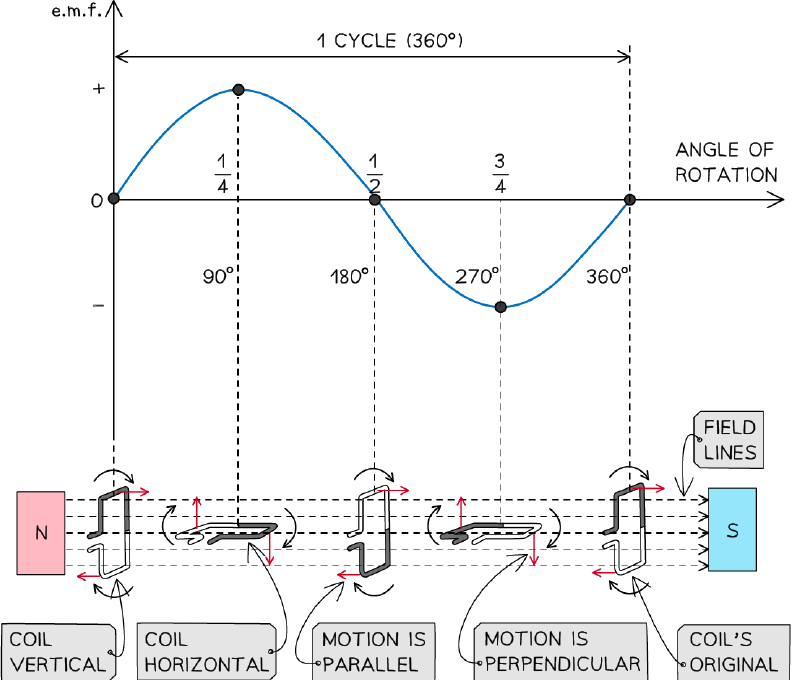
- As the coil rotates, it cuts field lines, inducing an alternating e.m.f. (and current).
- Maximum e.m.f. when coil is parallel to field (moving perpendicular); zero e.m.f. when coil is perpendicular to field (moving parallel).
- Output graph is a sine/cosine wave; frequency equals rotation frequency.
- To increase maximum e.m.f.: increase rotation speed, more turns, stronger magnet, add soft iron core.
The relationship between the rotation of a coil in a magnetic field and the induced e.m.f. in an AC generator
Magnetic Effect of a Current
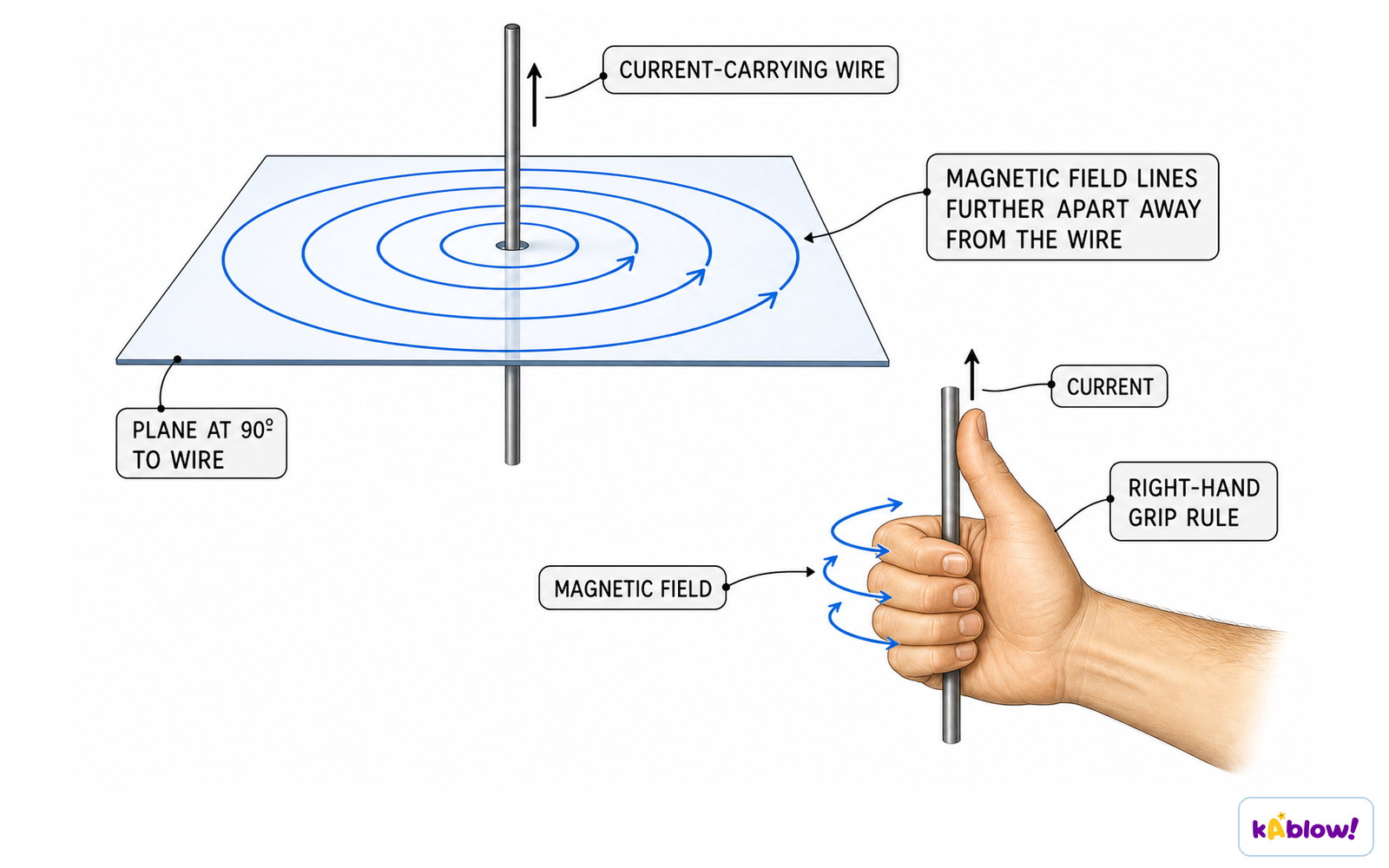
- A current-carrying wire produces a magnetic field of concentric circles around the wire.
- Right-hand grip rule: Thumb points in current direction; curled fingers show field direction.
- A solenoid (coiled wire) produces a field similar to a bar magnet (one end north, other south).
- Field strength increases with larger current, more turns, and inserting a soft iron core (electromagnet).
- Applications: relay circuits (electromagnet switches a second circuit), electric bells, loudspeakers (motor effect).
Magnetic field around a current-carrying wire, shown with the right-hand grip rule.
Force on a Current-Carrying Conductor
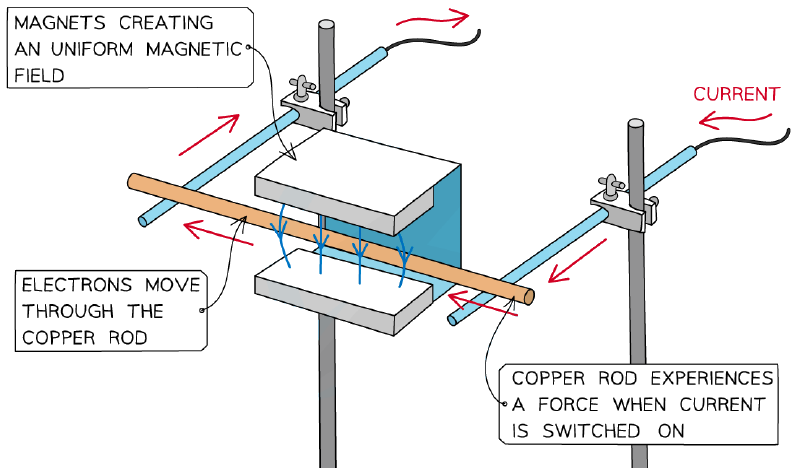
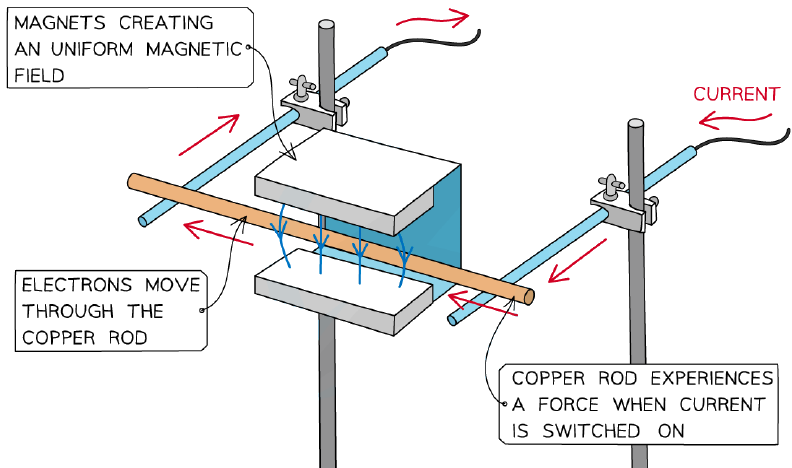
- A current-carrying conductor in a magnetic field experiences a force (motor effect) if current is perpendicular to field.
- Fleming's left-hand rule: Thumb = Force (Thrust), First finger = Field, Second finger = Current.
- Reversing current or magnetic field reverses the force direction.
- Charged particles (e.g., electrons) in a magnetic field also experience a force, deflecting perpendicular to both velocity and field.
A copper rod experiencing a force when current is switched on in a magnetic field.
Electric Motors
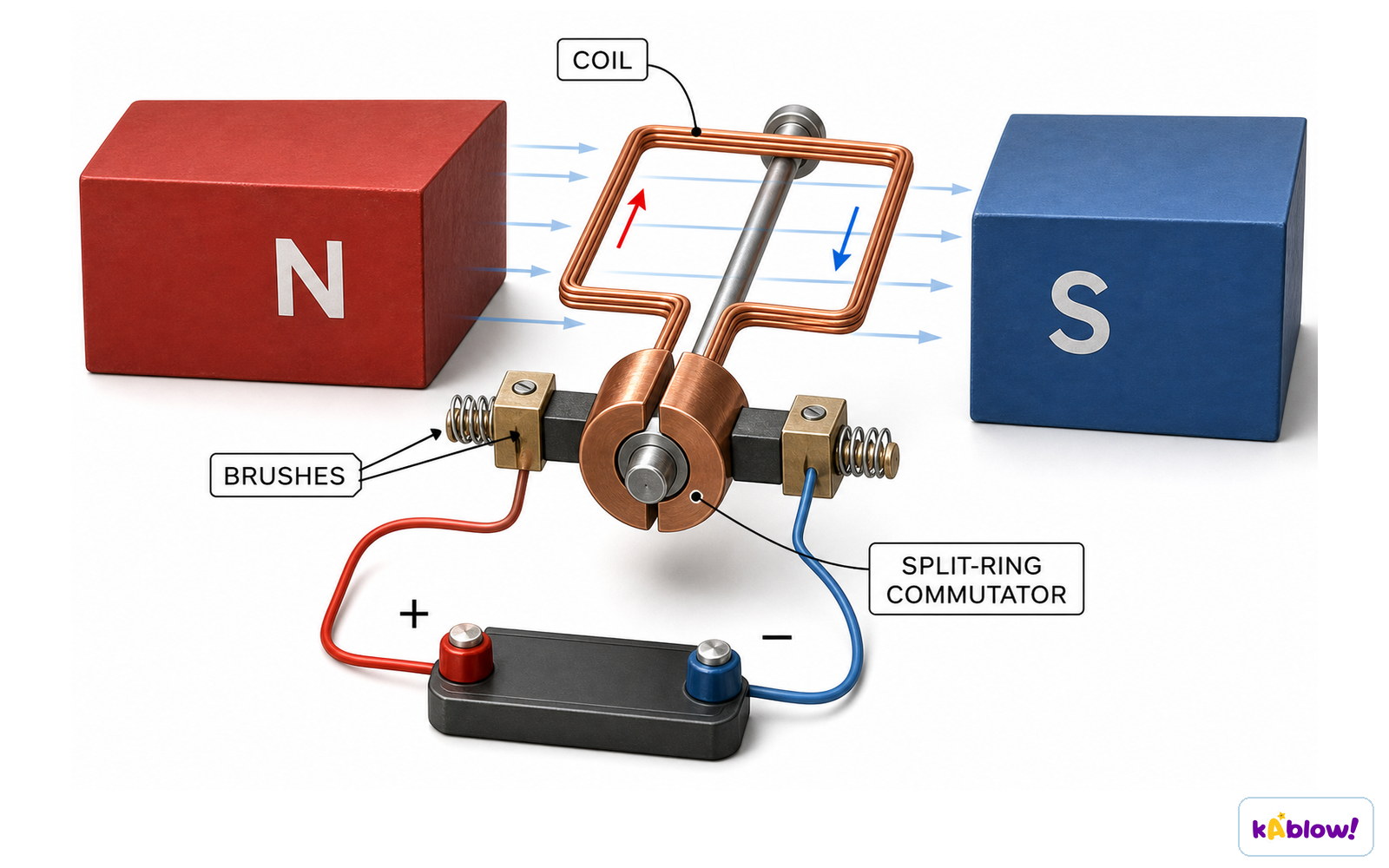
- A d.c. motor uses the motor effect to rotate a coil continuously.
- Components: coil in magnetic field, split-ring commutator and carbon brushes connected to a d.c. supply.
- The split-ring commutator reverses current every half turn, so the coil rotates in the same direction.
- Forces on opposite sides of the coil are opposite, causing rotation.
- To increase speed/turning effect: increase current, stronger magnet, more turns on coil.
- To reverse rotation: reverse current direction or magnetic field.
Structure of a simple d.c. motor, showing the coil, split-ring commutator, carbon brushes and magnetic field.
Transformers
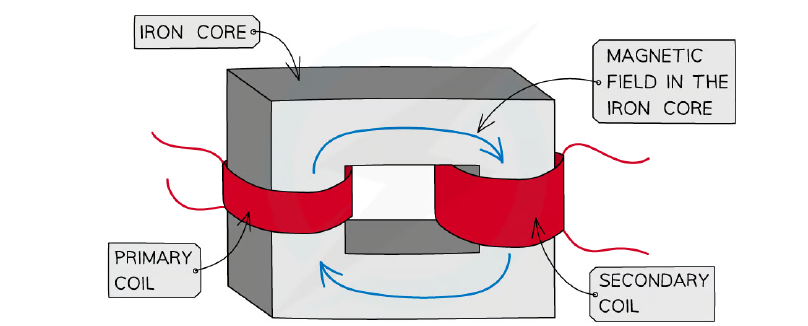
- A transformer changes the size of an alternating voltage using electromagnetic induction.
- Structure: primary coil, secondary coil, and a soft iron core (easily magnetised).
- Step-up transformer: more turns on secondary than primary → increases voltage (Vs > Vp).
- Step-down transformer: fewer turns on secondary than primary → decreases voltage (Vs < Vp).
- Transformer equation: Vp / Vs = Np / Ns (where N = number of turns).
- High-voltage transmission reduces energy loss (lower current for same power, less heating in wires).
Structure of a simple transformer, showing the primary coil, secondary coil, soft iron core and the magnetic field linking them.
슬라이드
연습 문제
무료 미리 보기 — 45개 중 8개 문제. 가입하면 전부 볼 수 있어요.
1.Which of the following metals can be permanently magnetised?
Easy- AAluminium
- BCopper
- CSteel
- DTungsten
2.What is the name of the component in a transformer that is made of soft iron?
Easy- APrimary coil
- BSecondary coil
- CCore
- DInsulation
3.In a simple a.c. generator, what is the function of the slip rings?
Medium- ATo reverse the current every half turn
- BTo allow the coil to rotate continuously
- CTo provide a uniform magnetic field
- DTo connect the coil to the external circuit
4.A transformer has 100 turns on the primary coil and 500 turns on the secondary coil. The input voltage is 20 V. What is the output voltage?
Medium- A4 V
- B100 V
- C500 V
- D1000 V
5.Which change would increase the strength of an electromagnet?
Easy- ADecreasing the current in the coil
- BRemoving the iron core
- CIncreasing the number of turns on the coil
- DUsing a shorter wire
6.A coil is connected to a sensitive voltmeter. A bar magnet is pushed into the coil and then held stationary inside it. What does the voltmeter show?
Medium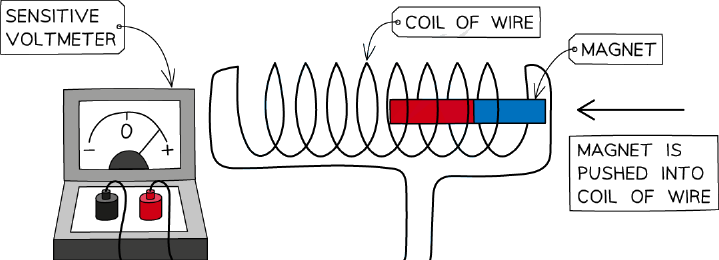
- AA constant deflection while the magnet moves, then zero
- BA deflection only while the magnet is moving
- CNo deflection at any time
- DA constant deflection while the magnet is stationary inside
7.In a d.c. motor, what is the purpose of the split-ring commutator?
Medium- ATo increase the magnetic field strength
- BTo reverse the direction of the current in the coil every half turn
- CTo connect the coil to the power supply continuously
- DTo reduce friction
8.A wire carrying a current is placed in a magnetic field. The direction of the force on the wire can be found using:
Easy- AFleming's right-hand rule
- BFleming's left-hand rule
- CThe right-hand grip rule
- DLenz's law