Binary numbers: counting in base two
플레이하며 배우기
이 문제들을 풀어 에너지를 얻은 뒤 낚시하고 탐험하세요. 계정이 필요 없어요.
교육자를 위해: Binary numbers: counting in base two(KS3 Computing, Computer Systems)을(를) 위한 바로 쓸 수 있는 수업 슬라이드, 복습 노트 — 수업에 사용하거나, 학습자들이 실시간 게임으로 즐기는 인터랙티브 클래스 활동으로 진행하세요.
수업 노트
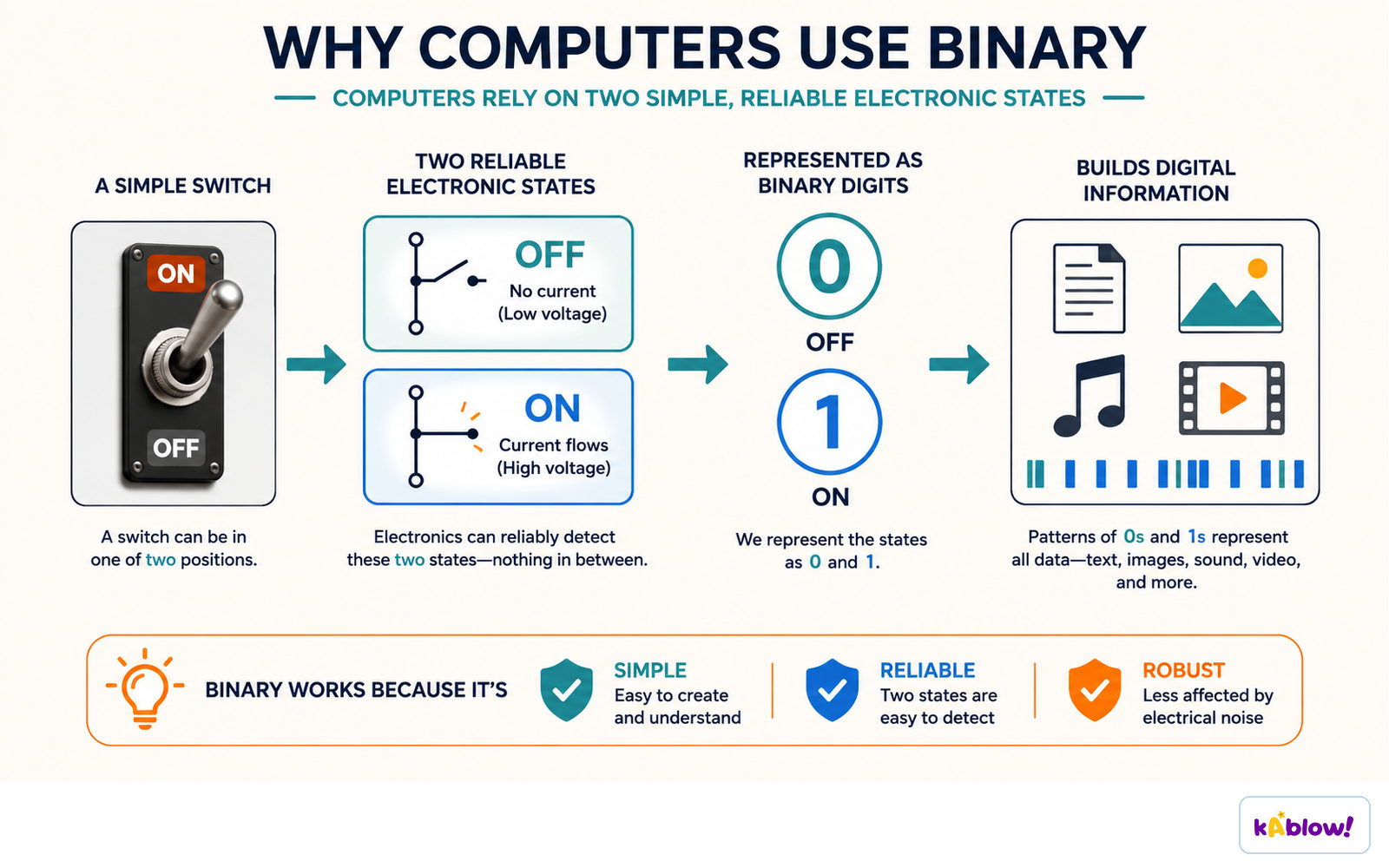
Why Computers Use Binary
- Computers use binary because their electronic circuits are two-state devices (on/off).
- Binary uses only two symbols: 0 and 1.
- This simplicity makes binary noise-immune and easy to implement with logic gates.
- Almost all modern computers and devices use the binary system.
Computers use binary because a switch has two reliable states, easy to detect and hard to confuse.
Place Value in Base Two
- Binary is a positional notation with a radix (base) of 2.
- Each digit in a binary number is called a bit (binary digit).
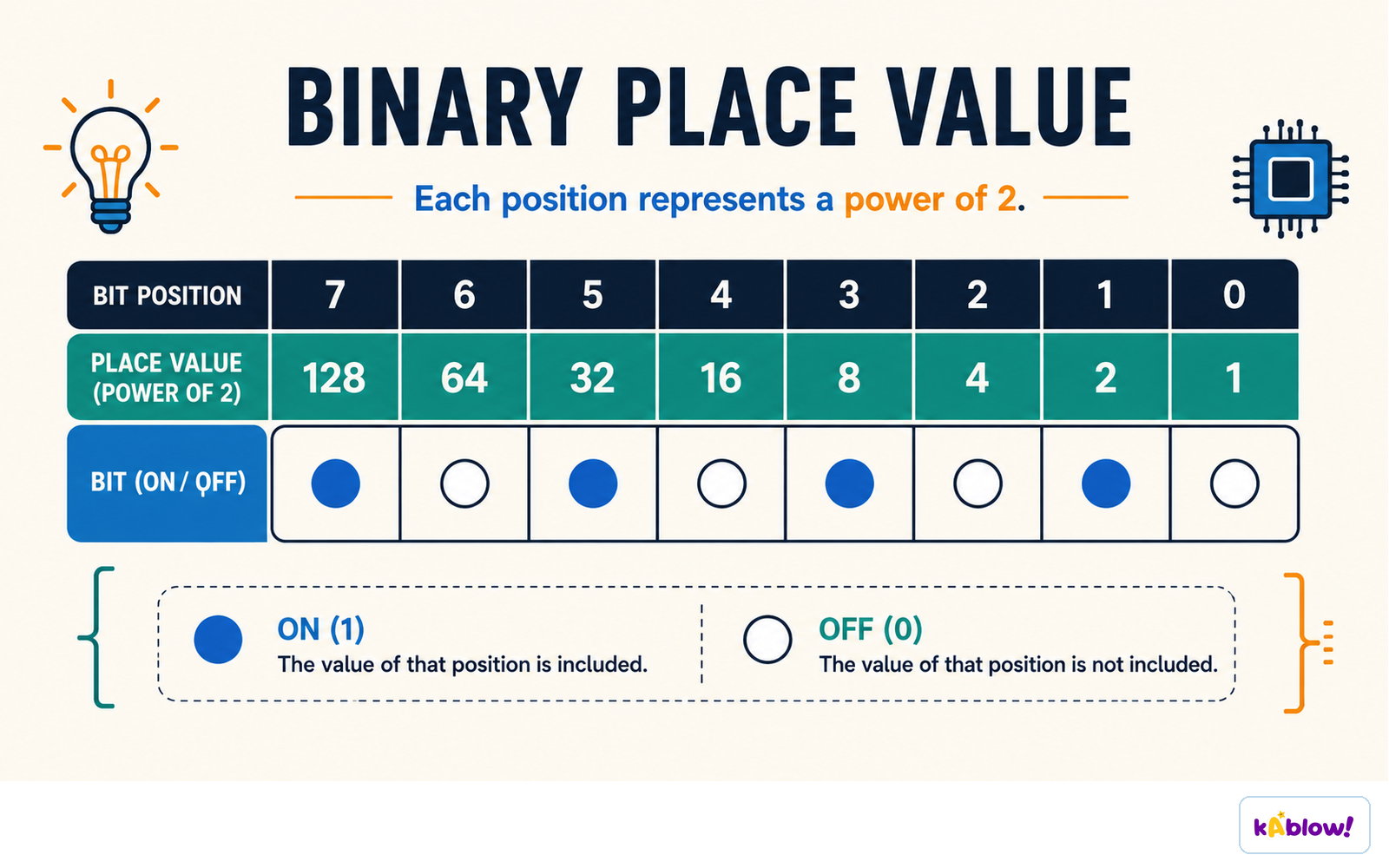
- In base two, each position represents a power of 2 (from right to left: 1, 2, 4, 8, 16, ...).
- The rightmost bit is the least significant bit (20 = 1).
- The leftmost bit is the most significant bit (highest power of 2).
In an 8-bit number each position is a power of two, from 128 down to 1.
Counting in Binary
- Counting in binary follows the same pattern as decimal, but only uses digits 0 and 1.
- When you reach 1, the next number is 10 (binary for 2).
- Binary sequence: 0, 1, 10, 11, 100, 101, 110, 111, ...
- Each time you add 1, you carry over to the next place when a bit becomes 2 (which is not allowed).
- With n bits, you can represent numbers from 0 to 2n - 1.
Bits, Nibbles, and Bytes
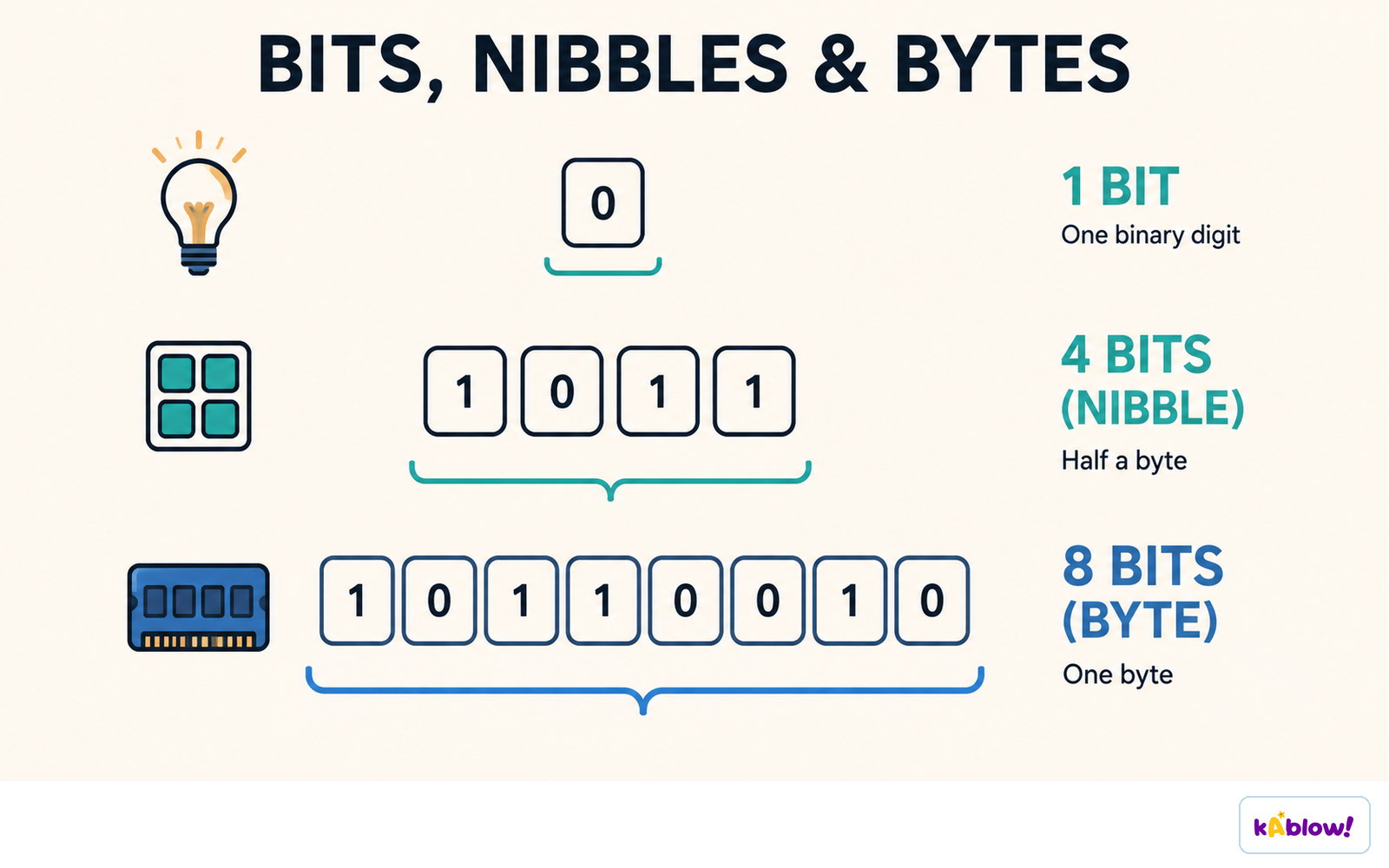
- A bit is a single binary digit (0 or 1).
- A nibble is a group of 4 bits (can represent 16 values, 0-15).
- A byte is a group of 8 bits (can represent 256 values, 0-255).
- Bytes are the standard unit for storing data in computers.
One binary digit is a bit, four bits are a nibble, and eight bits are a byte.
Converting Binary to Decimal
- To convert binary to decimal, multiply each bit by its place value (power of 2) and sum the results.
- Example: 1011₂ = 1×8 + 0×4 + 1×2 + 1×1 = 11₁₀.
- Start from the rightmost bit (20) and move left, doubling the place value each time.
- Practice with small numbers: 1101₂ = 13₁₀, 10000₂ = 16₁₀.
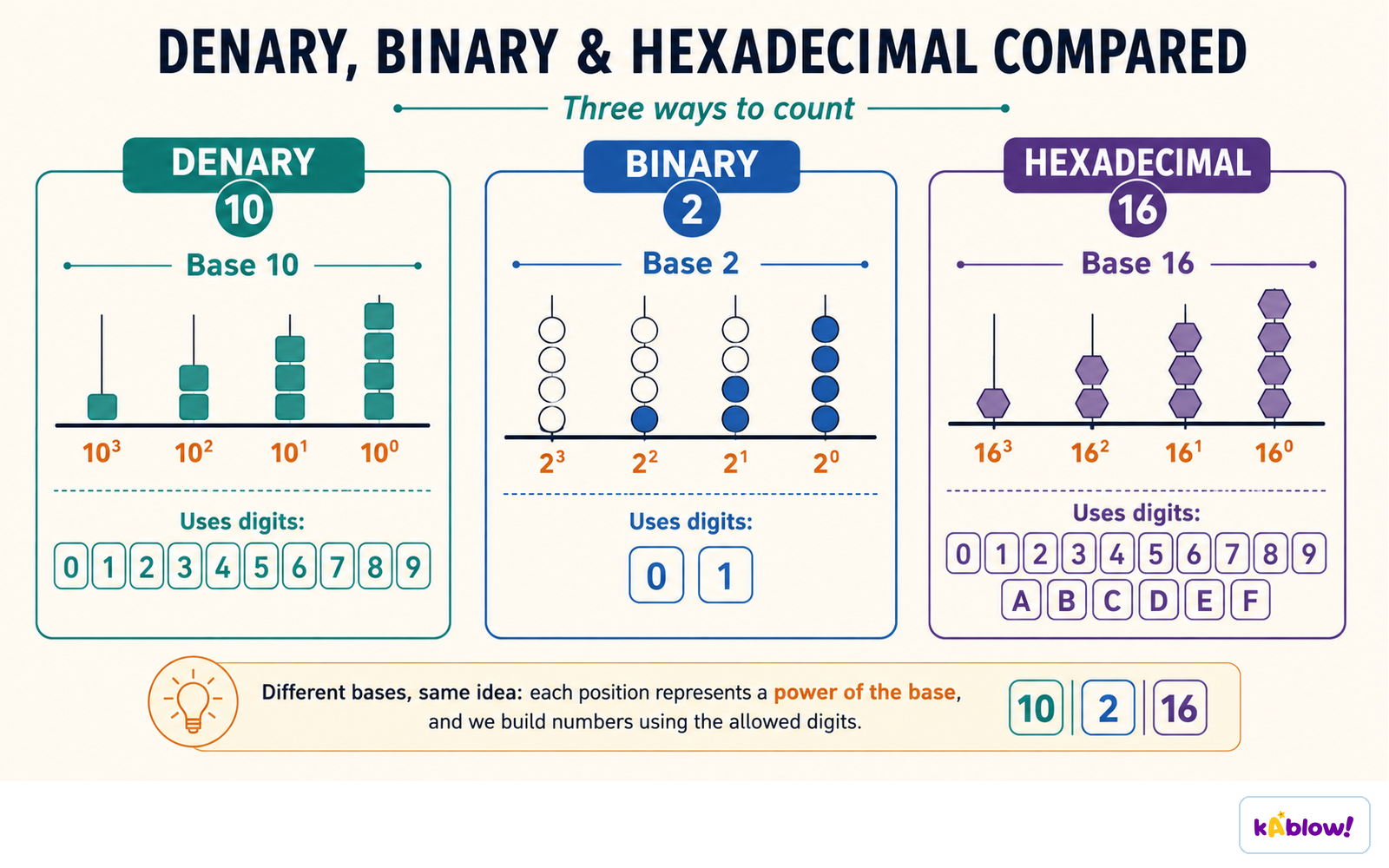
Denary, binary and hexadecimal are three ways to count: the same idea in a different base.
Historical Context
- The modern binary system was studied by Gottfried Leibniz in the 17th century.
- Earlier cultures used binary-like systems: ancient Egypt (Horus-Eye fractions), China (I Ching), India (Pingala's prosody).
- Ancient Egyptian multiplication used a method related to binary numbers.
- The I Ching uses trigrams and hexagrams that resemble binary numerals.
슬라이드
연습 문제
무료 미리 보기 — 58개 중 8개 문제. 가입하면 전부 볼 수 있어요.
1.A binary number system uses only the digits 0 and 1.
EasyTrue or false?
2.In the binary system, each digit is called a 'byte'.
EasyTrue or false?
3.Why do computers use the binary system?
Easy- ABecause it is easier for humans to read
- BBecause it is simple to implement in digital electronic circuitry
- CBecause it uses fewer digits than decimal
- DBecause it was invented by Charles Babbage
4.In binary, the place values are powers of 2 (1, 2, 4, 8, ...).
EasyTrue or false?
5.Which of the following is the correct binary representation of the decimal number 5?
Medium- A101
- B110
- C100
- D011
6.In binary, the number 1000 is equivalent to the decimal number 8.
MediumTrue or false?
7.Arrange the following binary numbers in increasing order of their decimal values.
Easy- 101
- 11
- 1000
- 110
8.Match each binary number to its decimal equivalent.
Medium- 1010
- 1100
- 1001
- 9
- 10
- 12
기출 문제
이 주제의 기출 문제 연습이 곧 나와요.
곧 출시