Life processes and unicellular organisms
플레이하며 배우기
이 문제들을 풀어 에너지를 얻은 뒤 낚시하고 탐험하세요. 계정이 필요 없어요.
교육자를 위해: Life processes and unicellular organisms(KS3 Science, Biology)을(를) 위한 바로 쓸 수 있는 수업 슬라이드, 복습 노트 — 수업에 사용하거나, 학습자들이 실시간 게임으로 즐기는 인터랙티브 클래스 활동으로 진행하세요.
수업 노트
Life Processes (MRS GREN)
- All living organisms perform seven life processes, remembered by the acronym MRS GREN.
- Movement: All living things move; plants grow towards light, animals move to find food or escape danger.
- Respiration: A chemical reaction that releases energy stored in glucose.
- Sensitivity: Living things sense changes in their environment and respond (e.g., humans feel heat, plants grow towards light).
- Growth: Organisms increase in size; unicellular organisms grow by increasing cell size, multicellular by producing more cells.
- Reproduction: The process of producing offspring.
- Excretion: The removal of waste products from the body.
- Nutrition: Plants photosynthesise; animals eat plants or other animals.
Unicellular Organisms
- Unicellular organisms are living organisms made of just one cell.
- Despite their small size, they perform all seven life processes.
- Examples include bacteria, euglena, amoebas, and yeast (a fungus).
Bacteria
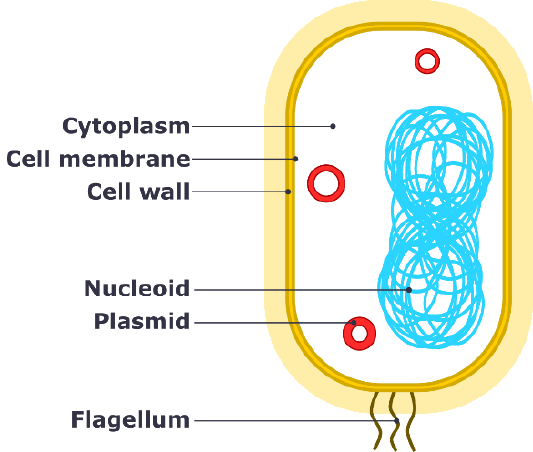
- Bacteria are some of the most common and diverse unicellular organisms.
- They do not have a nucleus; genetic material is located in the nucleoid and plasmids.
- Some bacteria have a long tail called a flagellum for movement.
- Bacteria have a cell wall, cell membrane, and ribosomes.
Structure of a bacterium
Euglena
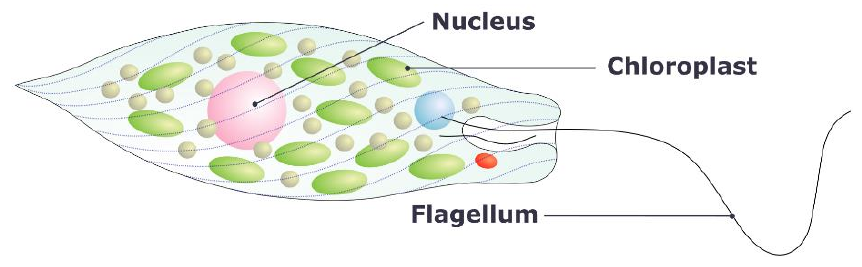
- Euglena is a unicellular organism found in water.
- It has a flagellum to help it swim.
- It contains chloroplasts for photosynthesis.
Structure of Euglena
Other Unicellular Organisms
- Amoebas are unicellular organisms that move and feed using pseudopods.
- Yeast is a unicellular fungus used in baking and brewing.
슬라이드
연습 문제
무료 미리 보기 — 26개 중 8개 문제. 가입하면 전부 볼 수 있어요.
1.How many life processes do all living organisms perform?
Easy- ASeven
- BFive
- CSix
- DEight
2.Which of the following is NOT a life process?
Easy- APhotosynthesis
- BRespiration
- CExcretion
- DSensitivity
3.Which statement about unicellular organisms is correct?
Easy- AThey are made of one cell and perform all life processes.
- BThey are made of many cells and perform only some life processes.
- CThey are made of one cell and perform only some life processes.
- DThey are made of many cells and perform all life processes.
4.Which of the following is an example of a unicellular organism?
Easy- ABacterium
- BHuman
- COak tree
- DMushroom
5.Bacteria do not have a nucleus. Where is their genetic material located?
Easy- AIn the nucleoid and plasmids
- BIn the nucleus
- CIn the cytoplasm
- DIn the cell wall
6.What is the function of the flagellum in some bacteria?
Easy- AMovement
- BRespiration
- CReproduction
- DNutrition
7.Euglena is a unicellular organism that can photosynthesise. Which organelle allows it to do this?
Easy- AChloroplast
- BMitochondrion
- CNucleus
- DFlagellum
8.A student observes a unicellular organism under a microscope. It has a flagellum and chloroplasts. Which organism is it most likely to be?
Medium- AEuglena
- BAmoeba
- CYeast
- DBacterium
기출 문제
이 주제의 기출 문제 연습이 곧 나와요.
곧 출시