Alkali metals
플레이하며 배우기
이 문제들을 풀어 에너지를 얻은 뒤 낚시하고 탐험하세요. 계정이 필요 없어요.
교육자를 위해: Alkali metals(KS3 Science, Chemistry)을(를) 위한 바로 쓸 수 있는 수업 슬라이드, 복습 노트, 다이어그램 — 수업에 사용하거나, 학습자들이 실시간 게임으로 즐기는 인터랙티브 클래스 활동으로 진행하세요.
수업 노트
Properties of Alkali Metals
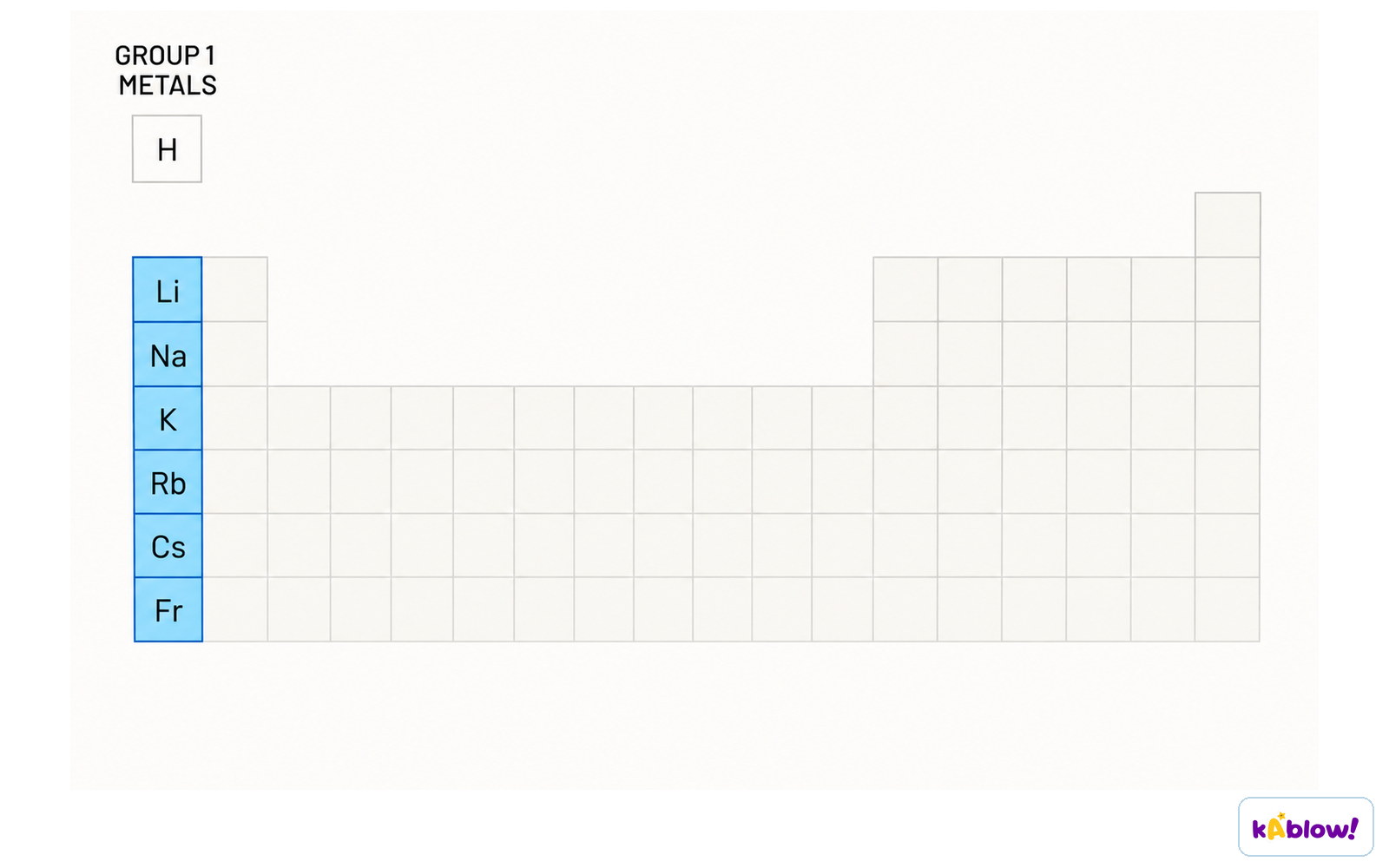
- Alkali metals are in Group 1 of the periodic table.
- They have low melting points and are soft enough to be cut with a knife.
- They have low densities and are very reactive.
- They are stored in oil to prevent contact with air and water.
Alkali metals occupy the far-left column; hydrogen is not presented as a Group 1 metal.
Trends Down Group 1
- Reactivity increases as you go down the group.
- Melting points decrease as you go down the group.
- Lithium is less reactive than potassium; caesium is even more reactive.
Reaction with Water
- Alkali metals react strongly with water.
- The general word equation: alkali metal + water → metal hydroxide + hydrogen.
- The metal hydroxides are alkaline (pH > 7).
- Reactions become more fierce down the group.
Examples of Reactions
- Lithium + water → lithium hydroxide + hydrogen (fizzes).
- Potassium + water → potassium hydroxide + hydrogen (ignites hydrogen).
- Caesium + water → caesium hydroxide + hydrogen (very vigorous).
Safety Precautions
- Demonstrations should be behind a safety screen.
- Only small amounts of alkali metal should be used.
- Keep alkali metals stored in oil.
Bohr model of a sodium atom (alkali metal) showing electron configuration 2.8.1.
Particle arrangement in solids, liquids, and gases. Alkali metals are solid at room temperature (except mercury).
슬라이드
연습 문제
무료 미리 보기 — 60개 중 8개 문제. 가입하면 전부 볼 수 있어요.
1.Which group of the periodic table are the alkali metals in?
Easy- AGroup 1
- BGroup 2
- CGroup 7
- DGroup 0
2.Which of the following is a property of alkali metals?
Easy- AThey have low melting points.
- BThey have high melting points.
- CThey are very unreactive.
- DThey are hard and cannot be cut with a knife.
3.What is the pH of an alkaline solution?
Easy- AGreater than 7
- BEqual to 7
- CLess than 7
- DExactly 7
4.Why are alkali metals stored in oil?
Easy- ATo keep air and water away from them
- BTo keep them cool
- CTo make them easier to cut
- DTo increase their reactivity
5.Complete the word equation: alkali metal + water → ?
Easy- Ametal hydroxide + hydrogen
- Bmetal oxide + hydrogen
- Cmetal hydroxide + oxygen
- Dmetal oxide + water
6.When lithium reacts with water, what causes the fizzing?
Easy- ARelease of hydrogen gas
- BRelease of oxygen gas
- CFormation of lithium hydroxide
- DIgnition of the metal
7.As you go down group 1, how does the reactivity of alkali metals change?
Easy- AReactivity increases
- BReactivity decreases
- CReactivity stays the same
- DReactivity first increases then decreases
8.Which alkali metal has a stronger reaction with water: lithium or potassium?
Easy- APotassium
- BLithium
- CThey react equally
- DNeither reacts
기출 문제
이 주제의 기출 문제 연습이 곧 나와요.
곧 출시