Changes of state
플레이하며 배우기
이 문제들을 풀어 에너지를 얻은 뒤 낚시하고 탐험하세요. 계정이 필요 없어요.
교육자를 위해: Changes of state(KS3 Science, Chemistry)을(를) 위한 바로 쓸 수 있는 수업 슬라이드, 복습 노트, 다이어그램 — 수업에 사용하거나, 학습자들이 실시간 게임으로 즐기는 인터랙티브 클래스 활동으로 진행하세요.
수업 노트
Conservation of Mass
- During a state change, the number of particles stays the same.
- The mass before a state change equals the mass after – this is conservation of mass.
- No particles are lost or gained; only their arrangement and energy change.
Particle Model of Solids
- Particles are held together in a regular pattern.
- They vibrate around fixed positions.
- Heating increases vibrations until the melting point is reached.
- Example: melting point of water is 0°C.
Melting (Solid → Liquid)
- At the melting point, temperature stays constant while melting occurs.
- Particles break free from fixed positions but remain in contact.
- Once fully melted, particles can move past each other (liquid state).
Boiling (Liquid → Gas)
- Heating a liquid makes particles move faster until the boiling point.
- At boiling point, particles gain enough energy to separate from each other.
- Gas particles are far apart and move quickly in random directions.
- Example: boiling point of water is 100°C.
Condensation (Gas → Liquid)
- Cooling a gas to its boiling point causes it to condense into a liquid.
- Particles lose energy and come closer together.
Freezing (Liquid → Solid)
- Cooling a liquid to its melting point causes it to freeze into a solid.
- Particles become fixed in a regular pattern.
Sublimation and Deposition
- Sublimation: solid changes directly into a gas (e.g., dry ice).
- Deposition: gas changes directly into a solid (e.g., frost formation).
Summary of State Changes
- Solid → Liquid: melting
- Liquid → Gas: boiling/evaporation
- Gas → Liquid: condensation
- Liquid → Solid: freezing
- Solid → Gas: sublimation
- Gas → Solid: deposition
Heating drives melting, boiling, evaporation and sublimation; cooling reverses them through freezing, condensation and deposition.
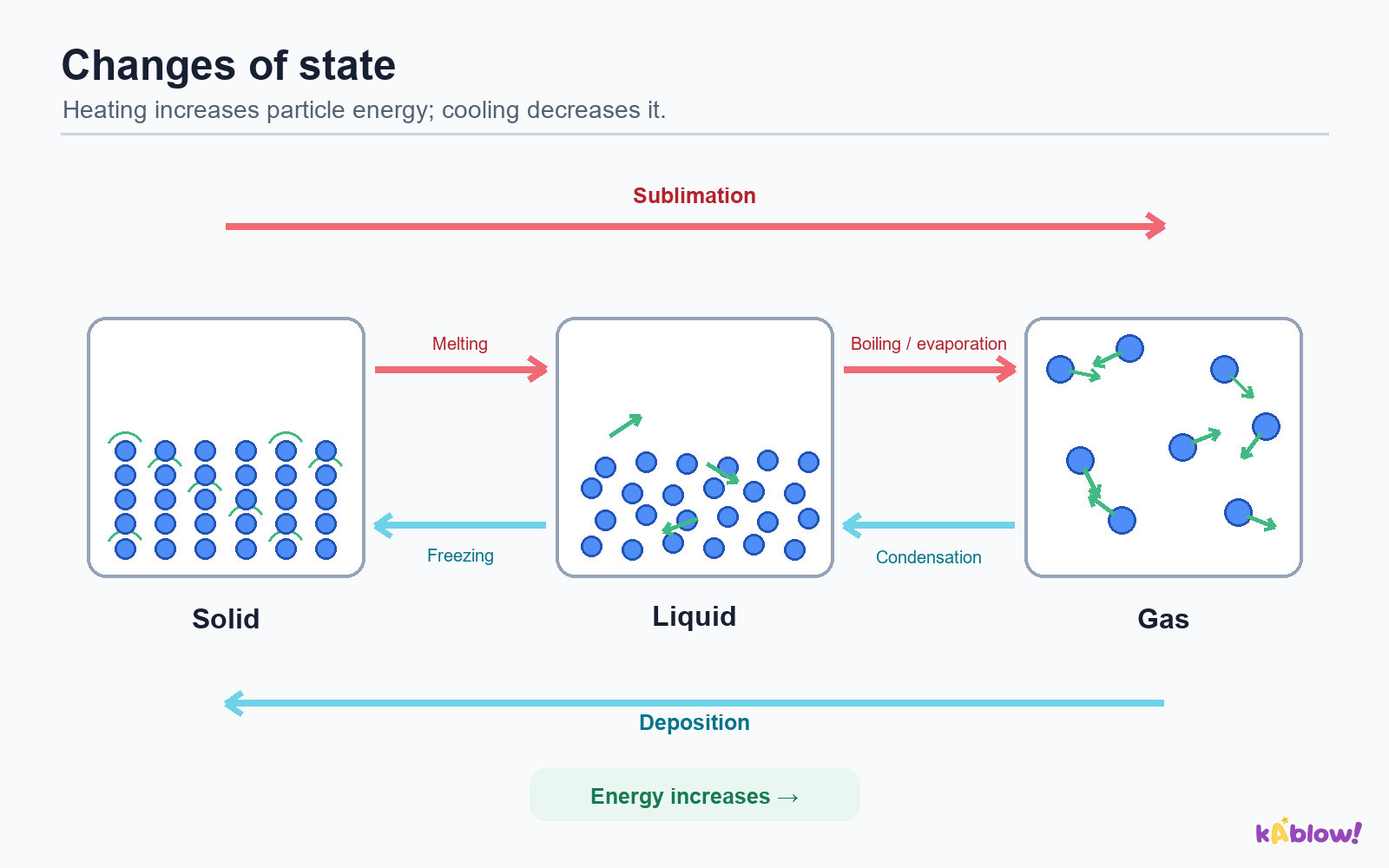
Particle arrangements in the three states
슬라이드
연습 문제
무료 미리 보기 — 40개 중 8개 문제. 가입하면 전부 볼 수 있어요.
1.What is meant by the conservation of mass during a change of state?
Easy- AThe total number of particles remains the same, so mass does not change.
- BMass is lost when a solid melts.
- CMass is gained when a gas condenses.
- DThe mass changes but the number of particles stays the same.
2.What is the name of the change of state from solid to liquid?
Easy- AMelting
- BFreezing
- CCondensation
- DSublimation
3.What is the name of the change of state from gas to liquid?
Easy- ACondensation
- BEvaporation
- CDeposition
- DFreezing
4.What is the name of the change of state from liquid to gas?
Easy- ABoiling
- BMelting
- CCondensation
- DSublimation
5.What is the name of the change of state from gas to solid?
Easy- ADeposition
- BSublimation
- CCondensation
- DFreezing
6.What is the name of the change of state from solid to gas?
Easy- ASublimation
- BDeposition
- CMelting
- DEvaporation
7.What is the name of the change of state from liquid to solid?
Easy- AFreezing
- BMelting
- CCondensation
- DDeposition
8.What is the melting point of water?
Easy- A0°C
- B100°C
- C-10°C
- D50°C
기출 문제
이 주제의 기출 문제 연습이 곧 나와요.
곧 출시