Elements, compounds and mixtures
플레이하며 배우기
이 문제들을 풀어 에너지를 얻은 뒤 낚시하고 탐험하세요. 계정이 필요 없어요.
교육자를 위해: Elements, compounds and mixtures(KS3 Science, Chemistry)을(를) 위한 바로 쓸 수 있는 수업 슬라이드, 복습 노트, 다이어그램 — 수업에 사용하거나, 학습자들이 실시간 게임으로 즐기는 인터랙티브 클래스 활동으로 진행하세요.
수업 노트
Elements
- An element is made from only one type of atom.
- There are over 100 known elements, listed on the periodic table.
- Examples: argon (monatomic gas – single atoms not joined), oxygen (diatomic gas – two atoms chemically joined).
Compounds
- A compound is a substance where two or more different atoms are chemically joined.
- Example: carbon dioxide contains carbon and oxygen atoms bonded together.
- Compounds have different properties from their constituent elements.
Mixtures
- A mixture contains two or more elements or compounds that are not chemically joined.
- Components can be separated by physical methods.
- Examples: nitrogen gas mixed with oxygen gas (mixture of elements); carbon dioxide mixed with carbon monoxide (mixture of compounds).
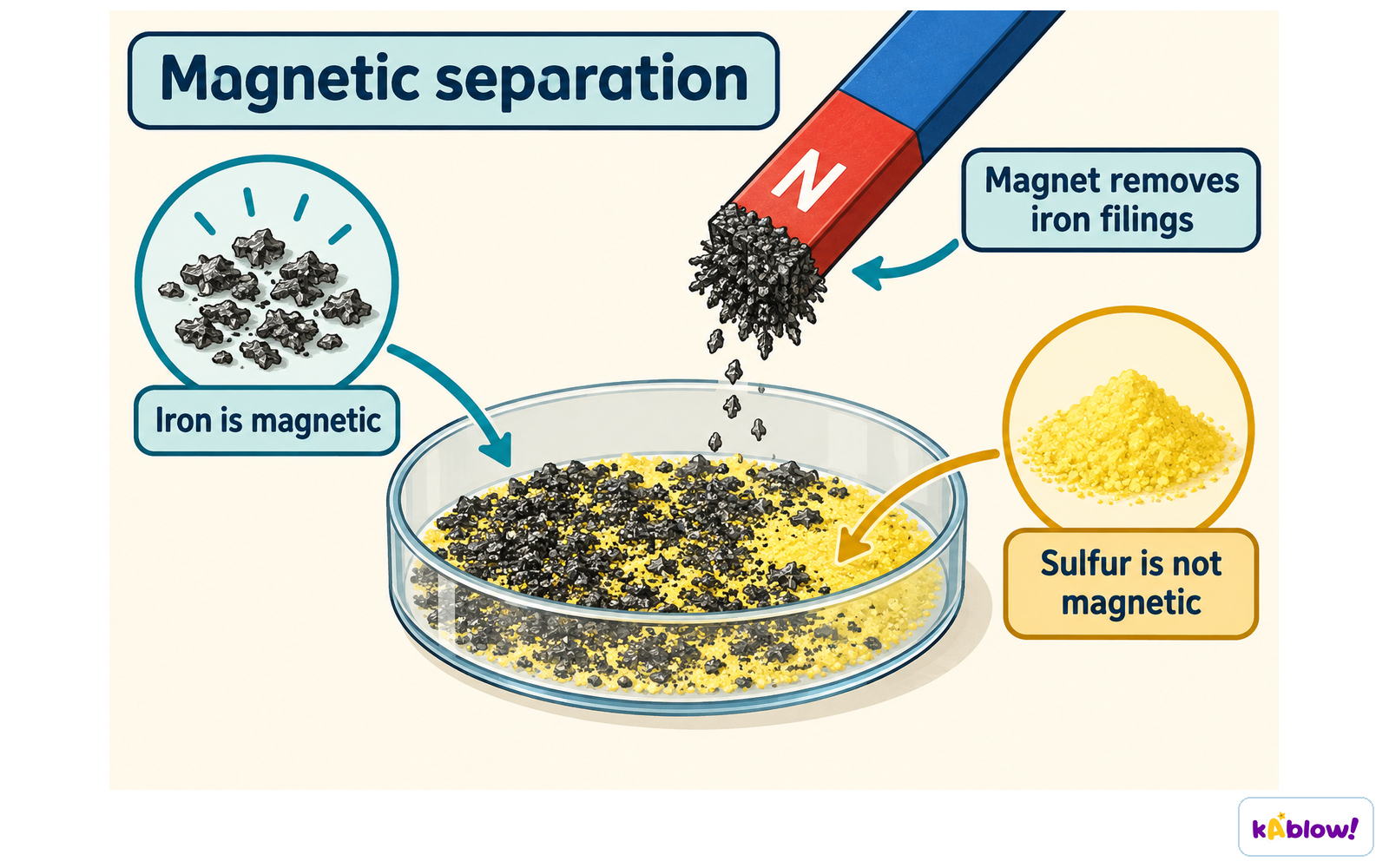
A magnet separates iron from sulfur because iron is magnetic and sulfur is not. The substances in a mixture are not chemically joined.
Key Differences
- Element vs compound: element has one type of atom; compound has two or more types chemically joined.
- Compound vs mixture: in a compound, atoms are chemically bonded; in a mixture, substances are not chemically joined and can be separated physically.
- A mixture can contain elements, compounds, or both.
Identifying Elements, Compounds, and Mixtures from Diagrams
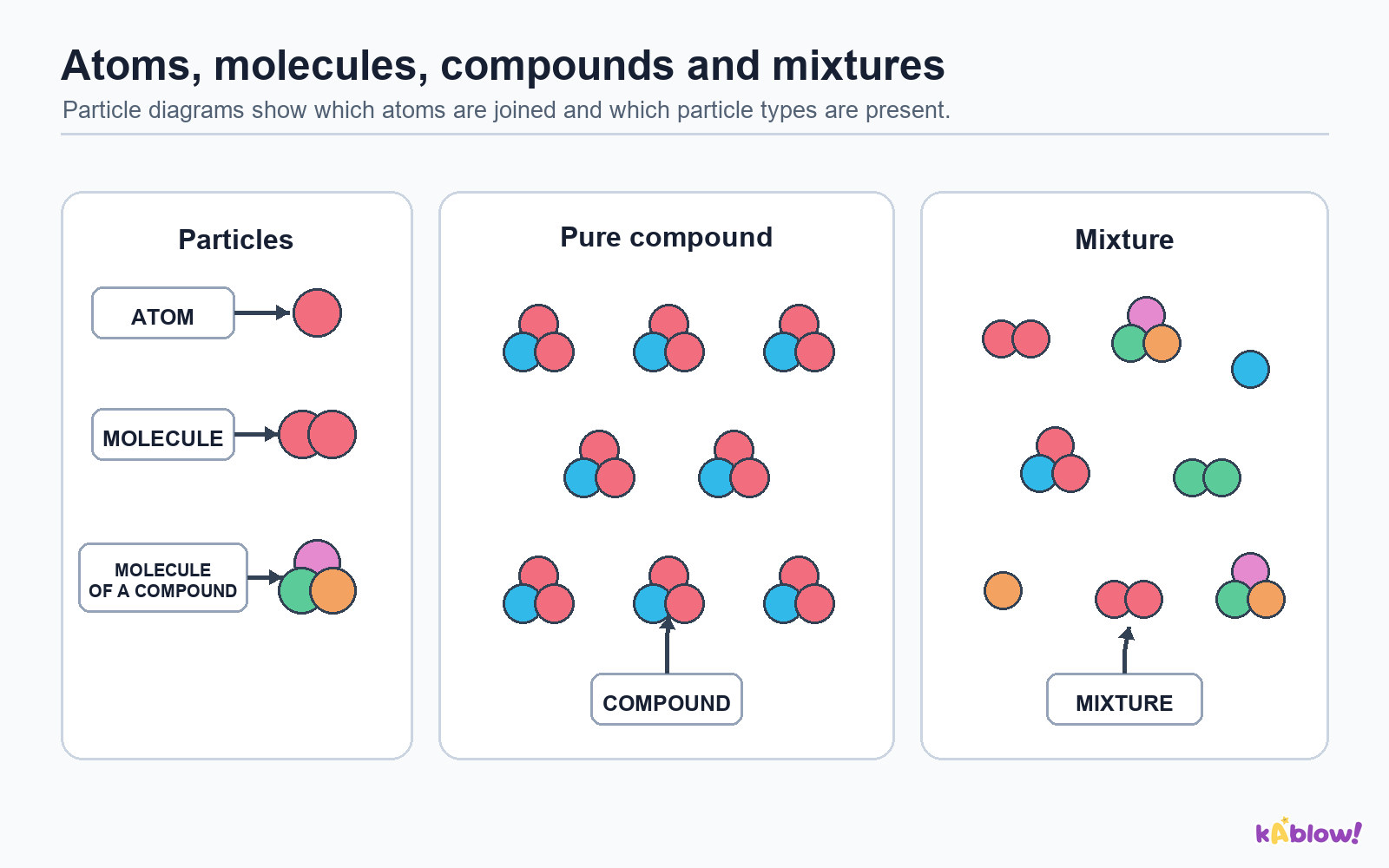
- Element: only one type of atom (same colour/size spheres).
- Compound: two or more different atoms chemically joined (different spheres bonded together).
- Mixture: two or more different atoms or molecules not bonded (different spheres or groups mixed but not joined).
Atoms, molecules, compounds and mixtures represented as particle diagrams.
Examples of Elements and Compounds
- Elements: iron, nitrogen, oxygen, aluminium.
- Compounds: iron oxide (iron + oxygen), carbon dioxide (carbon + oxygen), hydrochloric acid (hydrogen + chlorine), water (hydrogen + oxygen).
Atomic structure of oxygen (element). Two oxygen atoms bond to form O₂ (diatomic element).
Atomic structure of argon (monatomic element).
Particle arrangement in solids, liquids, and gases – useful for understanding mixtures of different states.
슬라이드
연습 문제
무료 미리 보기 — 52개 중 8개 문제. 가입하면 전부 볼 수 있어요.
1.Which of the following best describes an element?
Easy- AA substance made from only one type of atom
- BA substance made from two or more different types of atom chemically joined
- CA substance containing two or more elements or compounds that are not chemically joined
- DA substance that can be separated by physical methods
2.What is a compound?
Easy- AA substance where two or more atoms of different elements are chemically joined
- BA substance containing only one type of atom
- CA substance where two or more elements are mixed but not chemically joined
- DA substance that consists of only molecules
3.Which of the following is a mixture?
Easy- AOxygen gas (O₂)
- BCarbon dioxide (CO₂)
- CAir (a mixture of gases)
- DWater (H₂O)
4.Which of the following substances is an element?
Easy- AIron oxide
- BNitrogen
- CCarbon dioxide
- DWater
5.Which of the following is a compound?
Easy- AOxygen
- BArgon
- CHydrochloric acid
- DNitrogen gas mixed with oxygen gas
6.What is the difference between an element and a compound?
Medium- AAn element contains only one type of atom, while a compound contains two or more different types of atom chemically joined
- BAn element can be separated by physical methods, while a compound cannot
- CAn element is always a gas, while a compound is always a solid
- DAn element contains molecules, while a compound contains atoms
7.Which statement correctly describes the difference between a compound and a mixture?
Medium- AIn a compound, different substances are chemically joined; in a mixture, they are not chemically joined
- BIn a compound, substances are physically combined; in a mixture, they are chemically combined
- CA compound can be separated by filtration, but a mixture cannot
- DA mixture always contains elements only, while a compound contains compounds only
8.Which of the following diagrams represents an element? (Assume different shapes represent different types of atoms)
Easy- AA diagram showing only one type of atom (e.g., all circles the same)
- BA diagram showing two different types of atoms bonded together
- CA diagram showing two different types of atoms not bonded together
- DA diagram showing many different types of atoms all bonded
기출 문제
이 주제의 기출 문제 연습이 곧 나와요.
곧 출시