Group 7 elements
플레이하며 배우기
이 문제들을 풀어 에너지를 얻은 뒤 낚시하고 탐험하세요. 계정이 필요 없어요.
교육자를 위해: Group 7 elements(KS3 Science, Chemistry)을(를) 위한 바로 쓸 수 있는 수업 슬라이드, 복습 노트, 다이어그램 — 수업에 사용하거나, 학습자들이 실시간 게임으로 즐기는 인터랙티브 클래스 활동으로 진행하세요.
수업 노트
What are the halogens?
- Group 7 elements are called the halogens.
- They are all non-metals.
- They do not conduct electricity or heat well.
- They have low melting and boiling points.
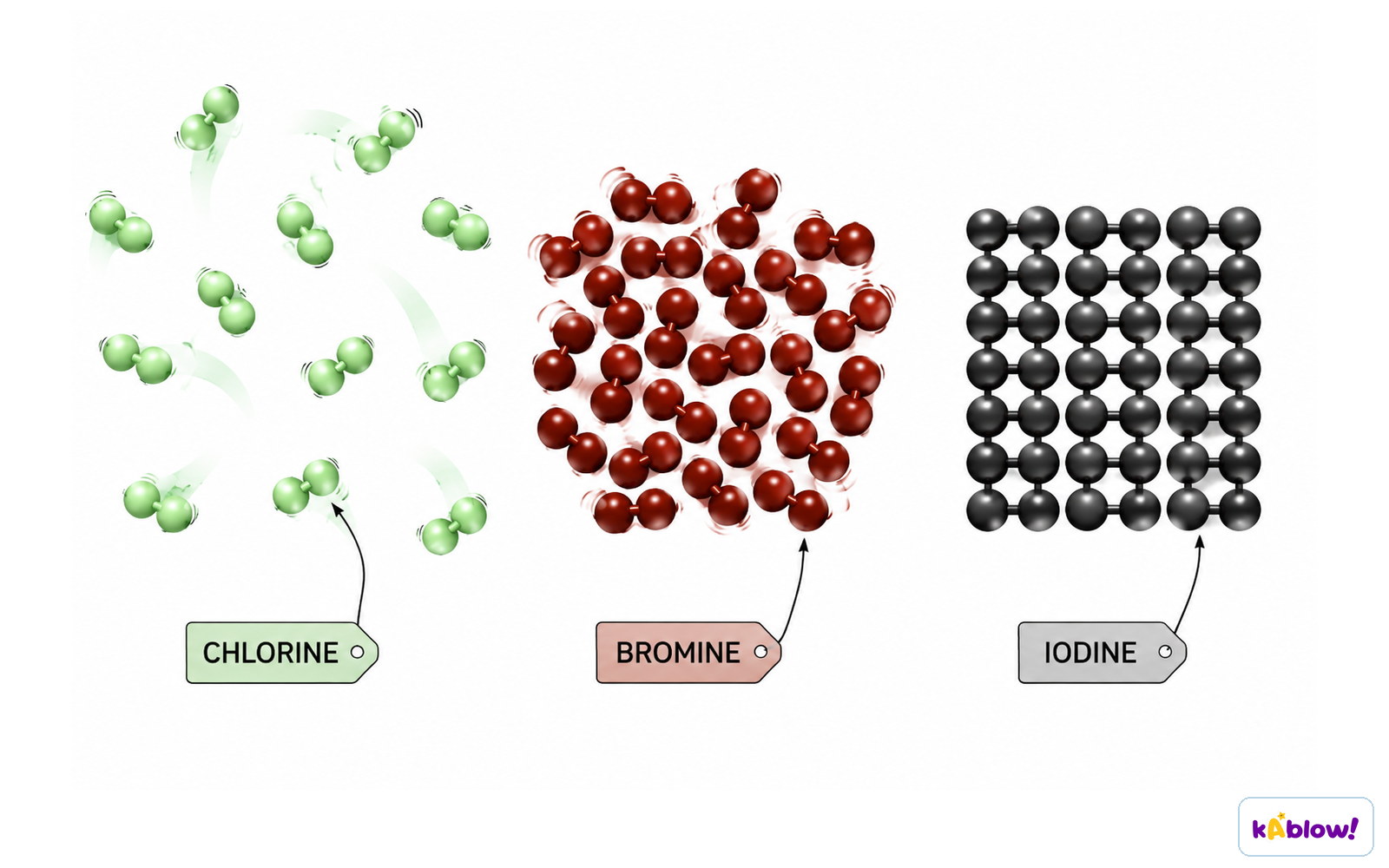
Chlorine is gaseous, bromine liquid, and iodine solid at room temperature; every particle is shown as a diatomic molecule.
Trends in group 7
- As you go down group 7, melting and boiling points increase.
- This is because larger molecules have larger intermolecular forces.
- As you go down group 7, reactivity decreases.
- Halogens are very reactive and toxic.
Uses of halogens
- Chlorine gas was used as a weapon in World War One.
- In low concentrations, chlorine is used to limit bacteria growth in swimming pools.
Displacement reactions
- A displacement reaction occurs when a more reactive element replaces a less reactive element in a compound.
- Both metals and halogens can undergo displacement reactions.
- If fluorine is in a compound, it ends with 'fluoride'; chlorine → 'chloride'; bromine → 'bromide'; iodine → 'iodide'; astatine → 'astatide'.
- These compounds are collectively called halides.
- Example: sodium bromide + chlorine → sodium chloride + bromine (chlorine is more reactive than bromine).
- No reaction occurs if the displacing element is less reactive: sodium bromide + iodine → no reaction.
- Another example: potassium iodide + chlorine → potassium chloride + iodine (colour change from colourless to brown).
Bohr model of a chlorine atom, showing electron configuration 2,8,7 (7 valence electrons).
슬라이드
연습 문제
무료 미리 보기 — 58개 중 8개 문제. 가입하면 전부 볼 수 있어요.
1.Which of the following is a halogen?
Easy- AChlorine
- BSodium
- CCarbon
- DOxygen
2.Which halogen has the highest melting point?
Easy- AFluorine
- BChlorine
- CBromine
- DIodine
3.Which property is true for all halogens?
Easy- AThey are all gases at room temperature
- BThey are all reactive and toxic
- CThey are all good conductors of electricity
- DThey all have high melting points
4.What is a displacement reaction?
Easy- AA reaction where a more reactive element replaces a less reactive element in a compound
- BA reaction where two elements swap places in a compound
- CA reaction where an element combines with oxygen
- DA reaction that releases heat
5.Why does a displacement reaction occur between potassium bromide and chlorine?
Easy- AChlorine is more reactive than bromine
- BBromine is more reactive than chlorine
- CPotassium is more reactive than chlorine
- DThe reaction produces a gas
6.Balance the equation: ___ KBr + Cl2 → ___ KCl + Br2
Medium- A2, 2
- B1, 2
- C2, 1
- D1, 1
7.Which of the following is a sign that a chemical reaction has taken place?
Easy- AA change in colour
- BAn increase in temperature
- CFormation of a gas
- DAll of the above
8.Complete the word equation: potassium iodide + bromine → ?
Medium- Apotassium bromide + iodine
- Bpotassium iodide + bromine (no reaction)
- Cpotassium bromine + iodine
- Dpotassium + iodine bromide
기출 문제
이 주제의 기출 문제 연습이 곧 나와요.
곧 출시