Pressure
플레이하며 배우기
이 문제들을 풀어 에너지를 얻은 뒤 낚시하고 탐험하세요. 계정이 필요 없어요.
교육자를 위해: Pressure(KS3 Science, Physics)을(를) 위한 바로 쓸 수 있는 수업 슬라이드, 복습 노트, 다이어그램 — 수업에 사용하거나, 학습자들이 실시간 게임으로 즐기는 인터랙티브 클래스 활동으로 진행하세요.
수업 노트
What is Pressure?
- Pressure is a measure of how much force is applied over a given area.
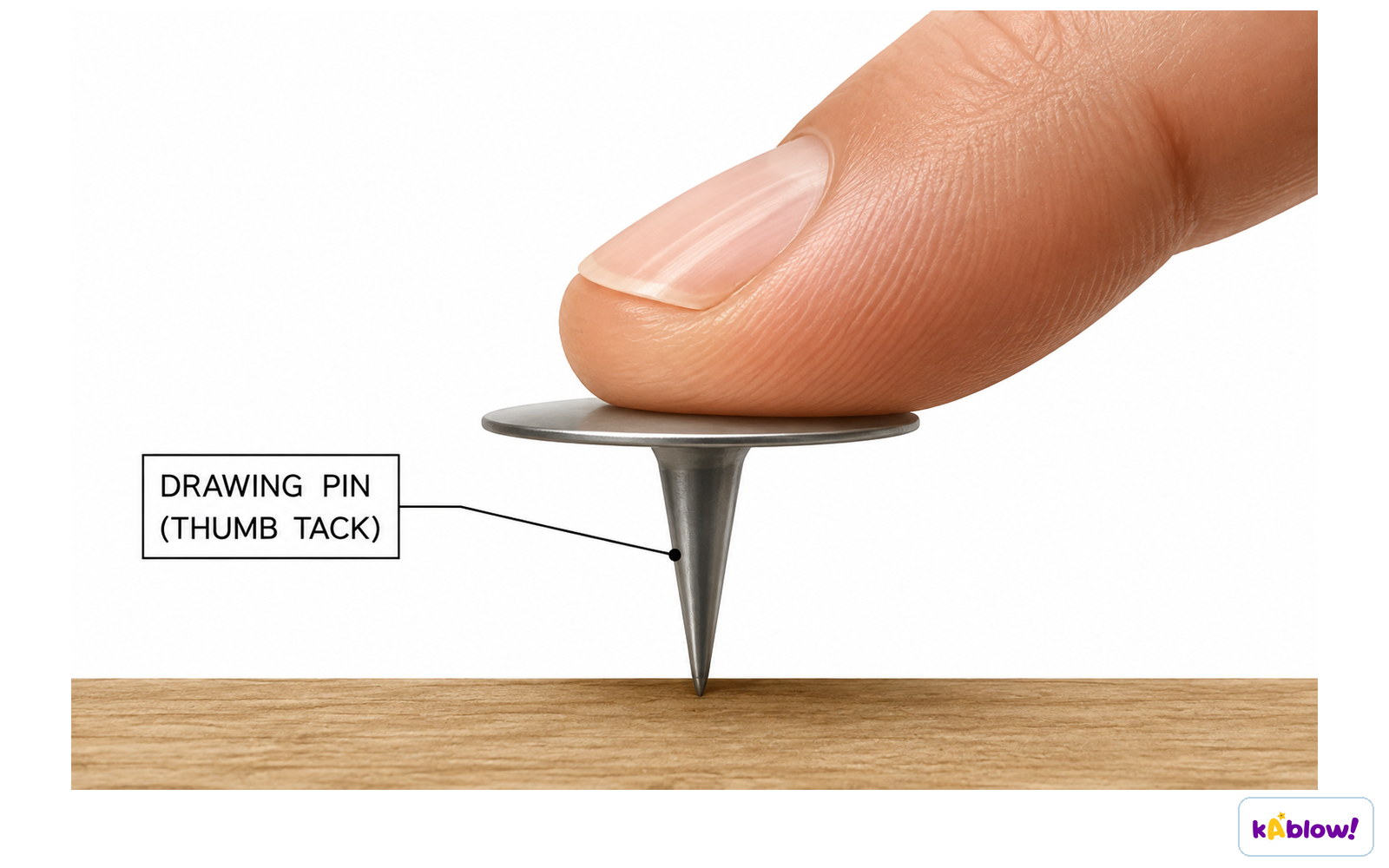
- The same force applied over a smaller area produces a larger pressure.
- Pressure in a liquid increases with depth because of the weight of liquid above.
- Atmospheric pressure decreases as altitude increases because there is less weight of air above.
A finger pushes a drawing pin into a surface; the sharp point's small area concentrates the force into a large pressure.
Pressure in Liquids
- In a bottle of water, pressure is greatest at the bottom and least at the top.
- The hole at the bottom has the most water above it, so water shoots out fastest.
- The hole at the top has the least water above it, so water comes out slowest.
- This demonstrates that liquid pressure depends on depth.
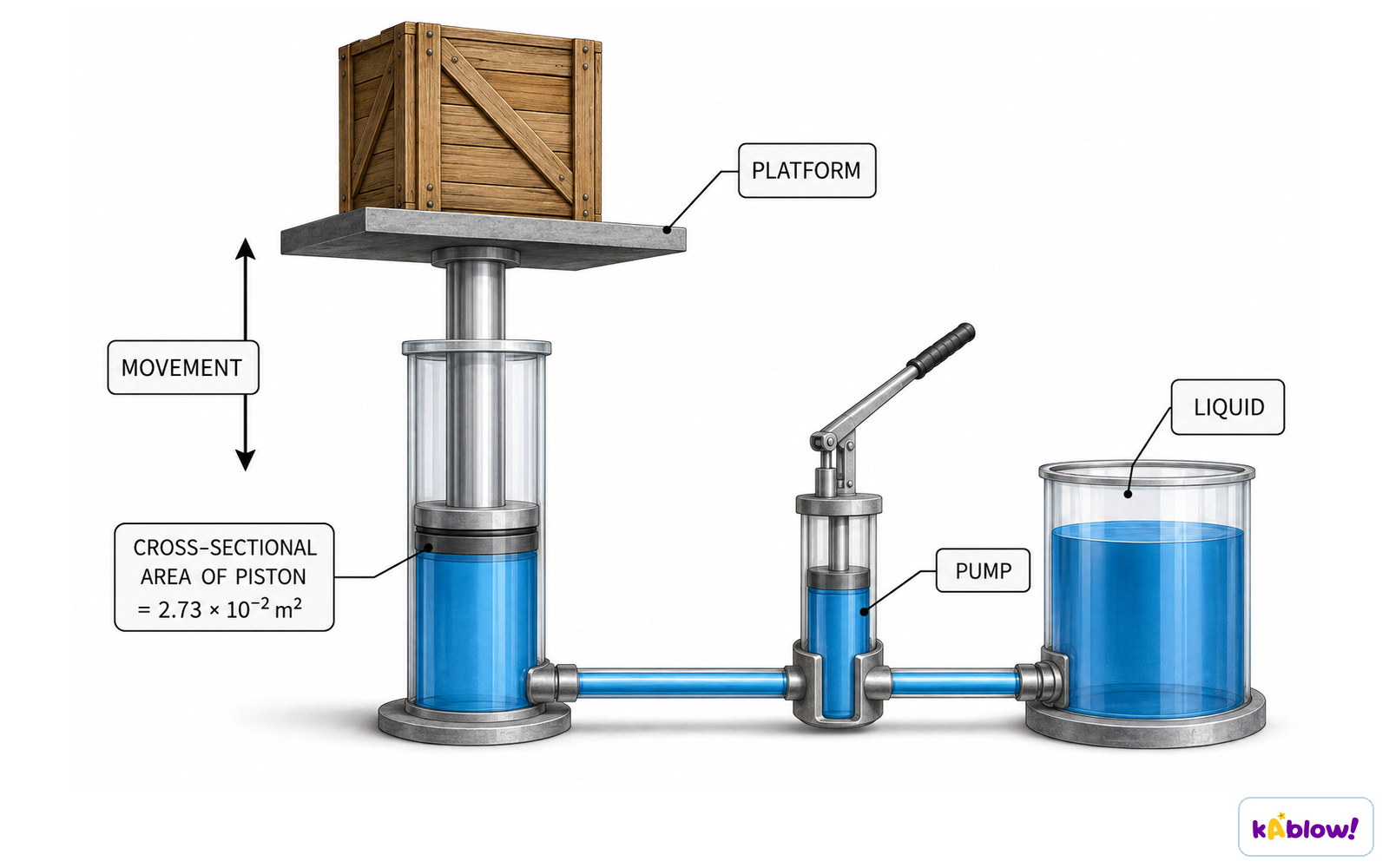
A hydraulic lift: a pump creates pressure in the liquid, transmitted to a piston of known cross-sectional area to raise the platform.
Atmospheric Pressure
- The atmosphere exerts pressure on everything due to the weight of air.
- Atmospheric pressure decreases as you go higher above Earth's surface.
- Higher altitude means less air above, so lower pressure.
The Pressure Equation
- Pressure = Force ÷ Area
- Force is measured in Newtons (N).
- Area is measured in square metres (m²).
- Pressure is measured in Pascals (Pa) or N/m².
- 1 Pa = 1 N/m².
Example Calculation
- A force of 500 N acts on an area of 0.25 m².
- Pressure = 500 N ÷ 0.25 m² = 2000 Pa.
- Always write the equation, substitute values, then calculate with units.
Applications of Pressure
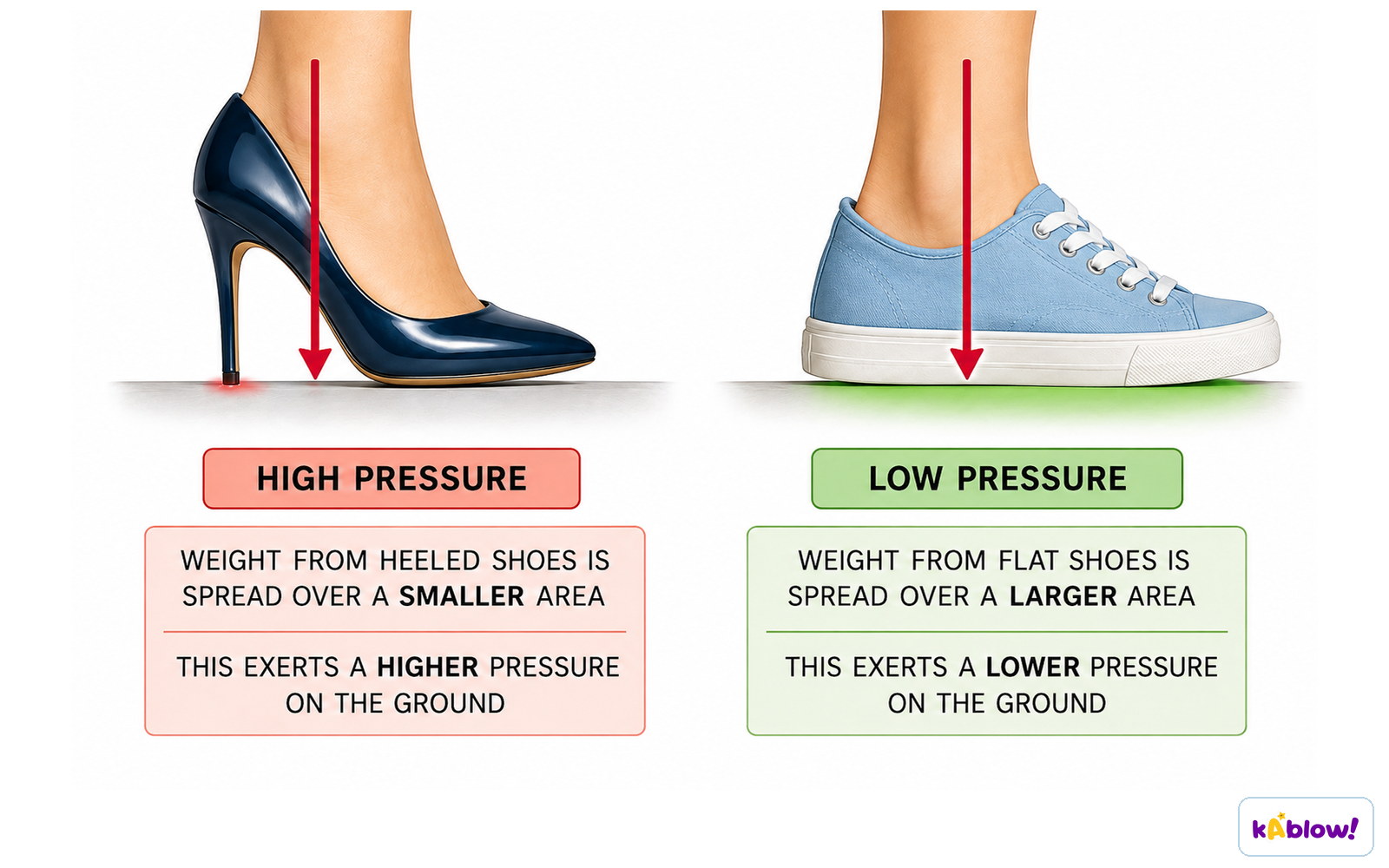
- A high heel shoe has a small area, so it exerts a large pressure and sinks into soft ground.
- A trainer has a larger area, so it exerts a smaller pressure and sinks less.
- Reducing area increases pressure; increasing area reduces pressure.
High heels concentrate weight over a small area (high pressure); flat shoes spread weight over a larger area (low pressure).
Particle arrangement in solids, liquids, and gases. Pressure in liquids and gases arises from particle collisions.
슬라이드
연습 문제
무료 미리 보기 — 56개 중 8개 문제. 가입하면 전부 볼 수 있어요.
1.Which equation correctly links pressure, force, and area?
Easy- APressure = Force × Area
- BPressure = Force ÷ Area
- CPressure = Area ÷ Force
- DPressure = Force + Area
2.What is the unit of pressure?
Easy- ANewton (N)
- BMetre squared (m²)
- CPascal (Pa)
- DNewton per metre (N/m)
3.As we go higher above the Earth's surface, atmospheric pressure:
Easy- Aincreases
- Bdecreases
- Cstays the same
- Dbecomes zero
4.A bottle has three holes at different heights. From which hole does water come out fastest?
Medium- AThe top hole
- BThe middle hole
- CThe bottom hole
- DAll holes at the same speed
5.A crate weighs 2600 N and has a base area of 2 m². What pressure does it exert on the ground?
Easy- A1300 Pa
- B5200 Pa
- C130 Pa
- D2600 Pa
6.A book weighing 20 N lies on a table, covering an area of 0.02 m². The pressure exerted by the book on the table is:
Easy- A1000 Pa
- B100 Pa
- C0.001 Pa
- D400 Pa
7.A skip weighing 5000 N has a base area of 4 m². The pressure on the ground is:
Easy- A1250 Pa
- B20000 Pa
- C125 Pa
- D5000 Pa
8.A person weighing 700 N stands on the ground. The combined area of their shoes is 0.04 m². The pressure they exert is:
Easy- A17500 Pa
- B28 Pa
- C1750 Pa
- D28000 Pa
기출 문제
이 주제의 기출 문제 연습이 곧 나와요.
곧 출시