Speed of sound
플레이하며 배우기
이 문제들을 풀어 에너지를 얻은 뒤 낚시하고 탐험하세요. 계정이 필요 없어요.
수업 노트
Sound Needs a Medium
- Sound waves need particles (a medium) to travel.
- Sound cannot travel in a vacuum because there are no particles.
- In air, sound travels at about 340 m/s (depends on pressure and temperature).
Speed in Different Materials
- Sound travels fastest in solids, then liquids, and slowest in gases.
- In water, speed ≈ 1500 m/s; in steel, speed > 3000 m/s.
- Particles in solids are closer together, so vibrations transfer more quickly.
Measuring Speed of Sound Using Echoes
- An echo is a reflected sound wave from a surface.
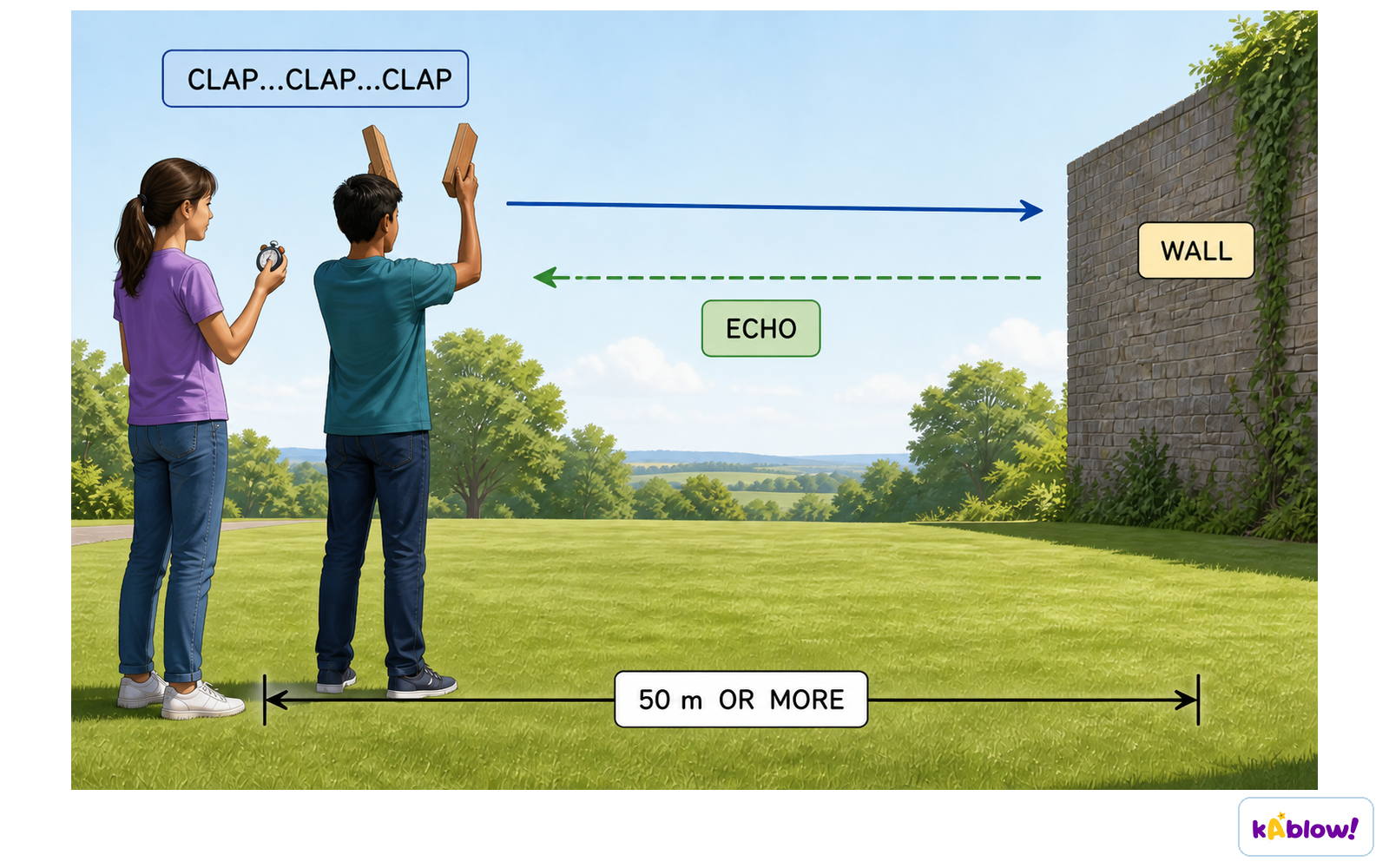
- Method: stand ≥50 m from a wall, make a loud sound, and time the echo.
- Total distance = 2 × distance to wall (sound travels there and back).
- Calculate speed using: Speed = Total distance ÷ Time.
- Repeat three times and take an average for accuracy.
A clap is reflected off a wall; the reflected sound heard back is the echo.
Improving Accuracy
- Use a microphone and oscilloscope to remove human reaction time error.
- Oscilloscope shows pulses for initial sound and echo, giving precise timing.
- Human reaction time makes measured time longer, so calculated speed is lower than actual.
Sound Absorption
- When sound reflects, some energy is absorbed by the medium.
- Not all sound is reflected back; absorption reduces echo loudness.
Key Equations
- Speed = Distance ÷ Time (or Total distance ÷ Time for echoes).
- Distance = Speed × Time.
- Time = Distance ÷ Speed.
Particle arrangement in solids, liquids, and gases explains why sound speed differs.
슬라이드
연습 문제
무료 미리 보기 — 69개 중 8개 문제. 가입하면 전부 볼 수 있어요.
1.Which of the following statements about sound waves is correct?
Easy- ASound waves can travel through a vacuum.
- BSound waves need particles to travel.
- CSound waves travel fastest in gases.
- DSound waves are a type of light wave.
2.What is the approximate speed of sound in air?
Easy- A1500 m/s
- B340 m/s
- C3000 m/s
- D3400 m/s
3.Sound travels fastest in which state of matter?
Easy- AGas
- BLiquid
- CSolid
- DVacuum
4.A student stands 50 m from a wall and claps. She hears the echo 0.40 s later. What is the speed of sound calculated from this experiment?
Medium- A125 m/s
- B250 m/s
- C340 m/s
- D400 m/s
5.Why does human reaction time cause the measured speed of sound to be lower than the actual value?
Medium- AReaction time adds extra time to the measurement, making speed appear lower.
- BReaction time subtracts time, making speed appear higher.
- CReaction time has no effect on the measurement.
- DReaction time causes the distance to be measured incorrectly.
6.Human reaction time is about 0.25 s. How far does sound travel in that time if the speed of sound is 340 m/s?
Easy- A85 m
- B1360 m
- C85 cm
- D13.6 m
7.A bat uses echolocation. It sends a sound wave and detects the echo after 0.80 s. How far away is the object? (Speed of sound = 340 m/s)
Medium- A272 m
- B136 m
- C425 m
- D68 m
8.To measure the speed of sound more accurately, a microphone and oscilloscope can be used. This reduces error from:
Easy- AMeasuring distance
- BHuman reaction time
- CSound absorption
- DWind speed