The solar system
플레이하며 배우기
이 문제들을 풀어 에너지를 얻은 뒤 낚시하고 탐험하세요. 계정이 필요 없어요.
교육자를 위해: The solar system(KS3 Science, Physics)을(를) 위한 바로 쓸 수 있는 수업 슬라이드, 복습 노트 — 수업에 사용하거나, 학습자들이 실시간 게임으로 즐기는 인터랙티브 클래스 활동으로 진행하세요.
수업 노트
The Solar System Overview
- The solar system consists of a star (the Sun) and eight planets.
- The Sun contains most of the mass of the solar system.
- Gravitational forces keep the planets in orbit around the Sun.
- The Sun's surface temperature is around 6000°C.
The Solar System: the Sun, eight planets, natural and artificial satellites, and the asteroid belt
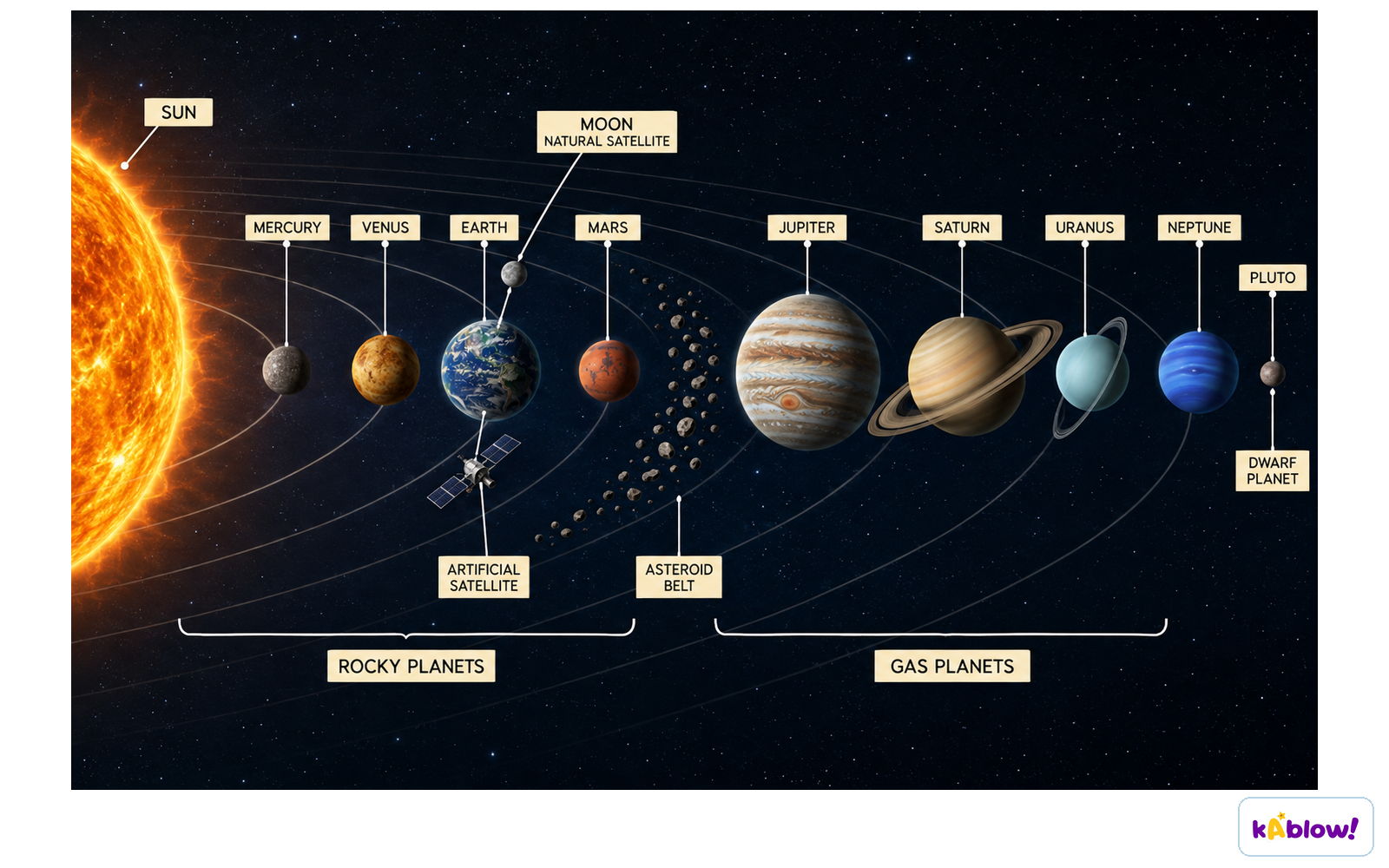
Planets in Order from the Sun
- 1. Mercury – smallest planet, closest to the Sun.
- 2. Venus – has a carbon dioxide atmosphere, hottest planet.
- 3. Earth – only known planet with life.
- 4. Mars – colder than Earth, further from the Sun.
- 5. Jupiter – largest planet, Great Red Spot (storm lasting >400 years).
- 6. Saturn – second largest, rings made of ice and rock.
- 7. Uranus – third largest, rotates on its side.
- 8. Neptune – furthest planet, lowest average temperature.
Types of Planets
- Terrestrial (rocky) planets: Mercury, Venus, Earth, Mars (closest four).
- Gas giants: Jupiter and Saturn.
- Ice giants: Uranus and Neptune.
- Pluto is a dwarf planet, beyond Neptune.
Temperature and Gravity
- Planet temperature generally decreases with distance from the Sun.
- Venus is an exception – its CO₂ atmosphere traps heat (greenhouse effect).
- Neptune has the lowest average temperature (furthest from Sun).
- Jupiter has the largest gravitational field strength (25 N/kg).
Mnemonic for Planet Order
- My Very Easy Method Just Speeds Up Naming (Planets).
- Corresponds to: Mercury, Venus, Earth, Mars, Jupiter, Saturn, Uranus, Neptune.
슬라이드
연습 문제
무료 미리 보기 — 54개 중 8개 문제. 가입하면 전부 볼 수 있어요.
1.How many planets are there in the solar system?
Easy- A8
- B7
- C9
- D10
2.Which of the following are the four terrestrial planets?
Easy- AMercury, Venus, Earth, Mars
- BMercury, Venus, Earth, Jupiter
- CVenus, Earth, Mars, Jupiter
- DEarth, Mars, Jupiter, Saturn
3.Which planets are the gas giants?
Easy- AJupiter and Saturn
- BUranus and Neptune
- CSaturn and Uranus
- DJupiter and Neptune
4.Which planets are the ice giants?
Easy- AUranus and Neptune
- BJupiter and Saturn
- CSaturn and Uranus
- DNeptune and Pluto
5.What is the correct order of planets from the Sun outward?
Easy- AMercury, Venus, Earth, Mars, Jupiter, Saturn, Uranus, Neptune
- BMercury, Venus, Earth, Mars, Saturn, Jupiter, Uranus, Neptune
- CVenus, Mercury, Earth, Mars, Jupiter, Saturn, Neptune, Uranus
- DMercury, Earth, Venus, Mars, Jupiter, Saturn, Uranus, Neptune
6.Which planet has the highest average surface temperature and why?
Medium- AVenus, because of its carbon dioxide atmosphere
- BMercury, because it is closest to the Sun
- CVenus, because it is closest to the Sun
- DJupiter, because it is a gas giant
7.What object contains most of the mass in the solar system?
Easy- AThe Sun
- BJupiter
- CEarth
- DSaturn
8.What force keeps planets in orbit around the Sun?
Easy- AGravitational force
- BMagnetic force
- CCentrifugal force
- DNuclear force
기출 문제
이 주제의 기출 문제 연습이 곧 나와요.
곧 출시