Properties of substances
플레이하며 배우기
이 문제들을 풀어 에너지를 얻은 뒤 낚시하고 탐험하세요. 계정이 필요 없어요.
교육자를 위해: Properties of substances(NGSS Middle School Science, Chemistry)을(를) 위한 바로 쓸 수 있는 수업 슬라이드, 복습 노트 — 수업에 사용하거나, 학습자들이 실시간 게임으로 즐기는 인터랙티브 클래스 활동으로 진행하세요.
수업 노트
Physical vs. Chemical Changes
- Physical changes do not change the chemical properties of a substance; examples include cutting, boiling, melting, dissolving, and whipping.
- Chemical changes (chemical reactions) transform one or more substances into new substances with different properties.
- Examples of chemical changes: burning gas, milk turning sour, iron rusting, frying eggs.
- Physical changes are often reversible, while chemical changes are usually not (e.g., you can't unbake a cake).
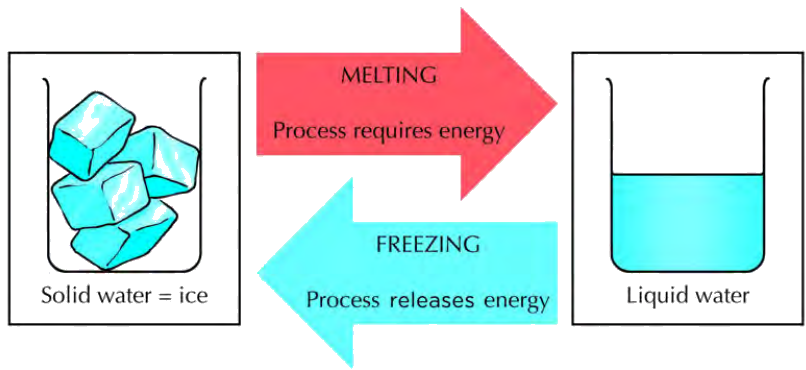
Melting and freezing of water
Signs of a Chemical Reaction
- Color change occurs (not just mixing colors).
- Gas formation – often seen as bubbles (not boiling).
- Formation of a solid – a precipitate or crystals appear in a liquid.
- Odor change – a new smell is produced.
- Energy change – heat, light, sound, or cold is produced or absorbed.
- Extreme property changes – e.g., changes in density, flammability, or state.
- The only definitive sign is the formation of a new substance.
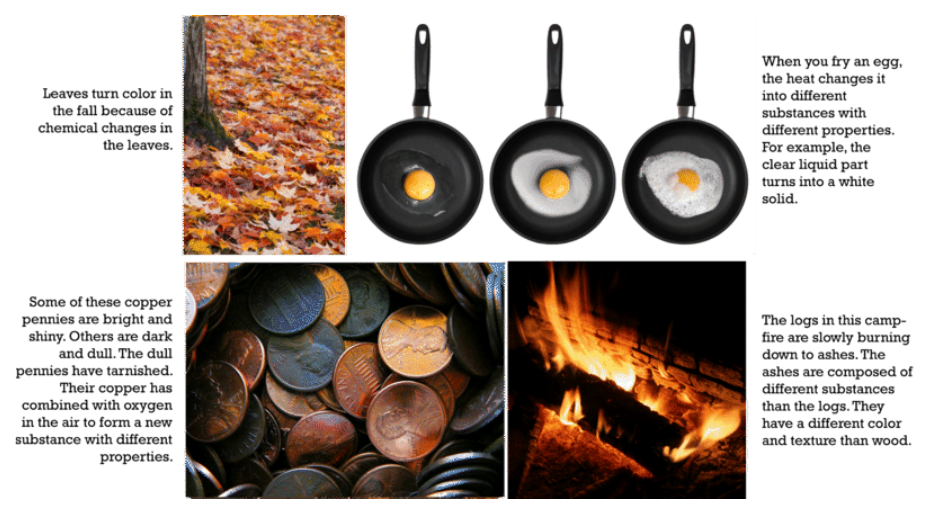
Everyday chemical reactions show new substances with different properties
Reactants and Products
- Reactants are the starting substances in a chemical reaction.
- Products are the new substances formed by the reaction.
- Comparing the properties of the reactants and products (colour, state, odor, and so on) is how we tell that a reaction has taken place.
Properties of Materials
- Properties are distinctive characteristics that describe a material.
- Important properties include: strength, durability, flexibility, malleability, ductility, electrical conductivity, heat conductivity, hardness, solubility, density, color, odor, state, melting point, boiling point, and flammability.
- Materials are chosen for specific uses based on their properties.
- Advantages are desirable properties; disadvantages are unfavorable features (e.g., plastic bags are strong but cause pollution).
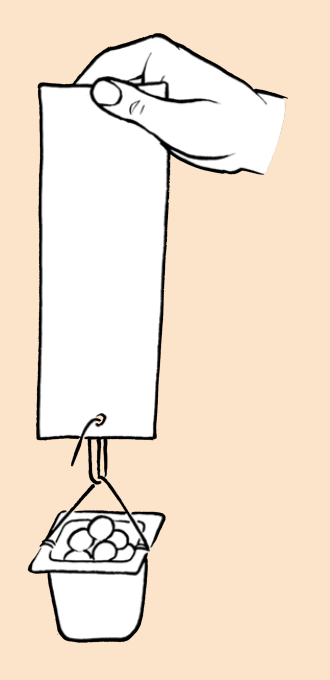
- Strength can be measured by testing how much force is needed to break a material (e.g., tearing paper with marbles).
Testing paper strength with marbles in a yoghurt tub
Heat and Temperature
- Heat is the transfer of energy between objects due to a temperature difference.
- Temperature measures how hot or cold something is; it is measured with a thermometer.
- Adding heat usually raises temperature, but during a phase change, temperature stays constant.
- Heat and temperature are related but not the same.
Melting and Boiling Points
- Melting point is the temperature at which a solid changes to a liquid.
- Boiling point is the temperature at which a liquid changes to a gas (bubbles form).
- For pure water, melting point is 0°C and boiling point is 100°C at sea level.
- Boiling point depends on atmospheric pressure (lower at high altitudes) and purity (impurities raise it).
- Different substances have different melting and boiling points (e.g., nitrogen boils at -200°C, ethanol at 78°C).
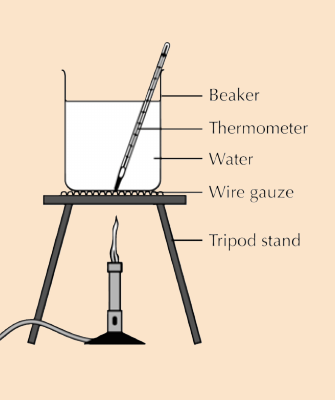
Apparatus for determining the boiling point of water
Matter and Classification
- Matter is anything that has mass and volume.
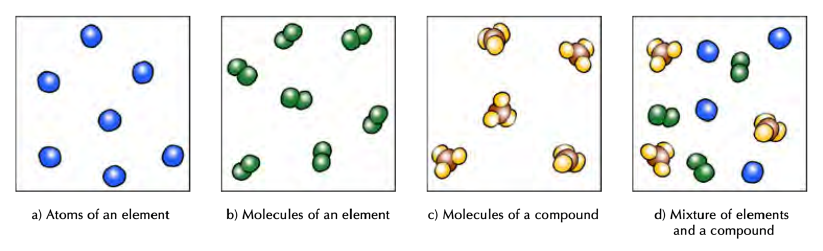
- Matter can be classified as pure substances (elements or compounds) or mixtures.
- Elements consist of one kind of atom; compounds consist of two or more kinds of atoms chemically bonded in a fixed ratio.
- Mixtures contain more than one kind of particle and can be separated by physical methods.
- Physical separation methods (e.g., filtering, evaporation) cannot break chemical bonds.
Diagrams to show the difference between elements, compounds and mixtures
Chemical Reactions in Everyday Life
- Cooking involves chemical reactions (e.g., baking bread changes ingredients into a new substance).
- Burning (combustion) is a chemical reaction (e.g., burning gas, logs).
- Rusting is a chemical reaction between iron and oxygen.
- Digestion and photosynthesis are examples of chemical reactions in living organisms.
- Indigenous practices often use chemical reactions, such as making dyes or preserving food.
슬라이드
연습 문제
무료 미리 보기 — 56개 중 8개 문제. 가입하면 전부 볼 수 있어요.
1.What is a chemical substance?
Easy- AA unique form of matter with constant chemical composition and characteristic properties
- BAny material that can be found on Earth
- CA mixture of two or more elements
- DA substance that can only exist as a solid
2.Which of the following is an example of a chemical substance?
Easy- APure water (H2O)
- BAir
- CSeawater
- DGranite
3.The law of constant composition states that:
Easy- AAll samples of a compound have the same proportions by mass of the elements present
- BAll mixtures have variable composition
- CElements always combine in the same physical state
- DThe composition of a compound changes with temperature
4.Which of the following is a characteristic property of pure water?
Easy- AIt boils at 100°C at standard pressure
- BIt is always a liquid
- CIt conducts electricity well
- DIt has a variable boiling point
5.What is the atomic ratio of hydrogen to oxygen in every molecule of pure water?
Easy- A2:1
- B1:2
- C1:1
- D2:2
6.Which of the following is NOT a chemical substance?
Easy- ASeawater
- BDiamond
- CTable salt (NaCl)
- DRefined sugar (C12H22O11)
7.Why are isomers considered distinct chemical substances even though they have the same composition?
Hard- AThey have different arrangements of atoms, leading to different properties
- BThey have different numbers of atoms
- CThey are mixtures of different elements
- DThey exist only in different phases
8.In geology, a mineral is defined as:
Easy- AAn inorganic solid substance of uniform composition
- BA mixture of two or more rocks
- CAny naturally occurring liquid
- DAn organic compound found underground
기출 문제
이 주제의 기출 문제 연습이 곧 나와요.
곧 출시