
Molecules: Shapes & Forces
Learn it by playing
Answer these questions to earn energy, then fish and explore. No account needed.
Lesson notes
Count electron domains around a central atom
- VSEPR models the repulsion between regions of valence electron density around a central atom. Their arrangement minimises repulsion; the model predicts geometry rather than electron trajectories.
- Each single, double or triple bond counts as one bonding region. Each central-atom lone pair adds one further region, so domain count is different from the number of shared electron pairs.
- Start with a valid Lewis structure and account for the overall charge. The total number of valence electrons increases for a negative ion and decreases for a positive ion.
Electron-domain bookkeeping
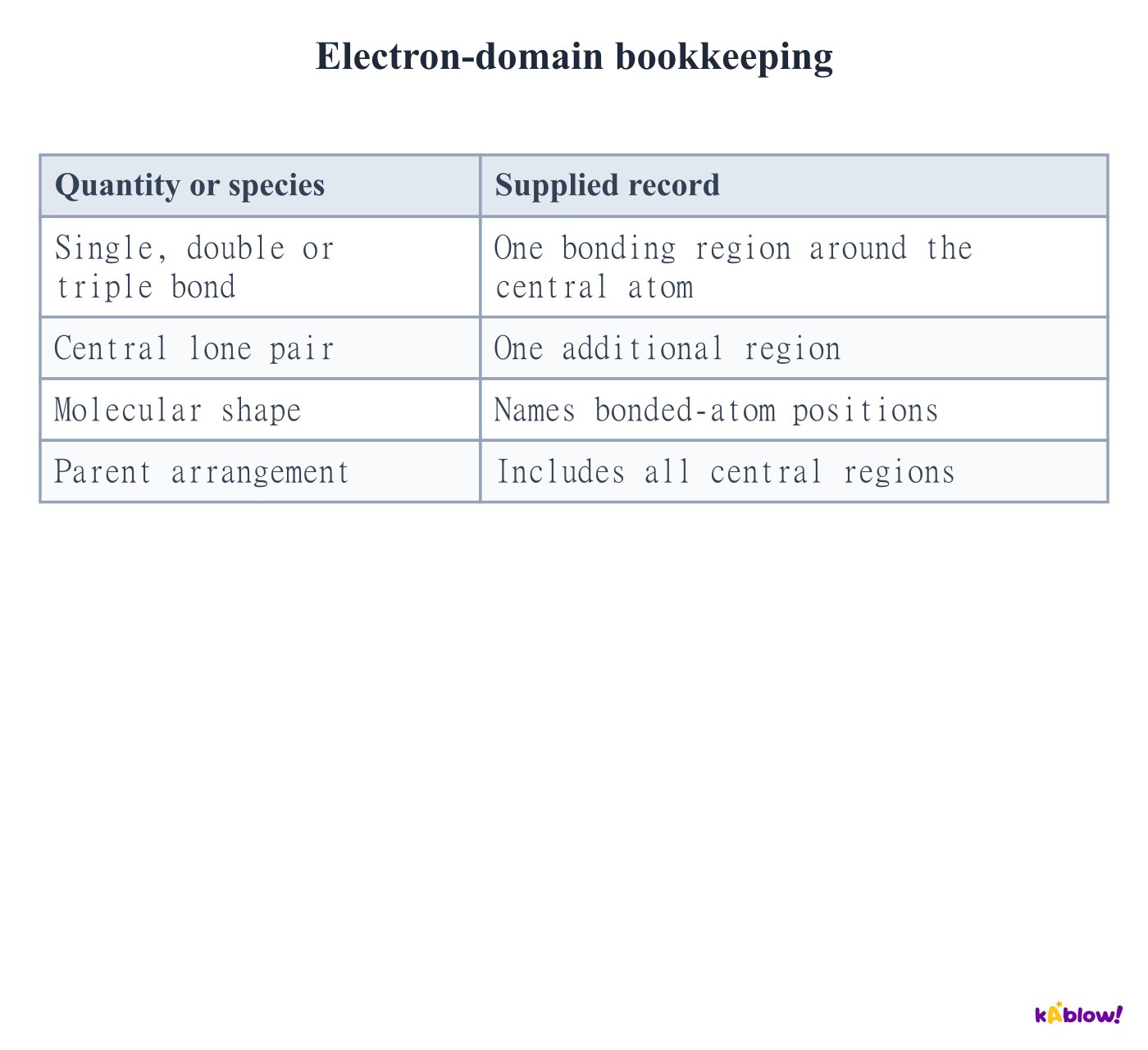
Distinguish electron arrangement from molecular shape
- An electron-domain arrangement includes both bonding regions and lone pairs. A molecular shape describes the positions of atoms and does not name a lone pair as if it were another atom.
- Four regions have a tetrahedral parent arrangement. Four bonded atoms give a tetrahedral molecule; three bonded atoms and a lone pair give a trigonal pyramid; two bonded atoms and two lone pairs give a bent molecule.
- Lone pairs occupy space and affect repulsion even though they do not appear in the molecular shape name. A flat Lewis drawing alone is not a reliable picture of the three-dimensional molecule.
Methane, ammonia and water molecular shapes
Explain linear and trigonal planar molecules
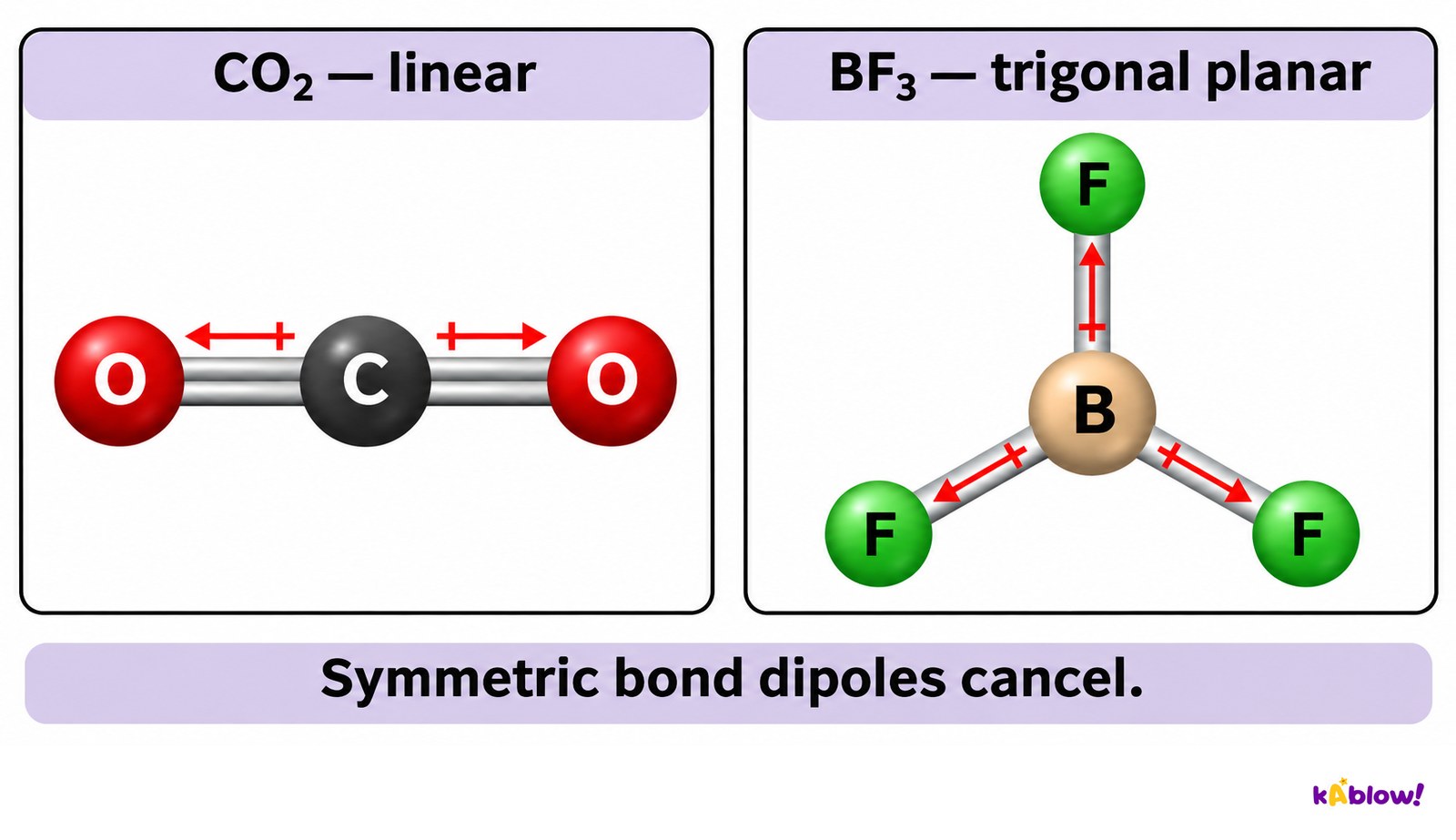
- Two bonding regions and no central lone pairs give a linear molecule with a 180° bond angle, as in CO₂. Its two double bonds remain two regions, not four.
- Three bonding regions and no central lone pairs give trigonal planar geometry with ideal 120° angles, as in BF₃. The three bonds lie in one plane around boron.
- These predictions concern the local geometry around the named atom. Electron-deficient boron can still be treated by VSEPR; a complete octet is not a prerequisite for a shape prediction.
Symmetric polar bonds with cancellation
Explain tetrahedral and pyramidal shapes
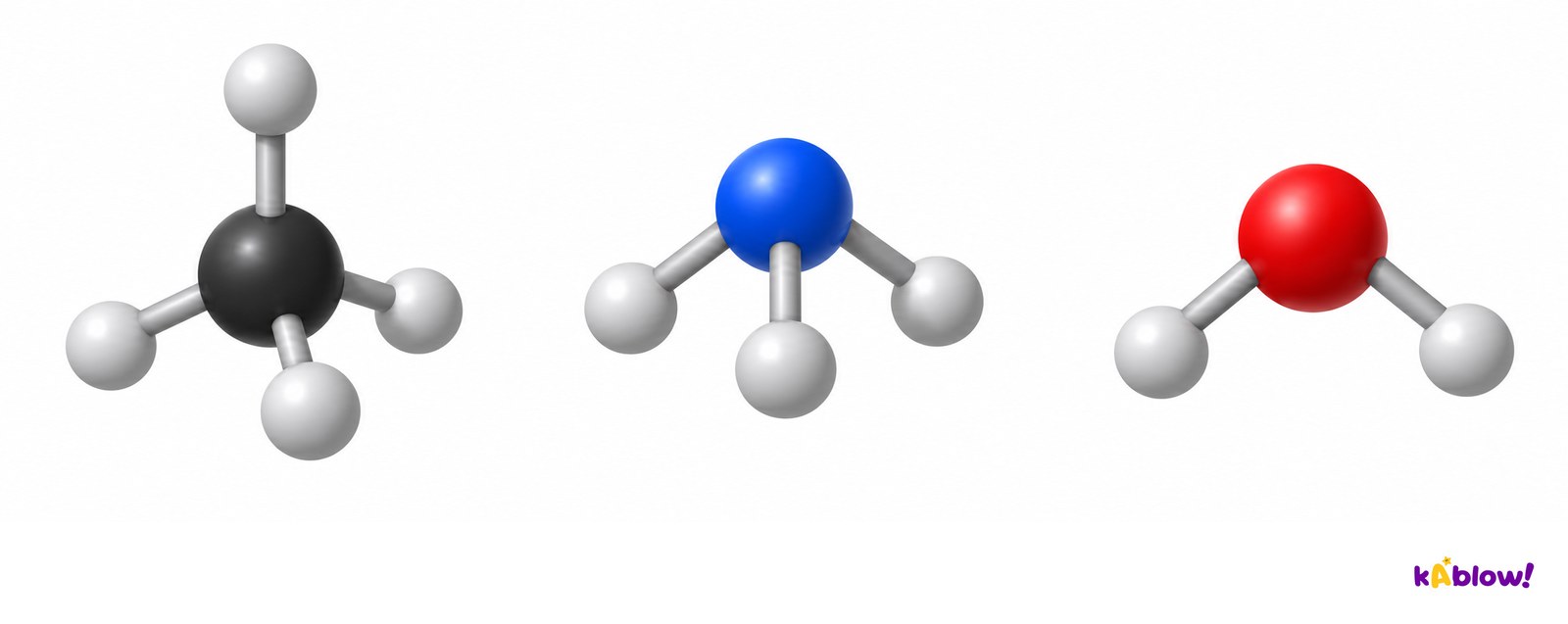
- Methane has four C–H bonding regions and no central lone pairs. Equivalent regions point towards the corners of a tetrahedron, with angles of approximately 109.5°.
- Ammonia has three N–H bonding regions and one central lone pair. Its molecular shape is trigonal pyramidal, with an H–N–H angle of about 107°.
- In the AQA repulsion model, lone pair–lone pair repulsion exceeds lone pair–bond pair repulsion, which exceeds bond pair–bond pair repulsion. A lone pair can compress angles between bonds.
Methane, ammonia and water molecular shapes
Explain water and the limits of angle shortcuts
- Water has two O–H bonding regions and two central lone pairs. Its molecular shape is bent, and the H–O–H angle is approximately 104.5°.
- Compare water and ammonia with the 109.5° tetrahedral parent arrangement. The differing repulsions help explain their compressed bond angles.
- Do not subtract a fixed 2.5° for every lone pair in every species. Actual angles also depend on the bonded atoms and bonding; 107° and 104.5° are familiar examples rather than universal constants.
Methane, ammonia and water molecular shapes
Include charge when predicting ion geometry
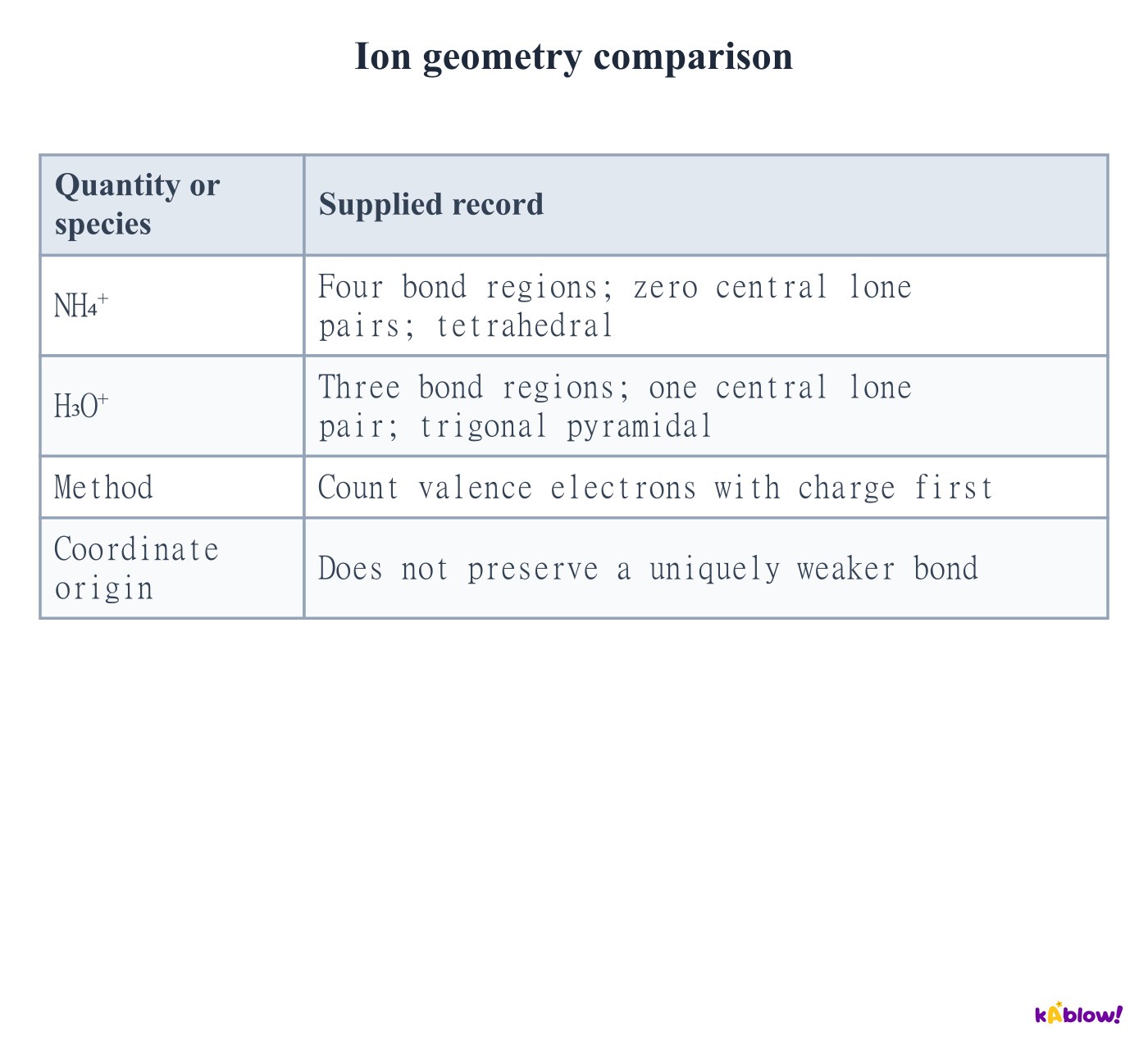
- NH₄⁺ contains eight valence electrons: 5 + 4 − 1. Four N–H bonds use four pairs, leaving no nitrogen lone pair, so its molecular geometry is tetrahedral.
- H₃O⁺ also contains eight valence electrons: 6 + 3 − 1. Three O–H bonds leave one oxygen lone pair, giving a trigonal pyramidal molecular shape.
- The coordinate origin of a bond does not require a permanently different bond direction or strength after an ion forms. Use the final electron arrangement for VSEPR.
Ion geometry comparison
Interpret five electron domains
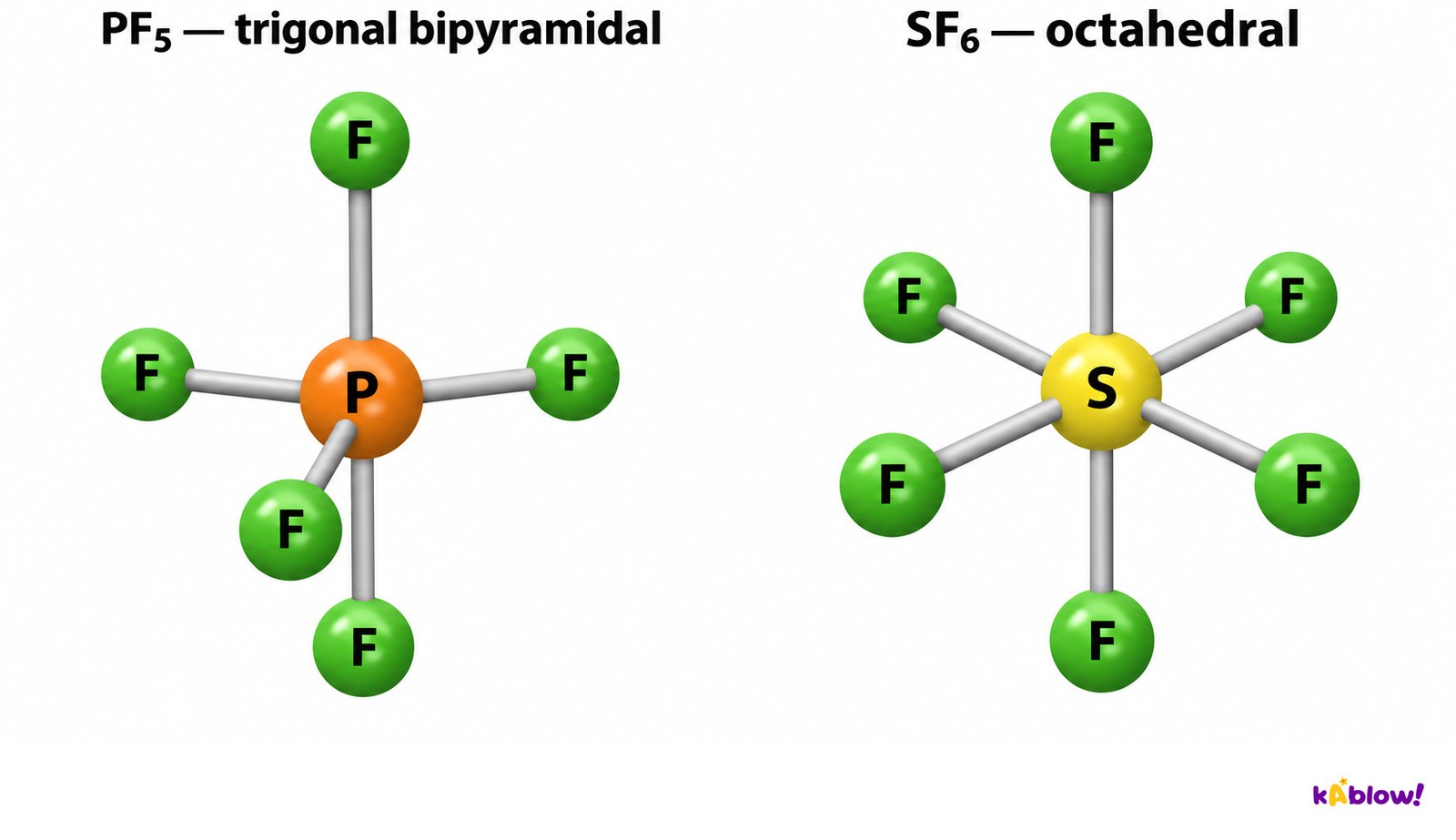
- Five bonding regions and no central lone pairs give trigonal bipyramidal geometry, illustrated by molecular PF₅. Three equatorial bonds lie in a plane; two axial bonds lie on an axis perpendicular to that plane.
- Ideal equatorial–equatorial angles are 120°, axial–equatorial angles are 90°, and the two opposite axial bonds form 180°.
- Use molecular species under stated conditions. Gas-phase PCl₅ can be treated as a trigonal bipyramidal molecule, while its solid-state structure requires a different description.
Five- and six-domain molecular geometries
Place lone pairs in a five-domain arrangement
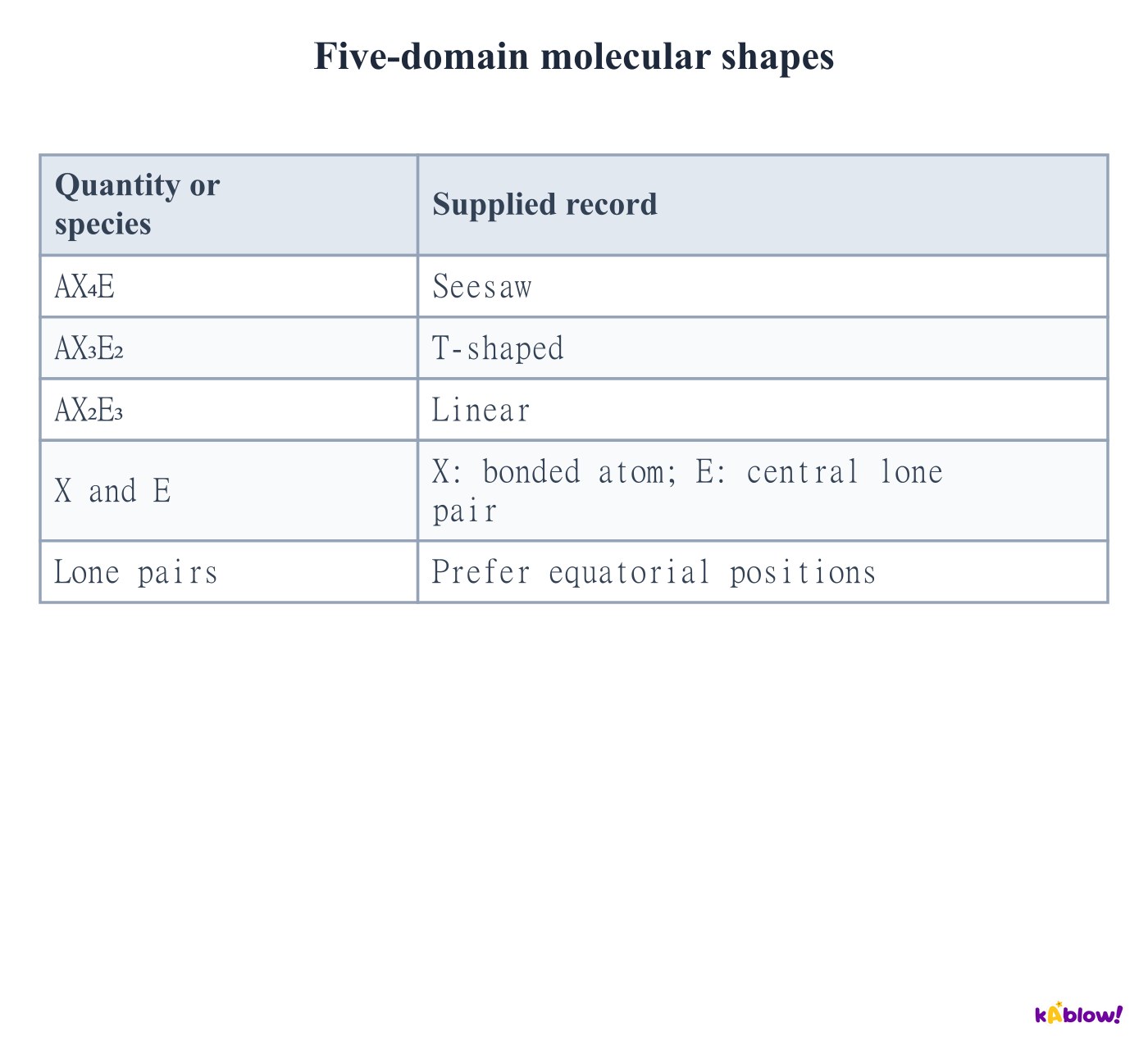
- In a trigonal bipyramidal parent arrangement, an equatorial position has fewer 90° interactions than an axial position. Lone pairs preferentially occupy equatorial positions in the simple model.
- AX₄E therefore gives a seesaw molecular shape, AX₃E₂ gives a T-shape, and AX₂E₃ gives a linear molecule. Here X is a bonded atom and E is a central lone pair.
- Non-equivalent repulsions distort some angles from their ideal parent values. Do not describe every five-domain molecule as trigonal bipyramidal simply because its domain count is five.
Five-domain molecular shapes
Interpret six electron domains
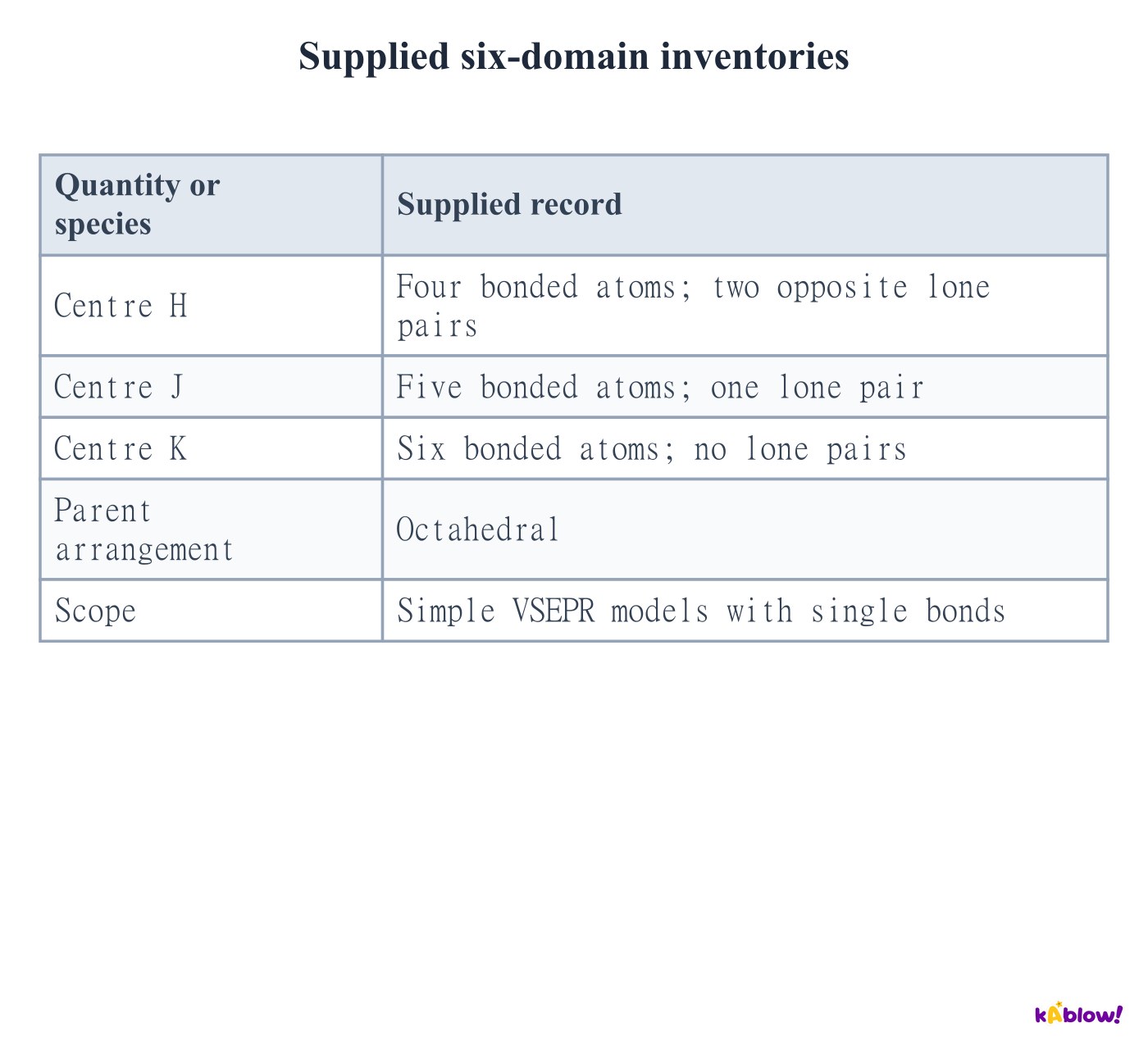
- Six bonding regions and no central lone pairs give octahedral molecular geometry, illustrated by SF₆. Four bonds lie in an equatorial square and two lie on the perpendicular axis.
- Adjacent bonds form ideal 90° angles and opposite bonds form 180°. A two-dimensional perspective view does not make the actual molecule planar.
- With one central lone pair, AX₅E is square pyramidal. With two opposite central lone pairs, AX₄E₂ is square planar; these are molecular shapes derived from the octahedral parent arrangement.
Five- and six-domain molecular geometries
Read perspective and compare unfamiliar species
- An ordinary line represents a bond in the page, a solid wedge comes towards the viewer, and a hashed wedge goes away. These symbols encode perspective rather than literal triangular bonds.
- Determine domains from electron counting before interpreting the drawing. Rotate a model mentally: a rotated tetrahedron is still a tetrahedron.
- For an unfamiliar species, state the central bonding and lone-pair counts, the parent domain arrangement, the molecular shape and appropriate angles. Do not infer a shape from a molecular formula without checking its bonding.
Methane, ammonia and water molecular shapes
Define electronegativity and explain trends
- Electronegativity is an atom’s ability to attract the shared pair of electrons in a covalent bond. It is not the energy change when a gaseous atom gains an electron.
- Across a typical main-group period, increasing nuclear charge with broadly similar inner-shell shielding strengthens attraction for bonding electrons. Down a group, increased distance and shielding usually outweigh increased nuclear charge.
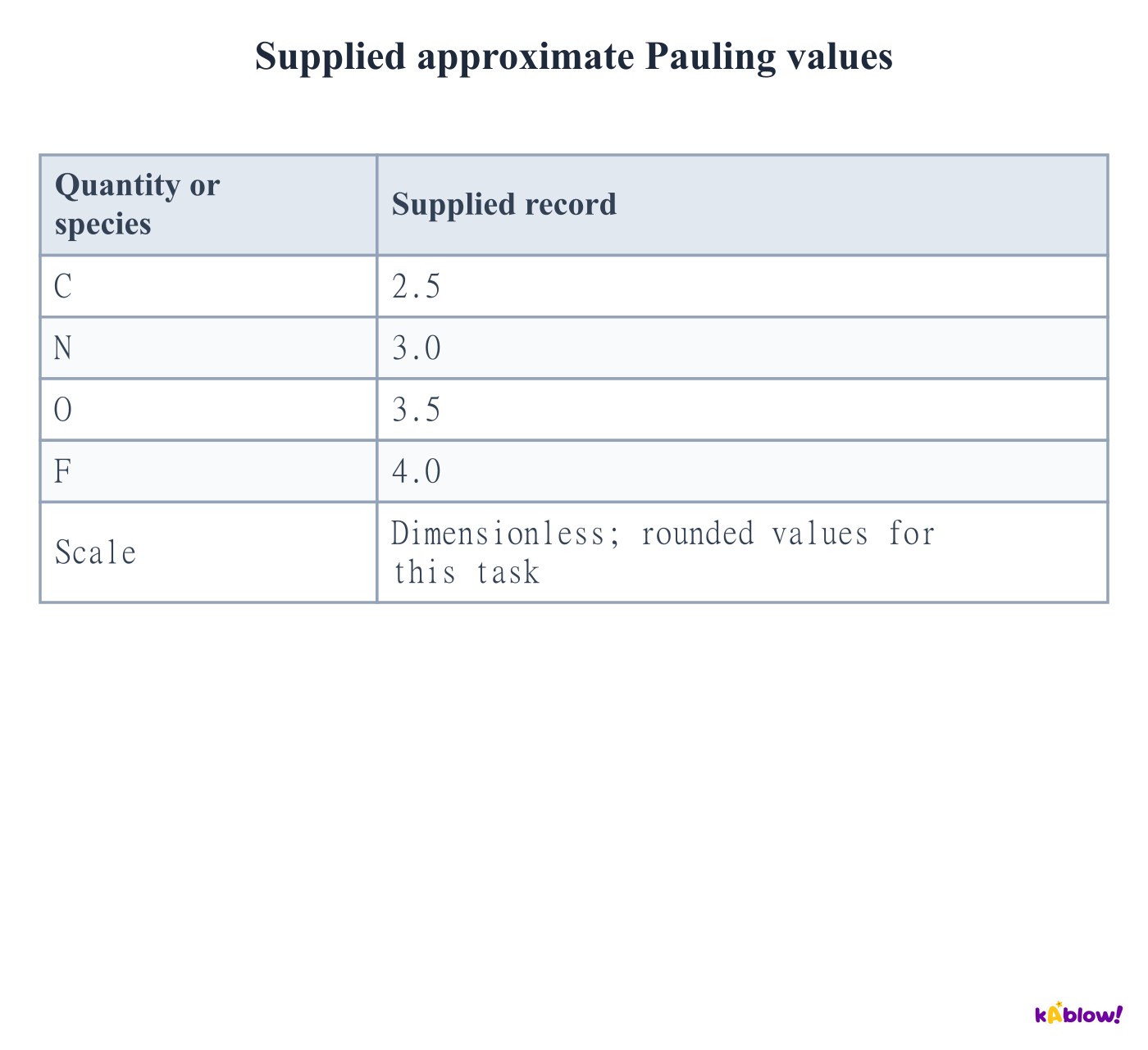
- Pauling values are dimensionless and scale-dependent. Fluorine is the most electronegative element on the usual scale; use supplied values rather than assigning unsupported values to all noble gases.
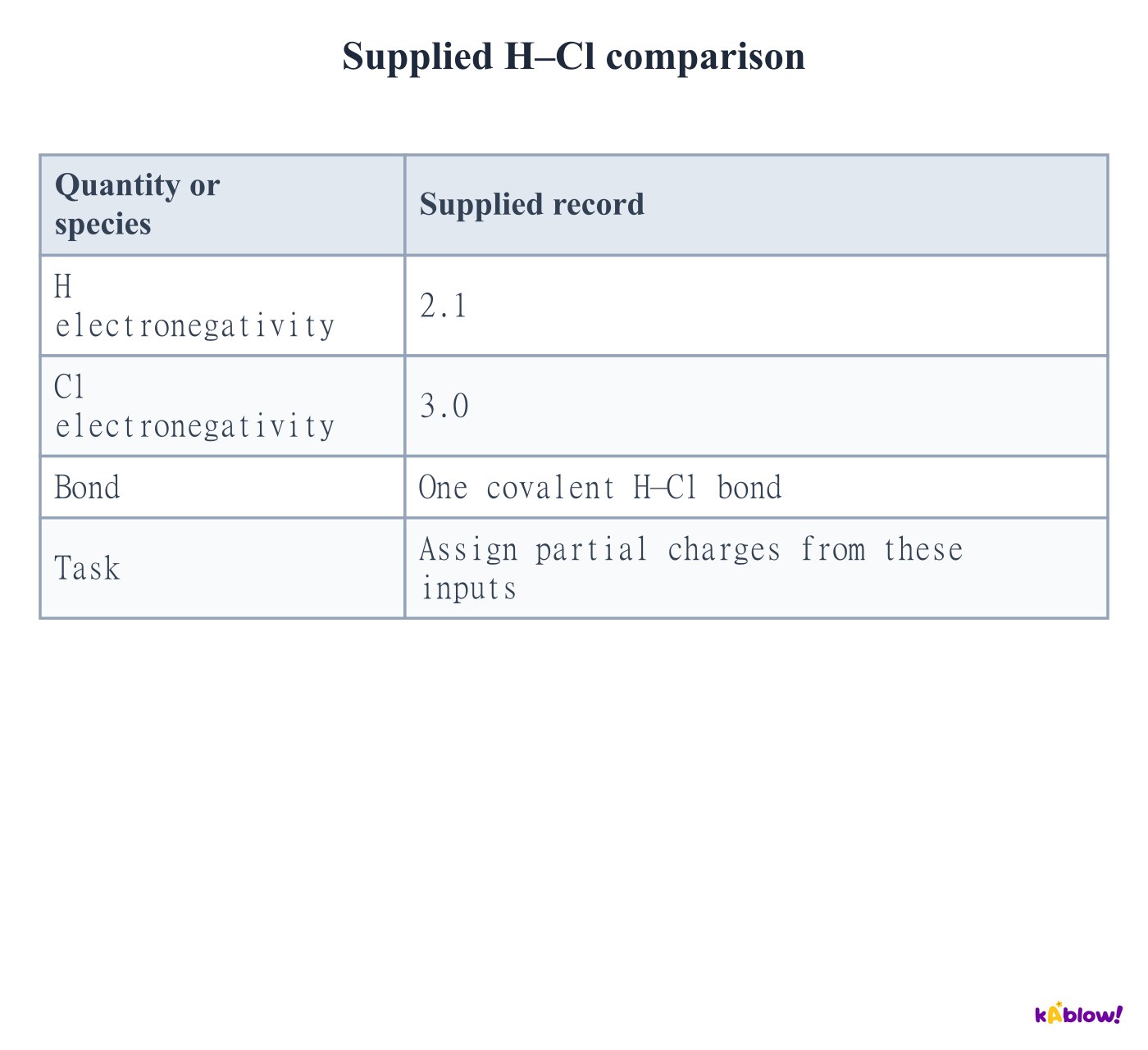
Supplied approximate Pauling values
Represent a polar covalent bond
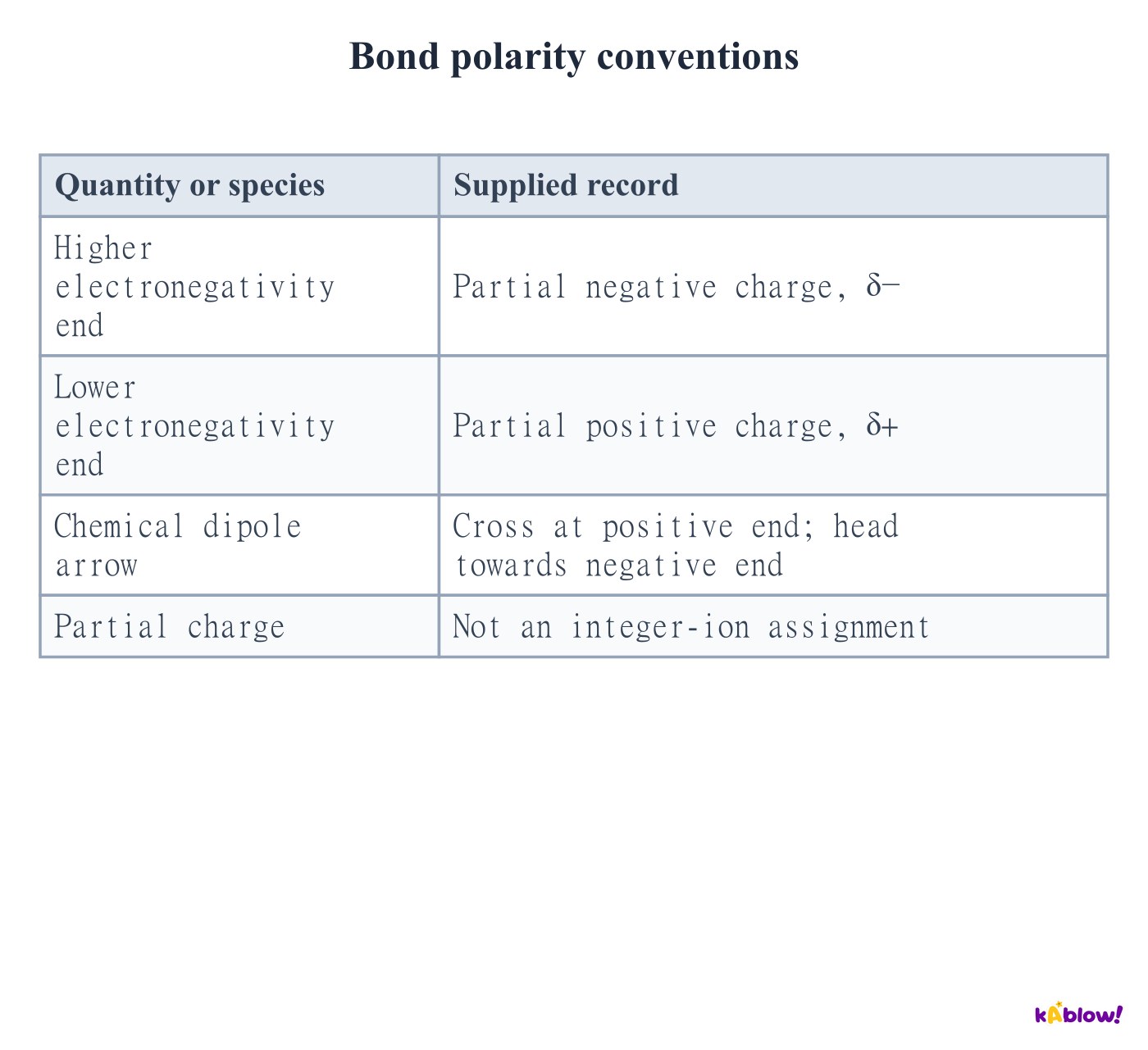
- Different electronegativities produce unequal sharing of electron density. The more electronegative atom carries δ− and its partner δ+ in the bond model.
- Partial charges do not mean that a complete electron has transferred or that the molecule consists of separate integer ions. A covalent bond can remain covalent while being polar.
- A chemical bond-dipole arrow points towards the negative end and has a cross at the positive end. Always identify the convention when comparing arrows from different scientific contexts.
Bond polarity conventions
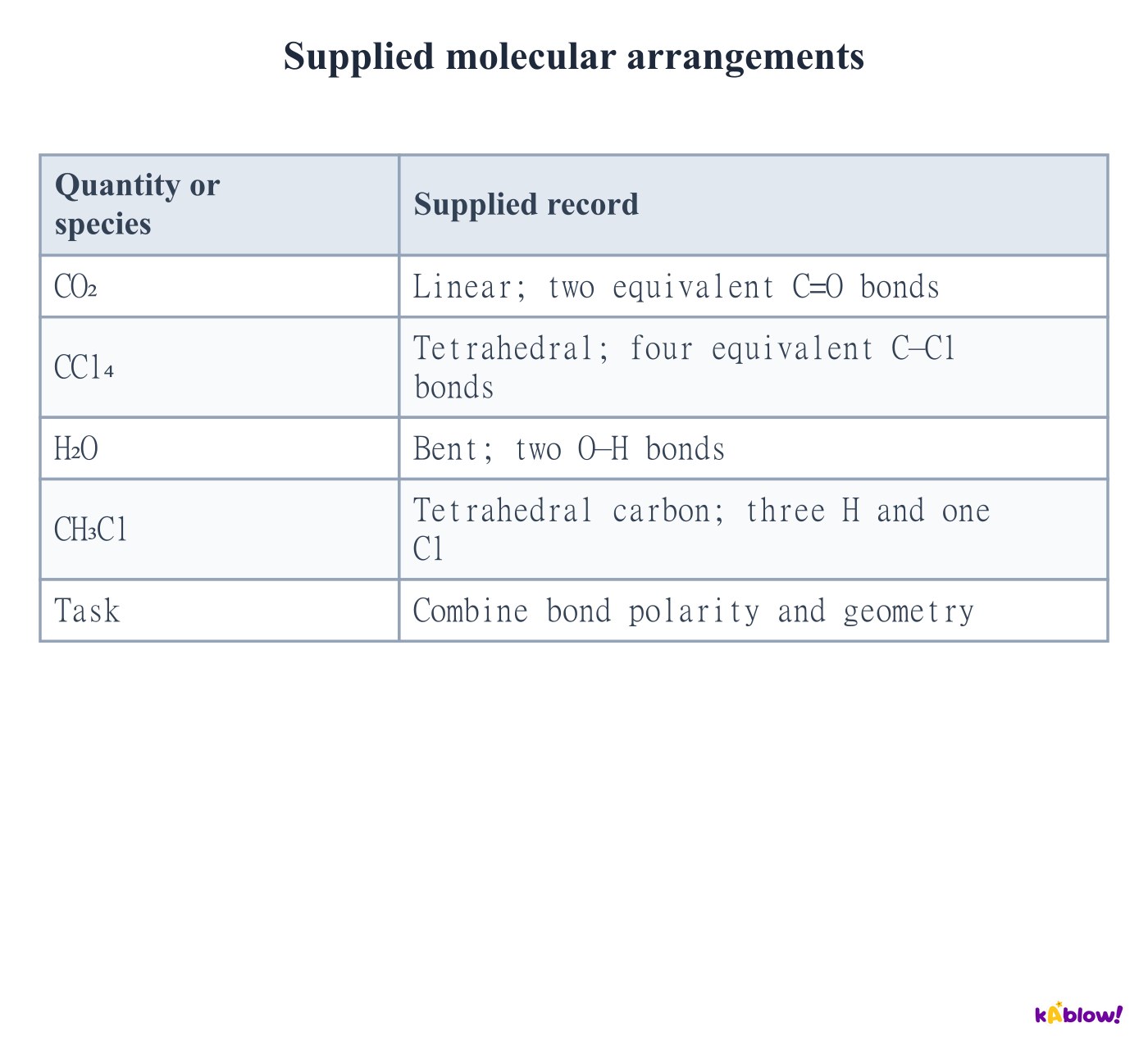
Decide whether bond dipoles cancel
- A polar bond does not automatically make a polar molecule. The vector sum of the bond dipoles depends on molecular geometry and the identity of the surrounding atoms.
- In linear CO₂, equal opposite C=O dipoles cancel. In trigonal planar BF₃ and tetrahedral CCl₄, the symmetric arrangements of equivalent bonds also cancel.
- Water’s bent geometry prevents the two O–H dipoles from cancelling. Replacing atoms around a tetrahedral centre can also remove cancellation, as in CH₃Cl.
Symmetric polar bonds with cancellation
Explain permanent dipole interactions
- Polar molecules have an uneven charge distribution and can orient with a δ+ region near a neighbour’s δ− region. Their electrostatic attraction is called a permanent dipole–dipole interaction.
- At finite temperature, molecules move and rotate, so the interaction is not a rigid head-to-tail chain of stationary particles. Orientation and separation affect the interaction.
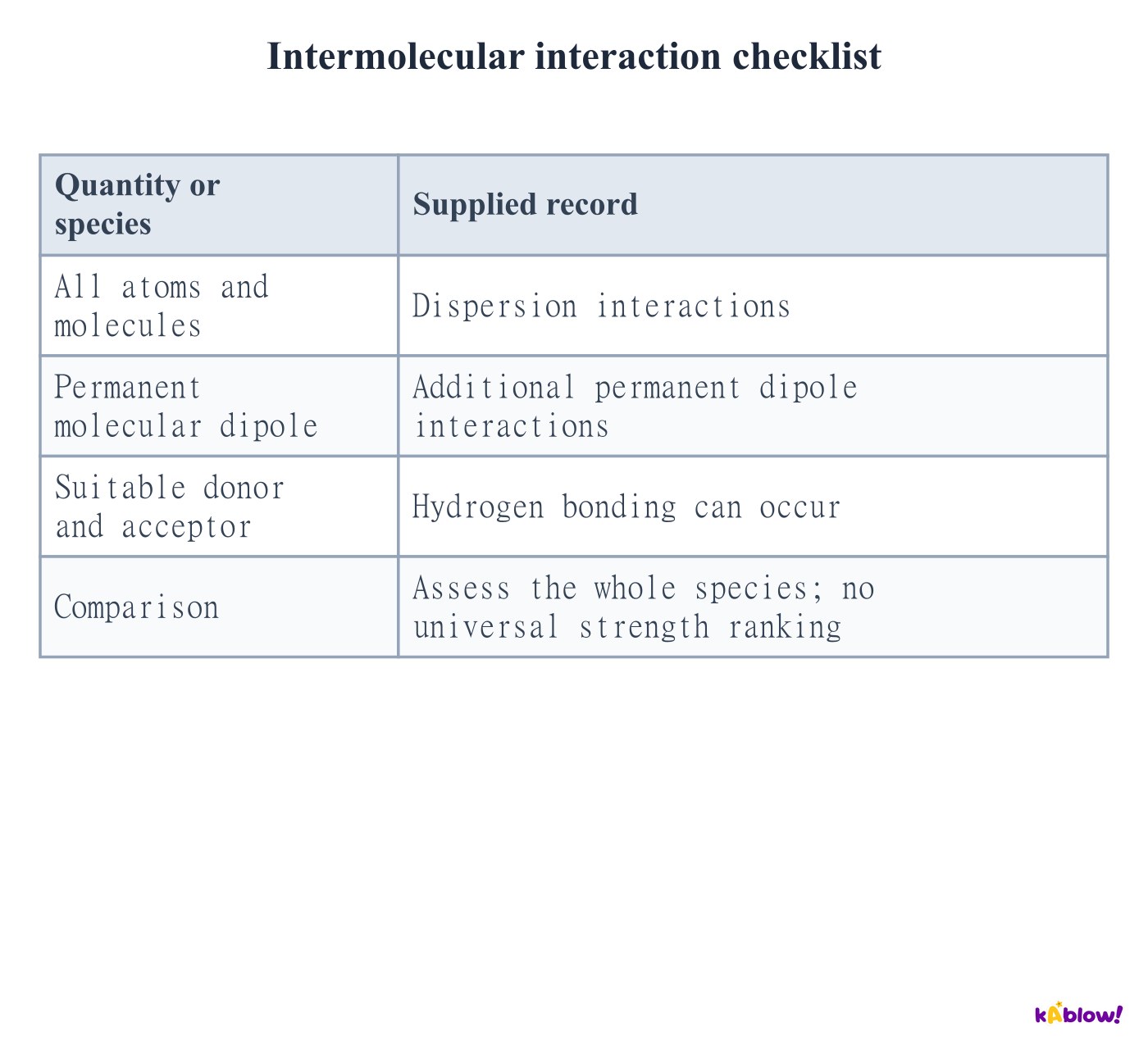
- Polar molecules also experience dispersion forces. Identifying a permanent dipole adds an interaction; it does not remove the others.
Intermolecular interaction checklist
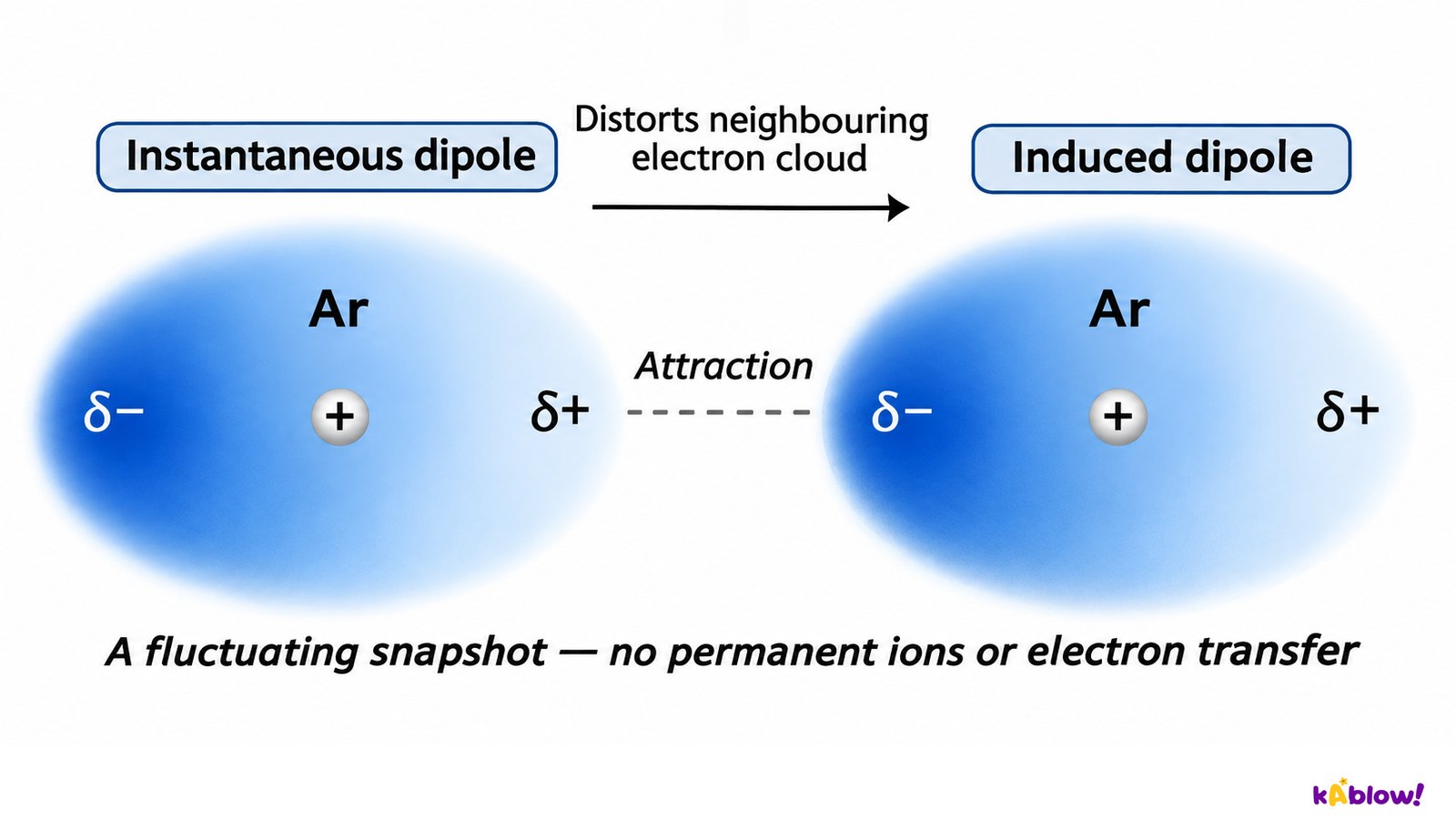
Explain instantaneous and induced dipoles
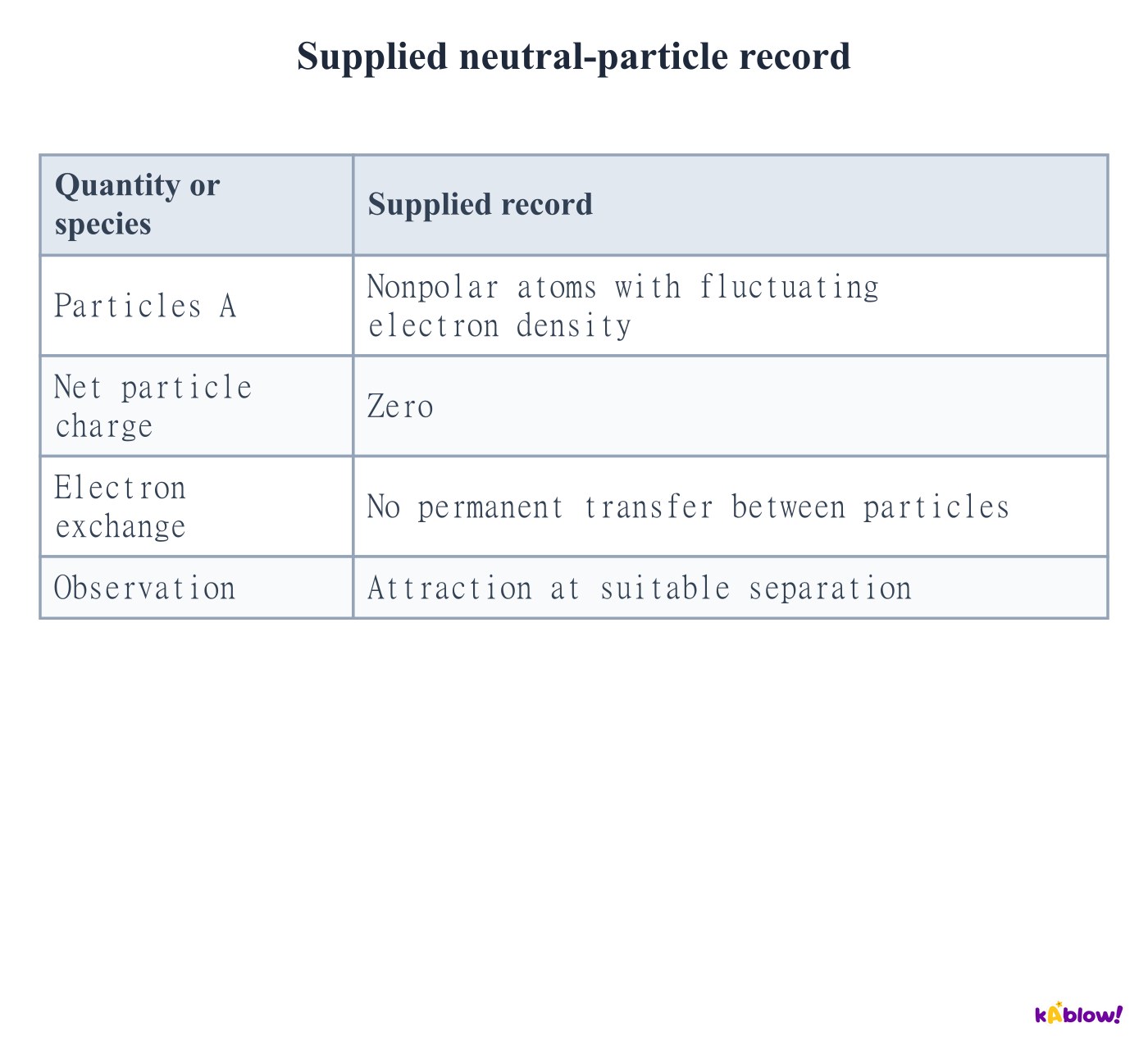
- Electron-density fluctuations can create an instantaneous dipole, which changes the electron distribution of a neighbouring particle and induces a correlated dipole.
- The resulting dispersion attraction exists between all atoms and molecules, including nonpolar particles. The dipoles fluctuate; this is not the transfer of an electron to make permanent ions.
- Larger, more easily distorted electron clouds are generally more polarisable. Electron number can support a comparison within related species, but is not a complete universal formula for attraction strength.
An instantaneous and an induced dipole
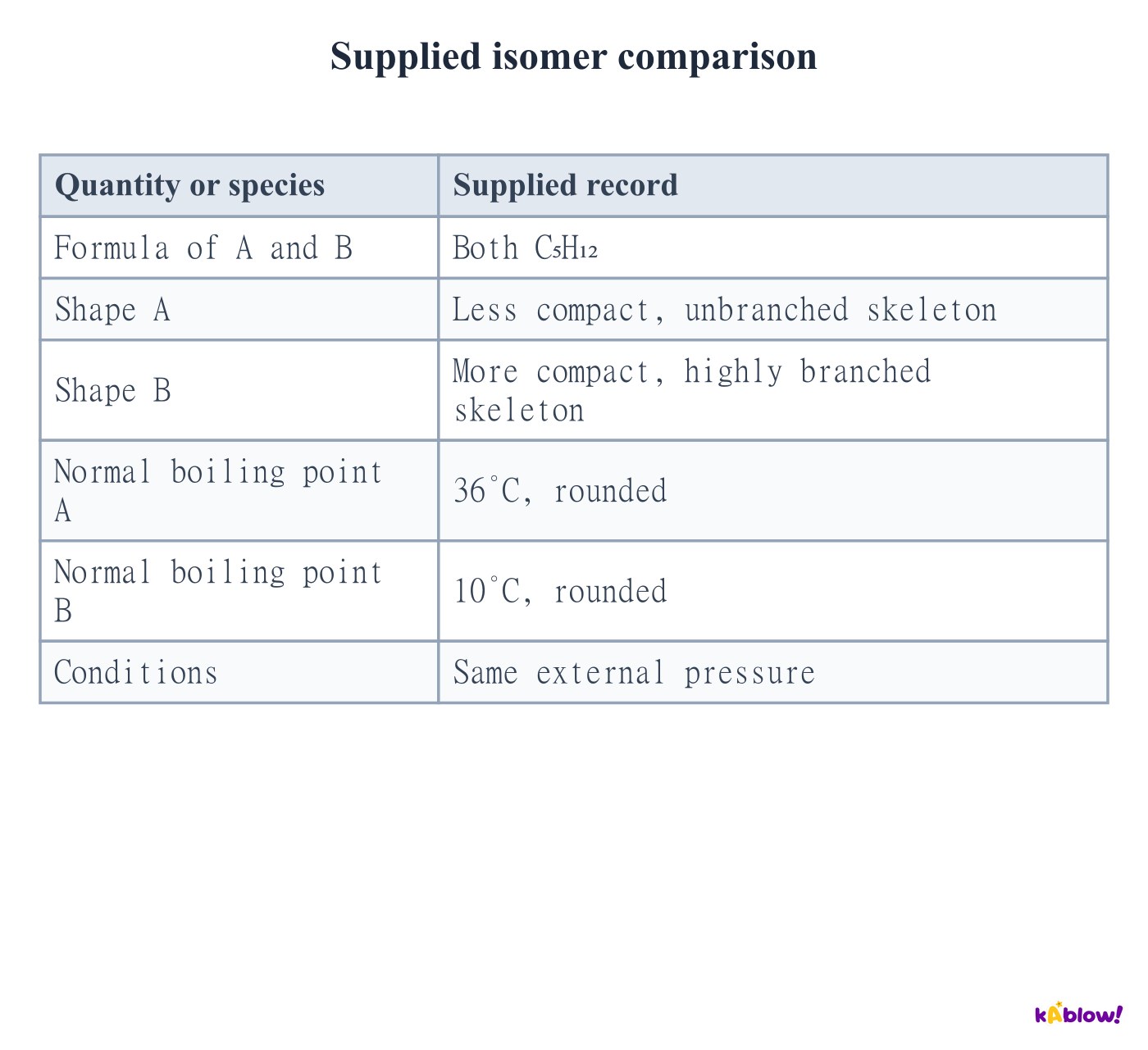
Compare polarisability and molecular contact
- Within a related series, larger electron clouds are often more polarisable, giving stronger dispersion interactions and higher boiling temperatures under the same pressure.
- For isomers, molecular shape affects close contact. A less compact shape can allow more extensive contact than a compact, branched shape and often has a higher boiling point.
- Keep variables and conditions explicit. Molecular mass alone does not determine boiling point, and melting points also depend strongly on crystal packing.
Supplied isomer comparison
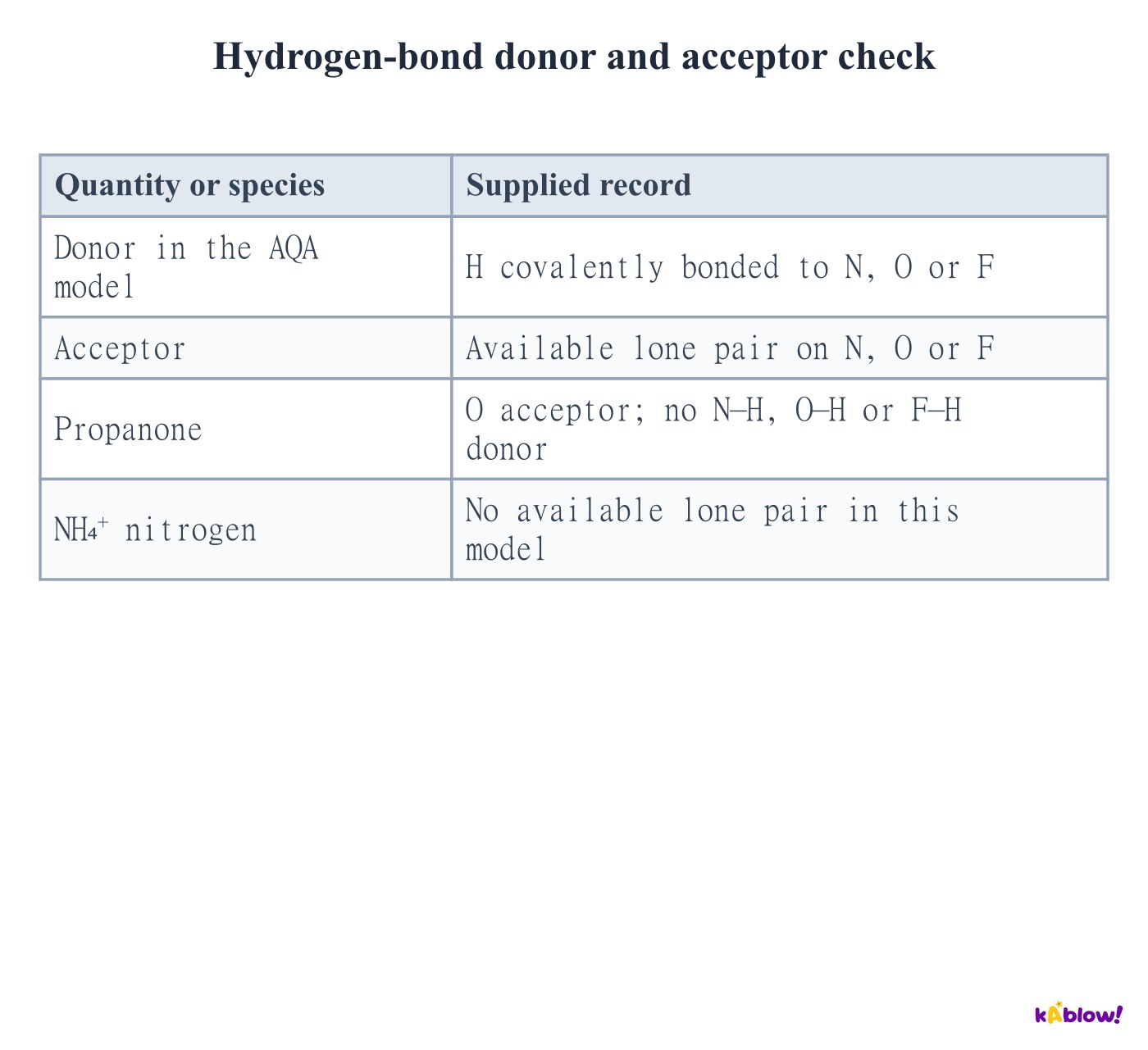
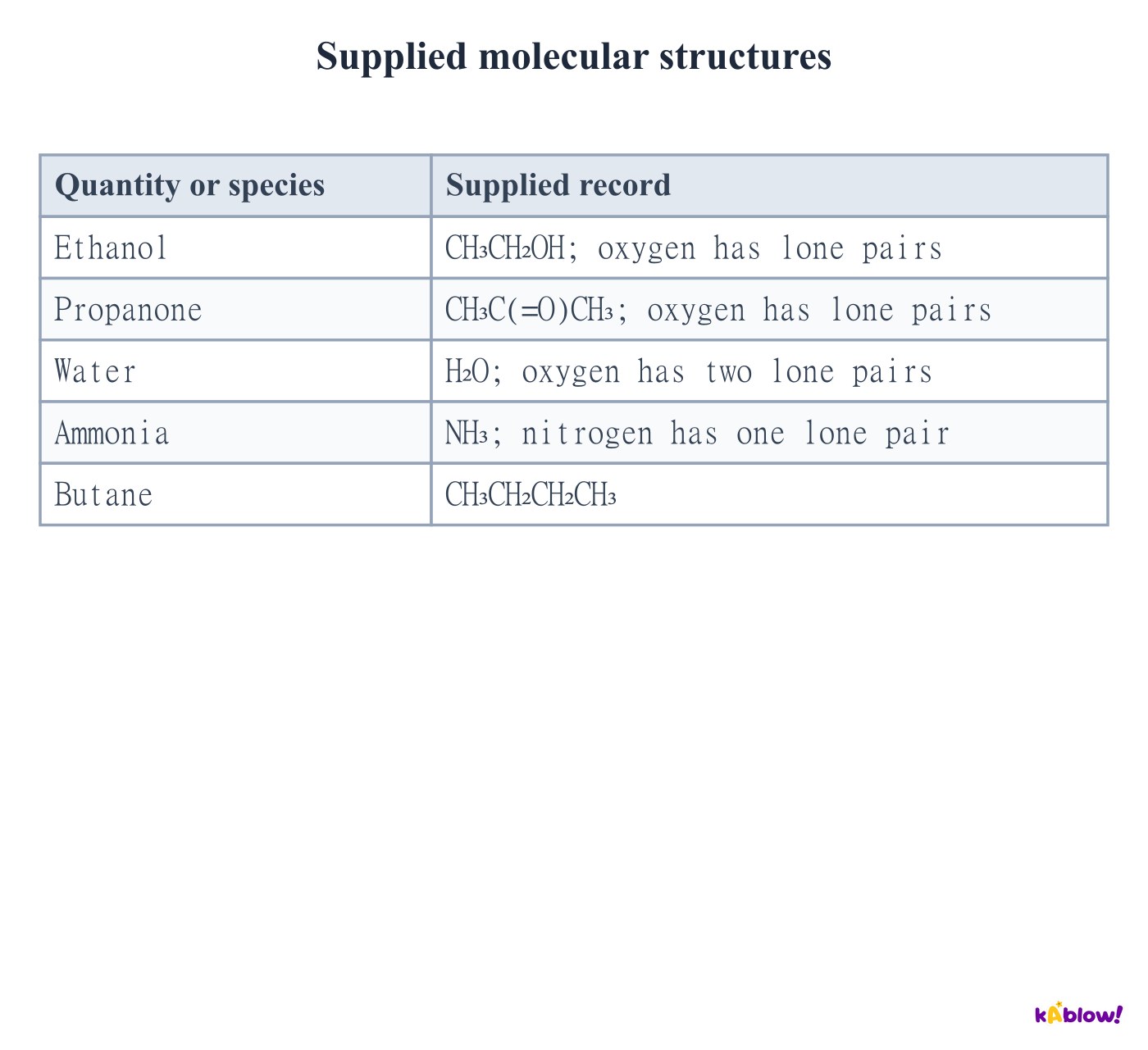
Identify hydrogen-bond donors and acceptors
- In the AQA model, hydrogen bonding involves H covalently bonded to N, O or F and an available lone pair on an N, O or F acceptor nearby.
- Distinguish the covalent donor bond from the intermolecular H···acceptor contact. An oxygen atom without an O–H bond can accept a hydrogen bond from water even if its own pure liquid lacks a donor.
- Check availability of the lone pair, not just the presence of a nitrogen symbol. For example, the nitrogen in NH₄⁺ has no lone pair available to accept in this simple model.
Hydrogen-bond donor and acceptor check
Count water’s hydrogen-bond contacts
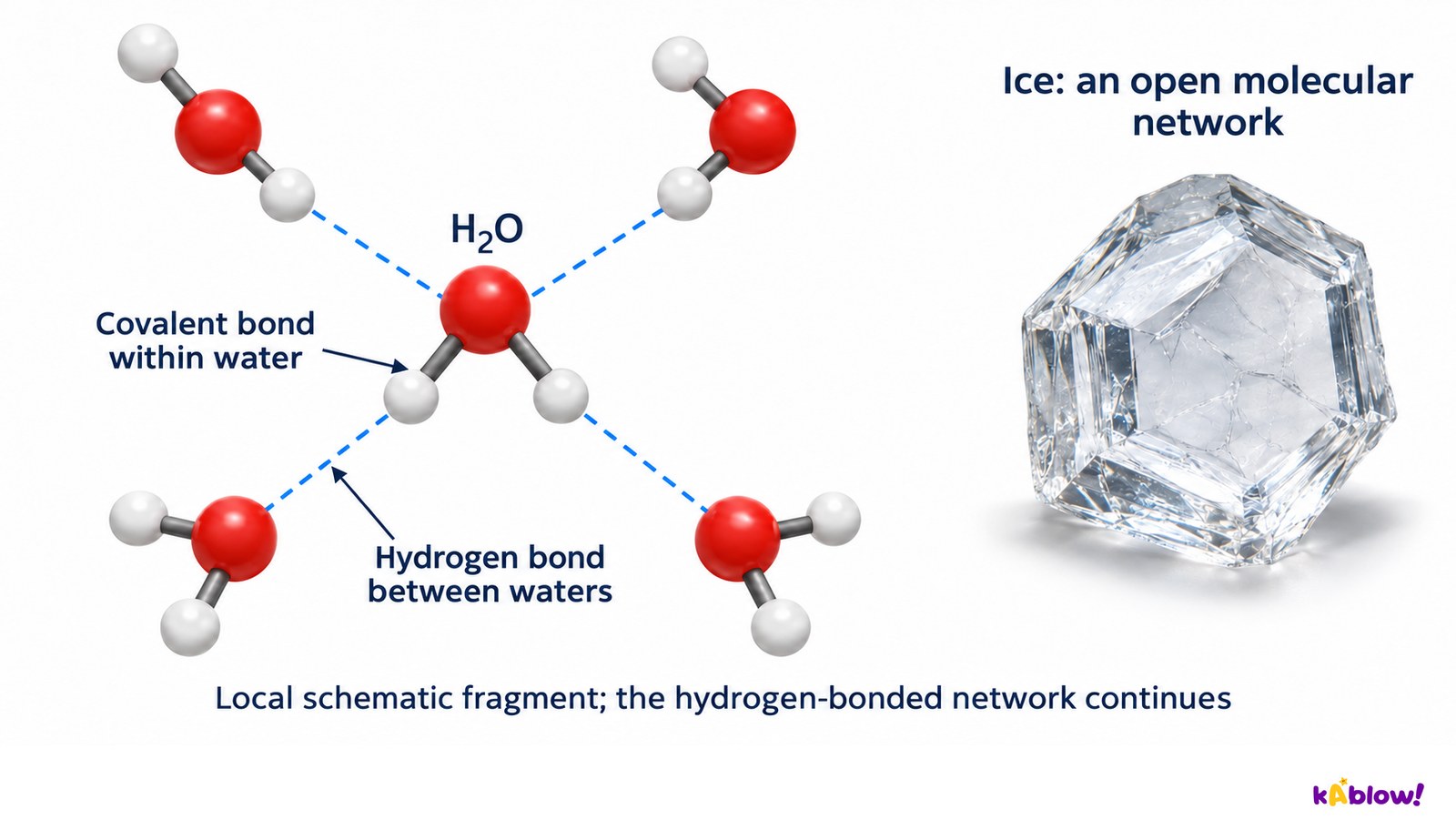
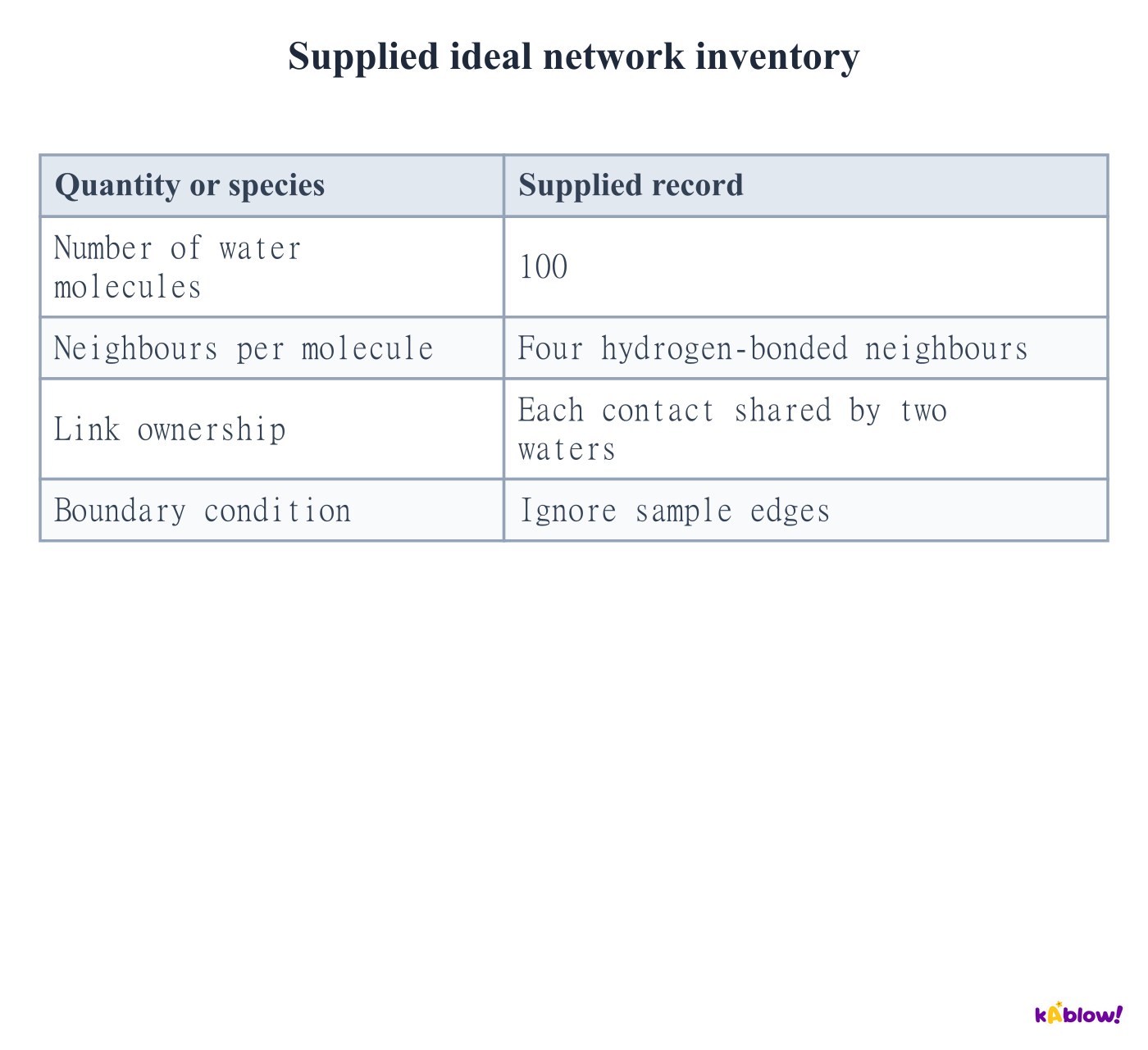
- A water molecule can donate through two O–H groups and accept through its two oxygen lone pairs. In an ideal ice-like network, it can therefore have four hydrogen-bonded neighbours.
- The local fragment illustrates two donated and two accepted contacts around the central molecule. Its O–H covalent bonds remain inside the water molecules.
- When counting network links, each intermolecular contact belongs to two neighbouring waters. Multiplying molecule count by four and stopping there counts every link twice.
A local hydrogen-bonded ice fragment
Compare the forces present in a pure liquid
- First establish molecular geometry and polarity, then identify donors and acceptors. All molecules have dispersion; polar molecules add permanent dipole interactions; suitable donor–acceptor pairs permit hydrogen bonding.
- Ethanol can hydrogen-bond between its own molecules. Propanone accepts hydrogen bonds from water but lacks the required donor for the same self-association pattern in the AQA model.
- Avoid an absolute strength ranking across arbitrary substances. A large nonpolar molecule can have stronger total intermolecular attraction than a small polar molecule; compare the entire molecular system.
Intermolecular interaction checklist
Explain boiling using intact molecules
- Boiling separates molecules against intermolecular attractions. It does not normally break the covalent bonds within every molecule or convert the sample into isolated atoms.
- At the same external pressure, stronger overall intermolecular attraction generally requires a higher temperature for boiling. Always state the pressure when comparing boiling temperatures.
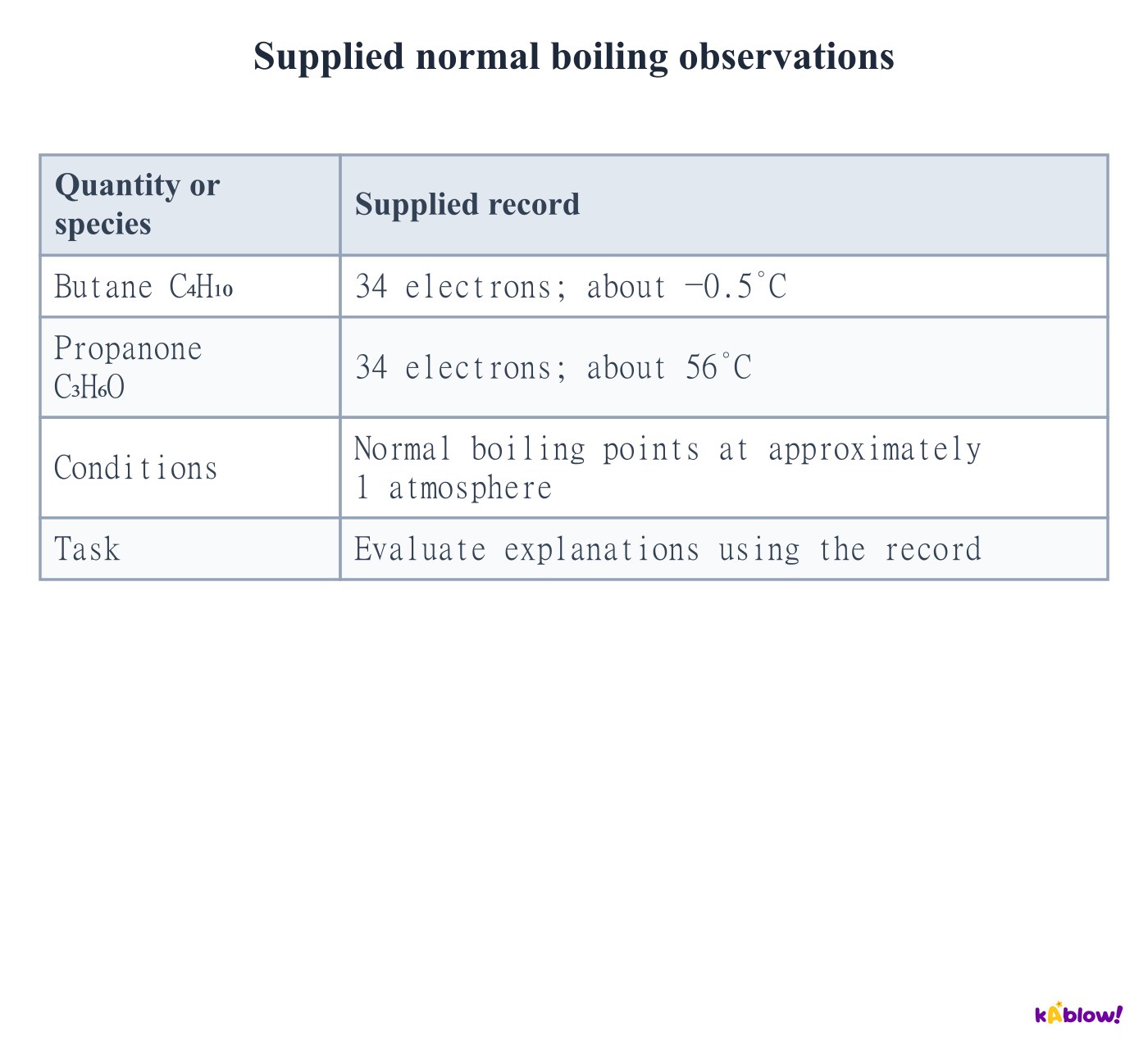
- Butane and propanone each have 34 electrons, yet their normal boiling points differ markedly. Propanone’s permanent dipole contributes to stronger overall cohesion; both liquids still have dispersion interactions.
Supplied normal boiling observations
Explain water’s anomalous boiling behaviour
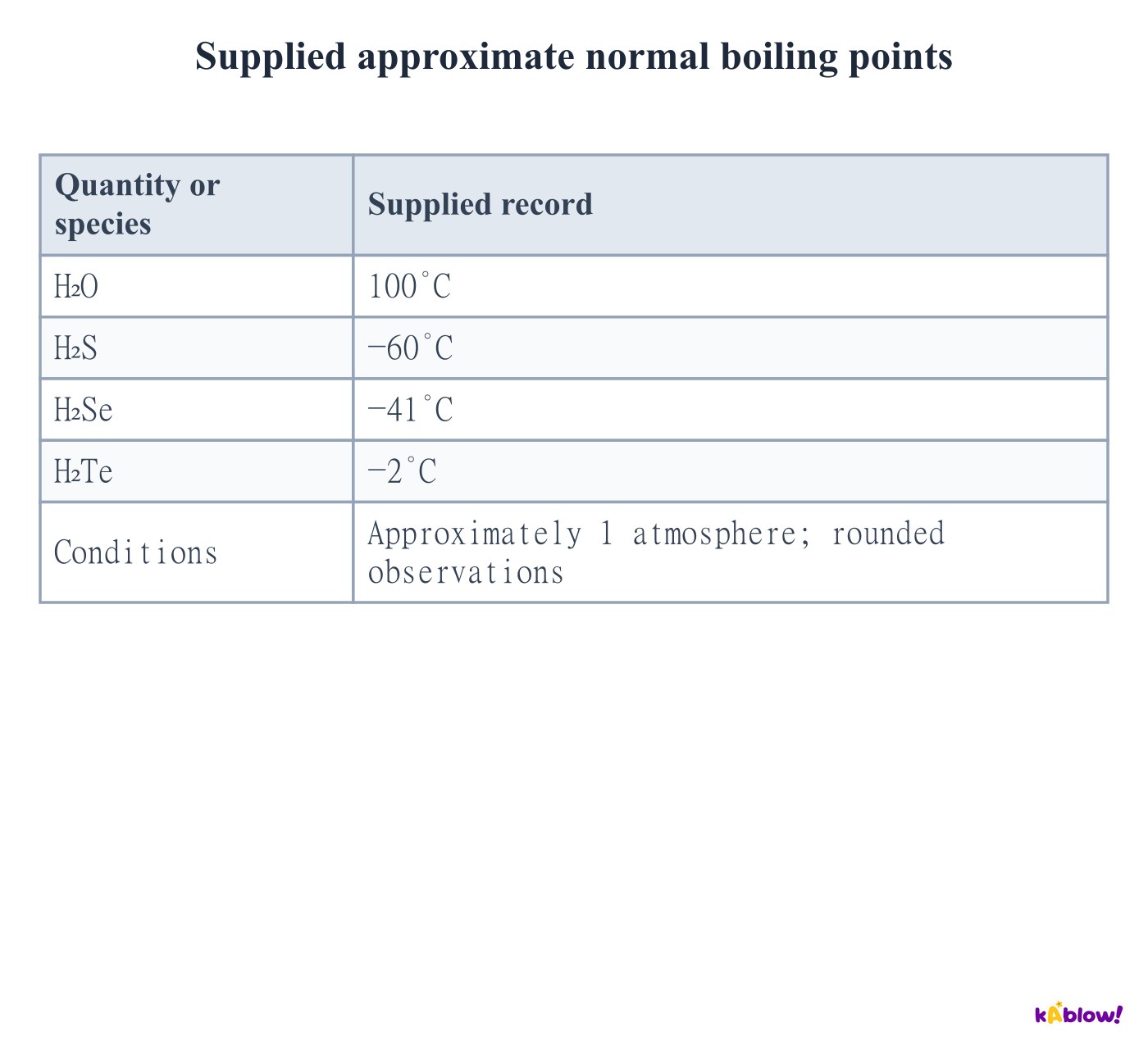
- H₂S, H₂Se and H₂Te show a broad increase in normal boiling point as electron clouds become more polarisable. These bent polar molecules have permanent-dipole interactions as well as dispersion.
- Water has a much higher normal boiling point than a simple extrapolation from the heavier hydrides would suggest. Extensive hydrogen bonding provides an additional important contribution.
- Do not attribute the heavier hydrides exclusively to dispersion or calculate an exact hypothetical water boiling point without a justified model. Use the supplied observations to support a qualitative explanation.
Supplied approximate normal boiling points
Relate ice structure to density
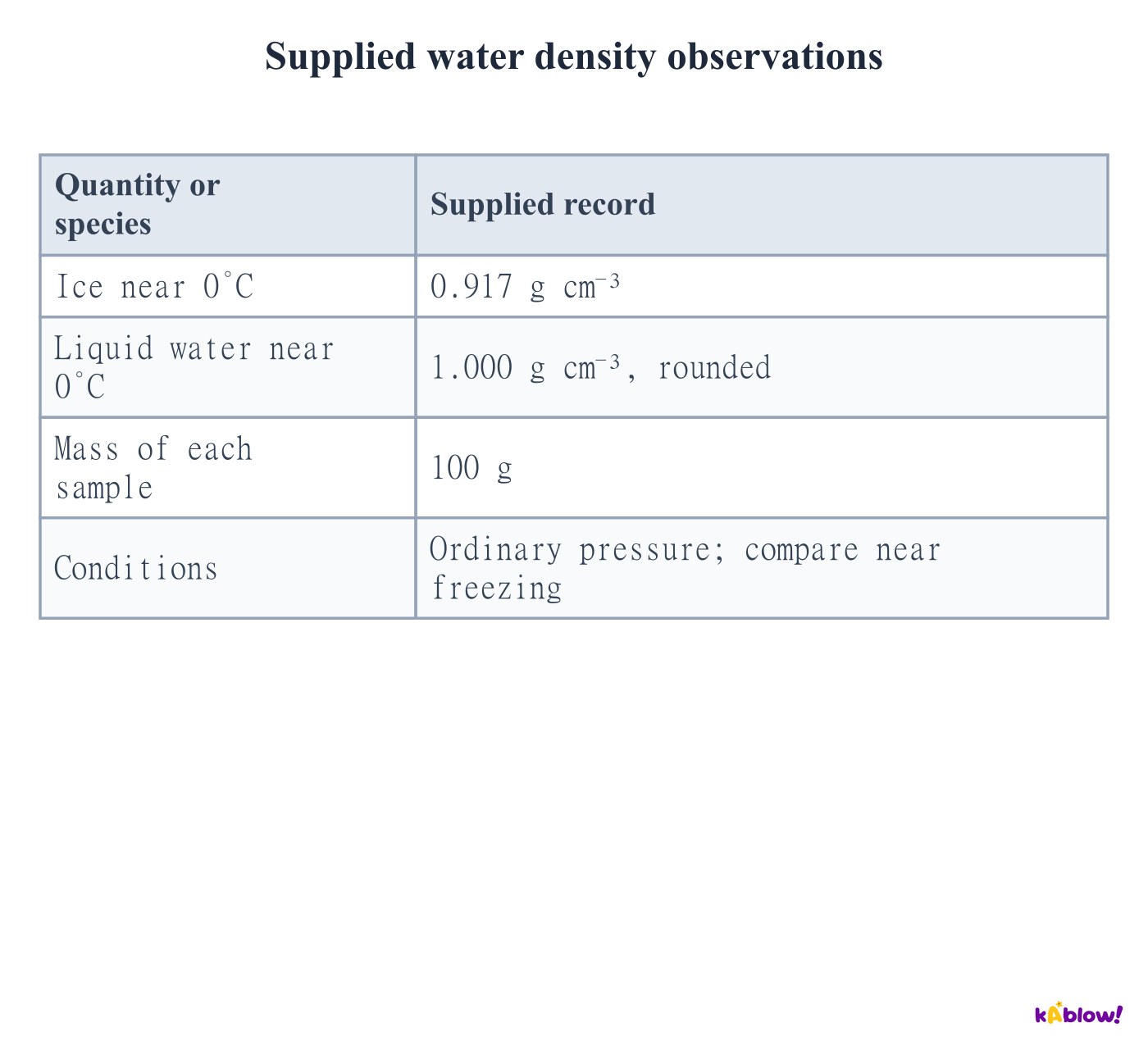
- Near the freezing point at ordinary pressure, ice has a more open hydrogen-bonded arrangement than liquid water. Four-neighbour local coordination helps form this extended structure.
- On melting, the network partly reorganises and molecules can pack more closely on average. The same mass then occupies less volume, so liquid water is denser under these conditions.
- Ice floating does not imply that every solid is less dense than its liquid or that water molecules themselves become larger. Retain the temperature and pressure conditions in the comparison.
A local hydrogen-bonded ice fragment
Explain surface tension without a rigid-skin model
- Surface tension can be expressed as force per unit length or surface free energy per unit area. Creating more liquid surface requires energy because surface molecules have a different neighbour environment.
- Water’s cohesive hydrogen-bond interactions contribute to its substantial surface tension. Inward attraction at a surface is a useful qualitative model, not a literal solid membrane or a guarantee that an object will be supported.
- A force calculation must identify how many contact lines contribute and whether a contact-angle factor applies. Use the supplied simplified model rather than inventing extra factors.
Supplied simplified surface-force model

Evaluate what physical-property evidence establishes
- Melting points depend on both interactions and crystal packing. A higher melting point does not by itself prove a specific intermolecular mechanism or a particular molecular geometry.
- Use a valid structure, polarity analysis and donor–acceptor assessment alongside controlled physical-property data. Keep observations separate from the explanation proposed for them.
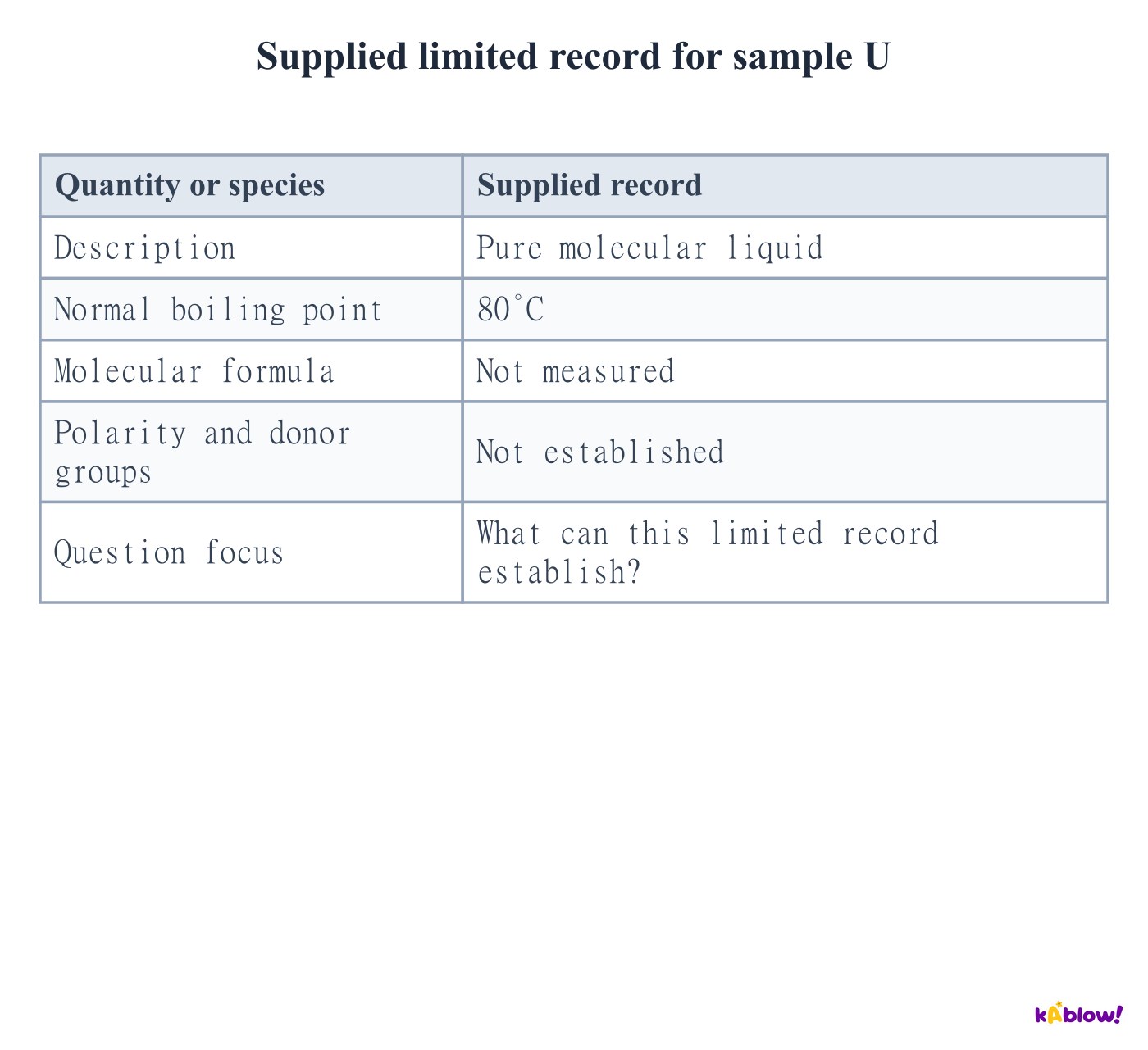
- For an unfamiliar substance, identify what is known, what is inferred and which extra evidence could distinguish alternatives. A single boiling value cannot uniquely determine its molecular formula.
Supplied limited record for sample U
Slides
Sign up free to view the lesson slides
Step through every slide for this topic — plus flashcards and revision notes — with a free account.
Practice questions
Free preview — 8 of 60 questions. Sign up to see them all.
1.Which supplied species has exactly two electron domains in total around its central atom?
Medium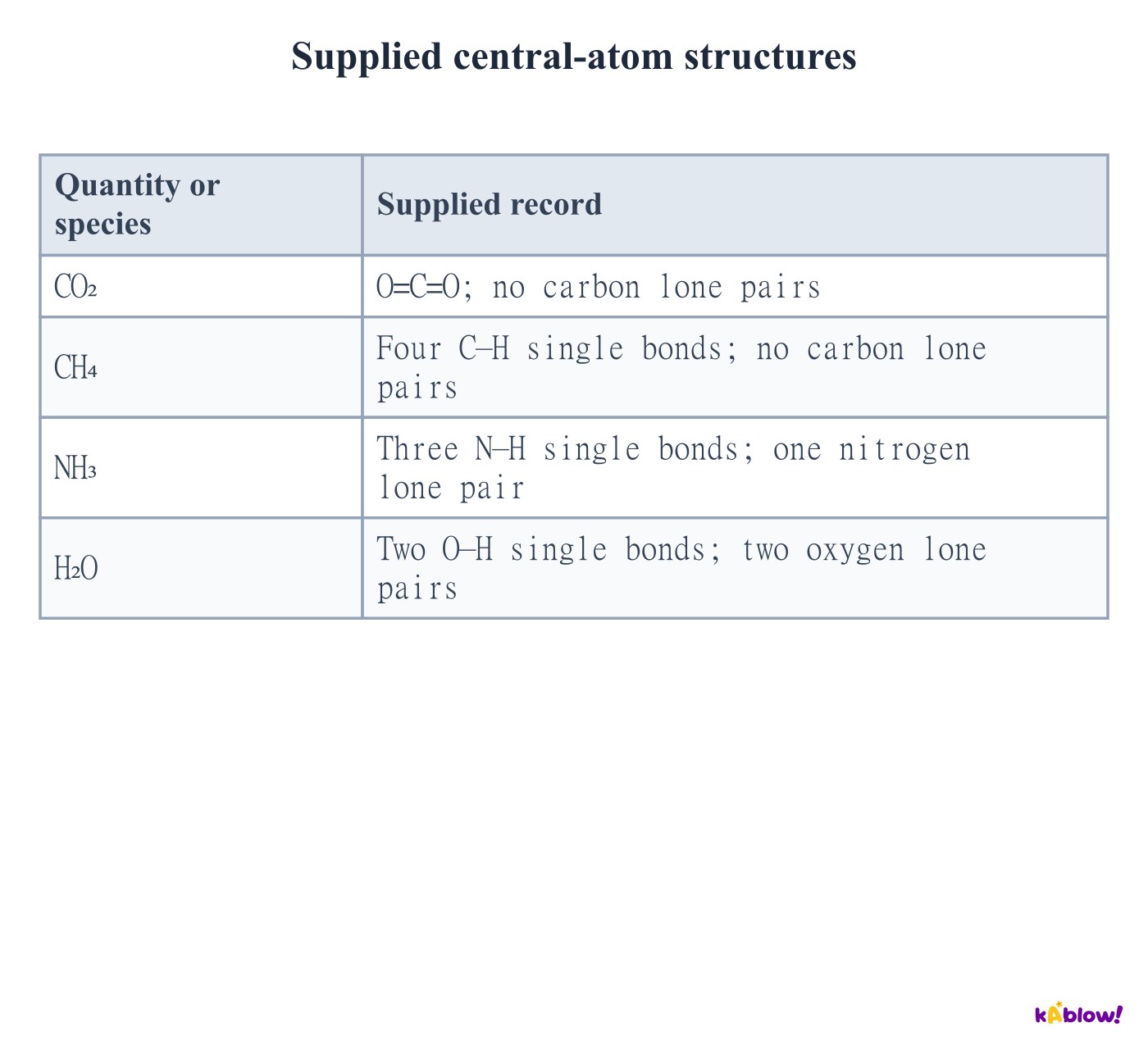
- ACO₂
- BCH₄
- CNH₃
- DH₂O
2.What is the molecular shape for supplied centre C?
Medium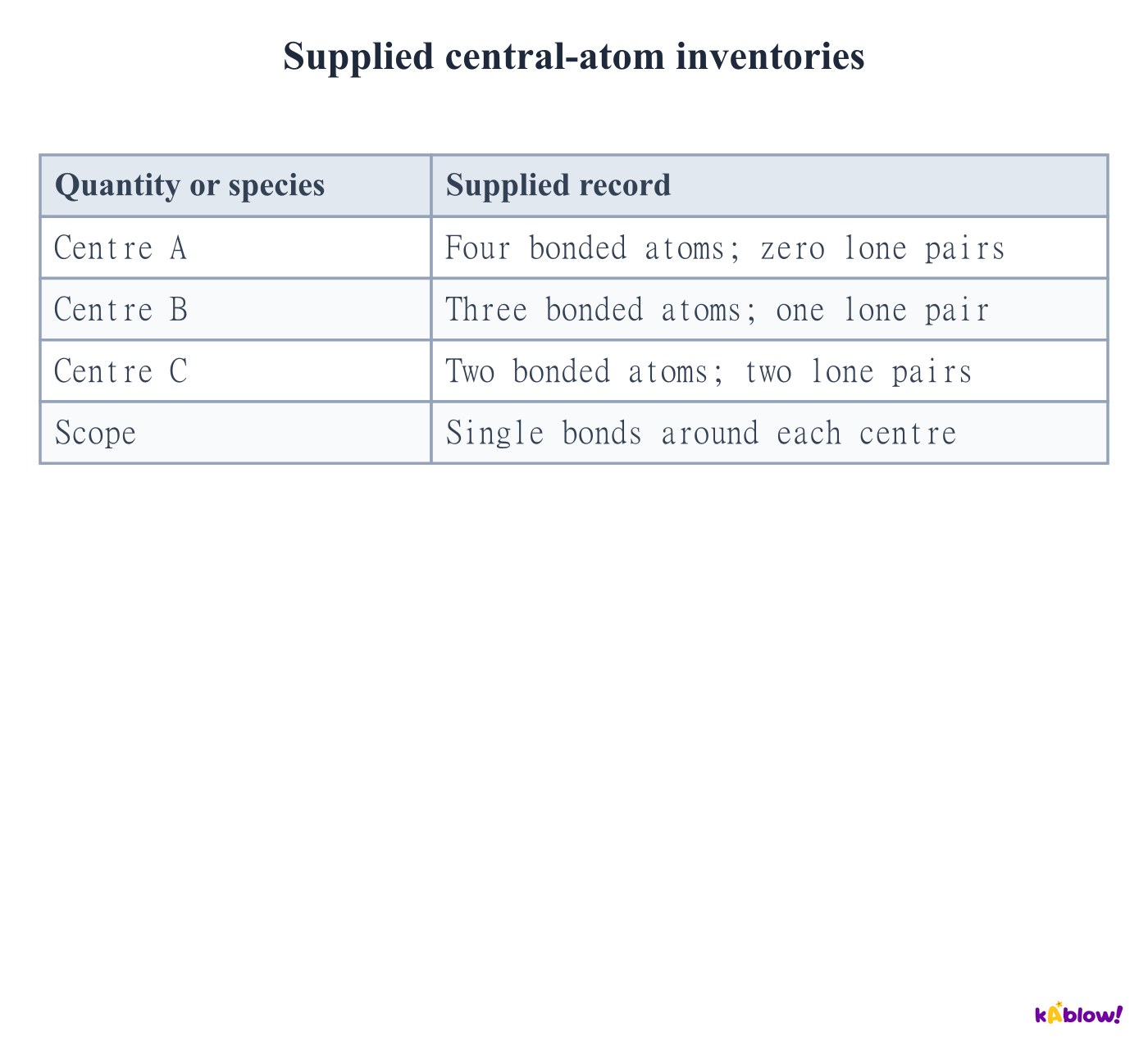
- ATetrahedral
- BTrigonal pyramidal
- CBent
- DLinear
3.What ideal bond angle follows for supplied centre D?
Medium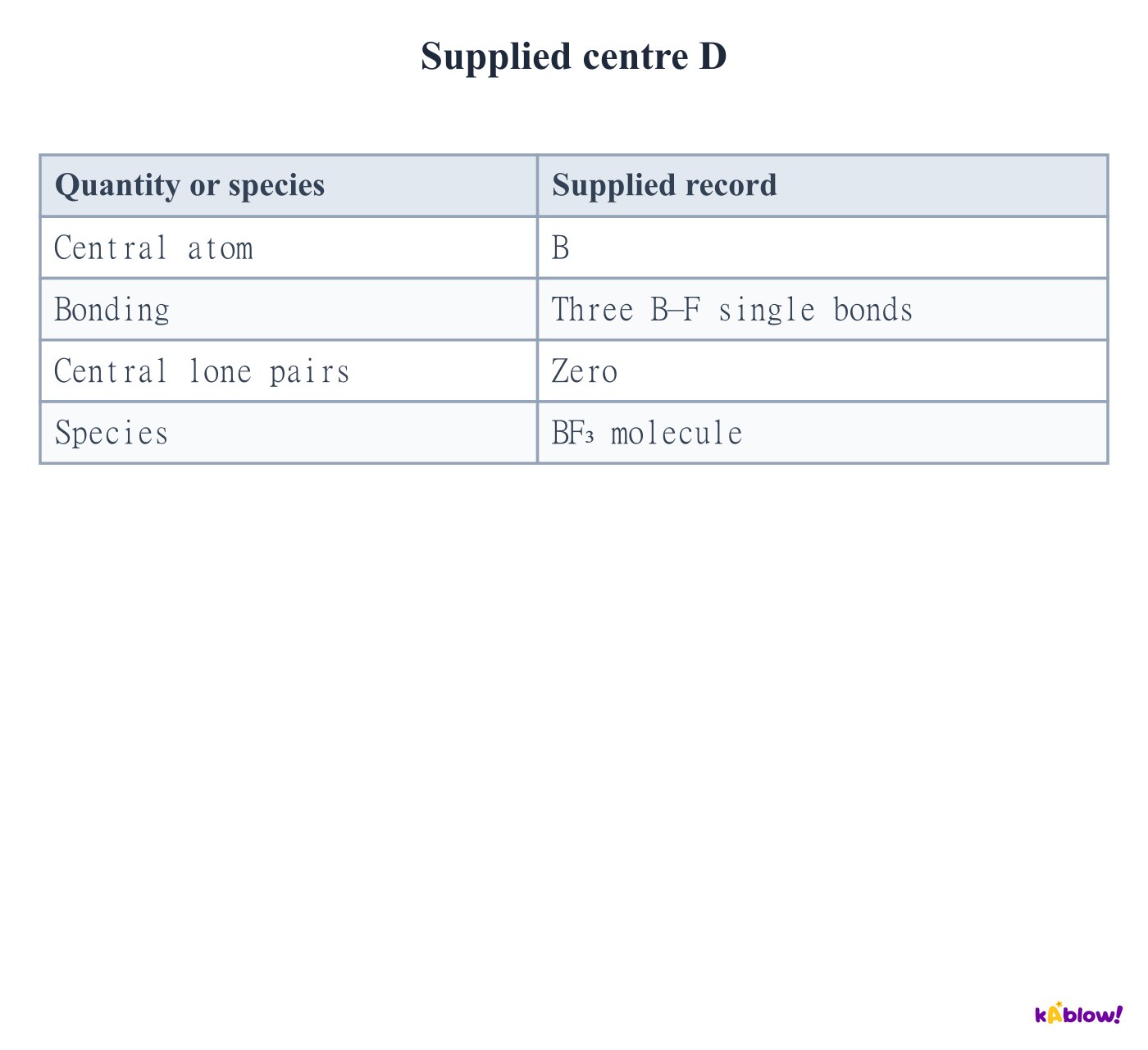
- A90°
- B109.5°
- C120°
- D180°
4.Which supplied centre has a trigonal pyramidal molecular shape?
Medium- AA
- BB
- CC
- DAll three
5.Which claim is justified by the supplied NH₃ and H₂O measurements?
Medium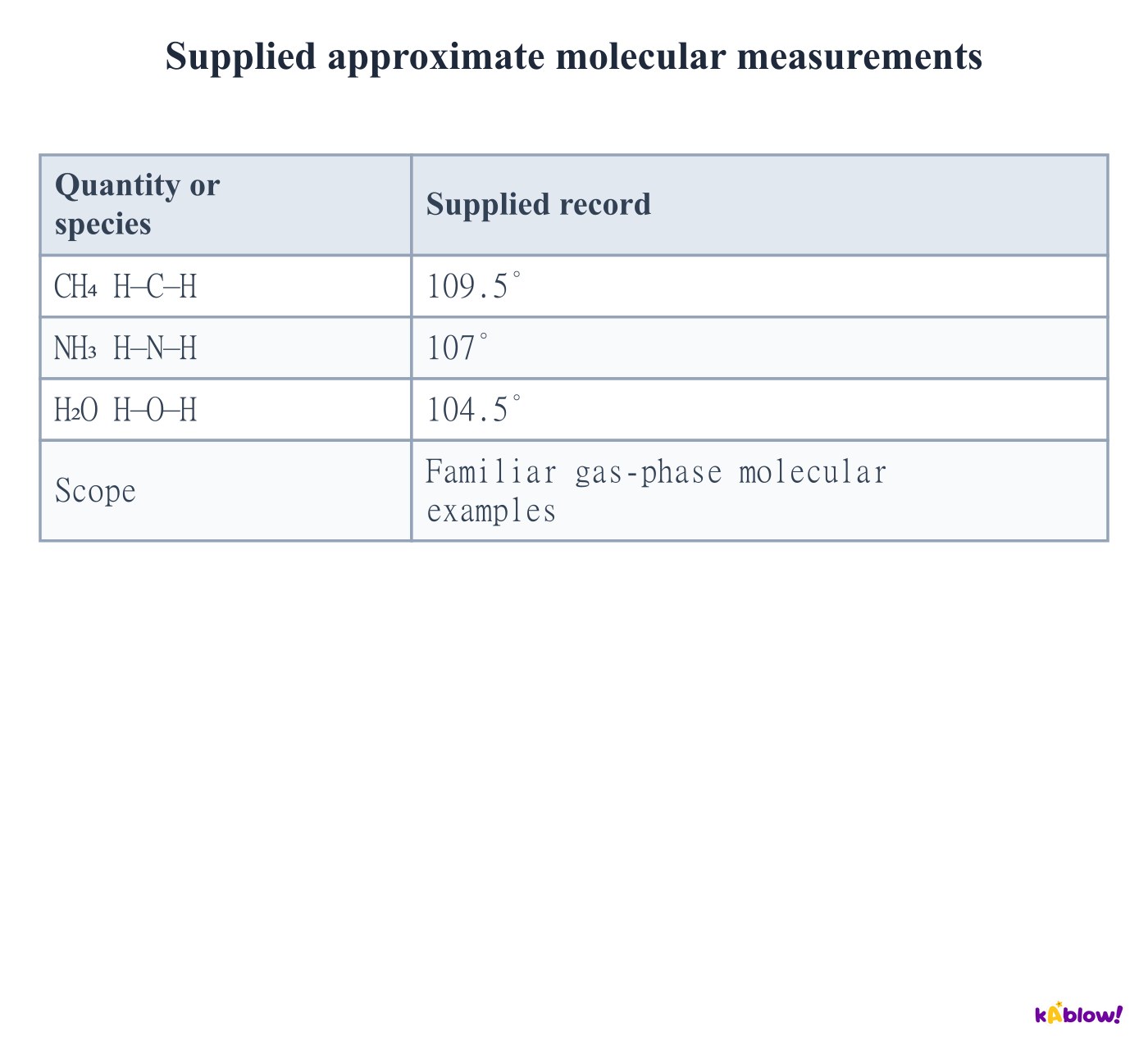
- AEvery lone pair reduces every angle by exactly 2.5°
- BThese two molecules have angles below 109.5°
- CWater is linear
- DBoth species have no lone pairs
6.How many central lone pairs remain in supplied H₃O⁺?
Medium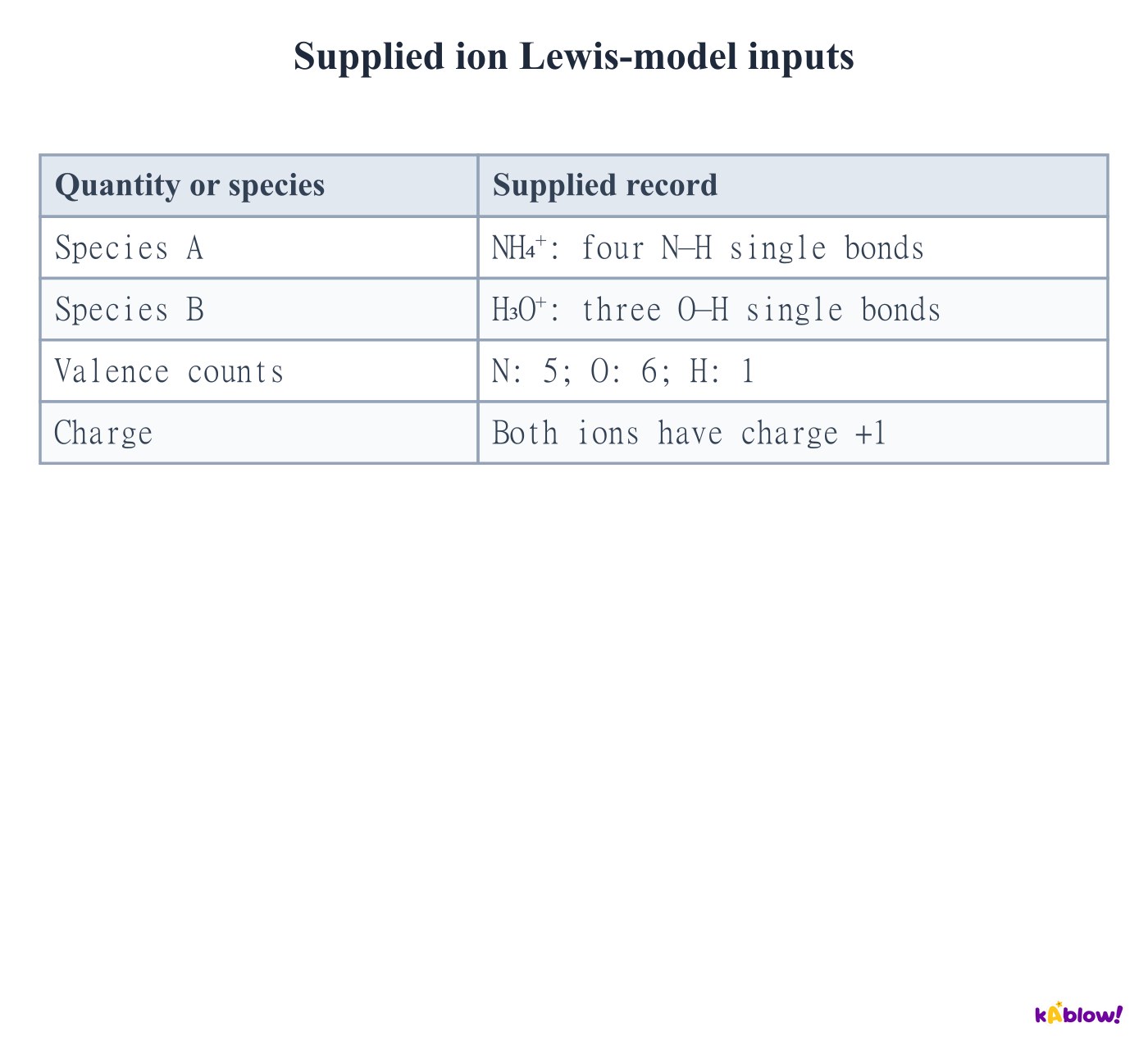
- A0
- B1
- C2
- D3
7.Which angle is missing from the proposed complete PF₅ list of 90° and 120°?
Medium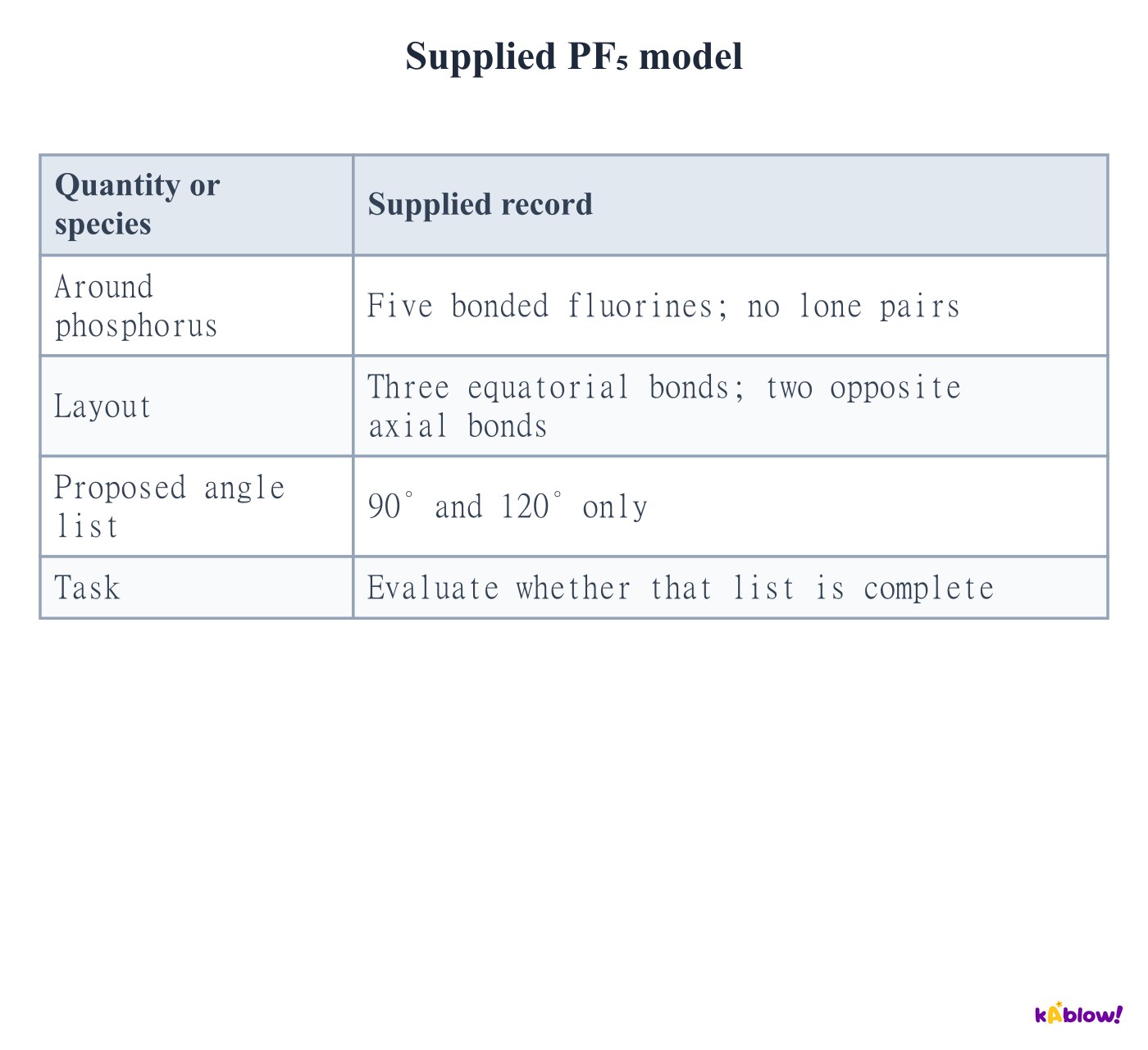
- A60°
- B104.5°
- C109.5°
- D180°
8.What molecular shape follows for supplied centre F?
Medium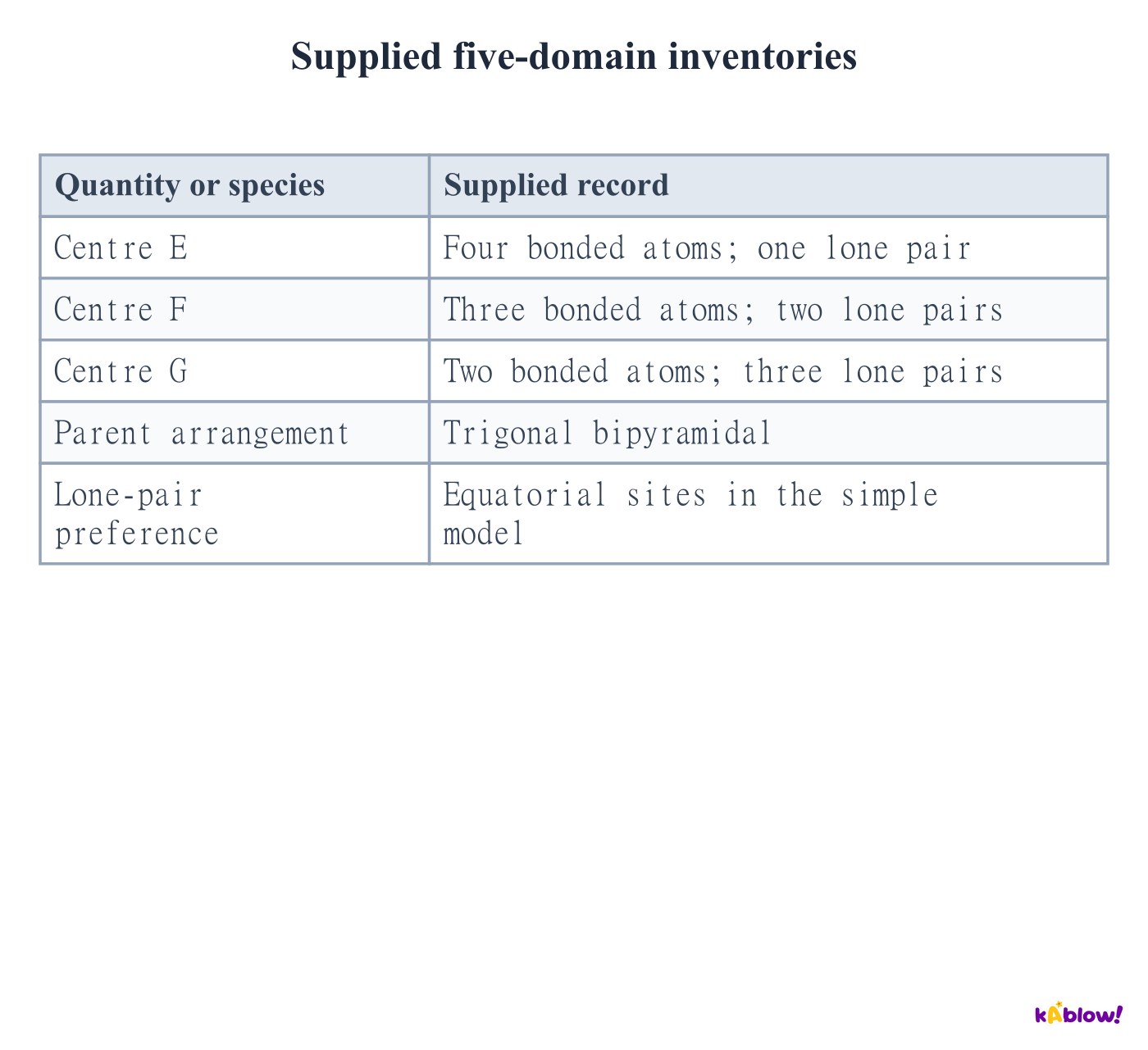
- ATrigonal planar
- BT-shaped
- CTetrahedral
- DOctahedral
Unlock all 60 questions, flashcards & more
Create a free account to see every question, the slides, flashcards and revision notes for this topic.