
Analysing and responding to artists' work
Learn it by playing
Answer these questions to earn energy, then fish and explore. No account needed.
For educators: ready-to-use lesson slides, revision notes for Analysing and responding to artists' work (Art and Design, Critical and Contextual Study) — use them in your lesson, or run the topic as an interactive class activity your learners play as a live game.
Lesson notes
Observation, analysis and interpretation
- Describe observable subject, marks, colours, forms or spaces, then examine how relationships between them work. Interpretation proposes a meaning or atmosphere supported by those observations and relevant evidence.
- Evaluation makes a reasoned judgement against an intention or criterion. These operations can interact rather than follow a compulsory four-paragraph recipe. A possible effect should not be presented as a fact about every viewer.
Four useful thinking operations
Context and sources
- Investigate the work’s relevant time, place, material, audience, purpose and cultural setting. An artist’s recorded statement can inform an enquiry into intention, but should still be read critically and in context.
- Primary and secondary depend on the research question, not simply on whether the source is a book or website. Attribute the maker’s statement, a historian’s interpretation and your own response separately; a date alone does not establish a private emotion.
Identify the basis of a claim
Visual language and vocabulary
- Visual language is how elements and relationships communicate or create effects; vocabulary supplies words such as composition, contrast, palette, brushwork and medium to discuss it. Use a term to explain a specific feature rather than to decorate an unsupported claim.
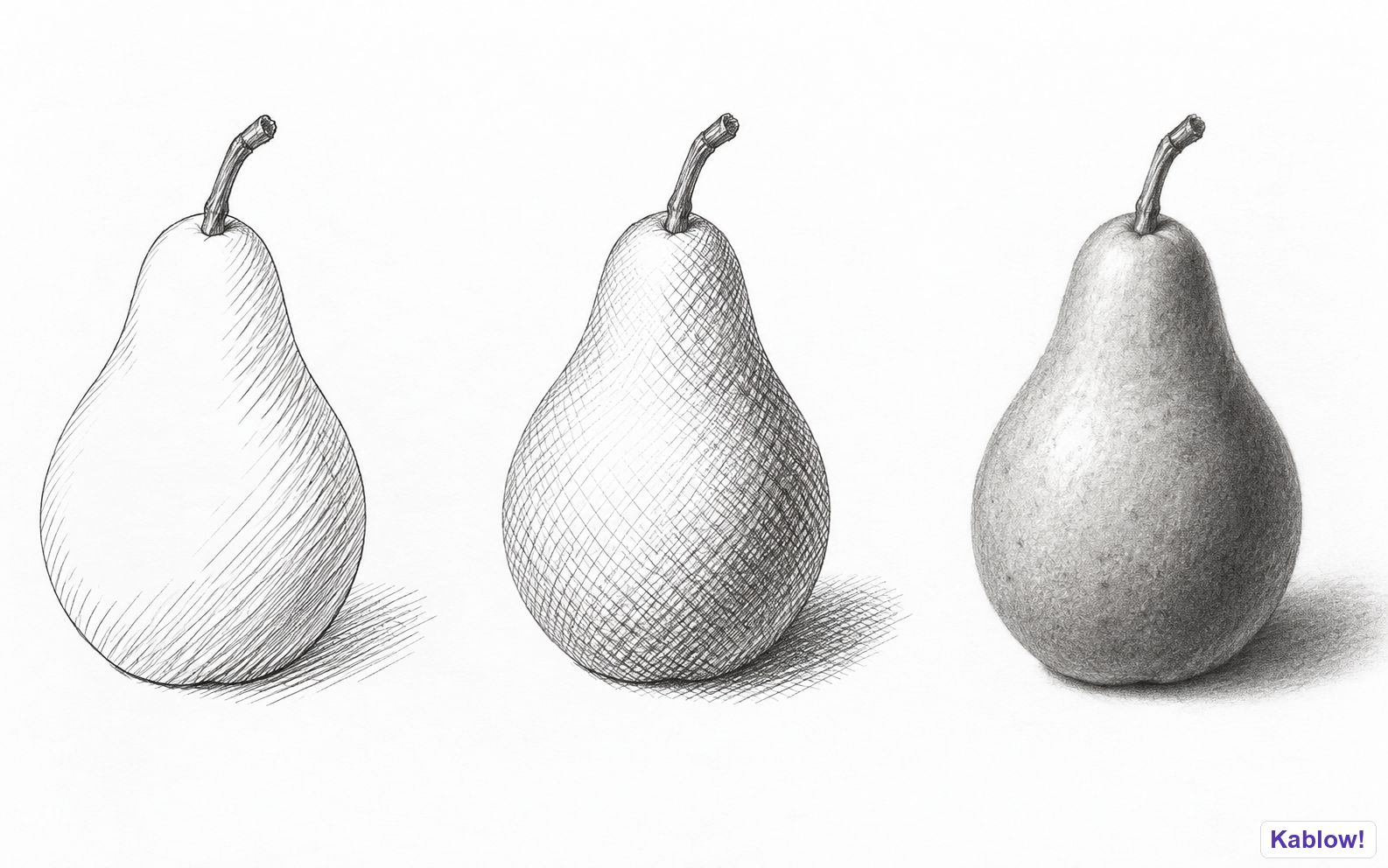
- The original pear studies compare visible directional lines, intersecting hatching and smoother tone. Their marks can be analysed for how they describe form, without assuming a named artist, physical pencil grade or universal mood.
Analyse marks in three teaching studies
Comparing selected works
- Choose a clear focus and compare particular examples using evidence from each. Connectives such as similarly and whereas can make the relationship explicit, but the significance of the comparison still needs explaining.
- For the teaching pears, compare how line direction and tonal transition suggest the same kind of rounded subject. No method is inherently superior; judge it against the intended effect and the actual result.
Make a focused comparison
Respond through development
- A credited study or partial copy can investigate a source’s technique. Develop a personal response by selecting a useful feature, testing it with your own subject or intention, and evaluating the change.
- Record what you retained, adapted and rejected, with reasons and source details. Personal development need not disclose private experiences or conceal the influence; presenting copied imagery as wholly original would misrepresent the work.
Turn a source into a personal test
Evidence-led writing
- A point, evidence and explanation structure can support clear writing, but it is optional. Explain how an observed feature produces a plausible effect and distinguish that reading from a documented statement of intention.
- The supplied invented colour study supports a tonal contrast between pale pear and dark blue cloth and a possible second emphasis from an orange cup. Those observations make the exercise answerable without an absent painting or invented biography.
Observation supports a possible effect
Evaluate with practical limits
- Use intentions or explicit criteria and evidence to support a judgement. Liking a work can start a response, but explaining the formal, contextual or practical reason makes it useful.
- Reproductions can alter apparent colour, surface and scale. State what you can establish, cite reliable information and identify what further observation or research would resolve. More art vocabulary alone cannot repair an unsupported assertion.
Slides
Sign up free to view the lesson slides
Step through every slide for this topic — plus flashcards and revision notes — with a free account.
Practice questions
Free preview — 8 of 33 questions. Sign up to see them all.
1.What does 'analyse' mean?
Easy- Aexamine how parts work together
- Bcopy
- Csign
- Dsell
2.What does 'interpret' mean?
Easy- Alist colours
- Bcopy
- Cframe
- Dpropose a supported reading of meaning
3.What is a focal point?
Easy- Athe frame
- Bthe signature
- Can area that attracts particular visual attention
- Dthe border
4.What is a medium?
Easy- Athe price
- Ba material or form of artistic practice
- Cthe size
- Dthe colour
5.When discussing a painting’s colour choices, what does palette mean?
Easy- Athe colours chosen
- Bthe canvas
- Cthe frame
- Dthe brush
6.What is brushwork?
Easy- Athe type of brush only
- Bthe canvas
- Cthe frame
- Dthe way paint is applied
7.What is composition?
Easy- Athe paper
- Bthe price
- Chow elements are arranged
- Dthe colour only
8.What is contrast?
Easy- Aa frame
- Bdifference between elements such as light and dark
- Csimilarity
- Da pattern
Unlock all 33 questions & more
Create a free account to see every question, the slides, flashcards and revision notes for this topic.
Past papers
Past-paper practice for this topic is coming soon.
Coming soon