
Art movements: Impressionism to Cubism
Learn it by playing
Answer these questions to earn energy, then fish and explore. No account needed.
For educators: ready-to-use lesson slides, revision notes for Art movements: Impressionism to Cubism (Art and Design, Critical and Contextual Study) — use them in your lesson, or run the topic as an interactive class activity your learners play as a live game.
Lesson notes
Impressionist practices and the exhibition group
- Impressionism developed through varied approaches to perception and modern life. The first group exhibition was in 1874; Monet’s Impression, Sunrise dates from 1872. Pissarro participated in all eight exhibitions, while Monet, Renoir and Degas are other central figures.
- Outdoor work and visible touches of colour were important but not compulsory. Degas’s studio methods show why an apparent instant is not proof of a rapid or unplanned process. Monet’s Water Lilies is a long-running series rather than one single dated canvas.
Avoid a single movement recipe
Distinct Post-Impressionist directions
- Post-Impressionism groups diverse practices rather than a shared recipe: Van Gogh’s directional marks, Cézanne’s organisation of form, Seurat’s separated touches and Gauguin’s constructed colour and imagery raise different enquiries. Seurat is also associated with Neo-Impressionism.
- The Starry Night dates from 1889; La Grande Jatte was first shown in 1886 after extensive preparation. Study Gauguin’s representations through colonial context and invention rather than treating them as authoritative records of all Tahitian culture.
Different Post-Impressionist enquiries
Fauvism and expressive colour
- Les fauves means wild beasts, a critical nickname linked with the bold colour of artists including Matisse and Derain around 1905. Freer colour departures are a useful tendency, not a claim that observation or natural colours disappeared.
- Compare a specific work’s relationships of hue, value, mark and shape. Impressionist colour is not uniformly literal, and Fauvism is not the name of every vivid painting. Artists’ practices changed across their careers.
Make a qualified colour comparison
Expression and abstraction
- Expressionist approaches can emphasise expressive distortion of form, colour and space. Munch’s The Scream began in 1893 and exists in different versions; Kandinsky is important in the development toward abstraction.
- Abstraction may simplify or transform a recognisable subject or depart further from it. Do not equate all abstraction with no real-world subject, and do not infer an artist’s diagnosis or private emotion solely from a formal feature.
Cubist form and phase distinctions
- Picasso and Braque centrally developed Cubism around 1907–08, challenging unified fixed-view space through fragmentation, overlap, signs and construction. Analytic examples often have small facets and restricted palettes; Synthetic work explores constructed forms and collage.
- Les Demoiselles d’Avignon (1907) relates to the early emergence; Guernica (1937), prompted by the bombing of Gernika, is much later. Neither every Cubist work nor every later Picasso painting fits a single phase recipe.
Broad Cubist phase distinctions
Compare original teaching studies
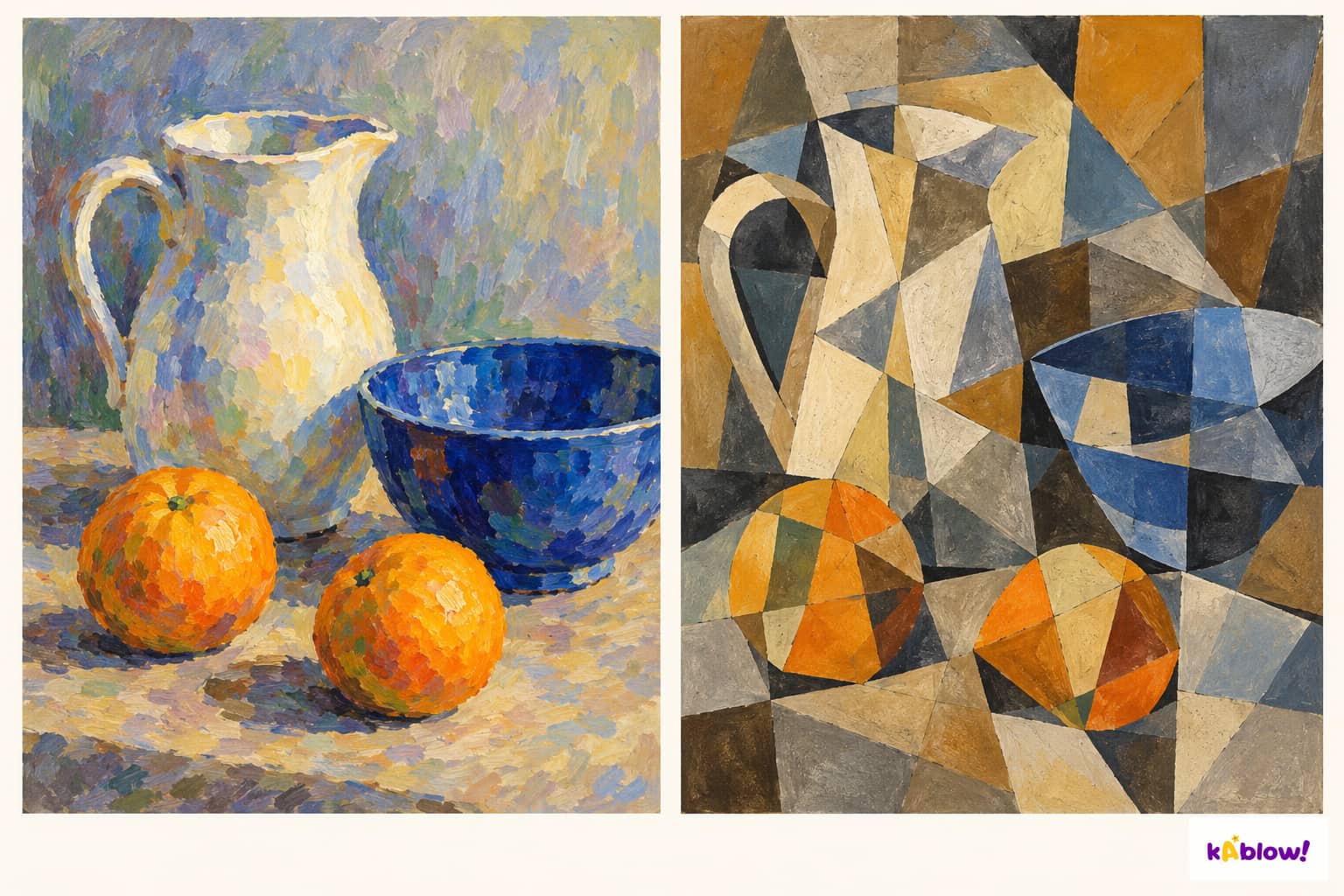
- The invented still-life pair retains a jug, bowl and two oranges while contrasting separate colour touches with angular overlapping planes. Observe which features remain recognisable and how the surface is organised.
- These are original teaching illustrations, not authentic historical examples or copies of a named artist. Use them to test formal vocabulary; consult reliable records and actual works when making claims about particular practitioners.
Two original approaches to a still life
Use labels and sources to develop your own work
- Movement labels and broad dates organise a study but do not replace close looking. Select a named work, check its date and source, and identify a feature relevant to your own intention rather than copying an entire style.
- Test one choice on your own subject, compare results and explain a decision. Recognisable imagery and abstraction can coexist, while colour, expressive effect and studio method need evidence from the particular work.
Develop one formal idea
Slides
Sign up free to view the lesson slides
Step through every slide for this topic — plus flashcards and revision notes — with a free account.
Practice questions
Free preview — 8 of 33 questions. Sign up to see them all.
1.What is Impressionism?
Easy- Aa diverse nineteenth-century movement exploring perception, light and modern subjects
- Ba type of sculpture
- Ca type of print
- Da type of photograph
2.What does en plein air mean?
Easy- Apainting only inside a studio
- Bpainting only from a photograph indoors
- Cpainting only from memory indoors
- Dpainting outdoors
3.Who made the well-known Water Lilies painting series at Giverny?
Easy- ASalvador Dalí
- BAndy Warhol
- CClaude Monet
- DPablo Picasso
4.Who painted The Starry Night?
Easy- AEdvard Munch
- BVincent van Gogh
- CClaude Monet
- DPablo Picasso
5.Who painted The Scream?
Easy- AEdvard Munch
- BVan Gogh
- CMatisse
- DKlimt
6.What does the French nickname les fauves, associated with Fauvism, mean?
Easy- Abright light
- Bmany views
- Cdreams
- Dwild beasts
7.Who was a leading Fauvist?
Easy- APaul Cézanne
- BEdgar Degas
- CHenri Matisse
- DGeorges Seurat
8.What did Seurat paint using dots?
Easy- ASunflowers
- BA Sunday on La Grande Jatte
- CThe Scream
- DGuernica
Unlock all 33 questions & more
Create a free account to see every question, the slides, flashcards and revision notes for this topic.
Past papers
Past-paper practice for this topic is coming soon.
Coming soon