
Sketchbooks and recording ideas
Learn it by playing
Answer these questions to earn energy, then fish and explore. No account needed.
For educators: ready-to-use lesson slides, revision notes for Sketchbooks and recording ideas (Art and Design, Developing Ideas) — use them in your lesson, or run the topic as an interactive class activity your learners play as a live game.
Lesson notes
Purpose and format
- A sketchbook is a working record that can connect ideas, observations, source research, trials and reflection. Finished studies can contribute alongside unresolved possibilities when their relationships explain the enquiry.
- Physical, loose-sheet, separate-sample or digital records may suit different media and requirements. Follow the actual submission guidance, but do not treat double-page spreads, decorative borders, messiness or neat mounting as universal evidence of quality.
A record connects thinking and making
Different records and their limits
- Observational drawing is informed by looking at a subject; identify whether it is the actual object or a reproduction. A study can investigate a whole subject, detail, process or idea, while a thumbnail often explores arrangement.
- Swatches sample colour or application; maquettes test a proposal; photographs, rubbings, sound or video can answer other questions. Record their role and limits, and use the appropriate taught process and source consent.
Connect evidence in an invented example
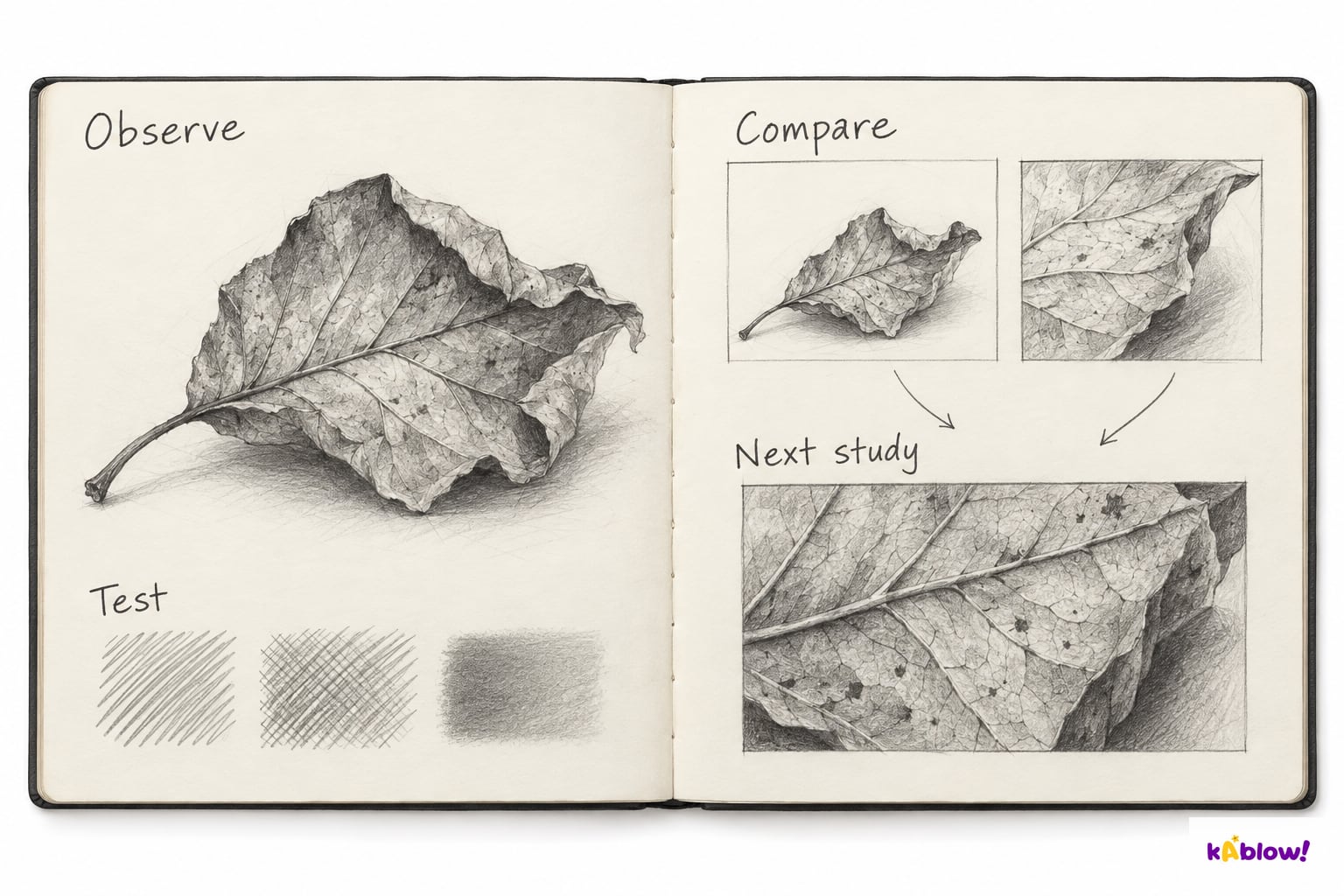
- The illustrative leaf spread groups an observation study, three mark tests, two crops and a next detail study. It is original teaching artwork, not a real student’s assessed work, a botanical diagram or proof of first-hand drawing.
- A concise annotation could explain selecting the detail because vein texture serves an enquiry. Arrows and headings can reveal links but do not by themselves supply the reason for the choice.
An invented working record
Useful annotation
- Write relevant observations, methods, reasons or next decisions. What, how and why are helpful prompts rather than a rigid three-sentence formula; precise art vocabulary should name an actual feature.
- Connect the note with the work it discusses. A short evidence-based reason is more useful than a long list of techniques, an artist biography copied from a source or a grade claimed without criteria.
A note explains a consequence
Sources and authorship
- Primary and secondary depend on the enquiry. Someone else’s original artwork, studio diary or recorded statement can be primary; a later historian’s account interprets evidence. Books and websites can hold either kind.
- Identify the maker, work and source details where known. Distinguish your direct observations, credited source studies and imagined proposals; a study does not become wholly self-created simply by changing medium.
Source roles depend on the enquiry
Organisation and storage
- Use grouping, sequence, links or cross-references to make relationships easy to follow. A single page, spread or digital arrangement is a choice for clarity rather than a universal rule.
- Keep information legible and use suitable mounting or storage. Bulky or fragile material can be recorded separately; photographs may omit surface, scale or movement, so identify their limits rather than force everything into a book.
Organise for the evidence
Reflection and refinement
- Review a result against the intention and decide whether to repeat, adapt, simplify or return to an earlier idea. Refinement is not limited to adding detail, and a change of direction can be coherent when explained.
- Useful unresolved results can reveal learning. Do not fabricate observations or pretend a branching enquiry was completely planned in advance; dates and links can make the actual sequence clear.
Review the actual evidence
Evidence of development
- A record should make the relationship between observation, trial and decision understandable. An appropriate range of media can serve the question, but quantity, cost or novelty does not establish stronger understanding by itself.
- Creative uncertainty remains within the taught material process. Personal choices need not reveal private life, and a clear evidence-led record matters more than a compulsory decorative house style.
Slides
Sign up free to view the lesson slides
Step through every slide for this topic — plus flashcards and revision notes — with a free account.
Practice questions
Free preview — 8 of 32 questions. Sign up to see them all.
1.What is annotation?
Easy- Awritten comments recording observations, reasons or decisions about work
- Ba type of drawing
- Ca paint
- Da frame
2.What is a thumbnail sketch?
Easy- Aa final painting
- Ba photograph
- Ca print
- Da small quick sketch of an idea
3.For an enquiry into an artist’s stated methods, which is a primary source?
Easy- Aa review guessing the method without evidence
- Ban unrelated shop description
- Cthe artist’s original recorded interview about the methods
- Da later textbook summarising the interview
4.For an enquiry into an artist’s methods, which is a secondary interpretation?
Easy- Athe artist’s studio diary
- Ba later historian’s analysis of the artist’s work
- Cthe artist’s original recorded explanation
- Dthe original work being examined
5.What is an observational drawing?
Easy- Aa drawing informed by looking at a subject
- Ba drawing from memory
- Ca pattern invented without a subject being looked at
- Da collage made without any observation of its subject
6.What is a colour swatch?
Easy- Aa drawing
- Ba brush
- Ca frame
- Da sample of a colour or mix
7.What is a maquette?
Easy- Aa print
- Ba drawing
- Ca preliminary model for exploring a proposal
- Da final sculpture
8.What is a study?
Easy- Aa frame
- Bwork investigating a subject, feature, process or idea
- Conly the final assessed outcome
- Donly a photograph made without any enquiry
Unlock all 32 questions & more
Create a free account to see every question, the slides, flashcards and revision notes for this topic.
Past papers
Past-paper practice for this topic is coming soon.
Coming soon