
Line, tone and form in drawing
Learn it by playing
Answer these questions to earn energy, then fish and explore. No account needed.
For educators: ready-to-use lesson slides, revision notes for Line, tone and form in drawing (Art and Design, Visual Elements) — use them in your lesson, or run the topic as an interactive class activity your learners play as a live game.
Lesson notes
Line and drawing exercises
- Line may be actual or implied and can vary in direction, value, width and continuity. Contour drawing responds to edges and changes of form; a boundary need not be uniformly outlined.
- Continuous line keeps the tool in contact with the surface for an exercise. Gesture drawing explores action, pose, weight or movement, often rapidly; blind contour is a different instruction about where to look.
Different line exercises
Tone through mark-making
- Tone or value is relative lightness/darkness. Hatching uses roughly parallel marks, including curved contour hatching; cross-hatching intersects families; stippling uses dots; blending softens transitions.
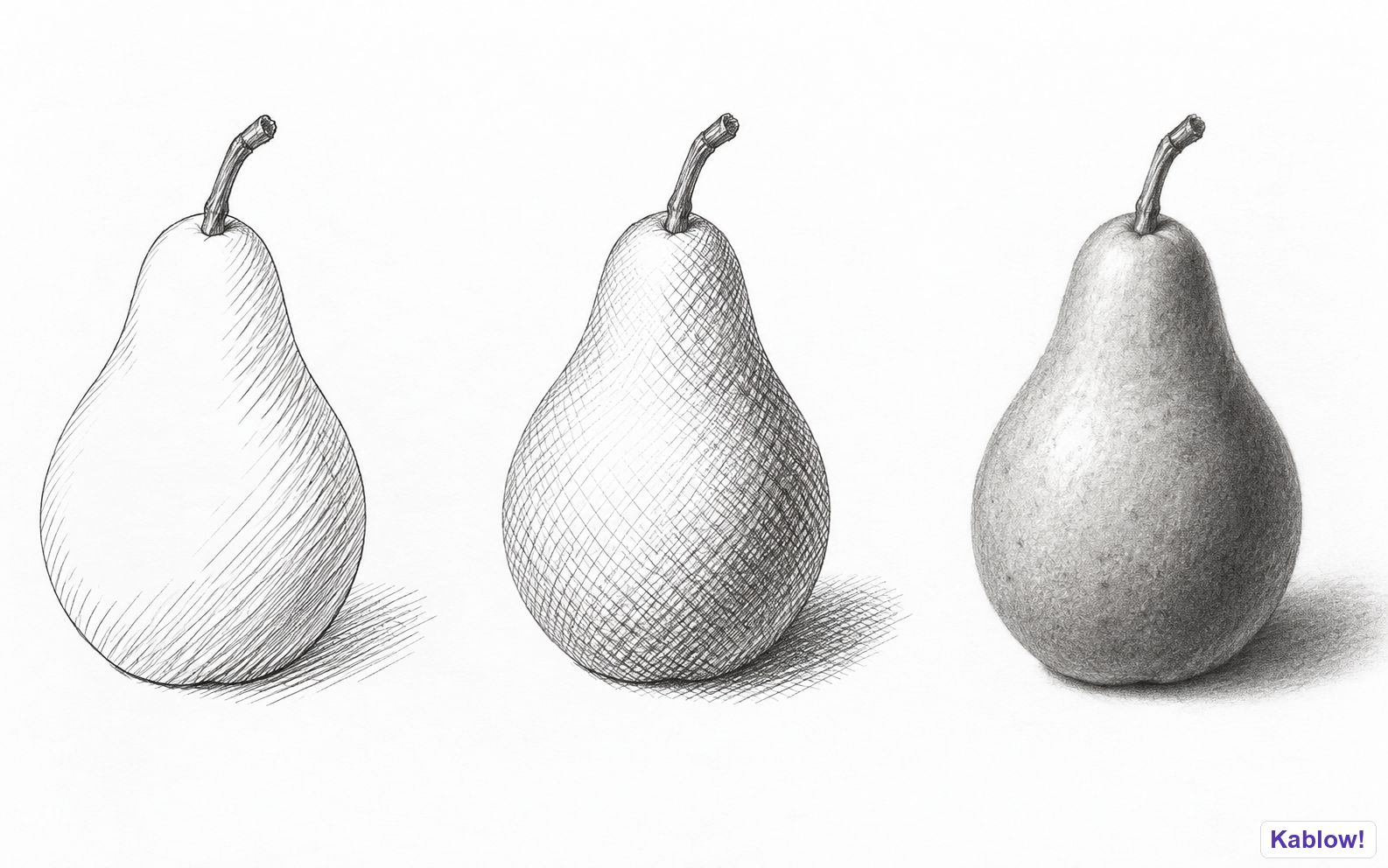
- Compare the original illustrative pears: contour hatching, cross-hatching and smoother graphite tone all suggest rounded volume. A tonal scale consists of actual swatches, not merely a list of pencil grades.
Compare hatching, cross-hatching and smooth tone
Form and observed lighting
- Form refers here to actual or suggested three-dimensional volume. A flat drawing can suggest form through tone, perspective, contours and spatial relationships.
- Light areas, mid-tones and a form-shadow region depend on material and lighting. A core shadow can be a darker band near reflected light; contact areas may be darker. A cast shadow occurs on another surface where the object blocks light.
Read light and shadow
Observation and proportions
- When observed accuracy is the aim, compare relative lengths, angles and negative spaces around, between and within forms. Look repeatedly at the subject and record the relationships you see.
- Light layers can make revision easier, but are a technique choice rather than a universal rule. Naturalistic accuracy, smooth blending or maximum detail is not compulsory when another expressive intention is being explored.
Observe relationships
Develop and evaluate drawing choices
- Compare small studies using different mark directions, densities or media. Explain what a technique contributes to the intended surface, value relationships or sense of volume.
- Collage can create tonal relationships and controlled scribble can model form. A method’s usefulness depends on its handling and purpose; avoid rejecting whole techniques as incapable of tone or depth.
Select a mark strategy
Pencil grades and practical tests
- Graphite grades describe a relative hardness range. H is typically harder and B softer within a range; 6B is normally softer than 2H. Brands, paper and technique affect the resulting marks.
- Create swatches with one pencil and varied pressure, then compare grades under similar conditions. Excessive pressure can indent paper; point shape and angle also affect width, so grade alone does not predict the finished value.
Test the tool, not only the label
Read the pear’s tonal relationships
- In the smoother right-hand study, a lighter upper-left area contrasts with the turning darker right side and the cast shadow on the support. Compare what happens on the form with what happens beside it.
- This is original illustrative artwork, not a measured lighting experiment or a student submission. Real subjects may have different reflections, shadow shapes or multiple lights; use observation rather than a universal darkest-edge rule.
Slides
Sign up free to view the lesson slides
Step through every slide for this topic — plus flashcards and revision notes — with a free account.
Practice questions
Free preview — 8 of 33 questions. Sign up to see them all.
1.What is line in art?
Easy- Aan actual or implied path with direction and extent
- Ba colour
- Ca texture
- Da pattern
2.What is tone?
Easy- Aa colour name
- Ba shape
- Ca texture
- Dhow light or dark something is
3.In the visual-elements distinction between shape and form, what is form?
Easy- Aa colour
- Ba line
- Cthree-dimensional volume, actual or suggested on a flat surface
- Da flat shape
4.What does hatching use?
Easy- Acollage
- Bparallel lines
- Cdots
- Dsmudges
5.What does stippling use?
Easy- Adots
- Blines
- Csmudges
- Dpaint
6.What does cross-hatching add?
Easy- Acolour
- Btexture only
- Cnothing
- Dcrossing lines for darker tone
7.What is blending?
Easy- Aerasing
- Bcutting
- Csmoothing tones together
- Dadding lines
8.In this tonal drawing, what does highlight refer to?
Easy- Aan outline
- Ba particularly light area of the depicted surface
- Cthe darkest area
- Da shadow
Unlock all 33 questions & more
Create a free account to see every question, the slides, flashcards and revision notes for this topic.
Past papers
Past-paper practice for this topic is coming soon.
Coming soon