
Earthquakes and volcanoes: hazards and responses
Learn it by playing
Answer these questions to earn energy, then fish and explore. No account needed.
For educators: ready-to-use lesson slides, revision notes for Earthquakes and volcanoes: hazards and responses (Geography, Physical Geography) — use them in your lesson, or run the topic as an interactive class activity your learners play as a live game.
Lesson notes
Earthquakes
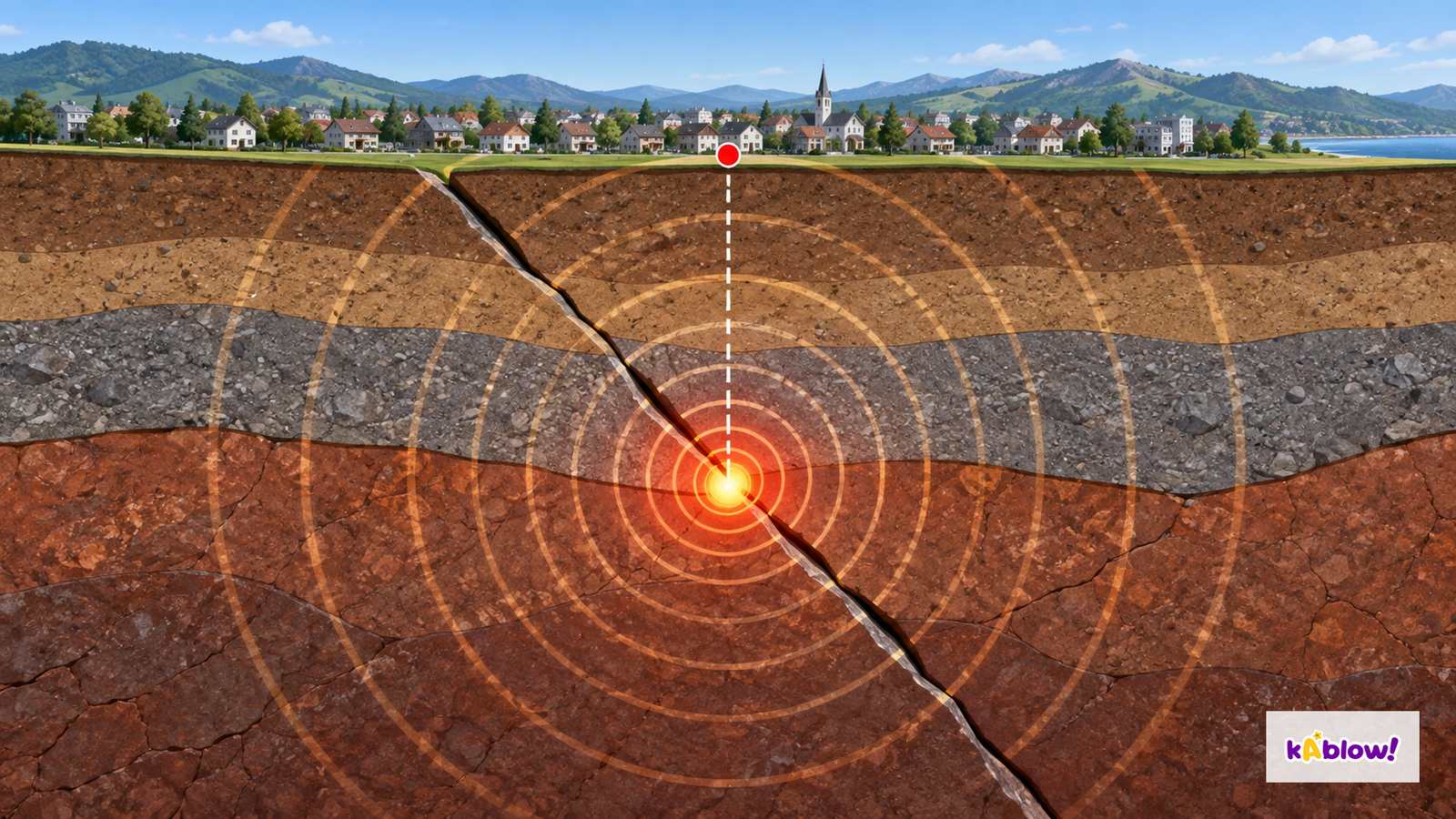
- Faults can remain locked while elastic strain builds. Sudden slip releases energy as seismic waves. The focus is the rupture’s starting point; the epicentre is the surface point directly above it. The fault is not necessarily an open underground canyon. Magnitude describes event size, whereas intensity describes local shaking and effects, influenced by distance, depth, ground and structures.
- Moment magnitude uses seismic moment. Other magnitude scales can give different values and estimates may be revised. Roughly one magnitude unit corresponds to ten times the measured wave amplitude in the relevant logarithmic relationship and about 32 times the released energy; it does not mean 32 times the deaths.
- Direct shaking can collapse buildings and rupture infrastructure. Consequences can cascade through fires, landslides, tsunamis or loss of services. Secondary effects can happen rapidly; immediate and long-term describe response timescales instead. Disease is a possible risk when water, sanitation and care are disrupted, not an automatic outcome. Tsunamis are wave series caused by rapid water displacement, not ordinary tides or necessarily a single breaking wave.
Conceptual focus and epicentre
Volcanoes
- Shield volcanoes have broad, low-angle profiles built mainly by fluid lava, and many eruptions are effusive. Composite volcanoes are commonly steeper, built from lava and fragmental deposits, and can have explosive eruptions. These are useful tendencies rather than universal rules: both types can pose serious hazards.
- Lava flows, hot pyroclastic density currents, ash fall and dispersal, gases and lahars have different pathways and risks. A lahar mixes water with volcanic debris and can occur after an eruption when rain remobilises deposits. Airborne ash can threaten aviation far from the vent; not every eruption produces every hazard.
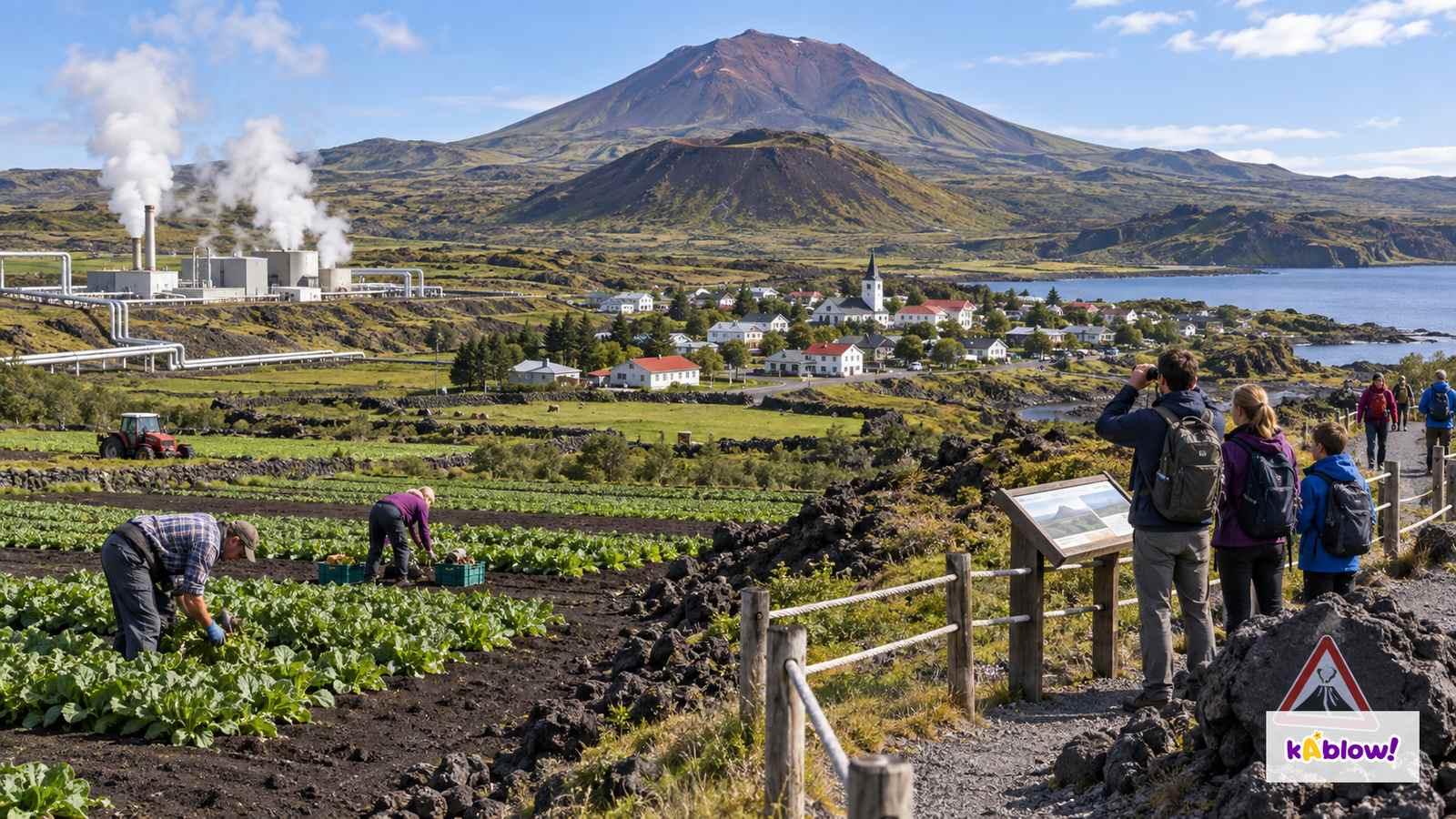
- People remain for jobs, services, family, community ties and place, with unequal relocation choices. Weathered volcanic materials can support productive soils, and some regions use geothermal energy or tourism. Fresh ash can damage crops, and these benefits do not establish safety.
Imagined livelihoods in a volcanic region
Case studies
- The Nepal Gorkha mainshock occurred on 25 April 2015 with moment magnitude 7.8. USGS’s 2016 retrospective reported about 9,000 disaster fatalities and widespread housing damage. Treat this as a rounded historical estimate; reporting scope, sequence and dates affect counts. Landslides, mountainous access, damaged infrastructure and building vulnerability complicated response.
- The 22 February 2011 Christchurch earthquake caused 185 deaths and severe damage, including liquefaction. GeoNet describes its shallow source close to the city and a working-day occurrence. Its historical account lists ML6.3 while its current event header gives 6.2; identify the scale and source instead of treating all quoted values as identical measurements. A wealthier setting did not prevent major losses.
- Compare hazard magnitude and location, shaking, ground conditions, building vulnerability, population exposure, access and response capacity. National income can influence available resources but cannot isolate why two different events caused different outcomes. Avoid claiming Christchurch experienced little economic damage or that every Nepal community responded in the same way.
- Eyjafjallajökull’s 2010 eruption dispersed ash that disrupted European aviation. This demonstrates connected economic effects beyond the immediate volcanic area; it is not evidence that every Icelandic eruption has the same plume or impact.
Explain the difference in impacts
Responses and management
- Urgent responses include rescue, medical help, safe water, food and shelter; longer-term recovery includes restoring services, homes, livelihoods and infrastructure. Categories overlap. Local communities and responders can act before outside assistance arrives, and access difficulties do not mean there was no response.
- Seismometers record ground movement. Volcano monitoring may combine seismicity, gas measurements, deformation and satellite observations; unrest can support forecasts but does not guarantee an eruption time or size. Earthquakes cannot be reliably predicted exactly; probabilistic hazard estimates and aftershock forecasts remain useful. Early warning is issued after rupture starts and may provide a short interval before strong shaking reaches some locations.
- Protection uses suitable design, retrofitting, construction standards and maintenance, such as bracing, ductility, dampers or base isolation where appropriate. Planning includes drills, evacuation arrangements for relevant hazards, and zoning with feasible alternatives. Monitoring only reduces losses when information leads to effective decisions; no instrument stops an earthquake. Evaluate funding, enforcement, accessibility, maintenance and residual risk.
Three distinct information tools
Slides
Sign up free to view the lesson slides
Step through every slide for this topic — plus flashcards and revision notes — with a free account.
Practice questions
Free preview — 8 of 33 questions. Sign up to see them all.
1.What is a tsunami?
Easy- Aa series of long waves produced by rapid displacement of water
- Ba type of storm
- Ca flood
- Da landslide
2.What is magnitude?
Easy- Aits depth
- Bits colour
- Cits time
- Dits size estimated from seismic recordings, related to the rupture and released energy
3.Which is a primary effect of an earthquake?
Easy- Afires
- Bbusiness interruption after damaged roads prevent deliveries
- Ccollapsed buildings
- Ddisease
4.Which is a secondary effect?
Easy- Aa fault line
- Bfires from broken gas pipes
- Cbuilding collapse
- Dground shaking
5.What is a pyroclastic flow?
Easy- Aa fast ground-hugging current of hot gas, ash and rock fragments
- Ba river
- Ca tsunami
- Da rainstorm
6.What was the moment magnitude of the 25 April 2015 Nepal mainshock?
Easy- A4.5
- B9.5
- C6.0
- D7.8
7.What rounded fatality estimate did the USGS 2016 retrospective give for the Nepal earthquake disaster?
Easy- A900,000
- B9
- Cabout 9,000
- D90
8.Which volcano disrupted European air travel in 2010?
Easy- AKrakatoa
- BEyjafjallajökull
- CEtna
- DVesuvius
Unlock all 33 questions & more
Create a free account to see every question, the slides, flashcards and revision notes for this topic.
Past papers
Past-paper practice for this topic is coming soon.
Coming soon