
Instruments, timbre and ensembles
Learn it by playing
Answer these questions to earn energy, then fish and explore. No account needed.
For educators: ready-to-use lesson slides, revision notes for Instruments, timbre and ensembles (Music, Musical Elements) — use them in your lesson, or run the topic as an interactive class activity your learners play as a live game.
Lesson notes
The orchestra
- The usual bowed-string sections are violin, viola, cello and double bass, from higher to lower overall register. Harp is also stringed but is usually grouped separately in an orchestral layout. Piano is a keyboard instrument whose hammers strike strings; different classification systems can describe its mechanism differently.
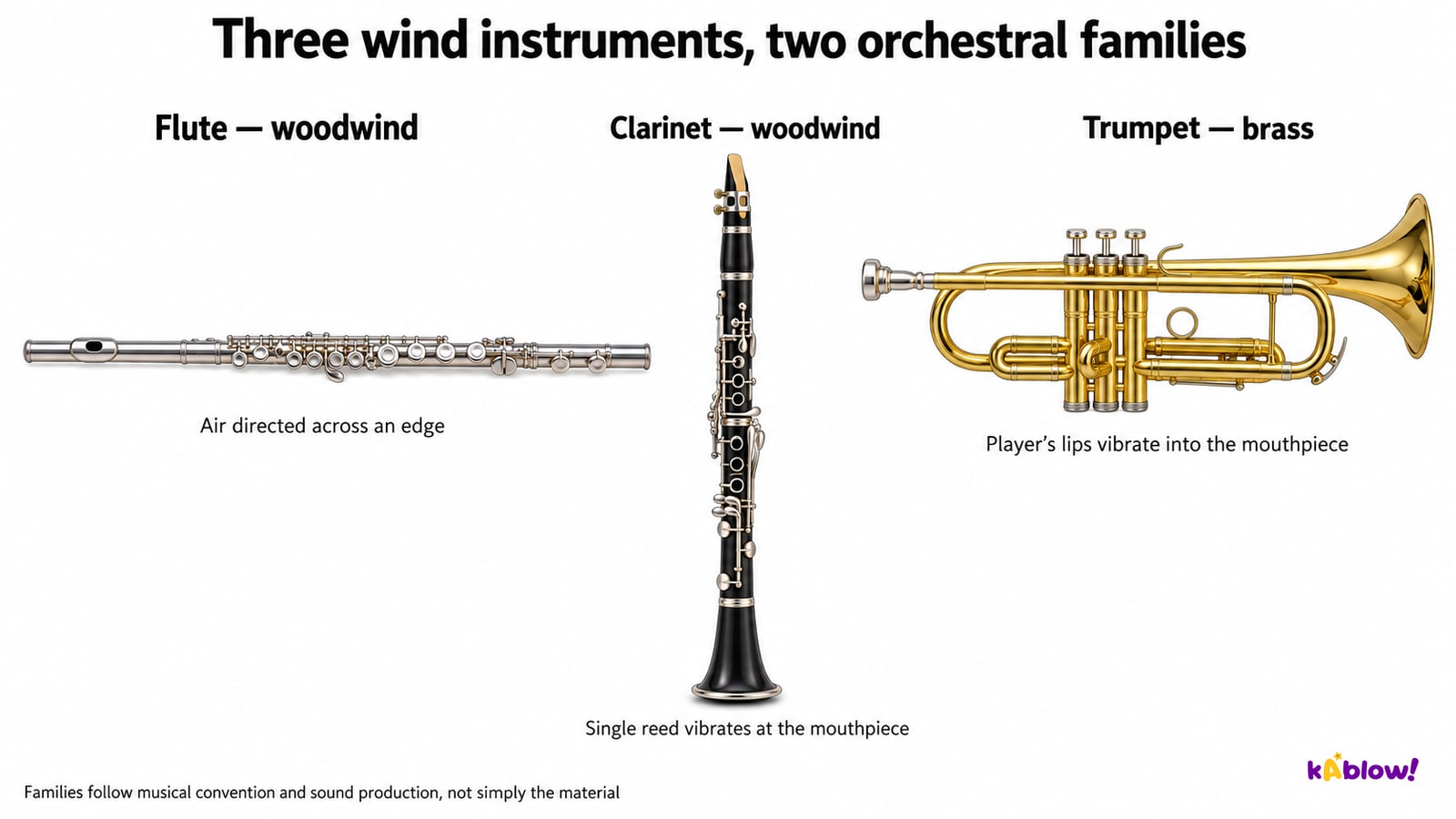
- Woodwind includes edge-blown flute and reed instruments such as oboe, clarinet and bassoon. Brass conventionally uses lip vibration at a mouthpiece, with instruments such as horn, trumpet, trombone and tuba. Material alone does not decide the family. Percussion includes tuned timpani and other pitched instruments as well as indefinite-pitch sources.
Three wind instruments, two orchestral families
Voices
- SATB stands for soprano, alto, tenor and bass, common choir part roles ordered from higher to lower register. Their ranges overlap and a choir may use other voicings or sing in unison; four part names do not require four independent parts at every moment.
- A cappella normally means singing without instrumental accompaniment. Falsetto and head voice are vocal-registration terms whose use varies between teaching traditions; neither is simply another name for every high note or a SATB part. Describe the actual production and context rather than imposing one universal equivalence.
SATB part roles
Techniques
- On bowed strings, arco uses the bow and pizzicato plucks. Double stopping sounds two strings at once; harmonics use particular vibration patterns and touching/bowing conditions. Vibrato varies pitch, while common bowed tremolo rapidly reiterates a note with the bow. Staccato articulation is also possible on strings.
- Tremolo can also refer to alternation between notes, or amplitude modulation in an electronic effect, so specify the context. A glissando can be continuous or pass through discrete pitches. Con sordino asks for a mute; the resulting colour, projection and loudness depend on the instrument, mute and technique.
Technique changes sound within a family
Electronic and modern sounds
- A synthesiser generates or shapes sound, while a sampler stores and triggers digital recordings, whether recorded directly or imported. A drum machine may use synthesis, samples or both. MIDI communicates note and control events rather than recorded audio; a sound generator converts the instructions into sound.
- Distortion changes waveform/harmonic character from subtle saturation to stronger effects. Reverb supplies a dense reflection/decay field suggesting space, whereas delay often gives more distinct repetitions. A mute is an acoustic playing resource rather than an electronic effect, and a sampled or synthesized imitation is not the same as a real-instrument listening example.
Data, sound generation and processing
Ensembles
- A standard string quartet has two violins, viola and cello. A chamber group uses relatively small forces, but the exact instrumentation varies. A rock band often includes guitar, bass, drums and voice; a big band commonly includes saxophone, trumpet and trombone sections with a rhythm section. These are familiar models, not compulsory lineups.
- A British-style brass band uses brass and percussion; other traditions use different lineups. Steelband centres on steelpans, developed in Trinidad and Tobago, with parts across registers and supporting rhythm. Choose timbres for the actual musical purpose, checking range, technique and balance rather than assuming brass is always heroic or flute always gentle.
Familiar ensemble models
Slides
Sign up free to view the lesson slides
Step through every slide for this topic — plus flashcards and revision notes — with a free account.
Practice questions
Free preview — 8 of 38 questions. Sign up to see them all.
1.Which instrument is in the string family?
Easy- Aviolin
- Bflute
- Ctrumpet
- Dtimpani
2.Which instrument is in the woodwind family?
Easy- Atrombone
- Bviola
- Ccymbals
- Dclarinet
3.Which instrument is in the brass family?
Easy- Acello
- Bxylophone
- CFrench horn
- Doboe
4.Which instrument is in the percussion family?
Easy- Atuba
- Btimpani
- Cbassoon
- Dviola
5.What does SATB stand for?
Easy- Asoprano, alto, tenor, bass
- Bstrings, altos, trumpets, basses
- Csolo, accompaniment, tenor, bass
- Dsoprano, alto, trombone, bassoon
6.What is a choir?
Easy- Aa group of drummers
- Bone singer
- Ca type of drum
- Da group of singers
7.What does a cappella mean?
Easy- Aplaying quietly
- Bplaying fast
- Csinging without instruments
- Dsinging with orchestra
8.What is pizzicato?
Easy- Asliding notes
- Bplucking strings
- Cbowing strings
- Dmuting brass
Unlock all 38 questions & more
Create a free account to see every question, the slides, flashcards and revision notes for this topic.
Past papers
Past-paper practice for this topic is coming soon.
Coming soon