Populations, competition and sampling
Learn it by playing
Answer these questions to earn energy, then fish and explore. No account needed.
Lesson notes
Big idea: relationships in an ecosystem
- Big idea (key concept): Relationships. Organisms do not live alone. They compete with each other, eat each other, and depend on non-living things such as light, water and soil.
- Related concept: Interaction. Every interaction changes how many organisms there are, and a change in numbers changes the interactions again.
- Global context: Globalization and sustainability. To protect wildlife and food supplies, people need to know how many organisms live in a place and why that number changes. Ecologists all over the world use the sampling methods in this lesson.
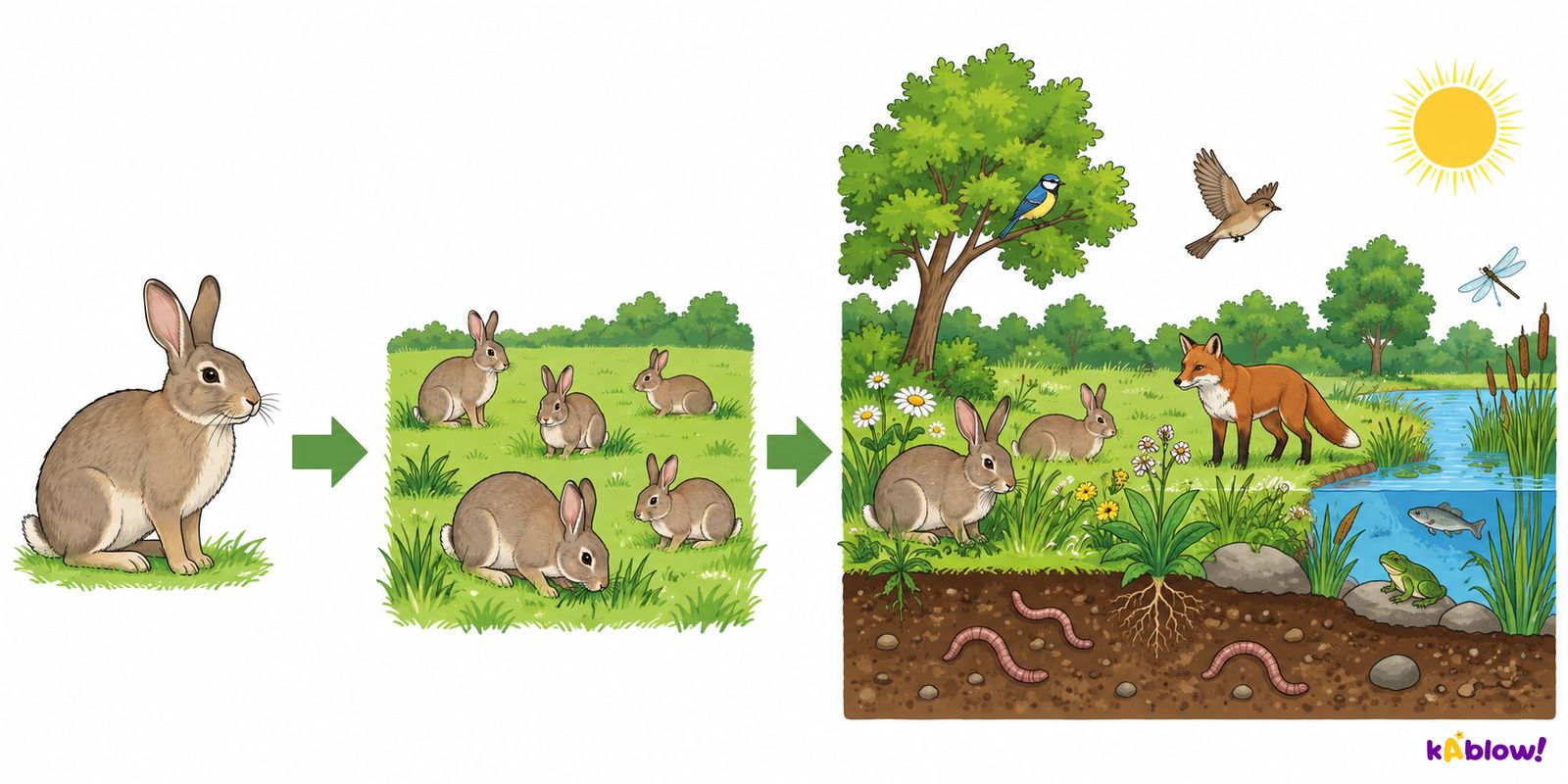
- A population is all the organisms of one species living in the same area at the same time, for example the daisies on a school field.
- A community is all the populations of different species living in an area. An ecosystem is a community together with its non-living environment. A habitat is the place where an organism lives.
From one rabbit to a whole ecosystem
Abiotic and biotic factors
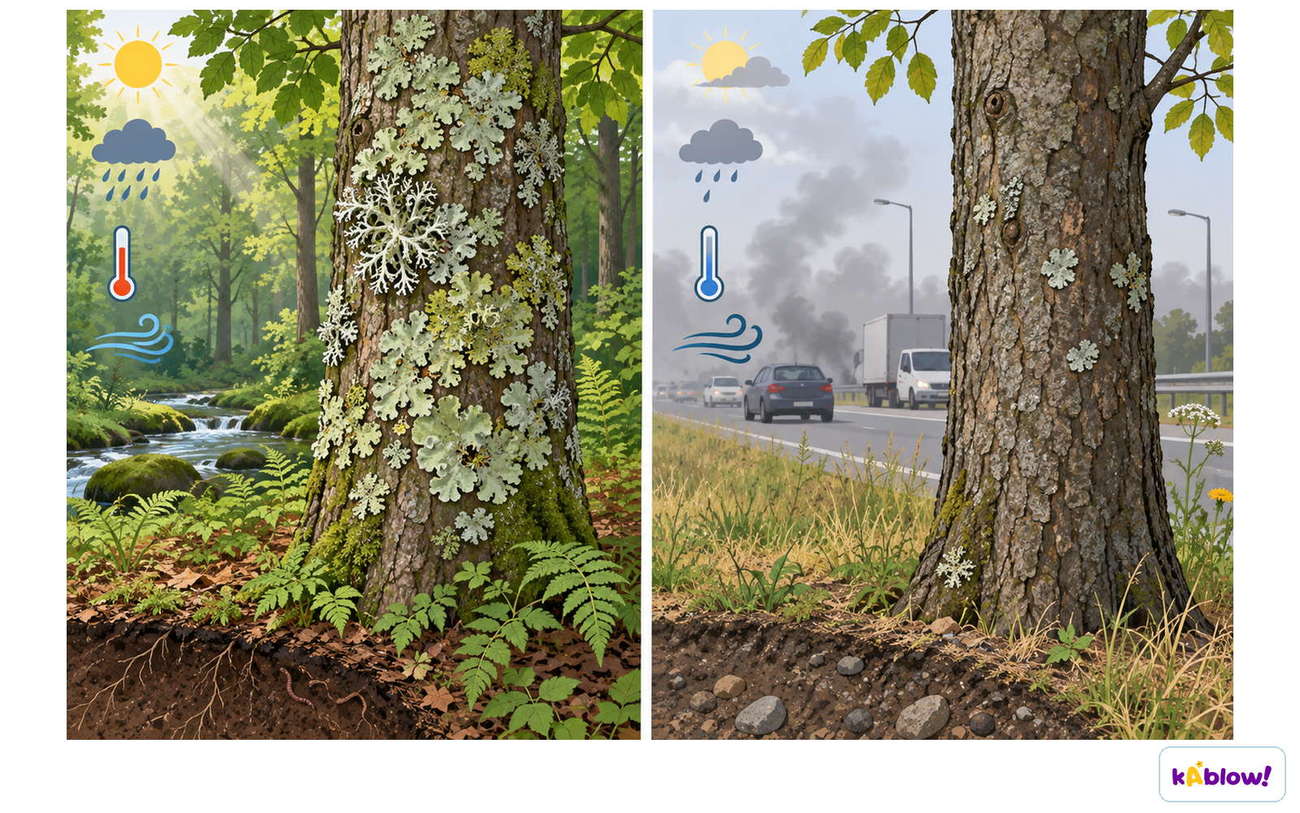
- Abiotic factors are the non-living parts of the environment: light intensity, temperature, water or rainfall, wind, soil pH and minerals, air pollution, and dissolved oxygen in water.
- Biotic factors are the living parts: the food supply, predators, competitors, disease and pollinators.
- Both kinds decide where an organism can live and how many can survive. Lichens are sensitive to air pollution, so few of them grow beside a busy road.
- Ecologists measure abiotic factors with instruments, such as a light meter for light intensity, a thermometer for temperature, a probe for soil pH and an anemometer for wind speed.
- Biotic and abiotic factors interact. A shady spot is cooler and damper (abiotic), which may suit slugs and moss (biotic) that then affect the plants growing there.
Abiotic factors affect where lichens grow
Competition and predation
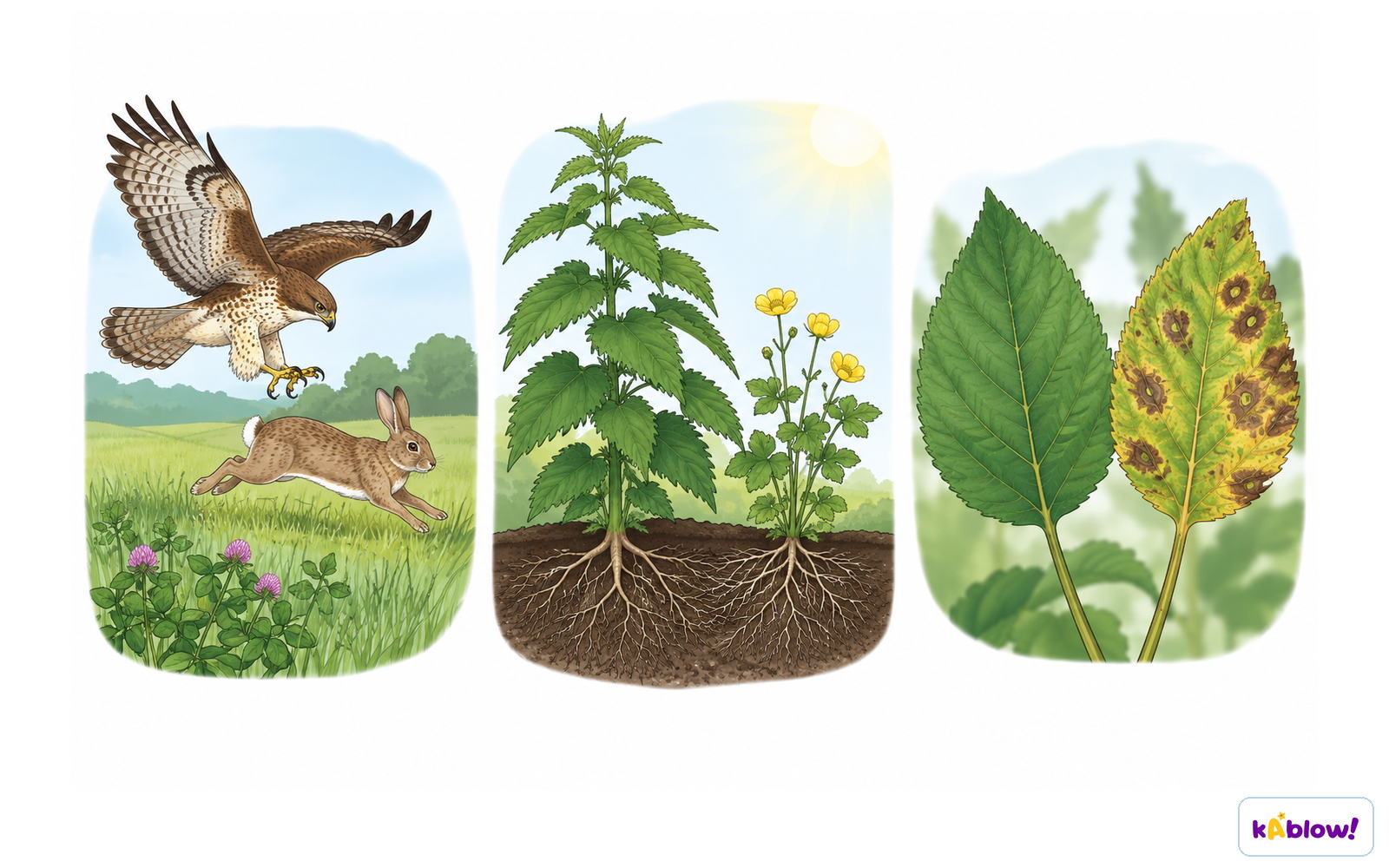
- Competition happens when organisms need the same resource and there is not enough for all of them. Intraspecific competition is between members of the same species. Interspecific competition is between different species.
- Plants compete for light, water, mineral ions and space. Animals compete for food, water, mates, territory and shelter.
- Organisms that are better adapted get more of the resource, so they are more likely to survive and reproduce. In parts of Britain, introduced grey squirrels use the same food as red squirrels, and red squirrel numbers have fallen where greys have arrived.
- A predator hunts and eats other animals, called prey. In a predator-prey relationship the numbers of the two populations rise and fall in a linked cycle.
- The cycle: prey increase, so predators have more food and increase a little later. More predators eat more prey, so prey fall. With less food, predators then fall, and the cycle repeats. The predator peak usually comes after the prey peak.
- Disease is another biotic factor. Pathogens spread more easily when a population is crowded.
Biotic factors that change a population
Population size and limiting factors
- A population changes size because of four things: births and immigration (organisms moving in) increase it, while deaths and emigration (organisms moving out) decrease it. Change in size = births + immigration − deaths − emigration.
- A limiting factor is anything that stops a population getting bigger, such as food, water, space, light, predators, disease or competition.
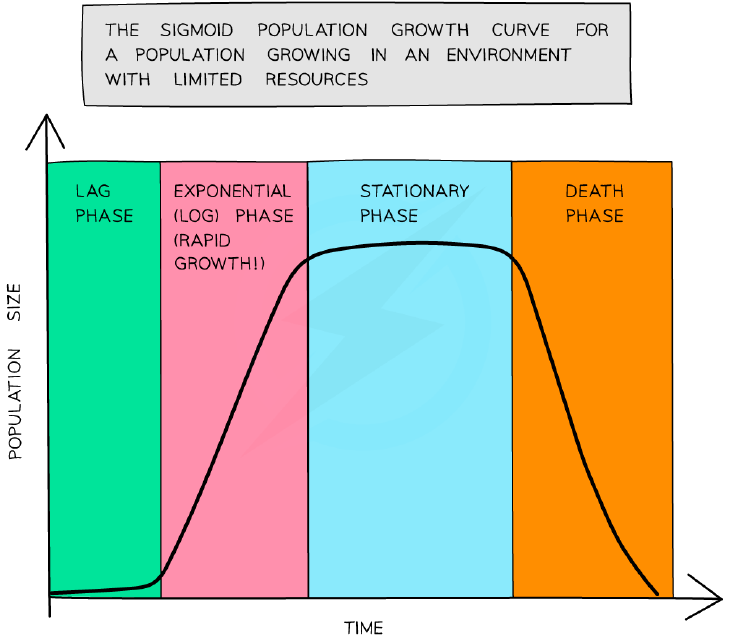
- In a closed container, such as yeast or bacteria in a flask with a fixed amount of food, growth follows four phases: a slow lag phase, a fast exponential phase, a stationary phase where births equal deaths, and a death phase when resources run out.
- In a natural ecosystem the population usually does not crash. It rises and then wobbles around the carrying capacity: the largest population the environment can support for a long time.
- Carrying capacity is not fixed. It can rise in a wet year with plenty of food, or fall if a habitat is damaged.
Growth of a population with limited resources
Sampling populations: quadrats and transects
- It is usually impossible to count every organism, so ecologists take samples and use them to estimate the whole population. An estimate is not exact, but a good method makes it close.
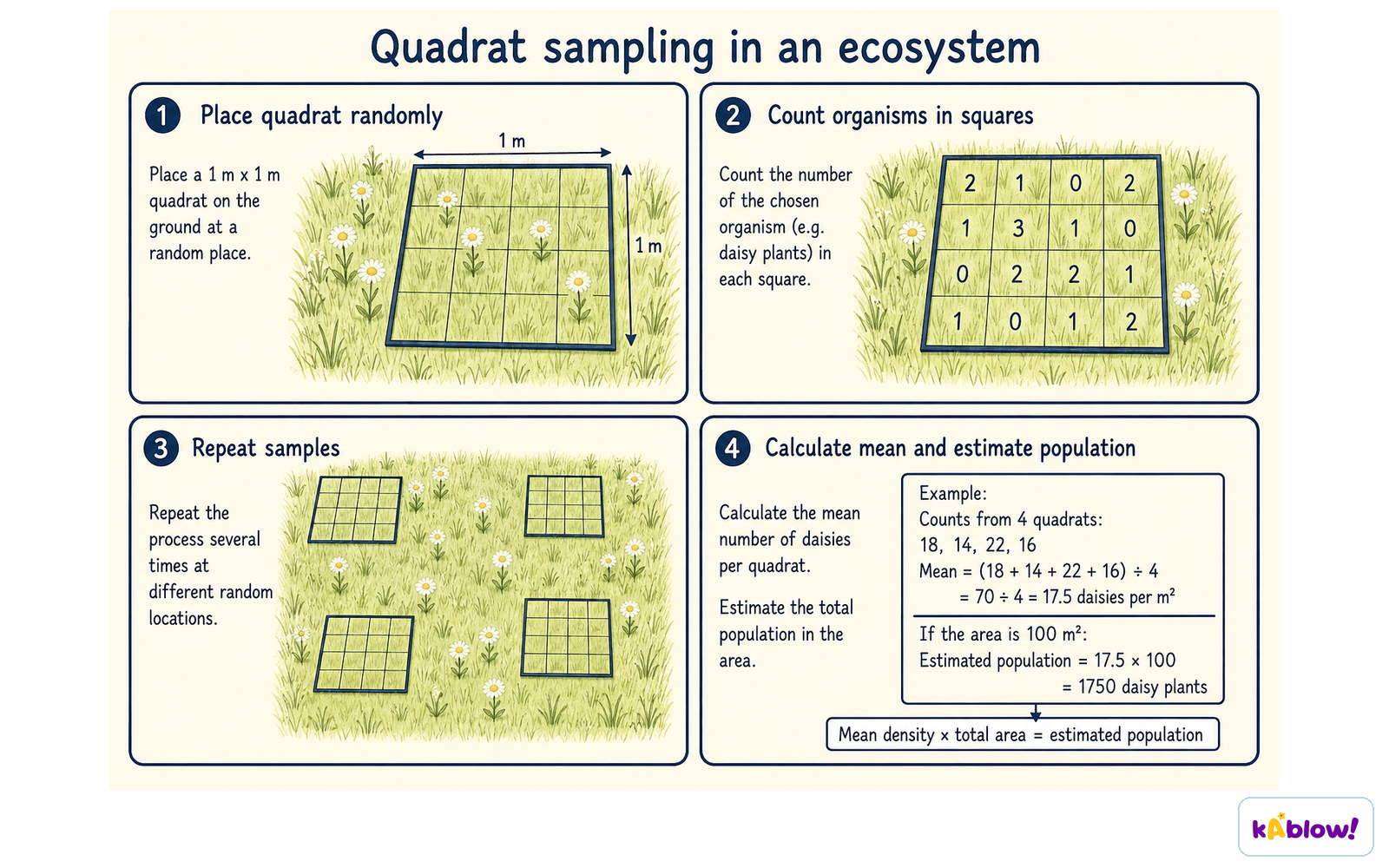
- A quadrat is a square frame, often 1 m by 1 m or 0.5 m by 0.5 m, used to mark out a sample area. Place it, count the chosen organism inside, then move on and repeat.
- Place quadrats randomly, for example by using random numbers as coordinates on two tape measures. This avoids bias, which would happen if you chose places that look interesting.
- Use many quadrats. A larger sample reduces the effect of chance, so the mean is more reliable.
- Worked example (1 m² quadrats). Counts: 6, 9, 4, 7, 9. Mean = 35 ÷ 5 = 7 plants per m². The field is 300 m², so the estimate is 7 × 300 = 2100 plants.
- Worked example (smaller quadrats). Ten quadrats of 0.25 m² hold 30 daisies in total. Mean = 3 per quadrat. A 1 m² area holds 4 quadrats, so the density is 3 × 4 = 12 per m². For a lawn of 600 m², the estimate is 12 × 600 = 7200 daisies.
- A transect is a line, such as a tape measure, along which you sample at set intervals. It is the best method when conditions change gradually, for example from shade into open ground.
- Animals that move cannot be counted in quadrats. In mark-recapture you catch a sample, mark the animals harmlessly, release them, then catch a second sample. Estimate = (number marked first) × (size of second sample) ÷ (number of marked animals in the second sample). For example, 40 marked, a second sample of 30 containing 6 marked, gives 40 × 30 ÷ 6 = 200 animals.
- Mark-recapture works only if marked animals mix back in evenly, the marks are not harmful or lost, marked animals are no easier or harder to catch, and the population stays about the same size between samples.
How to sample with quadrats
Think like a scientist: does light change where buttercups grow?
- Question: do buttercup numbers change from the shady side of a hedge out into an open field? A class lays a 10 m tape measure at right angles to the hedge and places a 0.25 m² quadrat at 0, 2, 4, 6, 8 and 10 m. At each distance three quadrats are counted side by side and a light meter reading is taken.
- Variables: the independent variable is the distance from the hedge. The dependent variables are the mean number of buttercups per quadrat and the light reading. Control variables include quadrat size, the time of day, the date, the field and the person counting.
- Results (one class's data): distance 0, 2, 4, 6, 8, 10 m. Mean buttercups per quadrat 1, 2, 4, 8, 10, 11. Light meter reading (arbitrary units) 12, 20, 35, 52, 60, 64.
- Pattern: both the buttercup count and the light reading rise with distance from the hedge. A pattern like this suggests light may matter, but it does not prove light is the cause. Soil moisture and root competition from the hedge also change with distance.
- Safety: wear gloves if the field has animal droppings, wash hands afterwards, and keep tape measures and quadrats out of walkways.
- Inquiry task: write a conclusion that matches the evidence. Then evaluate the method: name two ways to make the data more reliable, and design a follow-up test that could separate the effect of light from the effect of hedge roots.
Slides
Sign up free to view the lesson slides
Step through every slide for this topic — plus flashcards and revision notes — with a free account.
Practice questions
Free preview — 8 of 53 questions. Sign up to see them all.
1.What is a population in ecology?
Easy- AAll the different species that are living in the same area
- BAll the living and non-living things found together in an area
- CAll the organisms of one species living in the same area
- DThe particular place where one type of organism usually lives
2.Match each ecological term to its meaning.
Easy- Population
- Community
- Ecosystem
- Habitat
- A community together with its non-living environment
- All the organisms of one species in an area
- The place where an organism lives
- All the populations of different species in an area
3.A school pond contains 25 frogs, about 300 pond snails, pondweed and algae. Which statement uses the ecological terms correctly?
Medium- AThe 25 frogs form one population within the pond community
- BThe frogs and the snails together form a single population
- CThe pondweed and algae together make up the whole pond ecosystem
- DThe pond community includes the water, the mud and the plants
4.A community includes the non-living parts of an area, such as water and soil.
EasyTrue or false?
5.Hares and foxes both live in the same meadow. Why are they not part of the same population?
Easy- AThey live in different habitats within the meadow
- BThey do not interact with each other at all
- CFoxes are much larger than hares are
- DThey belong to different species
6.Which of these is an abiotic factor?
Easy- APredation by owls
- BSoil pH
- CCompetition for food
- DInfection by a virus
7.Which of these are biotic factors? (select all that apply)
Medium- ADisease
- BLight intensity
- CPredation
- DRainfall
- EFood supply
8.Match each factor to a way it can affect a population.
Medium- Temperature
- Predators
- Soil pH
- Disease
- Reduce the number of prey animals
- Changes how fast organisms grow and reproduce
- Weakens or kills members of a population
- Decides which plants can grow in the soil
Unlock all 53 questions, flashcards & more
Create a free account to see every question, the slides, flashcards and revision notes for this topic.