Homeostasis, the kidney and blood glucose
Learn it by playing
Answer these questions to earn energy, then fish and explore. No account needed.
Lesson notes
Big idea: keeping the inside steady
- Big idea (key concept): Systems. Your body is a set of systems that work together. Receptors, control centres and effectors act as one system to keep conditions inside you steady.
- Related concept: Balance. Too hot, too cold, too much glucose or too little water would all damage your cells. The body keeps each of these inside a narrow range.
- Global context: Identities and relationships. Your body keeps itself in balance without you thinking about it, and some people have a condition, such as diabetes or kidney failure, where part of that balance needs extra support. Understanding the science helps us understand each other's health.
- Homeostasis is the maintenance of a constant internal environment. Body temperature, blood glucose concentration and the water content of the blood are all kept close to a set point by homeostasis.
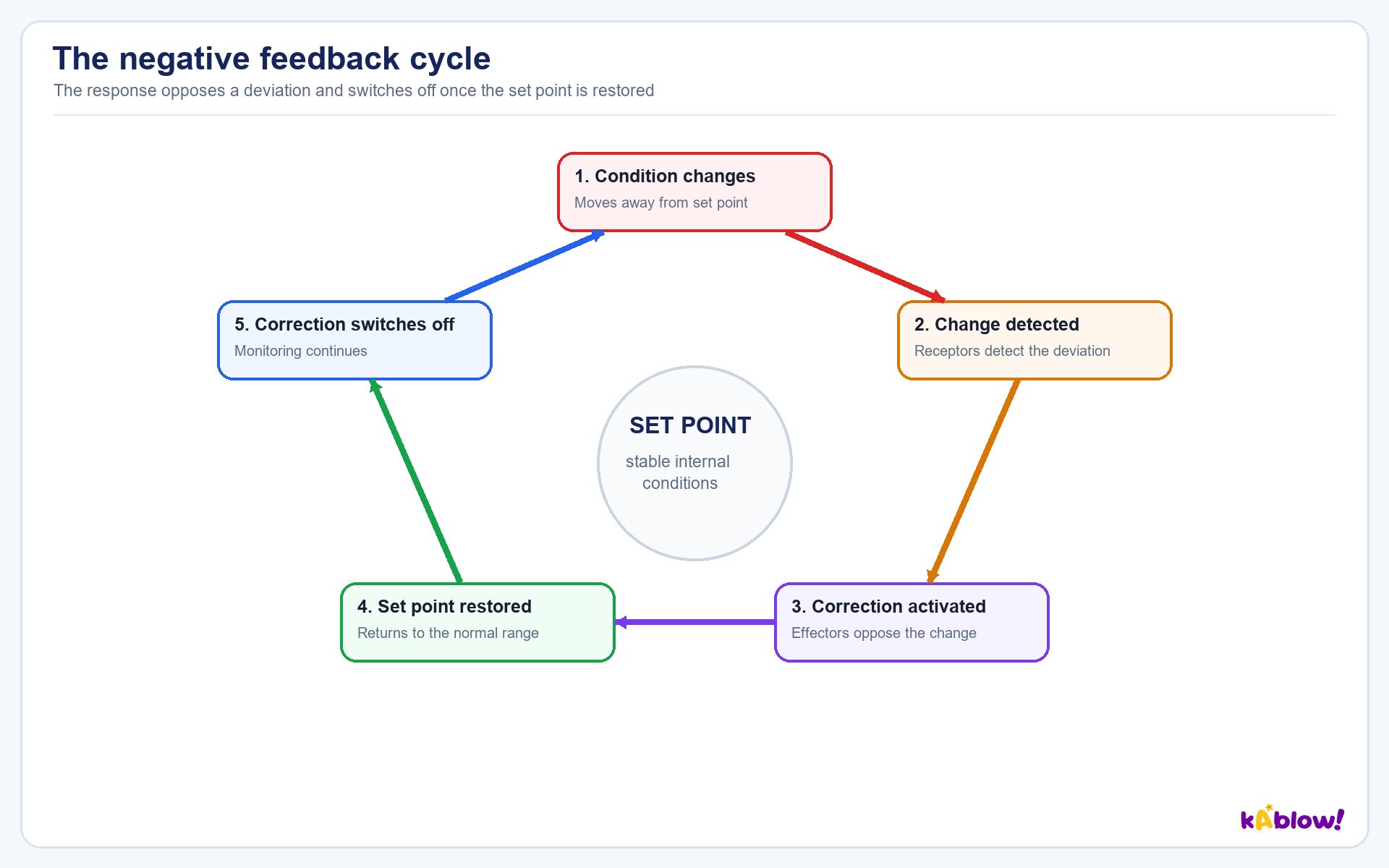
- Most homeostasis uses negative feedback. A receptor detects a change away from the set point and sends a message to a control centre (the brain or the pancreas, for example). The control centre signals an effector (a muscle or a gland) that produces a corrective response which opposes the change. When the level returns to normal, the response switches off.
- Negative feedback is like a thermostat in a house. If the room gets too hot, the heating switches off. If it gets too cold, the heating switches on. The level swings a little either side of the set point but never runs away.
- Your body also uses hormones (chemical messengers carried in the blood) and the nervous system to carry the messages. Hormones act more slowly than nerves but their effects usually last longer.
The negative feedback cycle
Controlling body temperature
- Normal core body temperature is about 37° Celsius. Enzymes work best at this temperature. If you get too hot, enzymes can denature. If you get too cold, reactions become too slow.
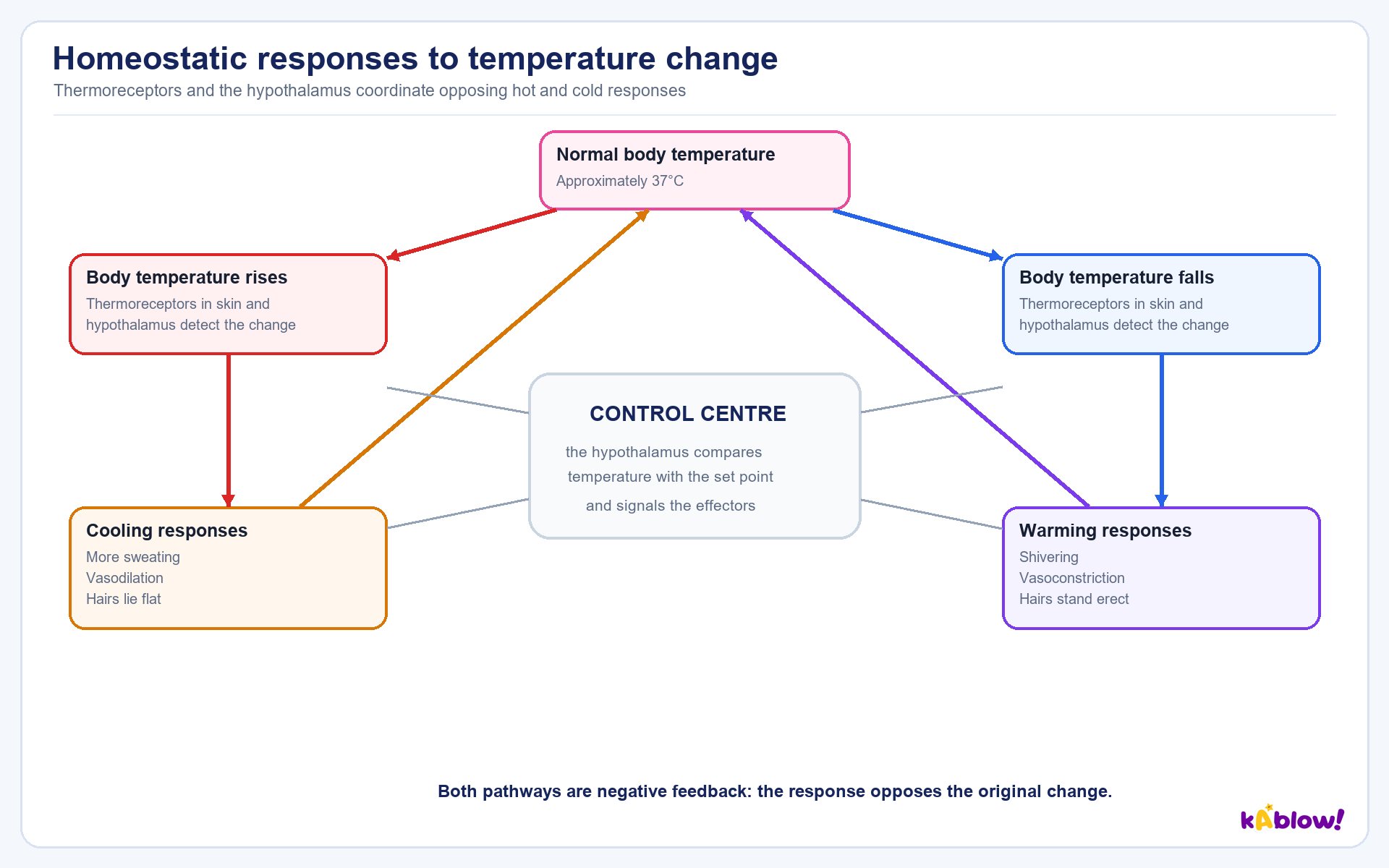
- The control centre is a part of the brain called the hypothalamus. It receives information from thermoreceptors in the skin and from the temperature of the blood flowing through the brain. It then signals the effectors.
- When you are too hot: sweat glands release sweat, and as it evaporates it takes heat from the skin. Vasodilation happens: blood vessels near the skin surface widen, more blood flows close to the surface and more heat is lost by radiation. Hairs lie flat.
- When you are too cold: sweating stops. Vasoconstriction happens: blood vessels near the surface narrow, so less blood flows near the skin and less heat is lost. Muscles contract rapidly (shivering), and the respiration needed releases heat. Hairs stand up and trap a layer of air, although this has little effect in humans because we have so little hair.
- Notice that every response opposes the change. That is what makes it negative feedback. Vasoconstriction and vasodilation do not happen because the blood vessels move: the muscle in the vessel walls contracts or relaxes.
- A person's temperature control can fail. In heat stroke the core temperature rises dangerously, and in hypothermia it falls dangerously. These show how narrow the safe range is.
Hot and cold responses controlled by the hypothalamus
Controlling blood glucose, and diabetes
- Cells need glucose for respiration, so the concentration of glucose in the blood must not fall too low. If it is too high, it upsets the water balance of cells and damages blood vessels and organs over time. The healthy range is roughly 4 to 7 millimoles per litre (mmol/l).
- Blood glucose is controlled by the pancreas, which acts as both the receptor and the control centre, and by the liver and other body cells, which act as effectors. Two hormones with opposite effects do the work.
- After a meal, blood glucose rises. β cells in the pancreas release insulin. Insulin makes liver and muscle cells take up glucose from the blood and the liver convert glucose into glycogen, a storage carbohydrate. Blood glucose falls back to normal.
- Between meals or during exercise, blood glucose falls. α cells in the pancreas release glucagon. Glucagon makes the liver break glycogen down into glucose and release it into the blood. Blood glucose rises back to normal.
- Diabetes is a condition in which blood glucose cannot be controlled properly. In type 1 diabetes the immune system destroys the β cells, so the pancreas makes little or no insulin. It usually starts in childhood or young adulthood. It is not caused by eating sugar. People with type 1 diabetes need insulin, which is given by injection or by a pump, and they monitor their blood glucose.
- In type 2 diabetes body cells become less responsive to insulin (insulin resistance), and the pancreas may not make enough insulin to cope. Risk is higher with factors such as older age, a family history of the condition, being overweight and being physically inactive. Management can include changes to diet and activity, medicines and sometimes insulin.
- Both types have the same core problem: blood glucose stays too high. Doctors and nurses work out the right management for each person, so this lesson describes the science, not what any one person should do. Scientists are also researching whether stem cells could one day replace damaged β cells.
The kidney and the first stage: filtration
- The kidneys are two organs at the back of the abdomen. They filter the blood, remove waste such as urea, and control the amount of water and salts in the body. A renal artery brings blood to each kidney and a renal vein takes it away. Urine leaves each kidney down a ureter, is stored in the bladder, and leaves the body through the urethra.
- Urea is made in the liver. When you eat more protein than your body needs, the liver removes the nitrogen part of the extra amino acids (deamination) and turns it into urea. Urea is poisonous in high amounts, so the kidneys remove it. Removing waste products of metabolism is called excretion.
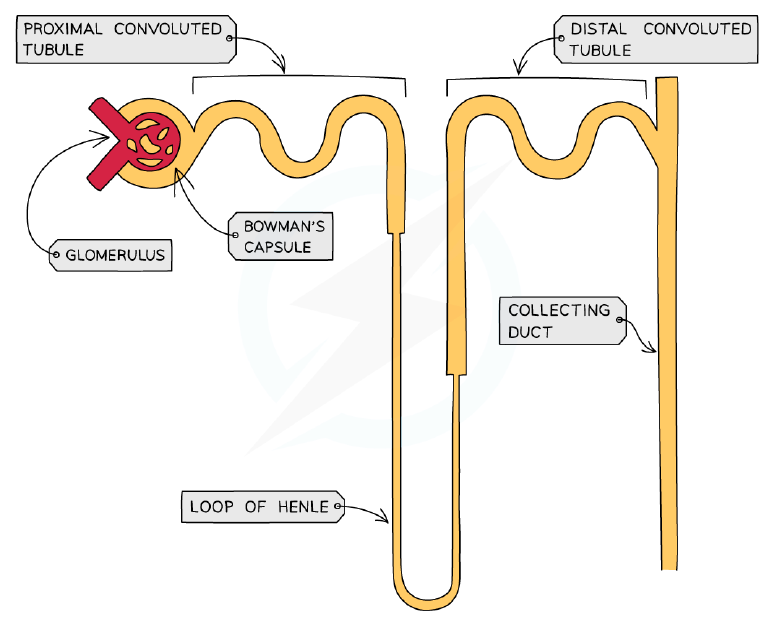
- Each kidney contains about a million tiny filtering units called nephrons. A nephron starts with a ball of capillaries, the glomerulus, inside a cup called the Bowman's capsule. A long tubule follows: the proximal convoluted tubule, the loop of Henle, the distal convoluted tubule and the collecting duct.
- Stage 1 is ultrafiltration. Blood enters the glomerulus at high pressure, because the vessel that carries blood out is narrower than the one that brings it in. The pressure forces small molecules out of the blood into the Bowman's capsule: water, glucose, urea and mineral ions. The liquid is called the filtrate.
- Large molecules stay in the blood. Proteins and blood cells are too big to pass through the filter, so a healthy person's filtrate contains none. If protein or blood appears in urine, it can be a sign that the filter is damaged.
- The filtrate is not urine yet. It contains useful substances such as glucose, and in an adult the kidneys filter around 180 litres of fluid every day. You do not lose that much, because most of it is taken back in the next stage.
The parts of a nephron
Reabsorption, urine and water balance
- Stage 2 is selective reabsorption. Useful substances are taken back into the blood from the tubule. In the proximal convoluted tubule, all the glucose is reabsorbed by active transport, which uses energy because glucose moves against its concentration gradient. Some mineral ions are also reabsorbed, and water follows by osmosis.
- More water is reabsorbed in the loop of Henle and the collecting duct. What is left is urine: water, urea and excess mineral ions. It flows to the bladder. A typical adult makes roughly 1 to 2 litres of urine a day.
- Urine contains no glucose in a healthy person. If blood glucose is very high, the carrier proteins in the tubule cannot reabsorb it all, and glucose appears in the urine. This is one reason a urine test can be an early sign of diabetes, though a doctor needs a blood test to be sure.
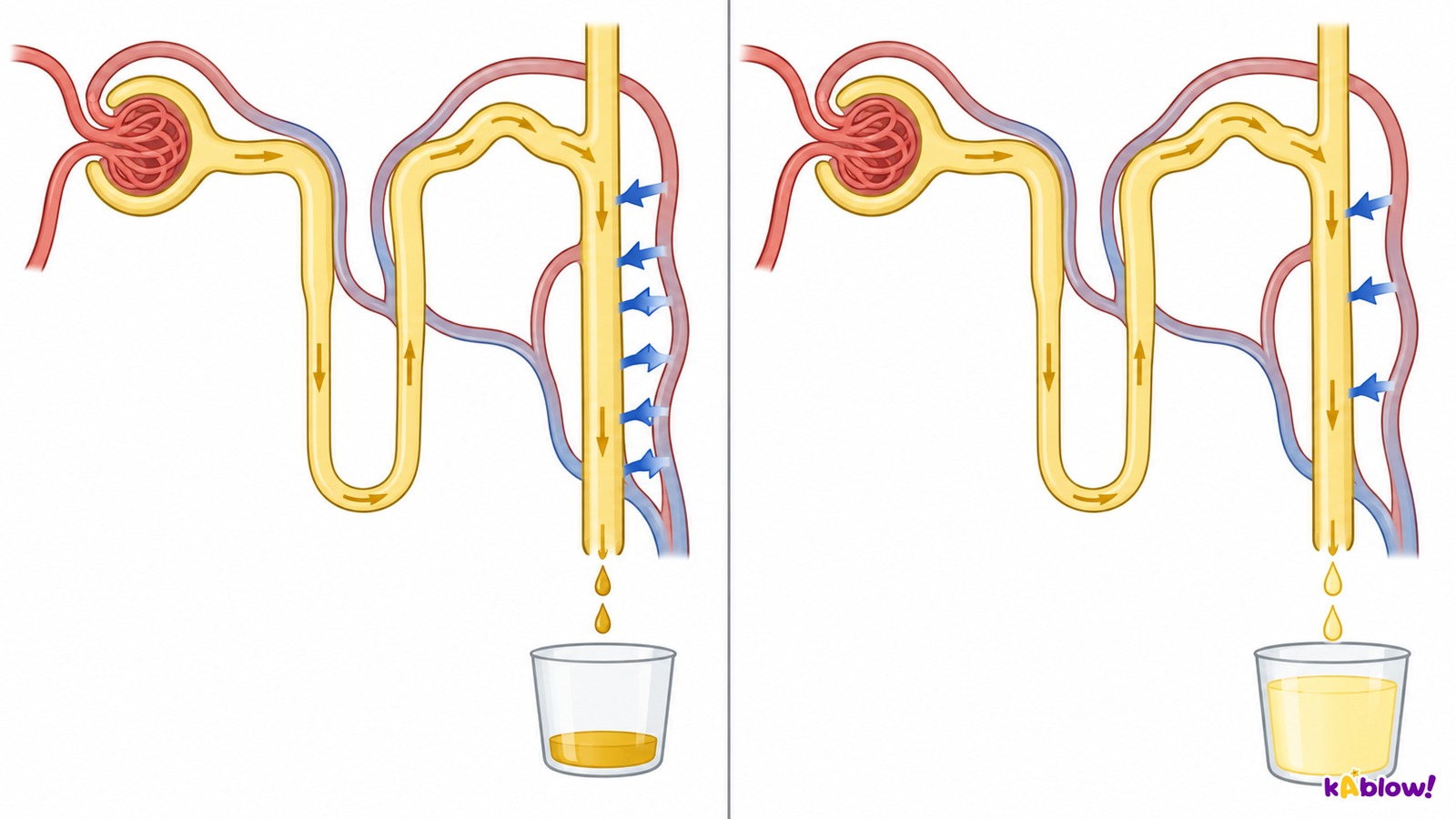
- The water balance of the body is controlled by negative feedback. If you sweat a lot or do not drink enough, the blood becomes more concentrated. The hypothalamus detects this and the pituitary gland releases more ADH (antidiuretic hormone) into the blood.
- ADH makes the walls of the collecting duct more permeable to water, so more water is reabsorbed into the blood. You produce a small volume of concentrated (dark) urine. If you drink a lot of water, less ADH is released, less water is reabsorbed and you produce a large volume of dilute (pale) urine.
- When the kidneys fail, a patient can use dialysis, in which a machine filters their blood, or receive a kidney transplant from a donor. Both have benefits and drawbacks. Dialysis takes many hours each week, and a transplant needs a suitable donor and medicines to stop the immune system rejecting the new kidney.
Two nephrons: more or less water reabsorbed
Think like a scientist: investigating control systems
- Scientists cannot always investigate homeostasis on people directly, so they use models and data. A model for sweating is a thermometer wrapped in wet cotton wool, compared with one wrapped in dry cotton wool. Both are placed in a gentle draught and the temperature is recorded every minute.
- In that investigation the independent variable is whether the cotton wool is wet or dry. The dependent variable is the temperature of the thermometer. Control variables include the starting temperature, the amount of cotton wool, the draught, the room temperature and the time between readings.
- To make results reliable, repeat the investigation at least three times and calculate a mean. To judge whether a difference is real, compare it with the spread of the repeats.
- A model has limits. Cotton wool does not have blood vessels or a hypothalamus, so it cannot show vasodilation or negative feedback. It shows only the cooling effect of evaporation.
- When you read health data, check the sample size and whether the groups were comparable. A urine test strip that finds glucose in one person does not prove that person has diabetes, because there may be other causes and one test is a small sample.
- Inquiry task: design an investigation to find out whether the volume of water a person drinks changes the volume or colour of the urine they produce over the next two hours. State the independent and dependent variables, say what you would control, explain how you would use a small group safely and fairly, and evaluate one weakness of your method.
Slides
Sign up free to view the lesson slides
Step through every slide for this topic — plus flashcards and revision notes — with a free account.
Practice questions
Free preview — 8 of 49 questions. Sign up to see them all.
1.What is homeostasis?
Easy- AMaking the body grow taller
- BFighting off harmful microorganisms
- CKeeping conditions inside the body steady
- DDigesting food into small molecules
- EMoving the body in response to a stimulus
2.What is the normal core body temperature of a healthy person?
Easy- AAbout 37° Celsius
- BAbout 27° Celsius
- CAbout 47° Celsius
- DAbout 20° Celsius
- EAbout 57° Celsius
3.In negative feedback, the corrective response opposes the original change.
EasyTrue or false?
4.Which organ makes insulin?
Easy- AThe liver
- BThe kidney
- CThe stomach
- DThe pancreas
- EThe pituitary gland
5.Which hormone makes the liver release glucose into the blood?
Easy- AInsulin
- BGlucagon
- CADH
- DThyroxine
- EUrea
6.Complete the sentence.
EasyGlucose is stored in the liver and muscles as ____.
7.What is the effect of insulin on blood glucose?
Easy- AIt raises the blood glucose concentration
- BIt lowers the blood glucose concentration
- CIt has no effect on blood glucose
- DIt destroys glucose in the blood
- EIt makes the pancreas stop working
8.Match each part of the urinary system to its job.
Easy- Kidney
- Ureter
- Bladder
- Urethra
- Carries urine from the kidney to the bladder
- Stores urine
- Carries urine out of the body
- Filters the blood and makes urine
Unlock all 49 questions, flashcards & more
Create a free account to see every question, the slides, flashcards and revision notes for this topic.