Ionic and covalent bonding
Learn it by playing
Answer these questions to earn energy, then fish and explore. No account needed.
For educators: ready-to-use lesson slides, revision notes for Ionic and covalent bonding (MYP Chemistry, Year 2) — use them in your lesson, or run the topic as an interactive class activity your learners play as a live game.
Lesson notes
Big idea: why atoms join up
- Big idea (key concept): Relationships. Atoms interact with each other, and the relationship between atoms decides what new substances are made.
- Related concept: Structure. The way particles are arranged and joined (the structure) decides the properties of a substance, such as its melting point and whether it conducts.
- Global context: Scientific and technical innovation. Knowing how bonds work lets chemists design materials, from plastics that insulate wires to salts that keep us healthy.
- Most atoms are not stable on their own. The noble gases (helium, neon, argon) are unreactive because their outer shells are full.
- Other atoms react to get a full outer shell as well. They can do it in two ways: by transferring electrons (ionic bonding) or by sharing electrons (covalent bonding).
- As a rule of thumb, a metal joined to a non-metal forms an ionic compound, and non-metals joined to non-metals form covalent substances.
Ions and ionic bonding
- An ion is an atom (or group of atoms) that has gained or lost electrons, so it has an electric charge.
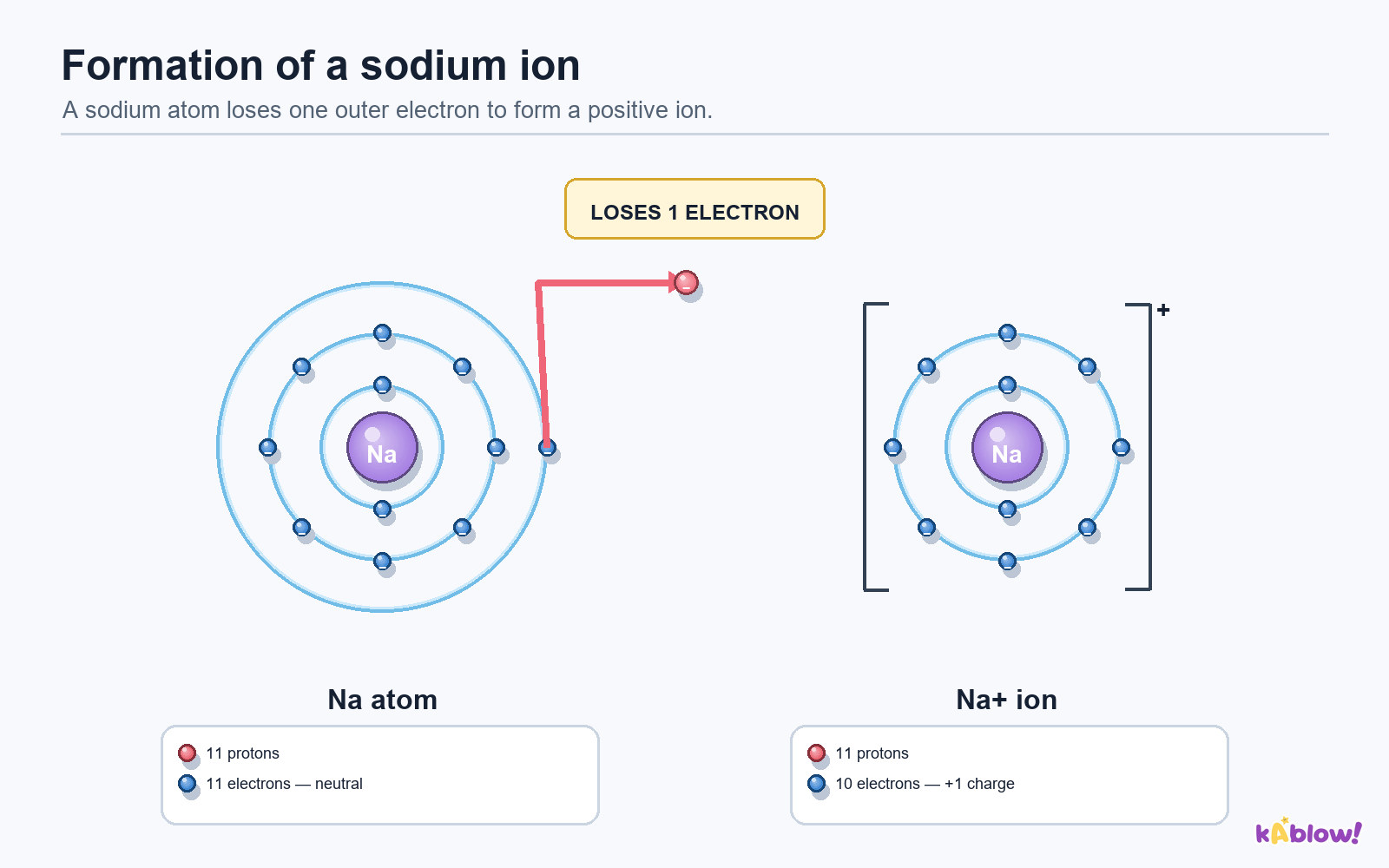
- Metal atoms lose their outer electrons and become positive ions. A sodium atom (2,8,1) loses one electron to become Na⁺ (2,8). The picture shows this. It now has 11 protons (+11) and 10 electrons (-10), so the charge is +1.
- Non-metal atoms gain electrons and become negative ions. A chlorine atom (2,8,7) gains one electron to become Cl⁻ (2,8,8), with 17 protons and 18 electrons.
- The charge on an ion follows the group: Group 1 gives +1, Group 2 gives +2, Group 6 gives -2 and Group 7 gives -1. So magnesium forms Mg²⁺ and oxygen forms O²⁻.
- In ionic bonding, electrons are transferred from the metal atom to the non-metal atom. The oppositely charged ions then attract each other strongly. This attraction is the ionic bond.
- Word equation: sodium + chlorine → sodium chloride. Symbol equation: 2Na + Cl₂ → 2NaCl. The reaction between sodium and chlorine is only ever done by a teacher in a fume cupboard.
A sodium atom losing one electron to form Na⁺
Formulae and properties of ionic compounds
- An ionic compound has no overall charge, so the positive and negative charges must balance. This gives the formula.
- Na⁺ and Cl⁻ balance one to one, so the formula is NaCl. Mg²⁺ and O²⁻ balance one to one, so it is MgO. Mg²⁺ needs two Cl⁻, so it is MgCl₂. Two Na⁺ are needed for one O²⁻, so it is Na₂O.
- Ionic compounds are made of a huge giant lattice of ions in a regular pattern, with every ion attracted to its neighbours in all directions.
- They have high melting and boiling points because a lot of energy is needed to overcome the strong attractions between the ions. Sodium chloride melts at about 801 °C.
- They are hard but brittle, and many dissolve in water.
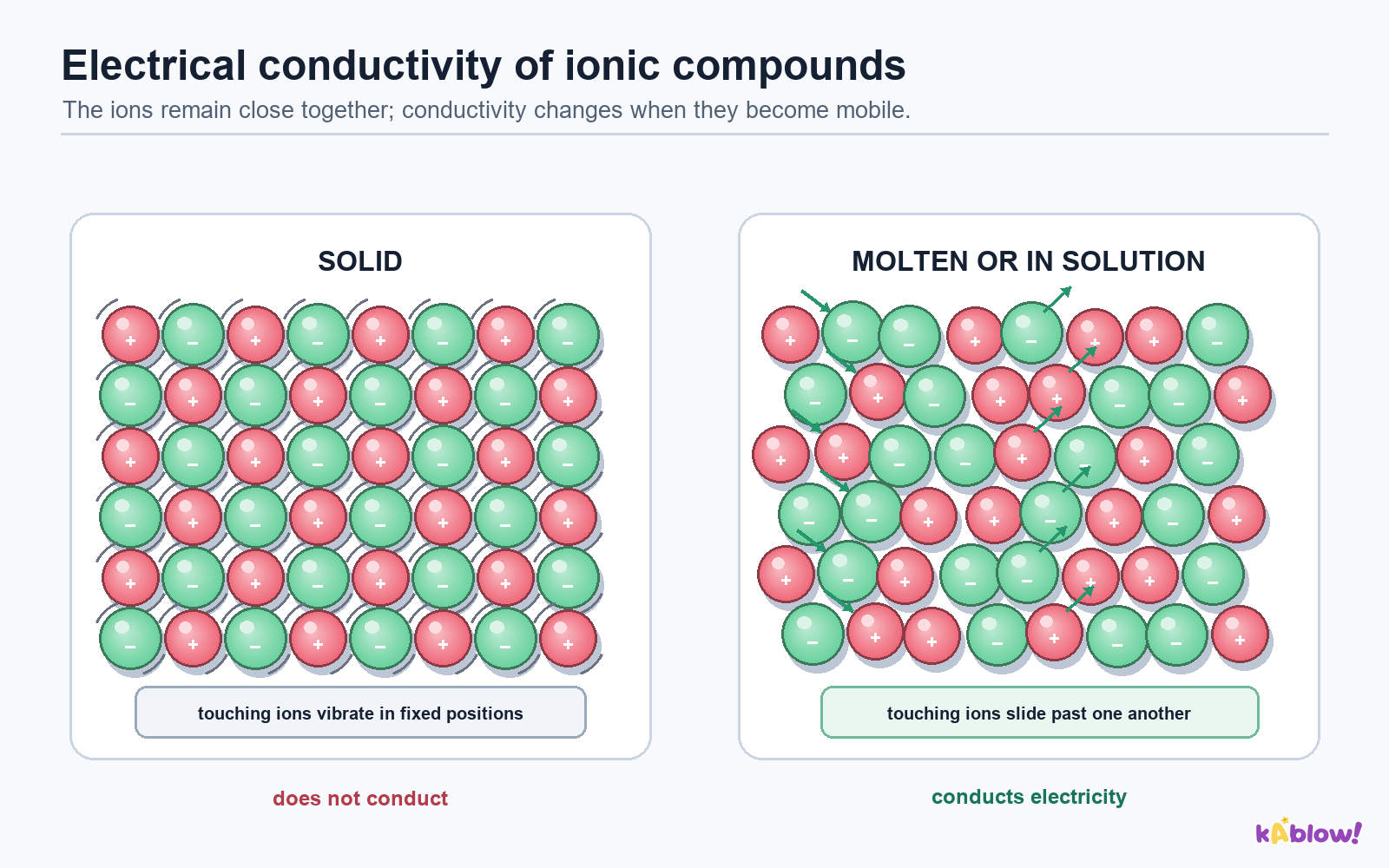
- They do not conduct when solid, because the ions are fixed in place. They conduct when molten or dissolved in water, because the ions are free to move and carry charge.
Ions in a solid and in a molten ionic compound
Covalent bonding in simple molecules
- In covalent bonding, two non-metal atoms share a pair of electrons. Each shared pair is one covalent bond.
- Each atom counts the shared electrons as part of its own outer shell, so both get a full outer shell. In a hydrogen molecule, H₂, each hydrogen atom shares its one electron, so both have a full shell of 2.
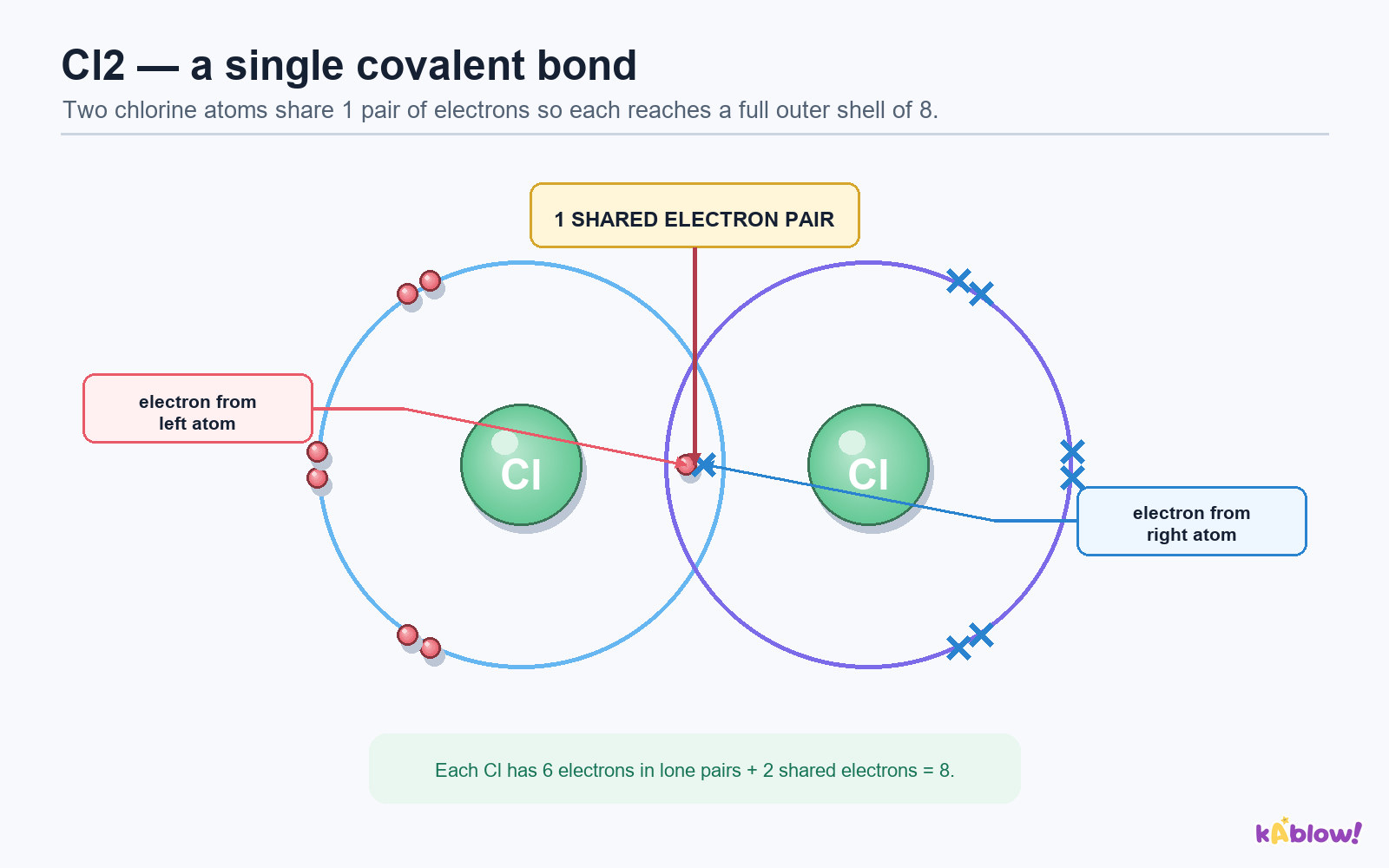
- A chlorine molecule, Cl₂, has one shared pair. Each chlorine atom has 6 other outer electrons in three pairs, called lone pairs, so each has 6 + 2 = 8.
- An oxygen molecule, O₂, has a double bond: two shared pairs (four shared electrons). Nitrogen, N₂, has a triple bond.
- The number of bonds an atom makes depends on how many electrons it needs: hydrogen 1, oxygen 2, nitrogen 3, carbon 4. That is why water is H₂O, ammonia is NH₃ and methane is CH₄.
- In a dot-and-cross diagram the outer electrons from one atom are drawn as dots and those from the other atom as crosses. A shared pair is one dot and one cross in the overlap.
Dot-and-cross diagram of a chlorine molecule
Covalent substances and giant structures
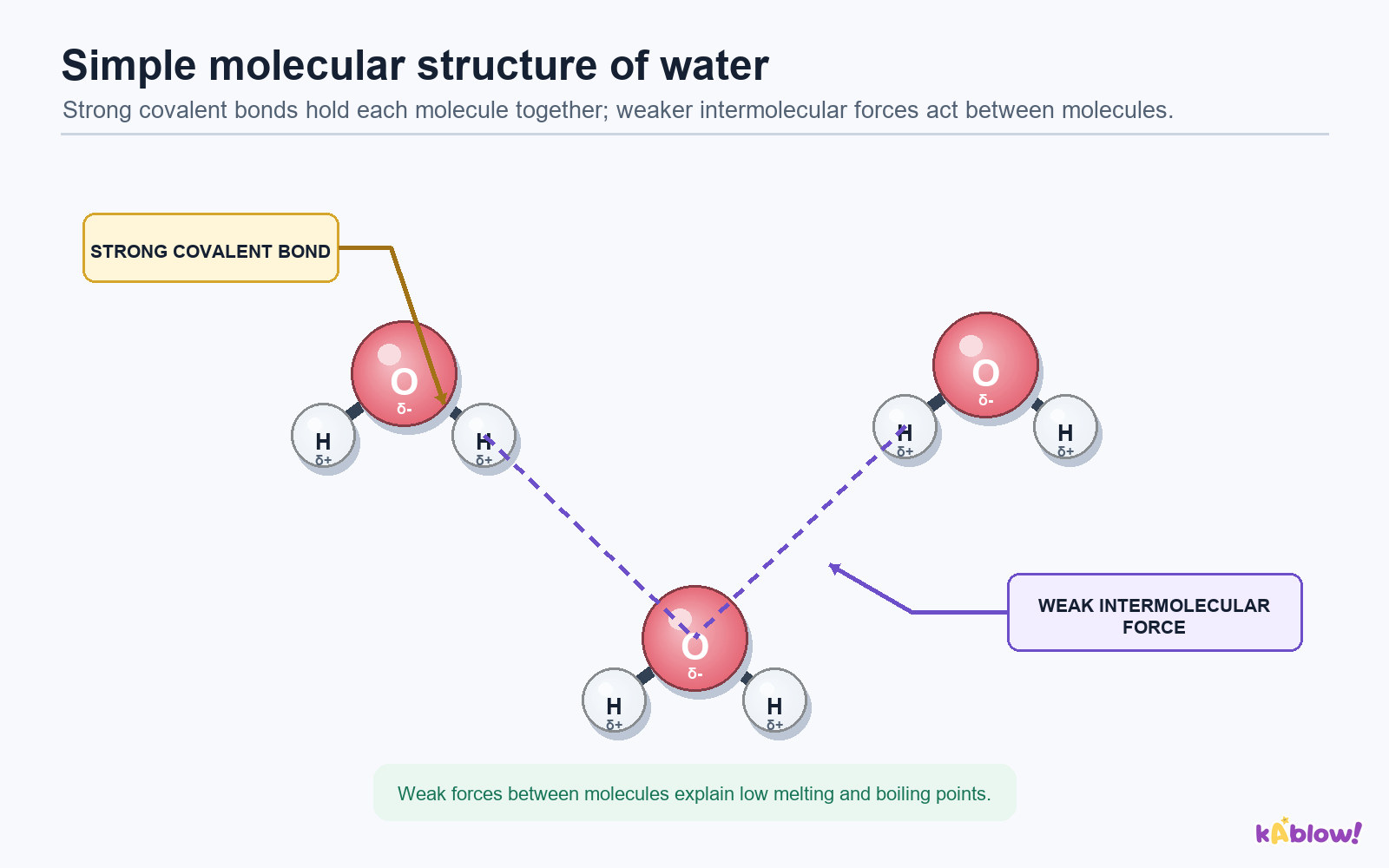
- Simple molecular substances, such as water, methane and carbon dioxide, are made of small molecules. The covalent bonds inside each molecule are strong.
- Between molecules there are only weak forces. When a simple molecular substance melts or boils, it is these weak forces that are overcome, not the covalent bonds. Little energy is needed, so they have low melting and boiling points and are often liquids or gases.
- They do not conduct electricity, because they have no ions or free electrons to carry charge. This makes covalent plastics good insulators for electrical wires.
- Some covalent substances have giant covalent structures, in which a huge number of atoms are joined in a network by covalent bonds. Diamond and silicon dioxide (sand) are examples. They have very high melting points because many strong bonds must be broken.
- Compare the two main types. Ionic: metal and non-metal, high melting point, conducts when molten or dissolved. Simple covalent: non-metals only, low melting point, does not conduct.
Strong bonds inside water molecules, weak forces between
Think like a scientist: identifying unknown substances
- The question: how can you tell whether an unknown white solid is ionic or covalent by looking at its properties?
- Safe tests (school practical, low-voltage cell and bulb, eye protection): test whether the solid conducts, test whether it dissolves in water, and test whether the solution conducts. The teacher runs any test that involves heating a substance strongly.
- The independent variable is the sample you test. The dependent variable is what you observe, such as whether the bulb lights or whether it dissolves.
- Control variables: the same size of sample, the same volume of water, the same cell and bulb, and clean electrodes each time.
- Evaluate: one test is not enough. Some covalent substances dissolve in water, and some conduct when they are in solution. Combining the melting point, conductivity as a solid, and conductivity when dissolved gives a more reliable conclusion.
- Your task: design an investigation to classify three unknown substances. Draw a results table, predict what you would see for an ionic and for a covalent substance, and explain how you will decide when two results disagree. Never taste or smell a lab chemical.
Slides
Sign up free to view the lesson slides
Step through every slide for this topic — plus flashcards and revision notes — with a free account.
Practice questions
Free preview — 8 of 55 questions. Sign up to see them all.
1.Why do atoms form bonds?
Easy- ATo get a full outer shell of electrons
- BTo get rid of all their electrons
- CTo increase the number of protons
- DTo become heavier
2.Which pair of elements usually forms an ionic bond?
Easy- ATwo non-metals
- BA metal and a non-metal
- CTwo noble gases
- DTwo atoms of hydrogen
3.How is a covalent bond formed?
Easy- AOne atom gives all its electrons away
- BTwo positive ions attract
- CAtoms share a pair of electrons
- DProtons move between atoms
4.An ion is an atom that has gained or lost electrons.
EasyTrue or false?
5.A sodium atom loses one electron. What ion does it form?
Easy- ANa⁻
- BNa²⁺
- CNa²⁻
- DNa⁺
6.A chlorine atom gains one electron. What ion does it form?
Easy- ACl⁻
- BCl⁺
- CCl²⁻
- DCl²⁺
7.Which of these substances is held together by covalent bonds?
Easy- ASodium chloride
- BWater
- CMagnesium oxide
- DCalcium chloride
8.Which of these compounds is ionic?
Easy- AWater
- BMethane
- CSodium chloride
- DCarbon dioxide
Unlock all 55 questions, flashcards & more
Create a free account to see every question, the slides, flashcards and revision notes for this topic.
Past papers
Past-paper practice for this topic is coming soon.
Coming soon