Pressure
Learn it by playing
Answer these questions to earn energy, then fish and explore. No account needed.
For educators: ready-to-use lesson slides, revision notes for Pressure (MYP Physics, Year 2) — use them in your lesson, or run the topic as an interactive class activity your learners play as a live game.
Lesson notes
Big idea: the same force can act very differently
- Big idea. Key concept: Relationships. The pressure on a surface depends on two things: the size of the force and the area it acts on.
- Related concept: Interaction. Pressure happens where two things push on each other, such as a foot on the ground or air on a wall.
- Global context: Scientific and technical innovation. Engineers use pressure to design knives, tyres, dams, diving suits and hydraulic machines.
- Pressure is how concentrated a force is. It is the force that acts on each unit of area of a surface.
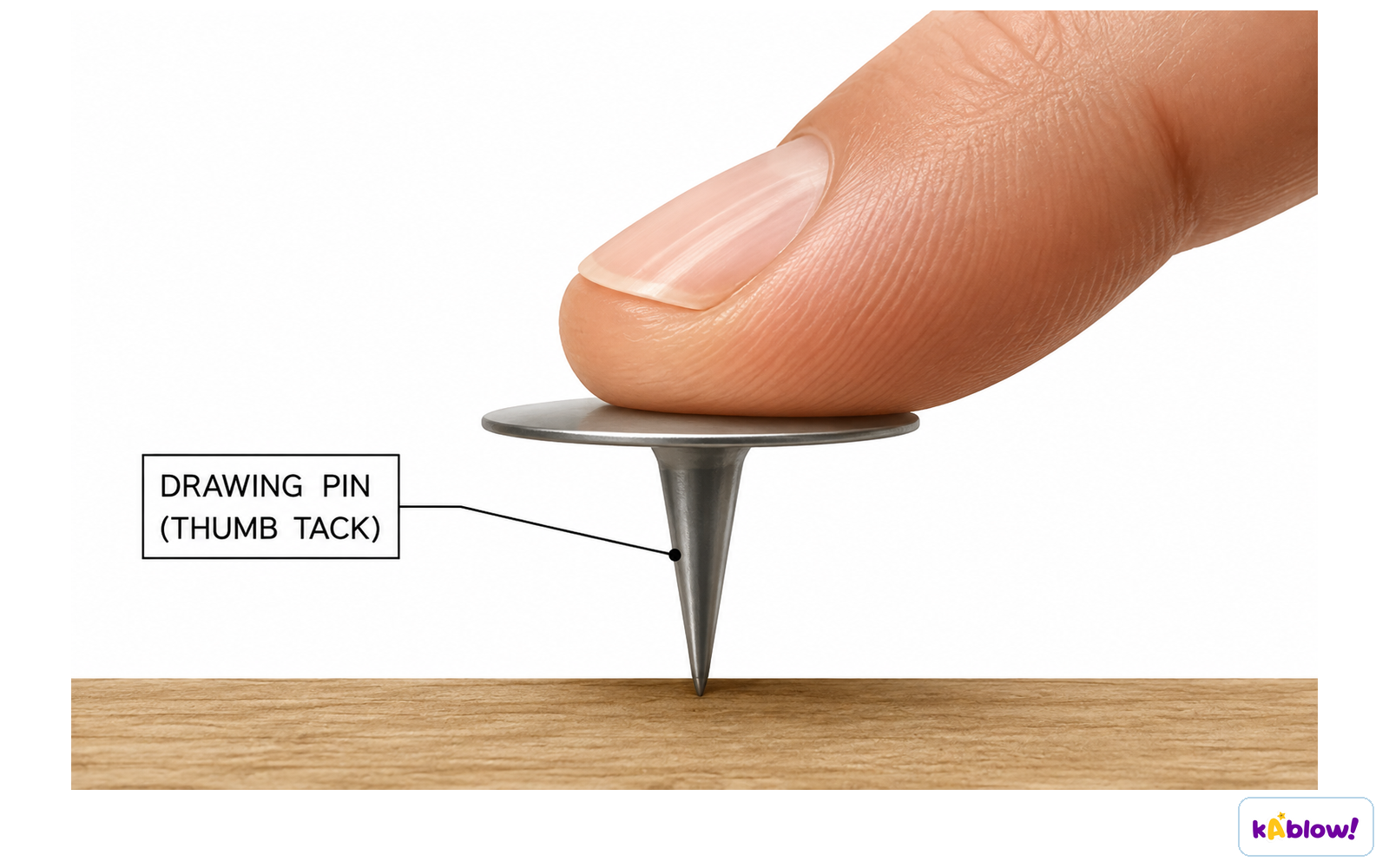
- Press a drawing pin into wood. Your finger pushes on the wide head with a force. The pin passes the same force to the point, but the point has a tiny area, so the pressure under the point is enormous and the pin goes in.
- More force gives more pressure. A smaller area also gives more pressure.
A drawing pin pressed into wood
Calculating pressure
- pressure = force ÷ area, or p = F ÷ A.
- If force is in newtons (N) and area is in square metres (m²), pressure is in pascals (Pa). One pascal is one newton on each square metre: 1 Pa = 1 N/m².
- A pascal is a small pressure, so we often use the kilopascal (kPa). 1 kPa = 1000 Pa. You can also work in N/cm² if the area is in square centimetres.
- Worked example: a force of 600 N acts on an area of 0.03 m². Pressure = 600 N ÷ 0.03 m² = 20 000 Pa.
- Rearranged: force = pressure × area (F = p × A) and area = force ÷ pressure (A = F ÷ p). A pressure of 5000 Pa on 0.4 m² gives a force of 5000 Pa × 0.4 m² = 2000 N.
- Area from sides: a face that is 0.2 m long and 0.1 m wide has an area of 0.2 m × 0.1 m = 0.02 m². Always work out the area in m² first, then divide.
- For a person standing, the force is their weight (weight = mass × 10 N/kg). Two feet on the ground share the weight, but the area is the area of both feet together.
Making pressure bigger or smaller
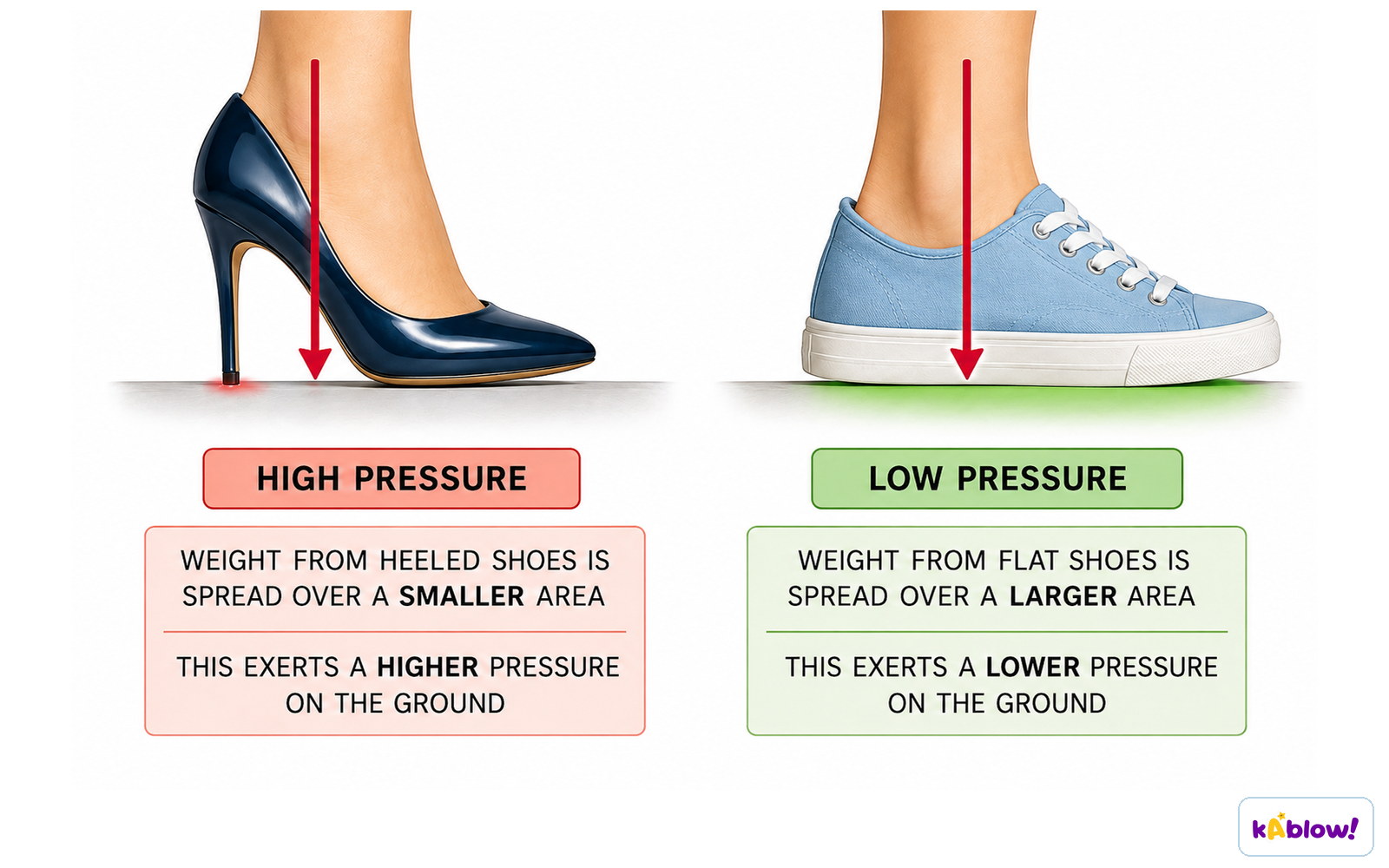
- To make a large pressure, use a small area: knife edges, nails, needles, drawing pin points and the thin heels of some shoes all concentrate the force.
- To make a small pressure, use a large area: wide tractor tyres, skis, snowshoes, caterpillar tracks and a wide school bag strap spread the force.
- Walking on soft snow, a person in thin-heeled shoes sinks in because the weight acts on a tiny area. Snowshoes spread the same weight over a much bigger area, so the pressure is lower.
- A knife is sharpened to make the area of the edge smaller. The same push from your hand then gives a much larger pressure under the edge, so it cuts easily.
- The weight of a block does not change when you turn it over, but the area on the table does. A block on its small end makes a higher pressure than the same block lying on its large face.
A high heel and a flat shoe compared
Pressure in liquids and hydraulics
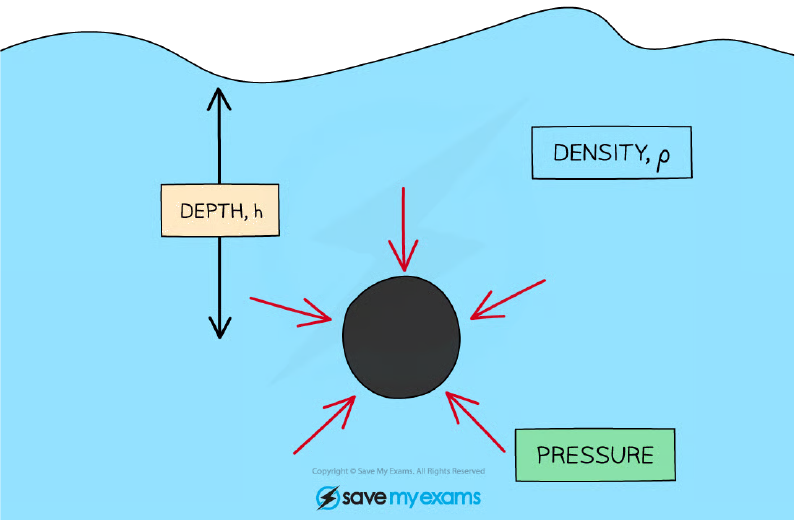
- A liquid pushes on the container and on anything in it. This liquid pressure acts in all directions: down, up and sideways.
- Pressure in a liquid increases with depth. Deeper down there is more liquid above, so there is more weight pressing down. Divers feel this on their ears, and submarines need very strong hulls.
- This is why a dam wall is built thicker at the bottom than at the top, and why water squirts out faster from a low hole in a bottle than from a high one.
- A liquid is very hard to squash. If you push on a liquid in a closed system, the pressure is passed on equally through the liquid. This is used in hydraulic machines such as car brakes, diggers and lifts.
- In a hydraulic lift a small force on a small piston makes a pressure. The same pressure acts on a large piston, so the force there is larger. For example 100 N on a piston of area 0.002 m² makes 50 000 Pa. On a piston of area 0.05 m² this gives 50 000 Pa × 0.05 m² = 2500 N.
- The big piston moves less far than the small one, so you do not get something for nothing: a bigger force means a smaller distance.
Pressure in a liquid acts in all directions
Pressure in gases and the atmosphere
- A gas is made of particles that fly about and collide with the walls of their container. Each collision gives a tiny push, and billions of them every second add up to the gas pressure.
- If you squeeze a gas into a smaller volume, the particles hit the walls more often, so the pressure rises. This is why a bicycle pump gets hard to push.
- If you heat a gas in a closed container, the particles move faster. They hit the walls harder and more often, so the pressure rises. This is why a sealed can must never be heated.
- The air around us is a gas with weight. The air pressing down on us is atmospheric pressure. At sea level it is about 100 000 Pa, which is about 10 N on every square centimetre.
- We do not feel it because the fluids inside our bodies push outwards with the same pressure.
- Atmospheric pressure falls as you climb, because there is less air above you. At the top of a high mountain the pressure is much lower than at sea level.
Think like a scientist: does area change the pressure?
- You can investigate how the area of a block changes how deep it sinks into a tray of sand or modelling clay.
- Put the same block down on its small face, then on its medium face, then on its large face. Measure the depth of the dent each time with a ruler. Keep your feet away from the block and wash your hands after using clay.
- The independent variable is the area of the face touching the clay. The dependent variable is the depth of the dent. Control variables include the weight of the block, the clay or sand, and how you place the block (gently, with no push).
- Calculate the pressure each time with p = F ÷ A, using the weight of the block as F. A small area should give a high pressure and a deep dent.
- Repeat each test three times and take a mean to make the results more reliable. Smooth the clay between tests so it is a fair test.
- Inquiry task: a classmate says a heavier block always makes a deeper dent. Plan an investigation that tests this fairly. State your variables, say what you will keep the same, and explain how you will decide if your results support the claim.
Slides
Sign up free to view the lesson slides
Step through every slide for this topic — plus flashcards and revision notes — with a free account.
Practice questions
Free preview — 8 of 53 questions. Sign up to see them all.
1.Which equation correctly gives pressure?
Easy- Apressure = force × area
- Bpressure = area ÷ force
- Cpressure = force ÷ area
- Dpressure = mass ÷ volume
2.Which unit is used for pressure?
Easy- APascal (Pa)
- BNewton (N)
- CJoule (J)
- DWatt (W)
3.One pascal (1 Pa) is the same as which of these?
Easy- A1 N × 1 m²
- B1 kg/m³
- C1 N/m
- D1 N/m²
4.A knife cuts well when it is sharp. Why?
Easy- AThe thin edge makes the force bigger, so the knife pushes harder on its own
- BThe thin edge has a very small area, so the same force makes a much bigger pressure
- CThe thin edge has a large area, so it spreads the force across the food
- DThe thin edge lowers the pressure, so the knife needs less force to move
5.Why do tractors have very wide tyres?
Easy- AWide tyres spread the weight over a large area, so the pressure on the soil is small
- BWide tyres make the tractor lighter, so it does not sink into the soil
- CWide tyres give the soil a larger pressure so it grips better
- DWide tyres reduce the force of gravity on the tractor so it floats
6.A diver swims deeper under water. What happens to the water pressure on the diver?
Easy- AIt decreases
- BIt stays the same
- CIt increases
- DIt becomes zero
7.In which directions does the pressure in a liquid act?
Easy- AOnly downwards
- BIn all directions
- COnly sideways
- DOnly upwards
8.What causes atmospheric pressure?
Easy- AThe wind blowing on us
- BThe heat from the Sun
- CThe pull of the Moon
- DThe weight of the air above us
Unlock all 53 questions, flashcards & more
Create a free account to see every question, the slides, flashcards and revision notes for this topic.
Past papers
Past-paper practice for this topic is coming soon.
Coming soon