The Solar System and beyond
Learn it by playing
Answer these questions to earn energy, then fish and explore. No account needed.
For educators: ready-to-use lesson slides, revision notes for The Solar System and beyond (MYP Physics, Year 2) — use them in your lesson, or run the topic as an interactive class activity your learners play as a live game.
Lesson notes
Big idea: our place in space
- Big idea. Key concept: Systems. The Solar System is a system of bodies held together by gravity, with the Sun at the centre.
- Related concept: Patterns. Planets show patterns in their order, their orbit times and their make-up.
- Global context: Orientation in space and time. Humans have used the sky for calendars and navigation for thousands of years.
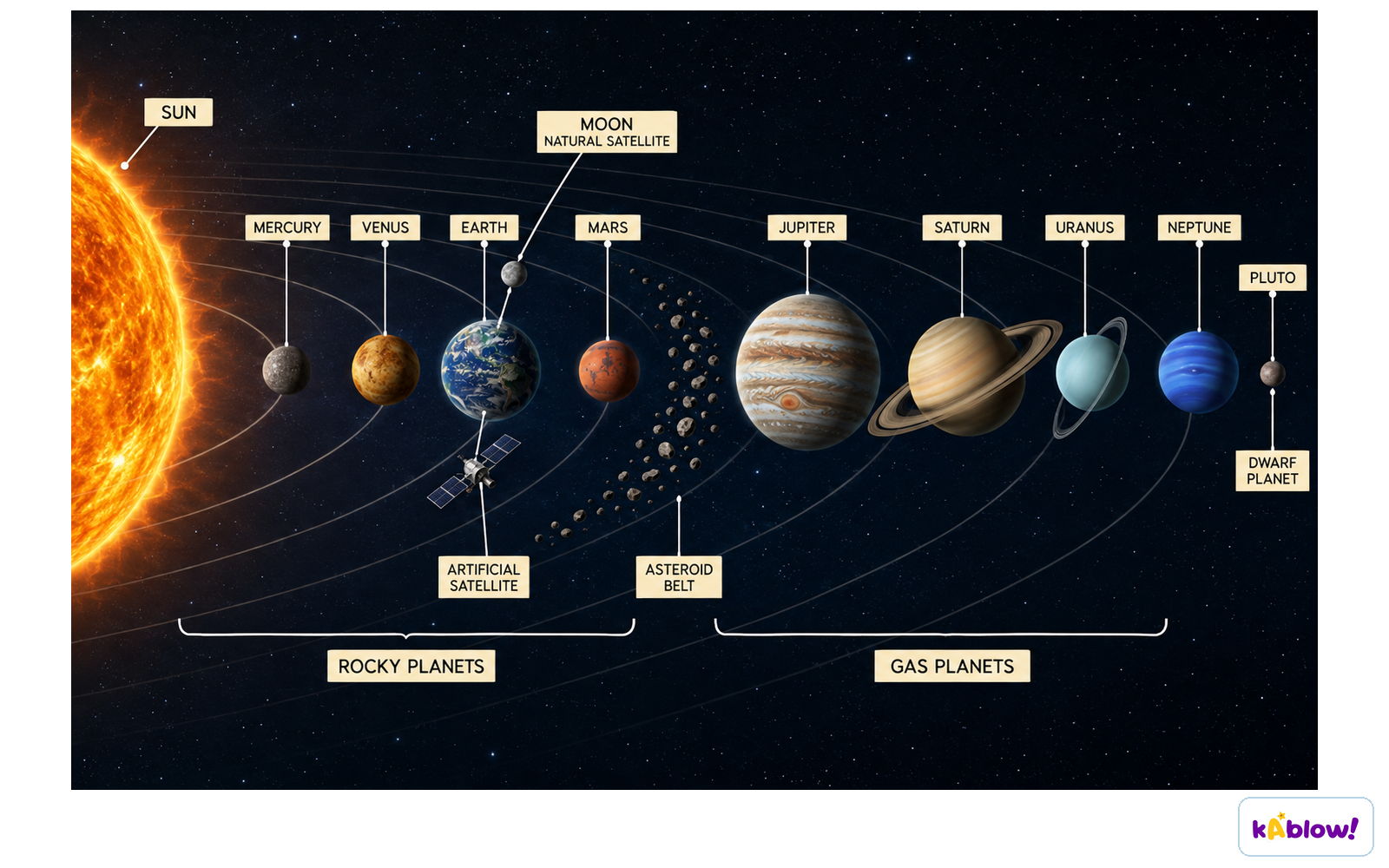
- The Sun is a star. Eight planets orbit it, in order from the Sun: Mercury, Venus, Earth, Mars, Jupiter, Saturn, Uranus, Neptune.
- The four inner planets are small and rocky. Jupiter and Saturn are huge gas giants, and Uranus and Neptune are ice giants.
- Between Mars and Jupiter lies the asteroid belt, a ring of rocky lumps. Dwarf planets such as Pluto are too small to count as planets.
- A moon is a natural satellite that orbits a planet. An artificial satellite is built by people. A comet is a ball of ice and dust that grows a tail when it nears the Sun.
- The Solar System formed about 4.6 billion years ago from a spinning cloud of gas and dust called a nebula.
The Sun, planets and other Solar System objects
Gravity and orbits
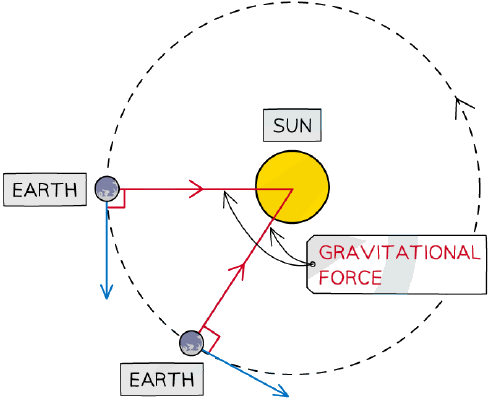
- Gravity is a force of attraction between objects that have mass. The bigger the mass, the stronger the pull. The further apart the objects, the weaker the pull.
- The Sun has a huge mass, so its gravity is strong enough to hold all the planets. Each planet is moving sideways at the same time as it is pulled inwards, so it keeps orbiting instead of falling in.
- Planets closer to the Sun are pulled harder, so they move faster and have a shorter orbit. Mercury takes about 88 days to go round the Sun, Earth takes about 365 days, Jupiter about 12 years and Neptune about 165 years.
- Comets have long, stretched-out (elliptical) orbits. They move fastest when they are close to the Sun and slowest when they are far away.
- Weight is the force of gravity on an object: weight = mass × gravitational field strength (W = m \times g). On Earth g is about 10 N/kg. On the Moon g is about 1.6 N/kg, so a 60 kg person weighs about 96 N there.
- Your mass stays the same everywhere. Only your weight changes with the strength of gravity.
Gravity keeps Earth in orbit
Day, night and the seasons
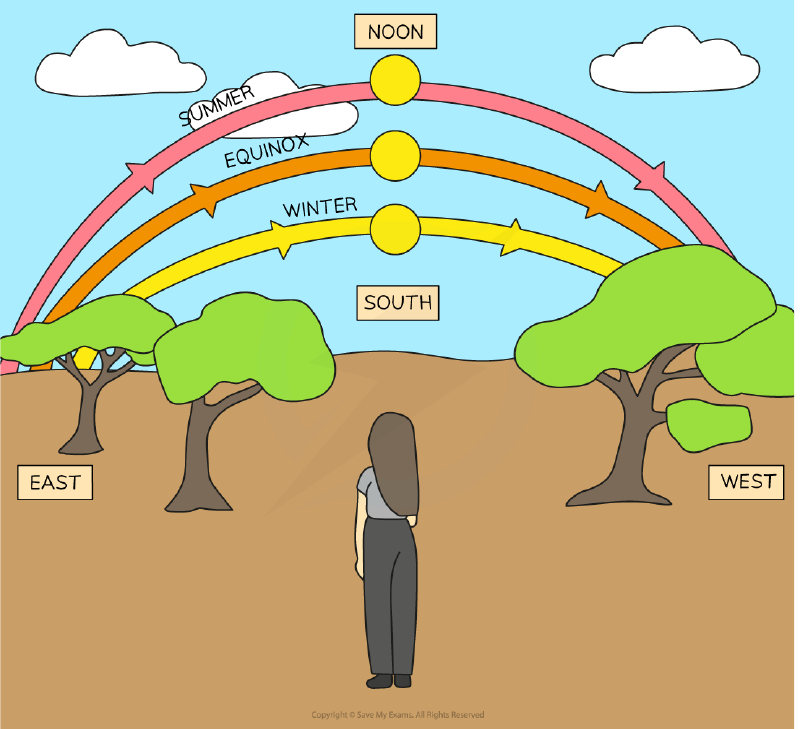
- Earth rotates once on its axis every 24 hours. The half facing the Sun has day and the half facing away has night. The Sun seems to rise in the east and set in the west because of this spin.
- Earth also orbits the Sun once in about 365 and a quarter days, which we call a year.
- Earth's axis is tilted at about 23.5°. The axis always points the same way in space as Earth orbits.
- When the northern hemisphere is tilted towards the Sun it has summer: the Sun is higher in the sky, days are longer and the sunlight is more concentrated, so it is warmer. At the same time the southern hemisphere has winter.
- Six months later the situation is reversed. The seasons are caused by the tilt, not by Earth being nearer to or further from the Sun. Earth is actually closest to the Sun in early January.
- Safety: never look directly at the Sun. It can cause permanent eye damage.
The Sun's path across the sky in each season
The Moon and its phases
- The Moon is Earth's only natural satellite. It orbits Earth about once every 27 days, and the same face always points towards us.
- The Moon makes no light of its own. It reflects sunlight, and the Sun always lights one half of it.
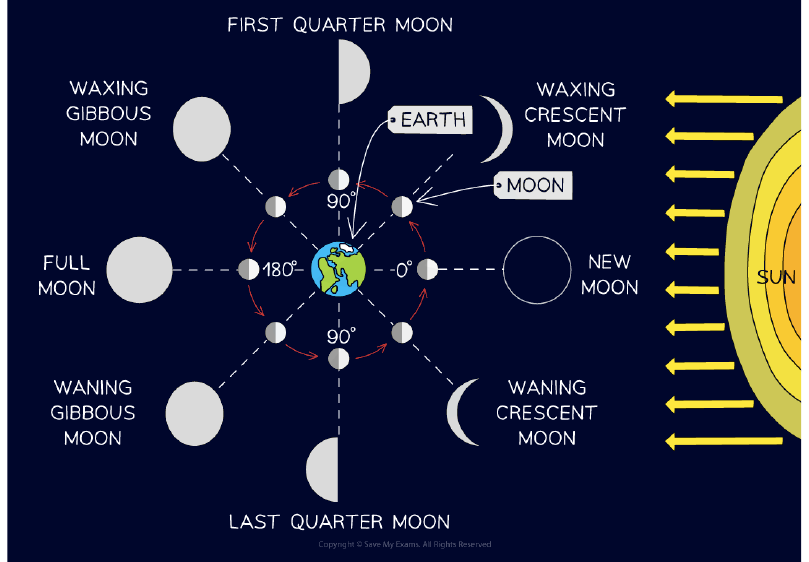
- As the Moon orbits Earth we see different amounts of its lit half. These are the phases of the Moon. The cycle from one new moon to the next takes about 29.5 days.
- At new moon the Moon is roughly between Earth and the Sun, so the lit half faces away from us. At full moon Earth is roughly between the Sun and the Moon, so we see the whole lit half.
- Between them the Moon is waxing (growing) through crescent, first quarter and gibbous to full, then waning (shrinking) back to new.
- The phases are not caused by Earth's shadow. They are caused by our changing view of the sunlit half.
Phases of the Moon
Stars, galaxies and the Universe
- A star is a huge ball of hot gas that gives out its own light. Stars shine because of nuclear fusion: hydrogen nuclei join to make helium and release energy.
- The Sun is a medium-sized star. A star like the Sun forms from a nebula, spends most of its life as a stable main sequence star, then swells into a red giant and finally shrinks to a white dwarf. A much more massive star can end in a supernova explosion, leaving a neutron star or a black hole.
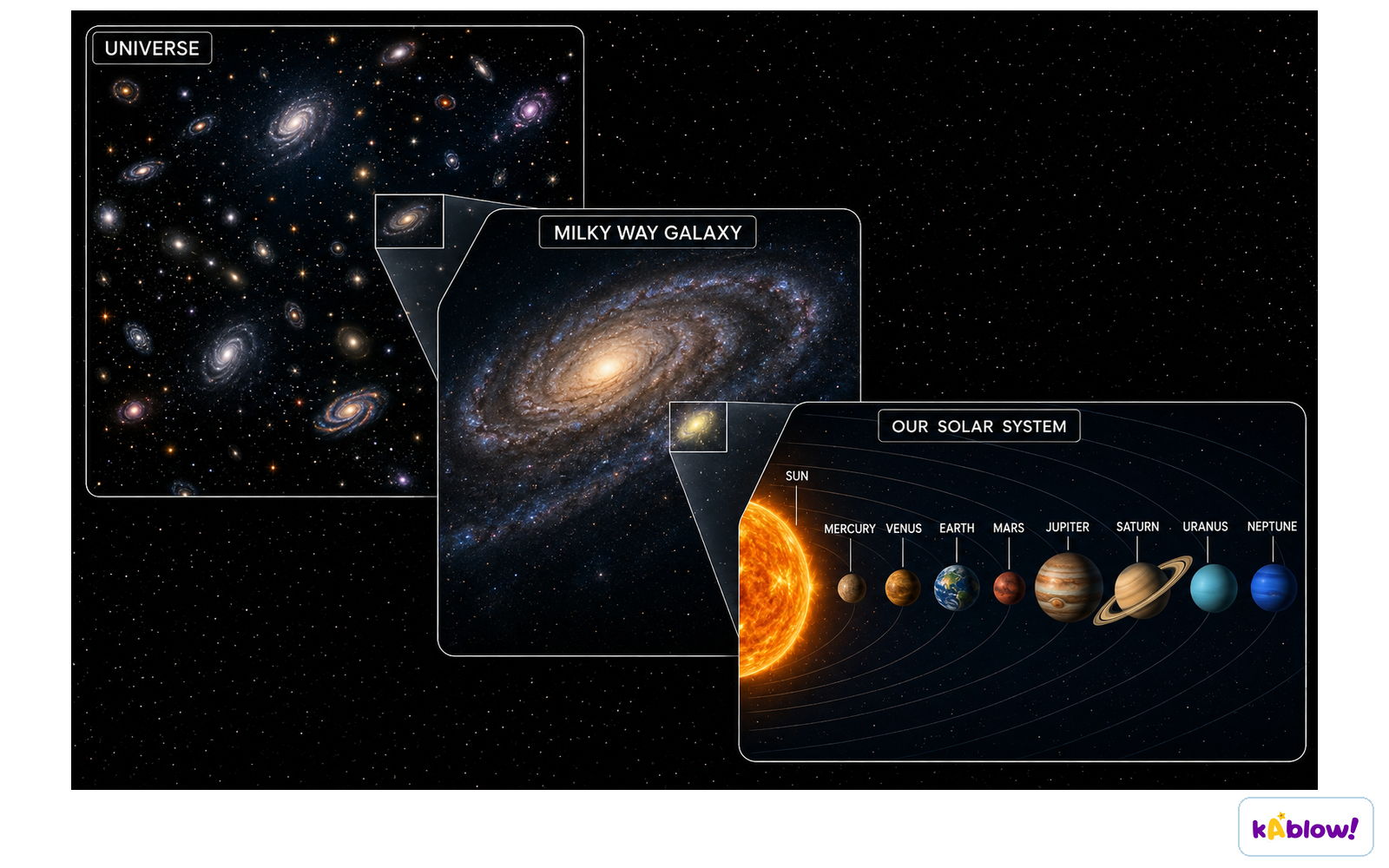
- A galaxy is a vast group of stars, gas and dust held together by gravity. Our galaxy is the Milky Way. It holds hundreds of billions of stars, and the Sun is one of them.
- The Universe is everything there is: all of space, matter and energy. It contains billions of galaxies, and the galaxies are moving apart as the Universe expands. Scientists think the Universe began about 13.8 billion years ago in the Big Bang.
- Distances between stars are so big that we use the light-year. A light-year is a distance, not a time: it is how far light travels in one year, about 9.5 × 10¹² km (9.5 million million km).
- The nearest star beyond the Sun, Proxima Centauri, is about 4.2 light-years away. The Milky Way is about 100 000 light-years across. Looking at distant stars is looking back in time: their light left long ago.
The Universe, the Milky Way and the Solar System
Think like a scientist: modelling the seasons
- We cannot travel into space to test ideas about the Sun and Earth, so scientists use models. A torch can model the Sun and a card can model the ground.
- Question: how does the angle at which light hits the ground change how spread out the light is?
- Hold a torch a fixed distance from a card in a dim room. Tilt the card to different angles and trace the lit patch on squared paper. The independent variable is the angle of the card. The dependent variable is the area of the lit patch.
- Control variables: the same torch, the same distance and the same card. Repeat each angle and find a mean. A tilted card gives a larger patch, so the same light is spread thinner. This is why low-angle winter sunlight warms the ground less.
- Evaluate the model. It is hard to see where the edge of the patch is. A torch beam is not parallel like sunlight, and the card does not model the atmosphere or the 24-hour spin. Never shine a torch into anyone's eyes, and never look at the Sun.
- Inquiry task: plan an investigation, using a lamp and a card, to see how the distance from the lamp changes the brightness on the card. List your variables, say how you will measure brightness and explain how you will make the test fair and safe.
Slides
Sign up free to view the lesson slides
Step through every slide for this topic — plus flashcards and revision notes — with a free account.
Practice questions
Free preview — 8 of 52 questions. Sign up to see them all.
1.Which planet is closest to the Sun?
Easy- AVenus
- BMars
- CMercury
- DEarth
2.What is at the centre of our Solar System?
Easy- AThe Sun
- BThe Earth
- CThe Moon
- DJupiter
3.What type of object is the Sun?
Easy- AA planet
- BA moon
- CA comet
- DA star
4.The Moon is a natural satellite of Earth.
EasyTrue or false?
5.Between which two planets is the asteroid belt found?
Easy- AEarth and Mars
- BMars and Jupiter
- CVenus and Earth
- DSaturn and Uranus
6.Match each object to its description.
Easy- Star
- Planet
- Moon
- Comet
- A ball of ice and dust with a tail near the Sun
- Orbits a star and shines by reflected light
- Gives out its own light
- A natural satellite of a planet
7.What causes day and night on Earth?
Easy- AEarth orbiting the Sun once a year
- BEarth spinning on its axis
- CThe Moon blocking the Sun's light
- DThe Sun moving round the Earth
8.About how long does Earth take to rotate once on its axis?
Easy- A12 hours
- B7 days
- C365 days
- D24 hours
Unlock all 52 questions, flashcards & more
Create a free account to see every question, the slides, flashcards and revision notes for this topic.
Past papers
Past-paper practice for this topic is coming soon.
Coming soon