Resultant forces and Newton's laws
Learn it by playing
Answer these questions to earn energy, then fish and explore. No account needed.
Lesson notes
Big idea: resultant forces and newton's laws
- Key concept: Relationships. Resultant force equals mass times acceleration. Zero resultant force means constant velocity, which can include rest.
- Related concepts: Models and evidence. Use a scientific explanation to make predictions, then test it against observations.
- Global context: Scientific and technical innovation. Force models explain vehicle acceleration and safety systems.
Resultant Forces
- A force is a push or pull that acts on an object due to interaction with another object.
- Forces can change an object's speed, direction, shape, or size.
- A resultant force is a single force that represents the combined effect of all forces acting on an object.
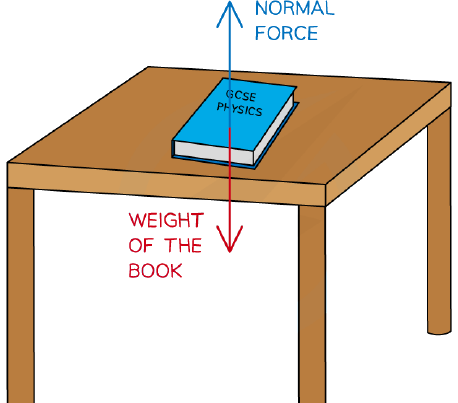
- Balanced forces are equal in magnitude and opposite in direction; they cancel out, giving zero resultant force.
- Unbalanced forces produce a non-zero resultant force, causing a change in motion.
- To calculate resultant force, assign positive/negative signs to directions and sum the forces.
Forces acting on a book rests on a desk
Newton's First Law
- Newton's First Law: An object remains at rest or moves with constant velocity unless acted on by a resultant force.
- Constant velocity means no change in speed and no change in direction.
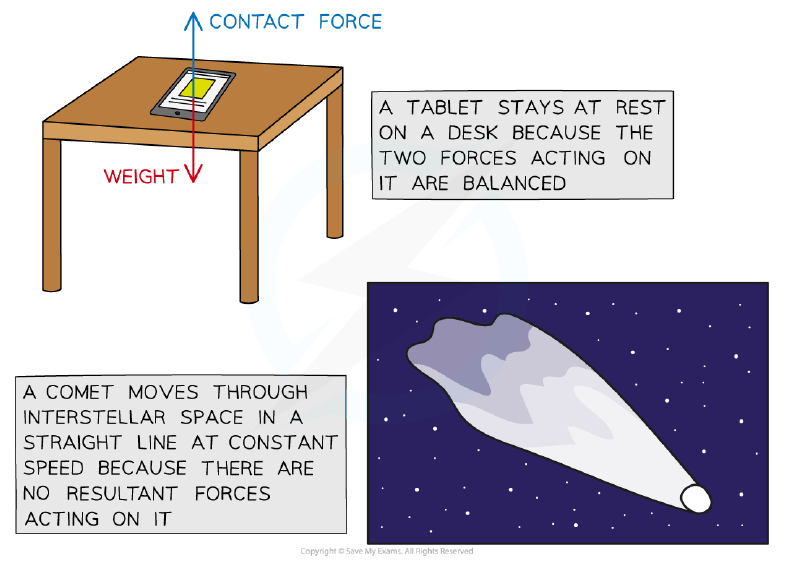
- If resultant force is zero, the object is either stationary or moving at constant velocity.
- Example: A car moving at constant speed in a straight line has balanced driving and frictional forces.
- The Moon orbits Earth at constant speed but changes direction, so it does not obey Newton's First Law (it has a resultant force).
Examples of Newton's First Law
Newton's Second Law
- Newton's Second Law: The acceleration of an object is proportional to the resultant force and inversely proportional to its mass.
- Equation: F = ma (force in N, mass in kg, acceleration in m/s²).
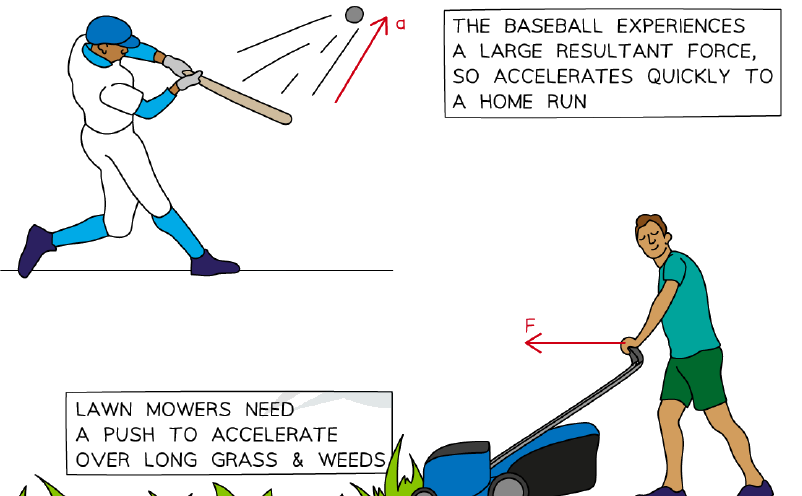
- Acceleration occurs in the same direction as the resultant force.
- For a given force, a larger mass gives a smaller acceleration.
- Example: A 900 kg car accelerating at 9 m/s² requires a force of 8100 N.
Examples of resultant forces causing acceleration in a baseball and a lawnmower.
Investigating Force & Extension
- Aim: Investigate the relationship between force and extension of a spring.
- Independent variable: Force (weight added). Dependent variable: Extension.
- Use a clamp stand, spring, masses, ruler, and pointer to measure extension.
- Calculate extension: extension = final length – original length.
- Plot a graph of force vs. extension; a straight line through origin shows direct proportionality (Hooke's Law).
- Take readings at eye level to avoid parallax error; repeat for reliability.
Hooke's Law
- Hooke's Law: The extension of an elastic object is directly proportional to the force applied, up to the limit of proportionality.
- Equation: F = kx, where k is the spring constant (N/m) and x is extension (m).
- Spring constant k = F/x; a high k means a stiff spring.
- On a force-extension graph, the gradient of the linear region equals the spring constant.
- Beyond the limit of proportionality, the graph curves and Hooke's Law no longer applies.
Circular Motion
- In circular motion, the velocity changes because direction changes, even if speed is constant.
- A force acting perpendicular to motion causes the object to travel in a circle.
- The force is always directed toward the centre of the circle (centripetal force).
- Factors affecting required force: mass (greater mass needs more force), speed (faster needs more force), radius (smaller radius needs more force).
Friction
- Friction opposes motion and causes heating (energy transfer).
- Solid friction arises from surface imperfections; can be reduced by lubrication or smoothing.
- Drag (air resistance) is friction in fluids; it slows objects and heats them.
- Air resistance can be reduced by streamlining the object's shape.
Think like a scientist
- Apply different measured horizontal pulls to the same low-speed trolley and measure its acceleration.
- Comparison: the resultant horizontal force. Outcome: acceleration in metres per second squared.
- Control: keep the trolley's mass constant. Explain why this makes the comparison fairer.
- Evidence: Use a consistent method, repeated observations where appropriate and a table with labelled quantities and units. Keep unexpected results and investigate their cause.
- Safety: Practical activities need teacher supervision and an appropriate risk assessment. Use the provided data or simulation where the investigation specifies it.
- Inquiry task: State a testable question, predict the outcome using the science, then explain how your observations would support or challenge the prediction.
Evaluate the science
- Force models explain vehicle acceleration and safety systems.
- The pulling force is not automatically the resultant force; friction must be considered.
- Evaluation task: Link your conclusion to evidence, identify a limitation and suggest a specific improvement. Distinguish a measured result from an explanation of its cause.
Slides
Sign up free to view the lesson slides
Step through every slide for this topic — plus flashcards and revision notes — with a free account.
Practice questions
Free preview — 8 of 52 questions. Sign up to see them all.
1.Which of the following is the correct definition of a force?
Easy- AA push or a pull that acts on an object due to interaction with another object
- BA measure of the amount of matter in an object
- CThe rate of change of velocity of an object
- DThe energy transferred when an object is moved
2.What is a resultant force?
Easy- AA single force that describes all of the forces operating on a body
- BThe largest force acting on an object
- CThe sum of all forces ignoring direction
- DThe force that remains when all other forces are removed
3.A book is at rest on a table. Which statement about the forces acting on the book is correct?
Easy- AThe weight of the book and the normal contact force are balanced
- BThe weight of the book is greater than the normal contact force
- CThe normal contact force is greater than the weight of the book
- DThere is no resultant force because no forces are acting on the book
4.A car is moving at a constant velocity. The driving force from the engine is 3 kN. What is the frictional force acting on the car?
Medium- A3 kN
- B0 kN
- C6 kN
- D1.5 kN
5.The Moon orbits the Earth at a constant speed. Which statement about the Moon's motion is correct?
Medium- AThe Moon is accelerating because its direction is changing
- BThe Moon is not accelerating because its speed is constant
- CThe Moon is not accelerating because no resultant force acts on it
- DThe Moon is accelerating only when its speed changes
6.A moving ball is struck sideways by a force. Which pair of changes is possible?
Easy- AIts speed and direction change
- BIts mass and chemical element change
- CIts mass increases but its motion cannot change
- DIts direction cannot change
7.A 2 kg object accelerates at 3 m/s². What is the resultant force acting on it?
Easy- A6 N
- B1.5 N
- C5 N
- D0.67 N
8.A spring has an unstretched length of 5 cm. When a 2 N weight is hung from it, its length becomes 9 cm. What is the spring constant?
Medium- A50 N/m
- B0.5 N/m
- C0.22 N/m
- D22.2 N/m
Unlock all 52 questions, flashcards & more
Create a free account to see every question, the slides, flashcards and revision notes for this topic.