Gas Exchange
Learn it by playing
Answer these questions to earn energy, then fish and explore. No account needed.
Lesson notes
Gas Exchange in Organisms
- Cellular respiration releases energy as ATP by oxidising substrates such as glucose; aerobic respiration requires oxygen and produces carbon dioxide as a waste product.
- Gas exchange is the diffusion of oxygen into an organism and carbon dioxide out of it, between the organism and its environment.
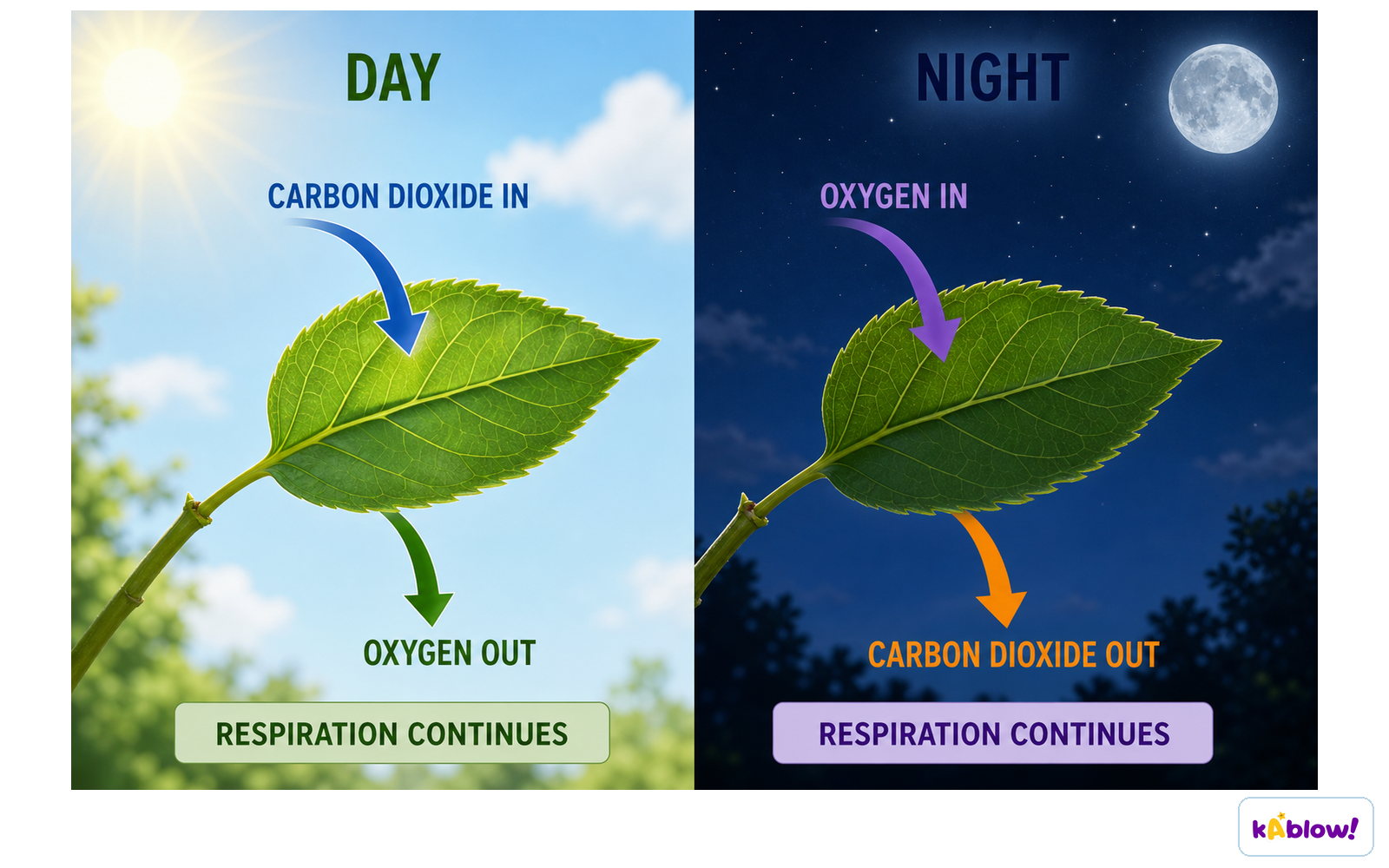
- In plants, carbon dioxide is absorbed and oxygen released during the day due to photosynthesis.
- The rate of diffusion depends on: surface area (larger = faster), concentration gradient (steeper = faster) and diffusion distance (shorter = faster).
- Small unicellular organisms like amoeba have a large surface area to volume ratio and a short diffusion distance, so diffusion alone is sufficient for gas exchange.
- As organisms get larger, the surface area to volume ratio decreases and the diffusion distance increases, so diffusion alone cannot supply all cells.
- Large, active organisms have higher metabolic demands and require specialised gas exchange organs; their outer surface is often impermeable for protection.
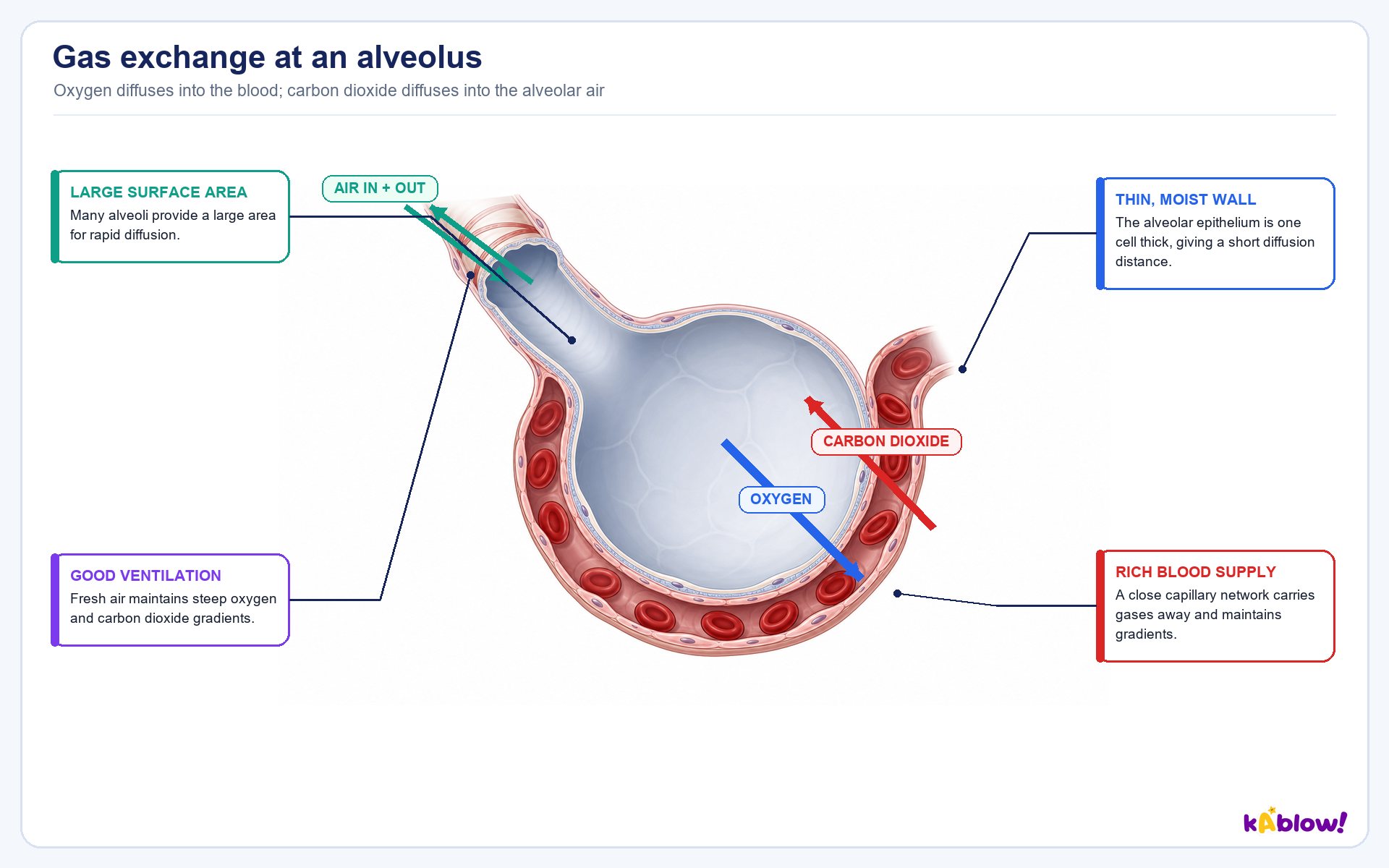
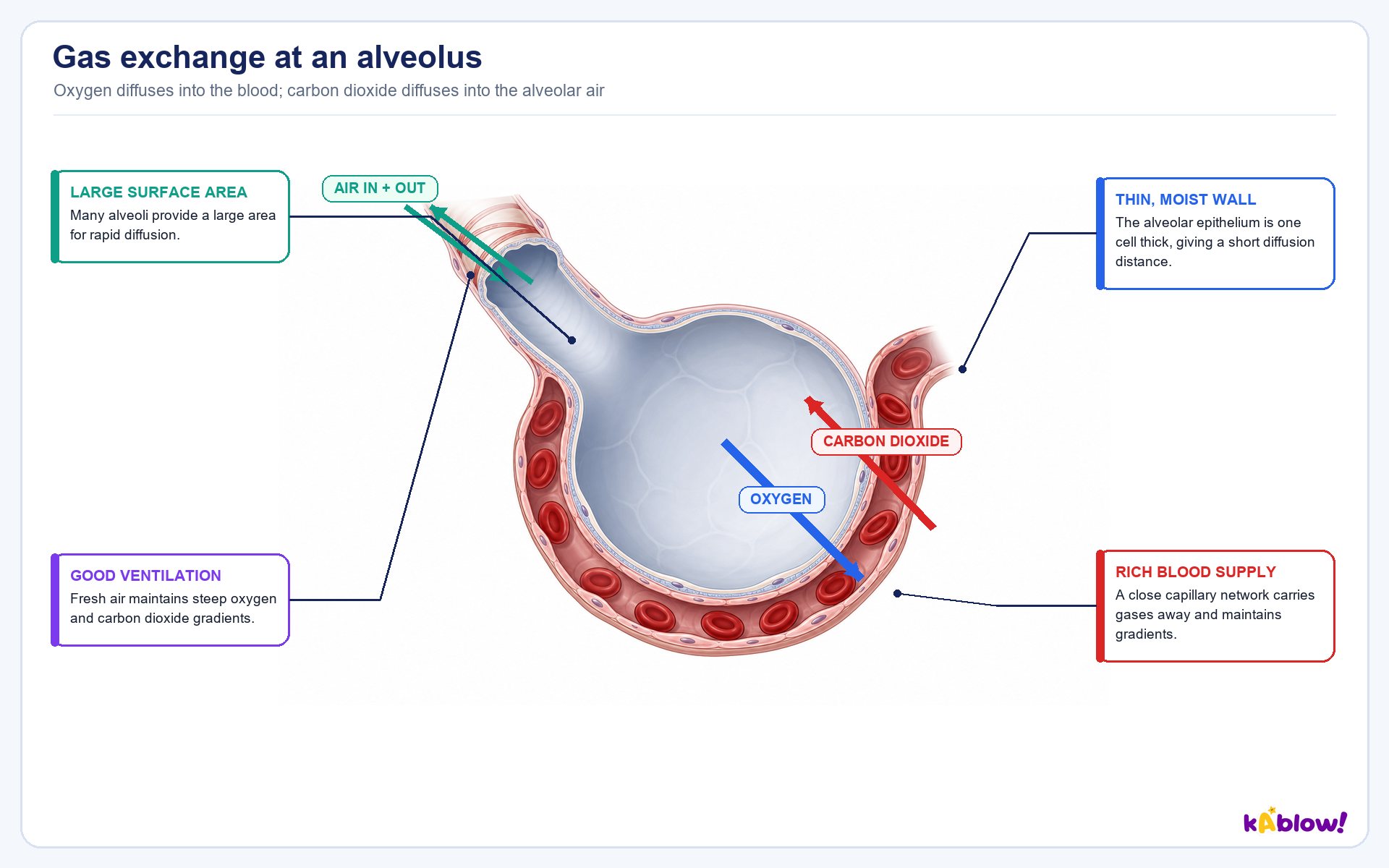
An alveolus and its capillary
Properties of Gas Exchange Surfaces
- Gas exchange surfaces must be permeable so gases can move across.
- They must be thin to provide a short diffusion distance.
- They must be moist so gases can dissolve before diffusing.
- They must have a large surface area so many gas molecules can diffuse at once.
- A steep concentration gradient is maintained by a dense network of blood vessels, continuous blood flow, and ventilation with air (lungs) or water (gills).
- Blood transports oxygen away from and carbon dioxide towards the gas exchange surface, keeping the gradient steep.
Features of gas exchange surfaces
Mammalian Lungs: Adaptations
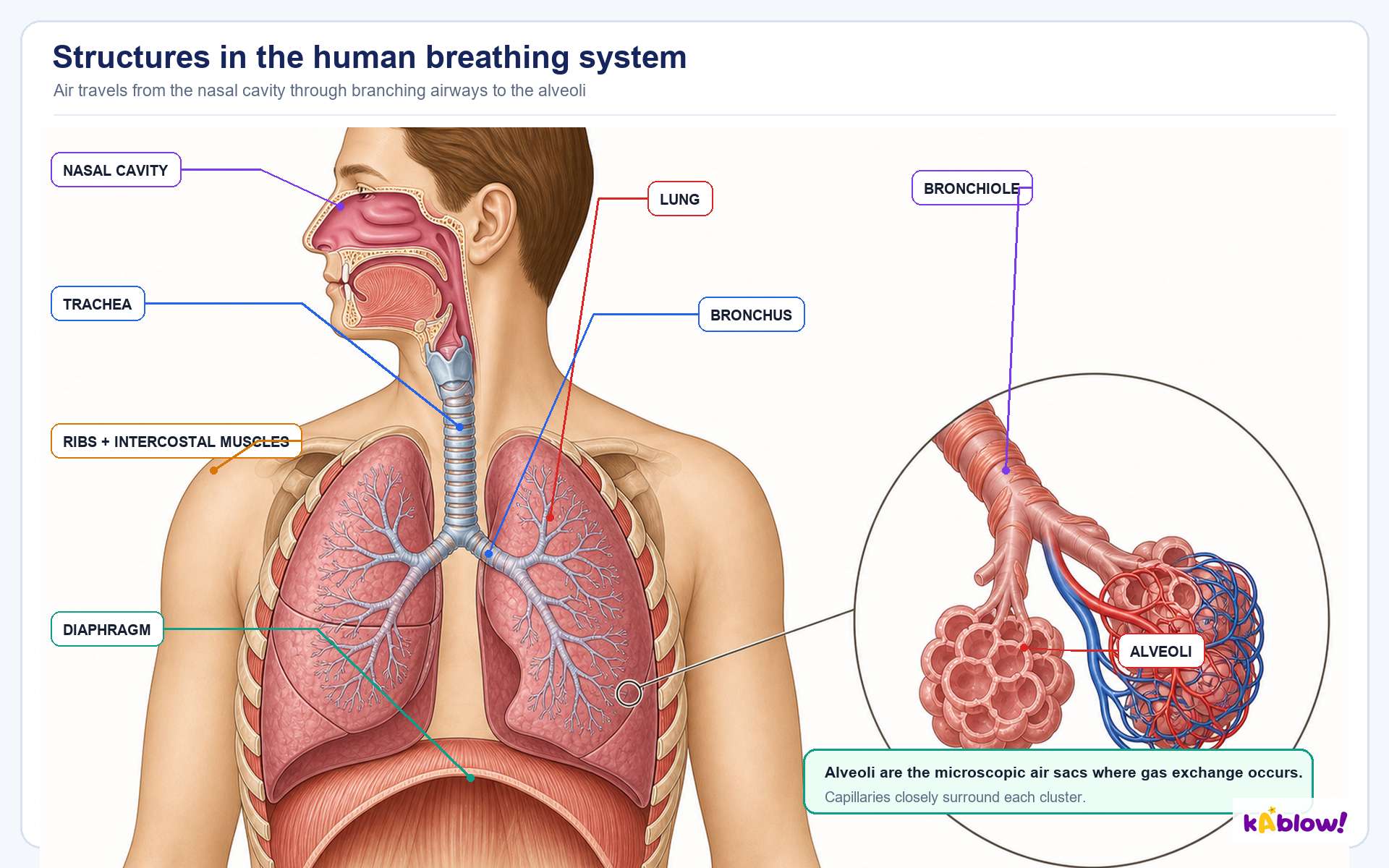
- Air enters through the nose and mouth, then travels down the trachea, which is supported by rings of cartilage to keep it open while allowing flexibility.
- The trachea divides into two bronchi (singular bronchus), also strengthened with cartilage and lined with ciliated epithelium to remove particles trapped in mucus.
- Bronchioles branch off the bronchi; their walls contain smooth muscle that can contract or relax to regulate airflow.
- Clusters of alveoli are found at the ends of bronchioles, providing a large surface area for gas exchange.
- Each alveolus is surrounded by an extensive capillary network, giving a large surface area and a good blood supply.
- Deoxygenated blood arrives via the pulmonary artery and oxygenated blood leaves via the pulmonary vein, maintaining concentration gradients.
- The alveolar wall is one cell thick, providing a short diffusion distance.
- Surfactant secreted by alveolar cells lowers surface tension, preventing alveoli from collapsing and sticking together during expiration.
The human breathing system
Mechanism of Ventilation
- Ventilation replaces stale air with fresh air, maintaining concentration gradients of oxygen and carbon dioxide between alveoli and blood.
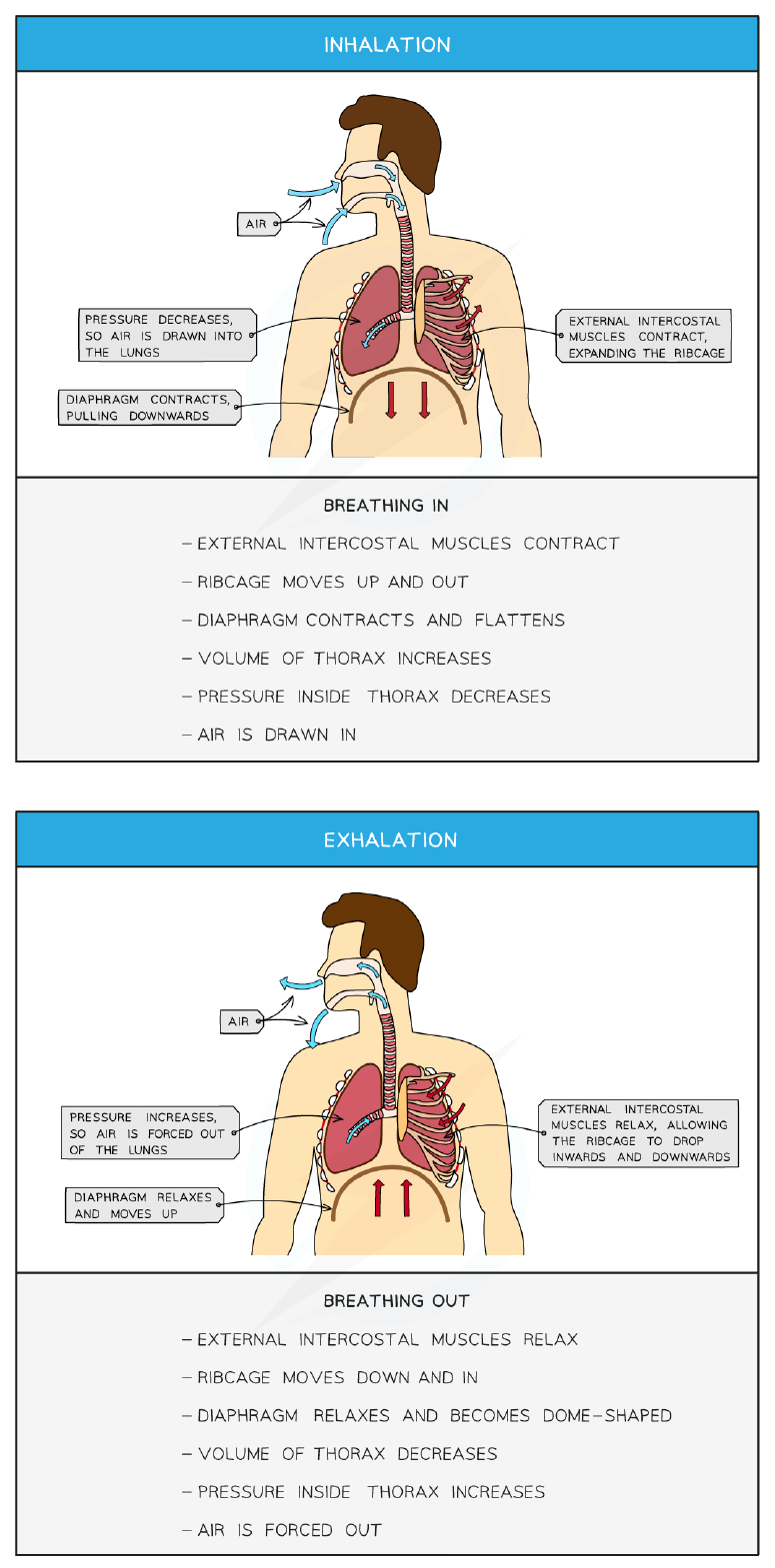
- Inspiration (breathing in): the diaphragm contracts and flattens, and external intercostal muscles contract, moving the ribcage up and out.
- These actions increase the volume of the thorax, which decreases the pressure below atmospheric pressure.
- Air then moves down the pressure gradient into the lungs.
- Expiration (breathing out) is mainly passive: external intercostal muscles relax, the diaphragm relaxes and becomes dome-shaped, and elastic fibres in alveoli recoil.
- This decreases volume and increases pressure, forcing air out down its pressure gradient.
- Forced expiration is active: internal intercostal muscles contract to pull ribs down and in, and abdominal muscles contract to push organs upwards against the diaphragm, further decreasing chest volume.
Inhalation and exhalation
Measuring Lung Volumes
- A spirometer measures lung volumes and ventilation; it contains a water-filled chamber with a hinged lid that moves as the person breathes through a mouthpiece.
- When filled with air, it measures lung capacity; when filled with oxygen and soda lime (to absorb carbon dioxide), it measures oxygen consumption.
- Spirometer traces are created by a pen on a revolving drum or by a computer, and show ventilation rate, tidal volume, reserve volumes and vital capacity.
- Tidal volume (TV) is the volume of air inhaled or exhaled during normal breathing; it increases with exercise.
- Inspiratory reserve volume (IRV) is the extra volume that can be inhaled beyond tidal volume; expiratory reserve volume (ERV) is the extra volume that can be exhaled beyond tidal volume.
- Vital capacity (VC) is the total air exhaled after a deep breath: VC = TV + IRV + ERV.
- Ventilation rate is the number of inhalations or exhalations per minute; it increases with exercise.
Gas Exchange in Plants
- Gas exchange in plants occurs through the leaf, which contains epidermal, mesophyll and vascular tissues.
- The epidermis is a single layer of tightly packed cells; the lower epidermis contains stomata (singular stoma), each surrounded by two guard cells.
- Guard cells become turgid when water enters, opening the stoma; they become flaccid when water is lost, closing the stoma.
- Stomata allow diffusion of oxygen and carbon dioxide into and out of the leaf.
- The epidermis is covered by a waxy cuticle, an impermeable barrier that reduces water loss and ensures gas exchange occurs through stomata.
- Palisade mesophyll lies beneath the upper epidermis and contains many chloroplasts for photosynthesis; spongy mesophyll has large air spaces for gas exchange.
- Vascular bundles (veins) contain xylem (transports water and mineral ions) and phloem (transports products of photosynthesis).
Gas exchange in plants, day and night
Transpiration and its Control
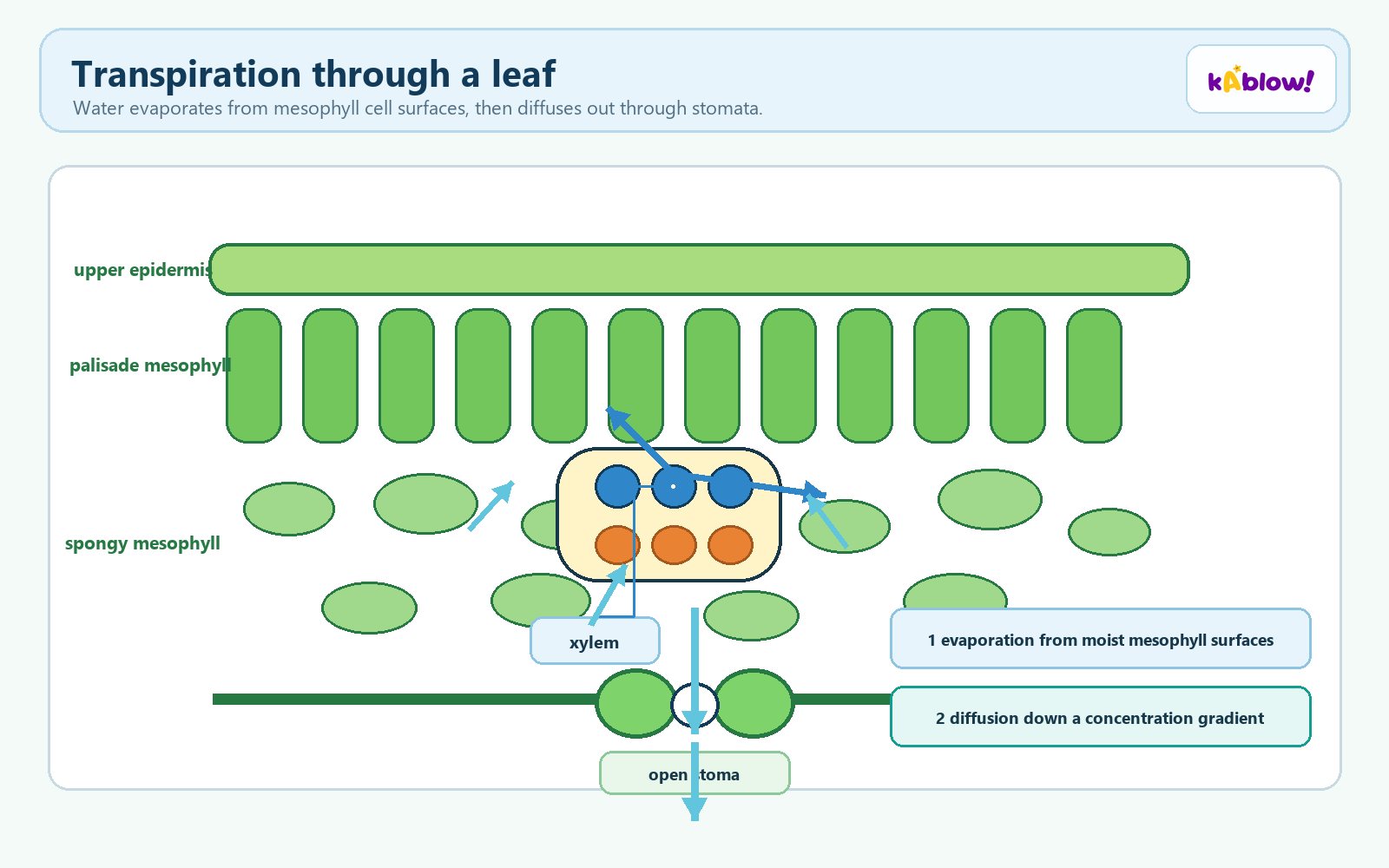
- Transpiration is the loss of water vapour from leaves through stomata; it is an inevitable consequence of gas exchange because stomata must be open for photosynthesis.
- Guard cells can close stomata to reduce water loss, but this also reduces gas exchange and therefore the rate of photosynthesis.
- Transpiration has advantages: it cools the plant by evaporation, helps uptake of mineral ions via the transpiration stream, and maintains turgor pressure for support.
- Air movement increases transpiration by removing water vapour and increasing the concentration gradient.
- Temperature increases transpiration up to a point; higher temperatures increase kinetic energy and evaporation, but very high temperatures cause stomata to close.
- Light intensity increases transpiration as stomata open in light; once all stomata are open, further increases have no effect.
- Humidity decreases transpiration because a high water vapour concentration outside the leaf reduces the concentration gradient.
Transpiration through a leaf
Measuring Transpiration
- A potometer measures the rate of water uptake, which is used to represent the rate of transpiration (a small amount of water is used in photosynthesis).
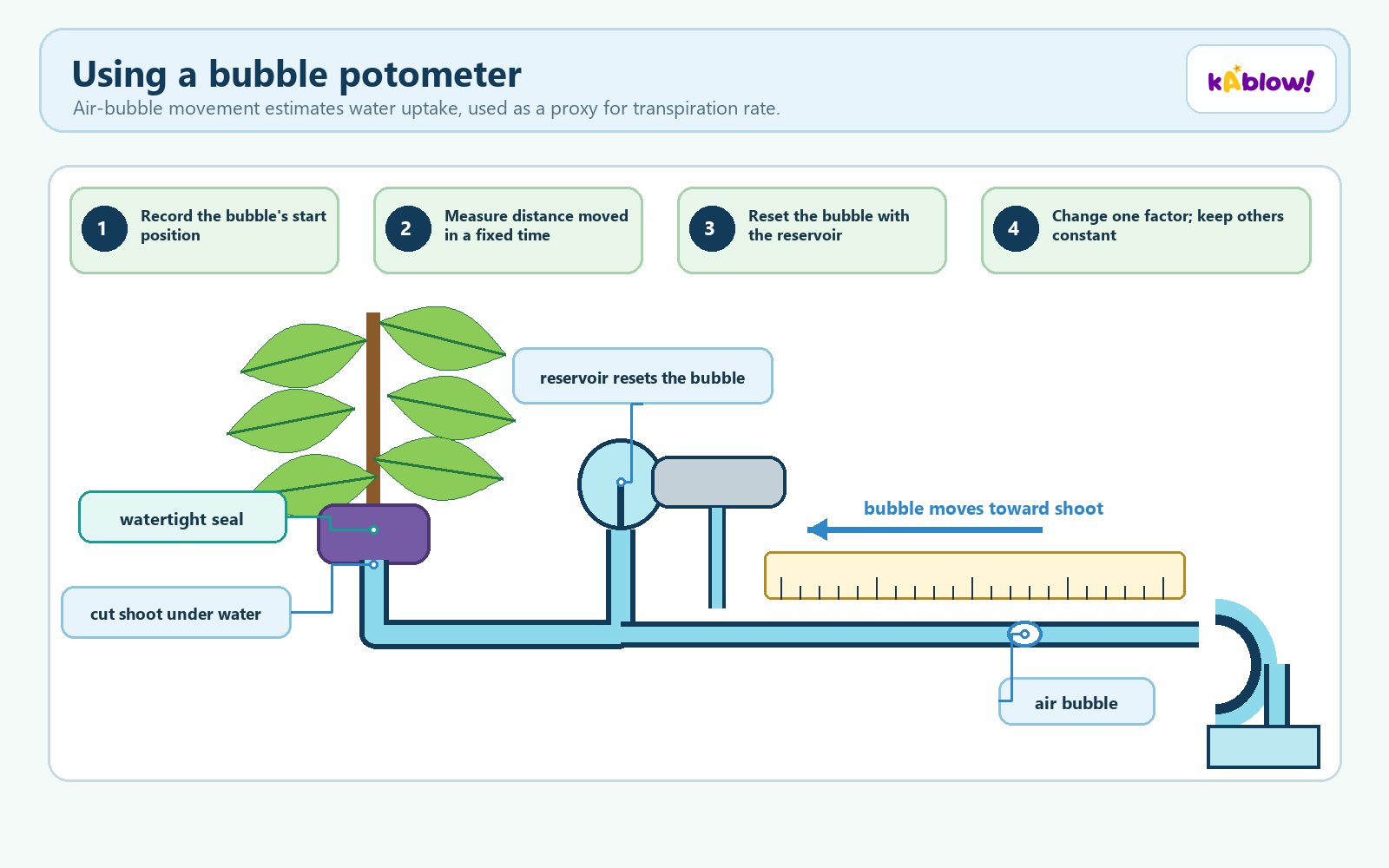
- A bubble potometer measures the movement of an air bubble along a water-filled tube connected to a plant shoot.
- A mass potometer measures the change in mass of a water-filled test tube connected to a plant shoot over time.
- Environmental factors can be investigated by varying air movement (fan), humidity (plastic bag, humidifier), light intensity (lamp at different distances) and temperature (heater, air conditioner).
- Control all other variables to ensure valid results; for example, placing shoots in different rooms may vary light and humidity as well as temperature.
Using a bubble potometer
Drawing Leaf Structure
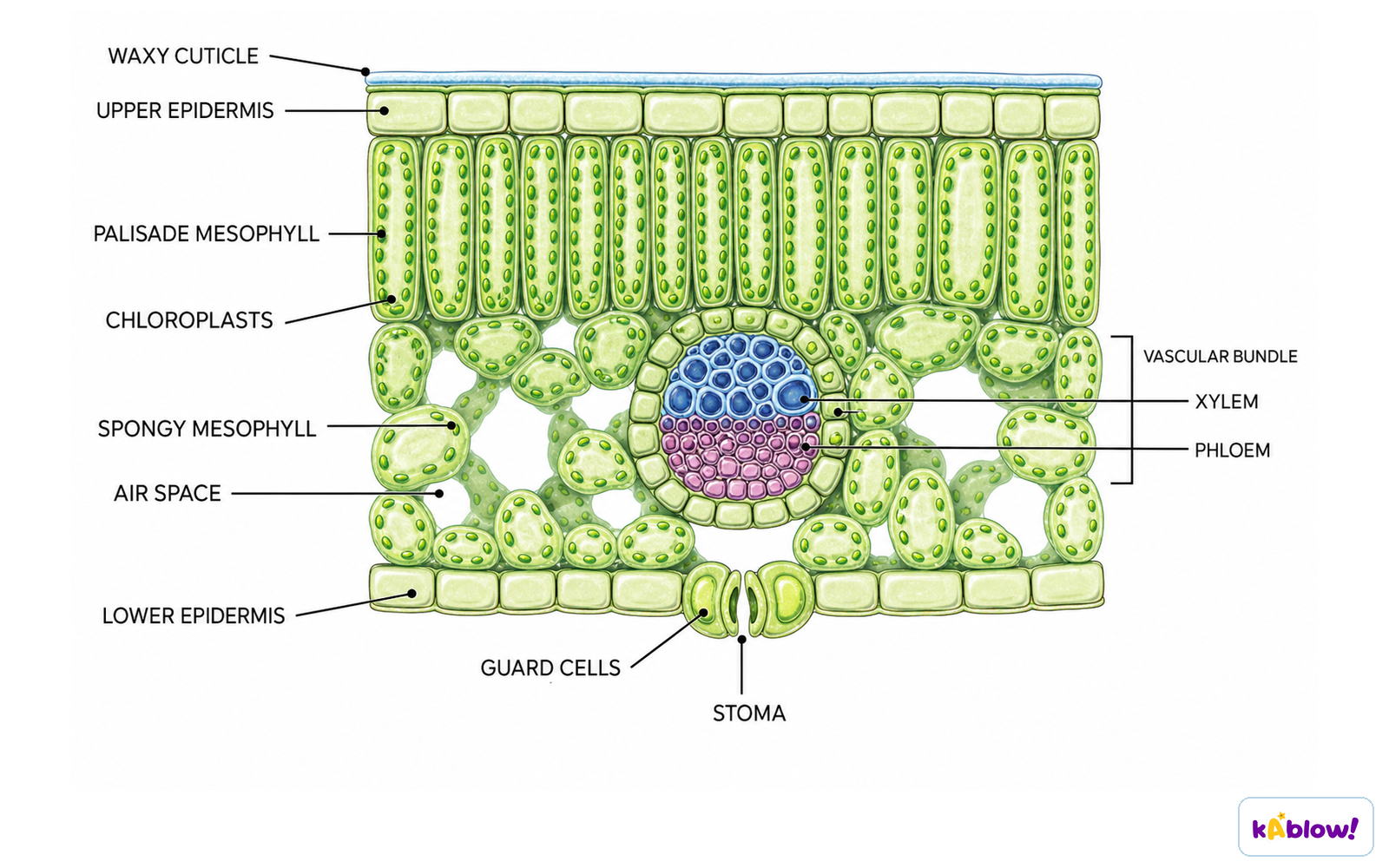
- You should be able to identify in a dicotyledonous leaf: chloroplasts, cuticle, guard cells, stomata, upper and lower epidermis, palisade mesophyll, spongy mesophyll, air spaces and vascular bundles (xylem and phloem).
- A plan diagram is drawn from a micrograph or specimen at low magnification; it shows tissue layers as lines, not individual cells.
- Use a sharp pencil and draw clear, continuous lines; do not shade any part of the drawing.
- Make proportions and observations accurate; draw what you see, not what you expect from a textbook.
- Draw large enough to fill at least half the available space.
- Use a ruler for label lines, avoid arrowheads, ensure lines stop at the structure and do not cross, and write all labels horizontally.
Leaf cross-section
Determining Stomatal Density
- Stomatal density is the number of stomata per unit area; it can indicate a plant's likely response to dry weather or predict behaviour in windy or wet climates.
- Method: paint clear nail varnish on the underside of a leaf, let it dry, peel off with sellotape, place the leaf cast on a slide and view under a microscope.
- Count stomata in a field of view (15–100 is ideal); count partially visible stomata at the edge as 1.
- Count at least 3 separate fields of view and calculate a mean to improve reliability and identify anomalies.
- Measure the diameter of the field of view using a stage micrometer at the same magnification used for counting.
- Calculate area of field of view using Area = πr² (r = diameter ÷ 2), then density = mean number of stomata ÷ area.
- Limitations: not all species produce good imprints; solvent-based varnish can damage cell structure; water-based varnish is safer but dries slowly.
- Repeating measurements increases the reliability of quantitative data; anomalous results (outliers) are omitted when calculating the mean.
Slides
Sign up free to view the lesson slides
Step through every slide for this topic — plus flashcards and revision notes — with a free account.
Practice questions
Free preview — 8 of 62 questions. Sign up to see them all.
1.Which row of the table describes the best overall conditions for gas exchange in the lungs?
Easy- ALarge surface area, short diffusion pathway, steep concentration gradient
- BLarge surface area, long diffusion pathway, steep concentration gradient
- CLarge surface area, short diffusion pathway, shallow concentration gradient
- DSmall surface area, short diffusion pathway, shallow concentration gradient
2.Which of the following is a feature of forced expiration?
Medium- AThe diaphragm contracts.
- BThe thorax undergoes a drop in pressure.
- CThe internal intercostal muscles contract.
- DThe external intercostal muscles contract.
3.How can the tidal volume of the lungs be measured?
Easy- ASpirometer
- BInhaler
- CData logger
- DOxygen meter
4.What is the function of pulmonary surfactant?
Medium- ATo increase surface tension on the alveolar wall.
- BTo reduce the diffusion distance across the alveolar wall.
- CTo stop the alveoli sacs from sticking together.
- DTo trap microorganisms and prevent infection.
5.Which set of conditions is required to allow the intake of air into the lungs during ventilation?
Medium- AContracted diaphragm, increased volume and increased pressure inside the thorax.
- BRelaxed diaphragm, increased volume and decreased pressure inside the thorax.
- CRelaxed diaphragm, decreased volume and increased pressure inside the thorax.
- DContracted diaphragm, increased volume and decreased pressure inside the thorax.
6.The diagram shows a trace recorded from a spirometer. Which label represents the tidal volume?
Medium- AThe small peaks and troughs during normal breathing
- BThe maximum peak after a deep breath
- CThe lowest trough after full expiration
- DThe total volume from maximum inspiration to maximum expiration
7.Identify the set of conditions under which transpiration would occur at the slowest rate.
Medium- ALow humidity, low temperature, high air movement, high light intensity
- BHigh humidity, low temperature, low air movement, low light intensity
- CLow humidity, high temperature, low air movement, low light intensity
- DHigh humidity, low temperature, high air movement, high light intensity
8.What does a potometer measure?
Easy- AThe rate of photosynthesis of a plant
- BThe rate of water uptake of a plant
- CThe rate of respiration of a plant
- DThe rate of transpiration of a plant
Unlock all 62 questions & more
Create a free account to see every question, the slides, flashcards and revision notes for this topic.