Natural Selection
Learn it by playing
Answer these questions to earn energy, then fish and explore. No account needed.
Lesson notes
Evolution and Natural Selection
- Evolution is defined as changes in the heritable characteristics of organisms over generations.
- Natural selection is the process by which organisms better adapted to their environment survive, reproduce, and pass on advantageous alleles, causing advantageous characteristics to increase in frequency.
- Charles Darwin developed the theory of evolution by natural selection after a five-year expedition observing a variety of organisms.
- Darwin published On the Origin of Species in 1859, presenting evidence that favourable characteristics increase in frequency over time.
- Unfavourable characteristics decrease in frequency because individuals with them are less likely to survive and reproduce.
- Darwin's theory replaced Lamarckism, the idea that organisms could pass on characteristics acquired during their lifetime.
- Darwin's theory caused a paradigm shift because it contradicted previous assumptions about how species change.
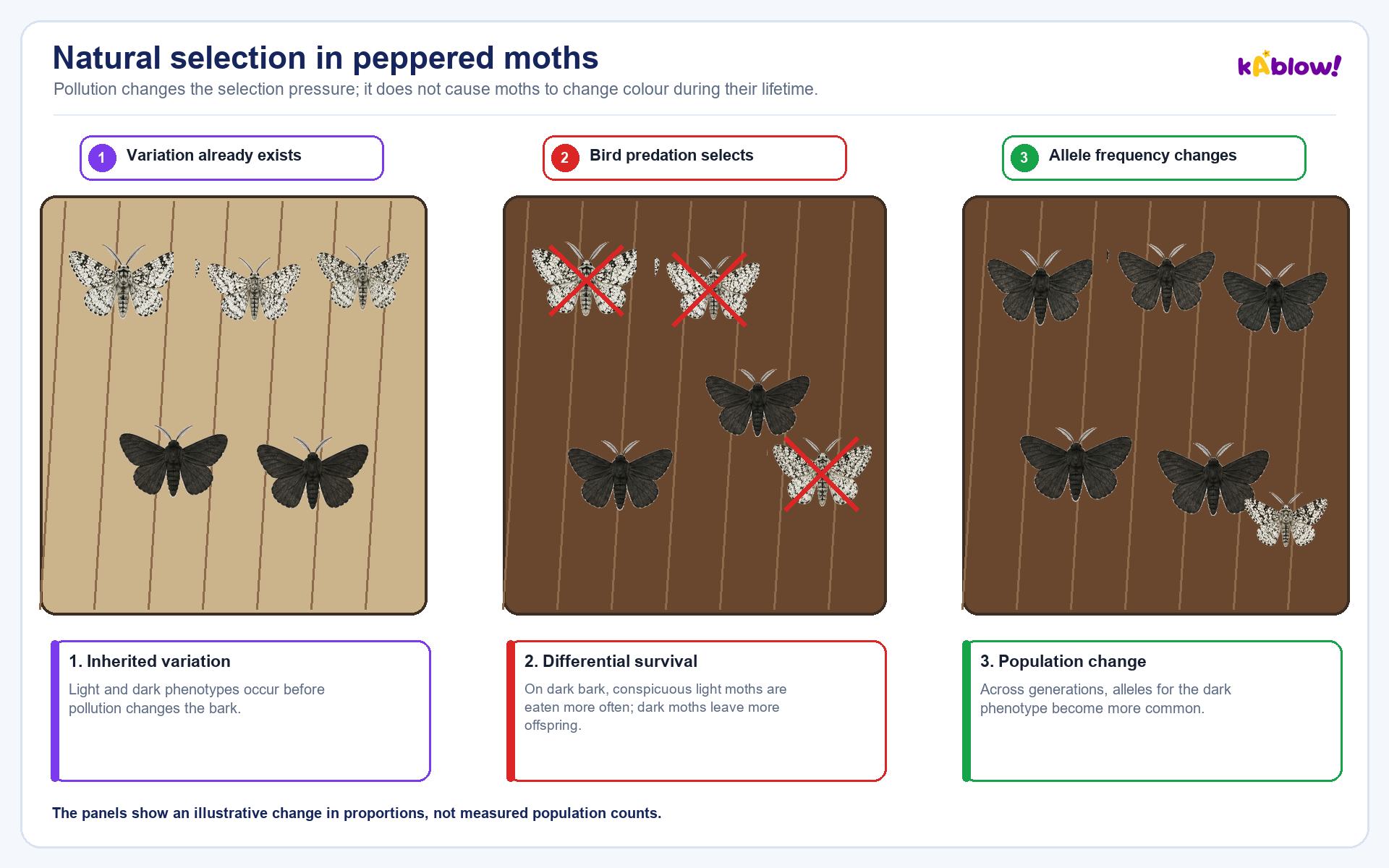
Natural selection in peppered moths
The Importance of Variation
- Variation refers to the differences between organisms of the same species, such as coat colour in mammals or flower colour in plants.
- Natural selection can only occur if there is variation in a population; if all individuals are identical, no individual is favoured.
- Without variation, a population cannot adapt to environmental changes and its characteristics remain the same over time.
- Variation results from small differences in DNA base sequences between individuals.
- Sources of genetic variation include mutation, meiosis, and random fertilisation during sexual reproduction.
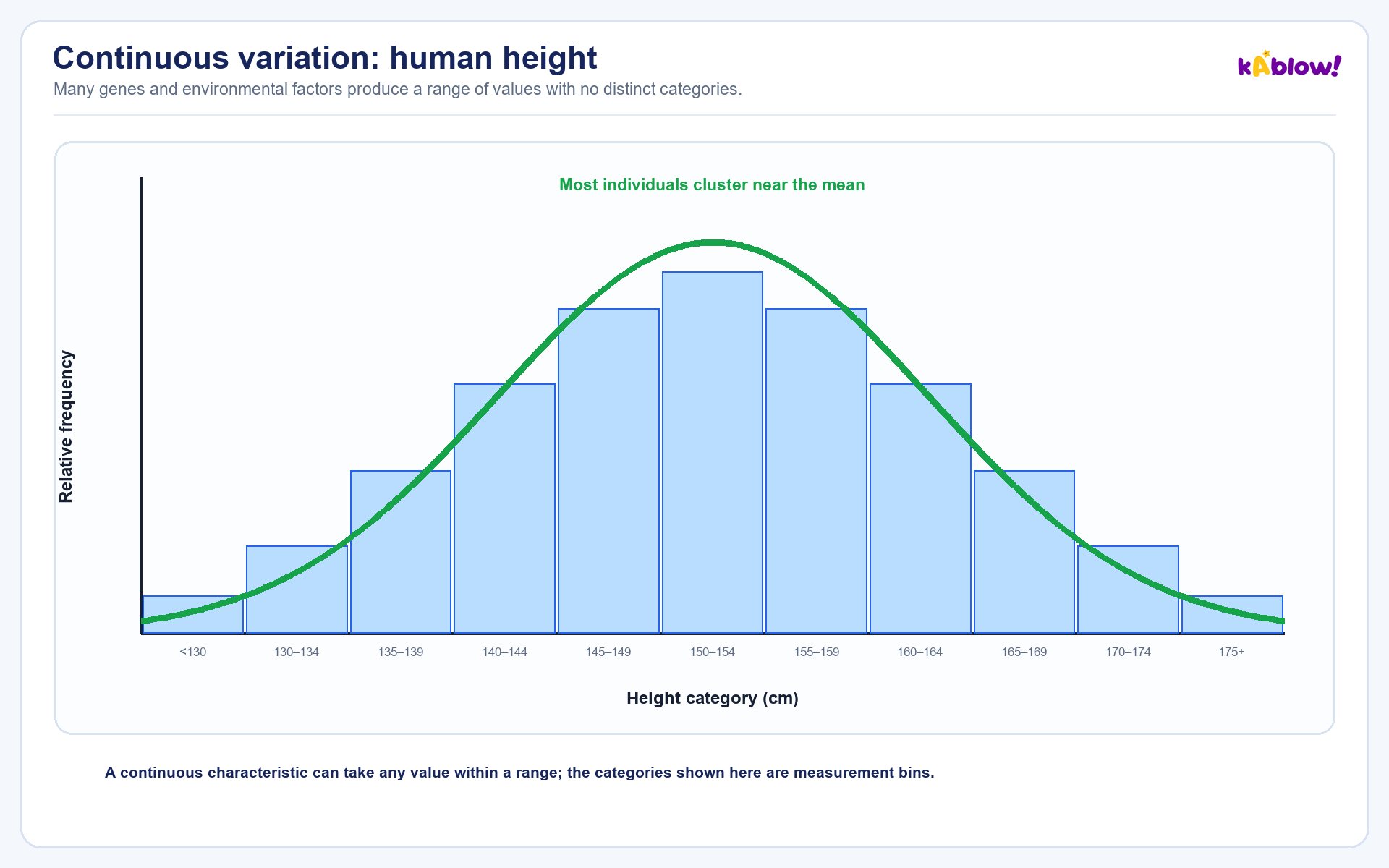
Distribution of height showing continuous variation
Sources of Genetic Variation
- Mutation is the original source of genetic variation; it is a change in the DNA base sequence that results from a copying error during DNA replication.
- Mutations in sex organs can produce new alleles in gametes that are passed to the next generation.
- A mutation may be advantageous, disadvantageous, or have no effect; advantageous alleles are more likely to be passed on.
- Mutations in somatic (body) cells are not passed on and do not affect natural selection.
- Meiosis generates variation through crossing over and random orientation (independent assortment).
- Crossing over involves homologous chromosomes exchanging alleles, creating new combinations of alleles.
- Random orientation occurs during metaphase I when homologous pairs line up independently; the number of combinations is 2n, where n is the haploid number.
- Random fertilisation during sexual reproduction creates genetic variation because any male gamete can fuse with any female gamete.
Overproduction and Competition
- Most species produce more offspring than can be supported by the environment, a phenomenon Darwin called overproduction of offspring.
- Overproduction leads to competition for limited resources such as food, space, and light.
- Environmental factors limit the carrying capacity of a population, so many offspring fail to survive and reproduce.
- Intraspecific competition occurs between individuals of the same species and plays a greater role in evolution than interspecific competition.
- Individuals of the same species share the same niche and are affected by the same abiotic and biotic factors.
- Individuals with characteristics better adapted for survival are more likely to survive, reproduce, and pass on their alleles.
- This is sometimes described as 'survival of the fittest'.
Heritable Traits and Evolutionary Change
- Characteristics determined by alleles are heritable and can be passed on to offspring.
- Heritable characteristics can be physical (e.g., giraffe neck length) or behavioural (e.g., woodlice moving to dark places).
- Individuals with advantageous heritable characteristics produce more offspring and pass on the alleles for those characteristics.
- Non-heritable characteristics, acquired during an organism's lifetime, are not passed on and do not affect evolution.
- Organisms better adapted to their environment are more likely to survive, not guaranteed to survive.
Selection Pressures: Abiotic Factors
- Abiotic factors are non-living factors within an ecosystem, such as temperature or rainfall.
- Abiotic factors can act as selection pressures, affecting the survival of individuals and causing population size to fluctuate.
- Some abiotic factors are density-independent, meaning their effect does not depend on population size.
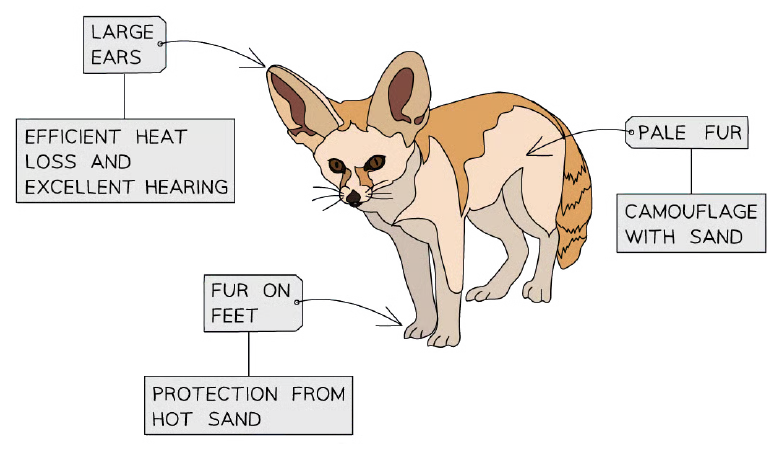
Adaptations of a fennec fox
Selection Pressures: Sexual Selection
- Sexual selection is a form of selection that occurs due to the preference of one sex for certain characteristics in individuals of the other sex.
- Sexual selection requires variation within the population; traits act as indicators of overall fitness.
- Sexual selection can lead to reproductive isolation and sexual dimorphism.
- Reproductive isolation occurs when changes in alleles or phenotypes prevent successful breeding with other individuals.
- Sexual dimorphism is the distinct difference in size or appearance between the sexes, such as in Birds of Paradise.
- Natural selection occurs due to competition for resources, while sexual selection occurs due to competition for mates.
- Sexual selection can result in traits that reduce survival, such as the peacock's long tail feathers.
- Sexual selection can be a more prominent evolutionary force than natural selection because variation in mating success can amplify selection and maintain genetic variation.
Selection Pressures: Skills – Guppy Case Study
- Guppies in Trinidad and Tobago show variation in colour and pattern, with males brightly coloured and females dull (sexual dimorphism).
- John Endler conducted lab and field experiments in the 1970s to investigate natural and sexual selection in guppies.
- Endler hypothesised that predation pressure affects spot brightness: low predation increases brightness due to sexual selection, while high predation decreases brightness.
- In the lab experiment, guppies were placed in ponds with different gravel types and predation levels; after five months, spot numbers and sizes were measured.
- Results showed that high predation decreased mean spot number, while low predation allowed spot number to increase.
- Guppies in coarse gravel ponds tended to have larger spots, while those in fine gravel ponds had smaller spots, mimicking gravel size.
- In the field experiment, dull male guppies transferred to a low-predation area became more colourful over 15 generations.
- The experiments demonstrated a dynamic trade-off between natural selection (predator avoidance) and sexual selection (mate attraction).
Slides
Sign up free to view the lesson slides
Step through every slide for this topic — plus flashcards and revision notes — with a free account.
Practice questions
Free preview — 8 of 61 questions. Sign up to see them all.
1.Which process does not generate heritable variation in a population?
Easy- AMutation
- BMitosis
- CMetaphase I of meiosis
- DFertilisation
2.Which of the following statements correctly explains the process of natural selection? I. Some species produce small numbers of young and provide higher levels of parental care II. Advantageous alleles increase an individual's chance of surviving and reproducing III. Individuals that change to suit their environment pass their alleles on to offspring IV. Advantageous alleles increase in frequency in the population
Medium- AI and II only
- BI, II, III, and IV
- CII, III, and IV only
- DII and IV only
3.Which of the following applies to the process of evolution by natural selection? I. Changes in the phenotype of organisms in a population II. Selection pressures favouring certain alleles within a population III. Individuals with a certain genetic makeup will not pass on their genes IV. Changes in the allele frequencies within a population over time
Medium- AII only
- BI, II and III
- CII and IV only
- DI, II, III and IV
4.Which of the following processes generate genetic variation? I. Random assortment II. Mitosis III. DNA replication IV. Random fertilisation
Medium- AI and III only
- BI and IV only
- CI, III, and IV only
- DI, II, III, and IV
5.Research was carried out on beak size in the island-living finch species Geospiza fortis. G. fortis feeds on seeds, which are plentiful, small, and soft in years when the weather is normal, but which become larger and tougher in drought years. Which of the following statements explains the results in the graph?
Medium- AFinches adapt to drought years by developing larger beaks, passing on the characteristic to their offspring, and leading to an increase in average beak size.
- BAverage finch beak size increases during years of drought and decreases during wet years.
- CAverage beak size increased from 9.5 mm in 1976 to 9.9 mm in 1977, before slowly decreasing to 9.7 mm by 1979.
- DFinches with larger beaks have an advantage when competing for food in drought years, and are therefore more likely to survive and pass on their alleles, leading to an increase in average beak size.
6.Which of the following does not describe the process of natural selection?
Hard- AA species of antelope where the population has stronger muscles after the individuals with weak muscles are eaten by predators
- BWhen a bacteria is exposed to a new type of antibiotic the exposure causes the bacteria to become resistant
- CSharks adapting to store more oxygen in their blood because the sharks with less oxygen were more likely to die
- DDark peppered moths increasing in number during the industrial revolution in response to increased predation of the light colour moths
7.Which of the following are sources of genetic variation within a population? (select all that apply)
Medium- AMutation
- BCrossing over during meiosis
- CRandom fertilisation
- DMitosis
- EIndependent assortment
8.Natural selection can only occur if there is variation within a population.
EasyTrue or false?
Unlock all 61 questions & more
Create a free account to see every question, the slides, flashcards and revision notes for this topic.