Proteins
Learn it by playing
Answer these questions to earn energy, then fish and explore. No account needed.
Lesson notes
Proteins: Polymers of Amino Acids
- Proteins are polymers (and macromolecules) made of monomers called amino acids.
- The sequence, type and number of amino acids in a protein determines its shape and therefore its function.
- Proteins are extremely important in cells because they form: enzymes, cell membrane proteins (e.g. carriers), hormones, immunoproteins (e.g. immunoglobulins), transport proteins (e.g. haemoglobin), structural proteins (e.g. keratin, collagen) and contractile proteins (e.g. myosin).
- Because all genes code for proteins, all reactions necessary for life depend on the function of proteins.
Amino Acid Structure
- Amino acids are the monomers of polypeptides; there are 20 amino acids found in polypeptides common to all living organisms.
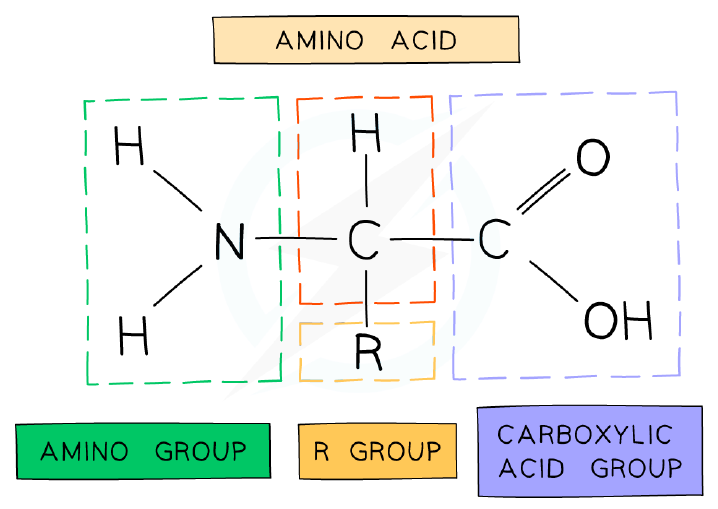
- The general structure of all amino acids is a central carbon atom (the α carbon) bonded to: an amine/amino group (-NH2), a carboxylic acid/carboxyl group (-COOH), a hydrogen atom, and an R group.
- The R group is how each amino acid differs and why amino acid properties differ (e.g. whether they are acidic or basic, or polar or non-polar).
- The R group can be as simple as another hydrogen atom (glycine), right through to complex aromatic ring structures (e.g. phenylalanine).
General structure of an amino acid
The Peptide Bond
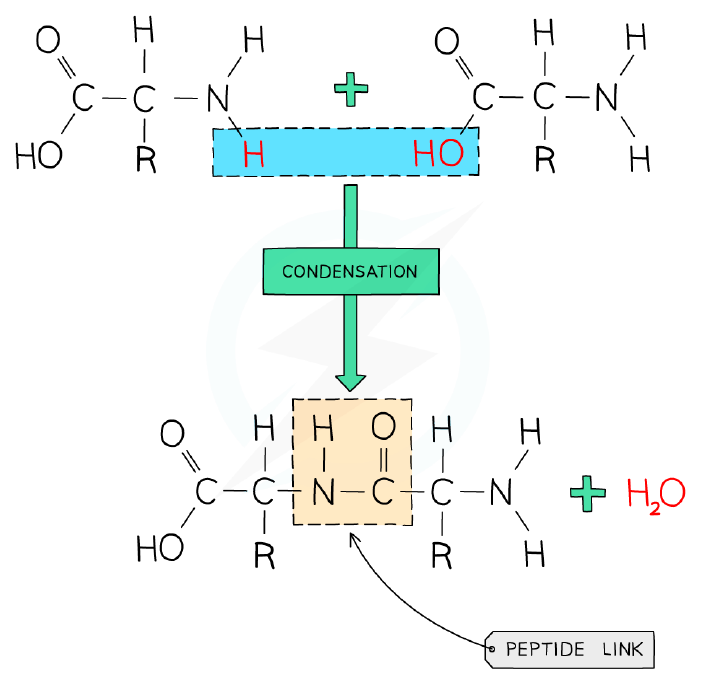
- To form a peptide bond, a hydroxyl group (-OH) is lost from the carboxylic group (-COOH) of one amino acid and a hydrogen atom is lost from the amine group (-NH2) of another amino acid.
- The remaining carbon atom (with the double-bonded oxygen) from the first amino acid bonds to the nitrogen atom of the second amino acid.
- This is a condensation reaction, so water is released.
- Dipeptides are formed by the condensation of two amino acids: amino acid + amino acid → dipeptide.
- Polypeptides are formed by the condensation of many (3 or more) amino acids.
- A protein may have only one polypeptide chain or it may have multiple chains interacting with each other.
- During hydrolysis reactions, the addition of water breaks peptide bonds, resulting in polypeptides being broken down into amino acids.
Forming a polypeptide
Dietary Requirements for Amino Acids
- There are 20 naturally occurring amino acids.
- Our cells can synthesise 11 of these from other amino acids; these are termed non-essential amino acids.
- The remaining nine we need to consume via our diets; these are called essential amino acids.
- A healthy, varied, well balanced diet will contain all nine essential amino acids required.
- Diets that restrict certain foods may require supplementation; meat contains all nine essential amino acids, so a vegetarian or vegan diet needs to be well balanced and varied to ensure all essential amino acids are consumed regularly.
The Variety of Proteins
- There is a large variety of proteins because: there are 20 naturally occurring amino acids, polypeptides can vary in length from a few to thousands, and the structure and amino acid sequence can also vary.
- The genetic code (DNA base sequence) codes for the number and order of amino acids in a polypeptide, and there is a huge variety of options for DNA base sequence.
- 20 amino acids can give an almost infinite number of polypeptides.
- Polypeptides are assembled at a ribosome by condensing individual amino acids onto a growing chain, one by one; the mRNA codon determines which amino acid is added.
- For a polypeptide chain of 50 amino acids, there would be 2050 possible combinations, giving 1.13 x 1065 combinations.
- Given that the average length of a protein is 300 amino acids, the number of possible combinations is so large it can be considered infinite.
Roles of Proteins
- Speeding up cellular reactions (catalysis) is performed by enzymes.
- Blood clotting, where blood proteins interact with oxygen to form a gel-like scab across a wound.
- Strengthening fibres in skin, hair, tendons, blood vessels e.g. collagen, keratin.
- Transport of vital metabolites e.g. oxygen carried by haemoglobin.
- Formation of the cytoskeleton, a network of tubules within a cell that cause chromosomes to move during the cell cycle.
- Cell adhesion, where cells in the same tissue stick together.
- Hormones, chemical messengers secreted in one part of the body to have an effect elsewhere.
- Compaction of DNA in chromosomes for storage, caused by histone proteins; the immune response produces antibodies, the most diverse group of proteins.
- Membrane transport channel and carrier proteins determine which substances can pass across a membrane; cell receptors are binding sites for hormones, chemical stimuli such as tastes, and for other stimuli such as light and sound.
Examples of Polypeptides
- Rubisco (Ribulose Bisphosphate Carboxylase): an enzyme that catalyses the fixing of CO2 from the atmosphere during photosynthesis; composed of 16 polypeptide chains as a globular protein; the most abundant enzyme on Earth and arguably the most important enzyme in nature.
- Insulin: a hormone produced and secreted by β-cells in the pancreas; binds to insulin receptors (on liver, fat and muscle cells) reversibly, causing absorption of glucose from the blood; composed of 2 polypeptide chains as a short, globular protein.
- Immunoglobulins (antibodies): have a generic 'Y' shape, with specific binding sites at the two tips of the 'Y'; bind to specific antigens; binding areas are highly variable, meaning antibodies can be produced against millions of different antigens; globular and the most diverse range of proteins.
- Rhodopsin: a pigment in the retina of the eye; a membrane protein expressed in rod cells; contains a light-sensitive part, retinal, derived from Vitamin A; a photon of light causes a conformational change, sending a nerve impulse along the optic nerve to the central nervous system.
- Collagen: a fibrous protein made of three separate polypeptide chains; the most abundant protein in the human body (approximately 25%); fibres form a network in skin, blood vessel walls and connective tissue that can resist tearing forces; plays a role in teeth and bones, helping to reduce their brittleness.
- Spider Silk: as strong as steel wire though considerably lighter; contains rope-like, fibrous parts but also coiled parts that stretch under tension; does not denature easily at extremes of temperature; can be genetically engineered to be expressed in goats' milk.
Protein Structure: Effect of pH & Temperature
- Protein structure is sensitive to changes in the environment, particularly temperature and pH changes.
- The precise structure of a protein depends on ionic interactions, hydrogen bonds and other intermolecular forces between polypeptide chains being intact.
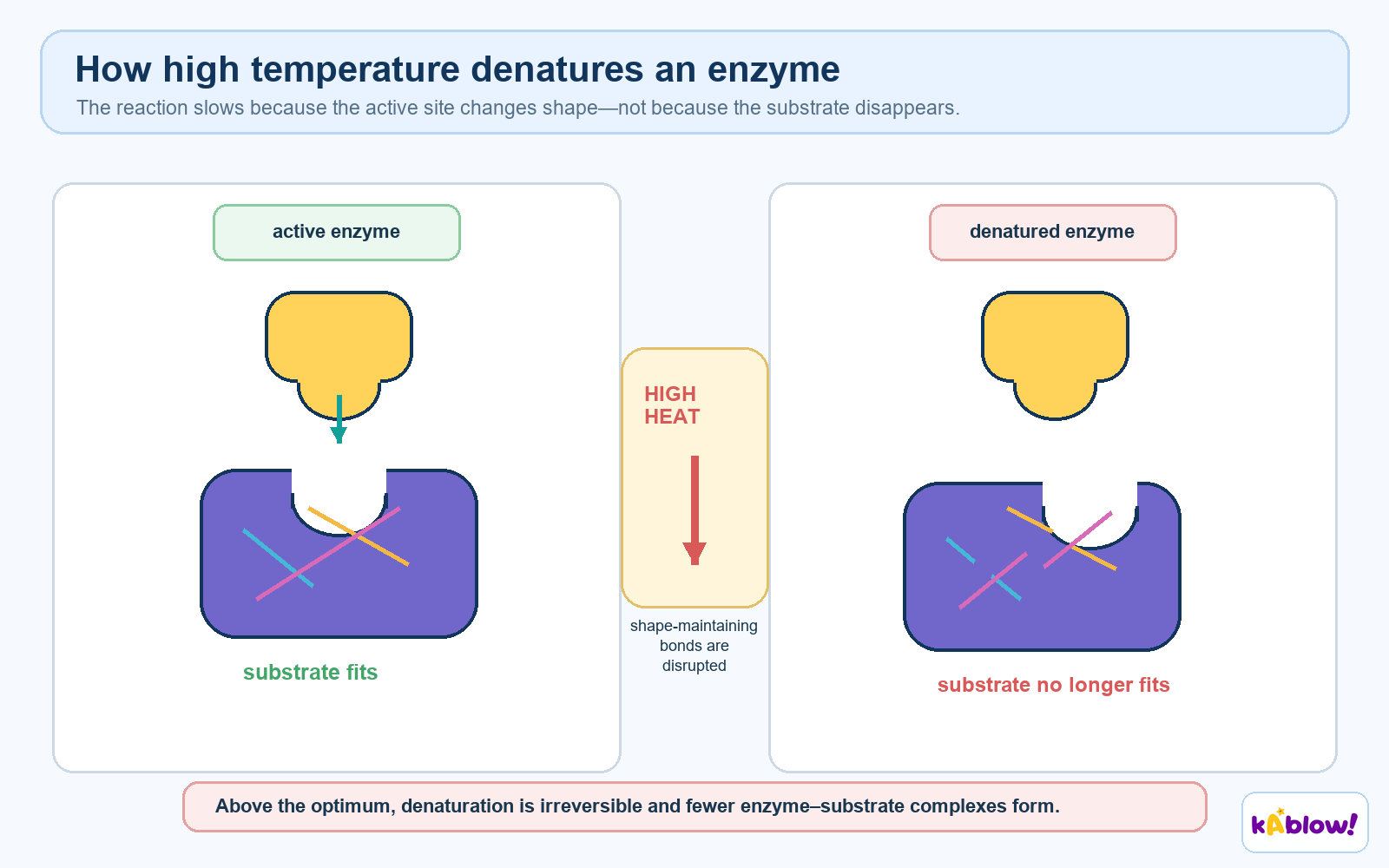
- Denaturation is the irreversible change of protein conformation; it may occur by temperature and pH extremes that interfere with these bonds.
- The bonds that form between different R groups are relatively weak (compared to peptide bonds); they can be broken easily, causing the conformation to change and denaturation.
- The altered protein shape may affect its function, physical state and general usefulness in its original role.
- A certain pH is considered an optimum for a particular protein because at that pH, the protein's 3D structure is not denatured.
- Denaturation is almost always irreversible; the protein cannot be re-formed in its original conformation by reversing the change in conditions. However, small denaturations and renaturations are possible in certain proteins to respond to small fluctuations in pH e.g. haemoglobin.
Denaturation in Action
- Denaturation can be seen most easily by looking at the changes in an egg white as the egg is fried or poached; egg white is mainly the protein albumin.
- The hydrophobic amino acids in albumin are at the centre of the molecule in its normal state, so albumin is soluble.
- Heating causes the hydrophobic amino acids to appear at the edges, where they cause the protein to become insoluble; a harder, solid layer forms, which is the cooked white.
- Denaturation also occurs in the stomach, where the low pH (pH 2) causes proteins in the diet to become denatured on their way to being fully hydrolysed further down the digestive system.
- The stomach enzyme pepsin, a protein-digesting enzyme, has an optimum pH of 2 for this reason.
- Certain extremophiles have evolved to have proteins that are stable even at extreme pH or temperature, e.g. Thermus aquaticus, a bacterium that lives in hot springs at 80°C.
- Denaturation of enzymes can be used as part of experiments to measure enzyme activity, e.g. to establish the optimum pH or temperature of an enzyme such as pepsin or lipase.
- Many drugs are proteins that cannot be taken by mouth because the protein will be denatured by stomach acid; these drugs should be delivered in another way e.g. by direct injection into the blood.
Denaturation of an enzyme
Slides
Sign up free to view the lesson slides
Step through every slide for this topic — plus flashcards and revision notes — with a free account.
Practice questions
Free preview — 8 of 59 questions. Sign up to see them all.
1.Which of the following is not a function of proteins?
Easy- AAct as a store of chemical potential energy in cells
- BAct as chemical messengers that are secreted by glands and act on different parts of the body
- CSpeed up chemical reactions within a cell
- DForm the cytoskeleton within a cell that facilitates chromosome movement
2.A simple tetrapeptide consists of four amino acids. How many different combinations of amino acids would be possible for this peptide?
Easy- A160
- B1 600
- C160 000
- D16 000 000
3.Which of the following are all examples of proteins?
Easy- ARubisco, collagen, amylopectin
- BAmylopectin, collagen, guanine
- CInsulin, amylose, spider silk
- DRhodopsin, immunoglobulins, rubisco
4.Which of the following would represent all the elements that are present in proteins?
Easy- ACarbon, hydrogen, oxygen, nitrogen
- BCarbon, hydrogen, oxygen, nitrogen, sulfur
- CCarbon, hydrogen, oxygen, nitrogen, phosphorus
- DCarbon, hydrogen, oxygen
- 5.Medium
Amino acids consist of oxygen, hydrogen, carbon and nitrogen atoms. The diameter of each atom when bonded to another atom is shown in the table below.
atom single bond / nm double bond / nm O 0.13 - H 0.06 0.110 C 0.154 0.120 N 0.14 0.134 Using the figures in the table, the approximate length of one amino acid is 0.7 nm. What would be the approximate length of a dipeptide of this amino acid after a condensation reaction has occurred?
- A1.0 nm
- B1.2 nm
- C1.4 nm
- D1.6 nm
6.Which of the following chemical groups does not bond directly with the central carbon of an amino acid?
Medium- A-OH
- B-NH2
- C-COOH
- D-H
7.Which of the following causes fibrous polypeptides to be insoluble?
Medium- AThey are very long.
- BTheir surface has nonpolar amino acids.
- CThey are usually structural.
- DThey have more than one polypeptide chain.
- 8.Medium
Which row of the table best classifies common proteins with differing numbers of polypeptide chains?
One polypeptide chain Two polypeptide chains Three polypeptide chains A Collagen Insulin Haemoglobin B Lysozyme Insulin Collagen C Lysozyme Haemoglobin Insulin D Haemoglobin Lysozyme Collagen - AA
- BB
- CC
- DD
Unlock all 59 questions & more
Create a free account to see every question, the slides, flashcards and revision notes for this topic.