From Models To Materials
Learn it by playing
Answer these questions to earn energy, then fish and explore. No account needed.
Lesson notes
Bonding Models
- Bonding models simplify complex systems and allow prediction of substance properties.
- Chemical bonding broadly falls into three types: ionic, covalent and metallic.
- Real bonding situations are more complex than these three idealised types suggest.
- Example: aluminium chloride, AlCl3, contains a metal and a non-metal, so it would be expected to be ionic with a high melting point.
- However, AlCl3 melts at 192 °C, which is lower than expected for an ionic compound, due to covalent character.
- The bonding in AlCl3 is polar covalent, not purely ionic.
The Bonding Triangle
- Bonding is better visualised using a bonding triangle, which places compounds on a spectrum.
- The triangle uses electronegativity difference (∆χ) on the y-axis and average electronegativity (χ̄) on the x-axis.
- Difference in electronegativity: ∆χ = χA − χB.
- Average electronegativity: χ̄ = (χA + χB) / 2.
- Elements have zero Δχ and appear along the x-axis depending on their electronegativity.
- Metals have zero Δχ and appear along the x-axis, but near the metallic corner.
- Ionic compounds have large Δχ and are placed near the apex of the triangle.
- Covalent compounds with low Δχ are near the bottom right; polar covalent compounds lie in between ionic and covalent.
Using the Bonding Triangle
- The bonding triangle appears in Section 17 of the IB Chemistry Data Booklet; electronegativity values are in Section 9.
- You don’t need to memorise the bonding triangle; focus on interpreting it when needed.
- Each compound is plotted using values in the format (x, y).
- Sodium (Na) has an electronegativity of 0.9; as a pure element Δχ = 0, placing it in the bottom left, 100% metallic.
- Chlorine (Cl2) has an electronegativity of 3.2; as a diatomic molecule Δχ = 0, placing it in the bottom right, 100% covalent.
- Sodium chloride (NaCl) has average electronegativity Σχ = (3.2 + 0.9)/2 = 2.05 and Δχ = 3.2 − 0.9 = 2.3, placing it near the apex with around 75% ionic character.
- This explains NaCl’s high melting point and ability to conduct electricity when molten.
Percentage of Bonding Type
- The triangular bonding diagram can help estimate the percentage of ionic or covalent character in a compound.
- Aluminium chloride (AlCl3): Σχ = (1.6 + 3.2)/2 = 2.4, Δχ = 3.2 − 1.6 = 1.6, placing it at (2.4, 1.6) with 50% ionic character.
- Aluminium oxide (Al2O3): Σχ = (1.6 + 3.4)/2 = 2.5, Δχ = 3.4 − 1.6 = 1.8, placing it at (2.5, 1.8) with 60% ionic character.
- Both AlCl3 and Al2O3 fall near the polar covalent region, indicating significant ionic character and covalent properties.
- Al2O3 has a much higher melting point (2072 °C) due to stronger ionic bonding; AlCl3 melts at just 192 °C due to weaker covalent interactions.
- The diagram allows accurate assessment of real bonding behaviour and prediction of properties like melting point, solubility and electrical conductivity.
- You do not need to calculate exact percentage ionic character in exams; use the triangle to compare materials qualitatively.
Properties of Alloys
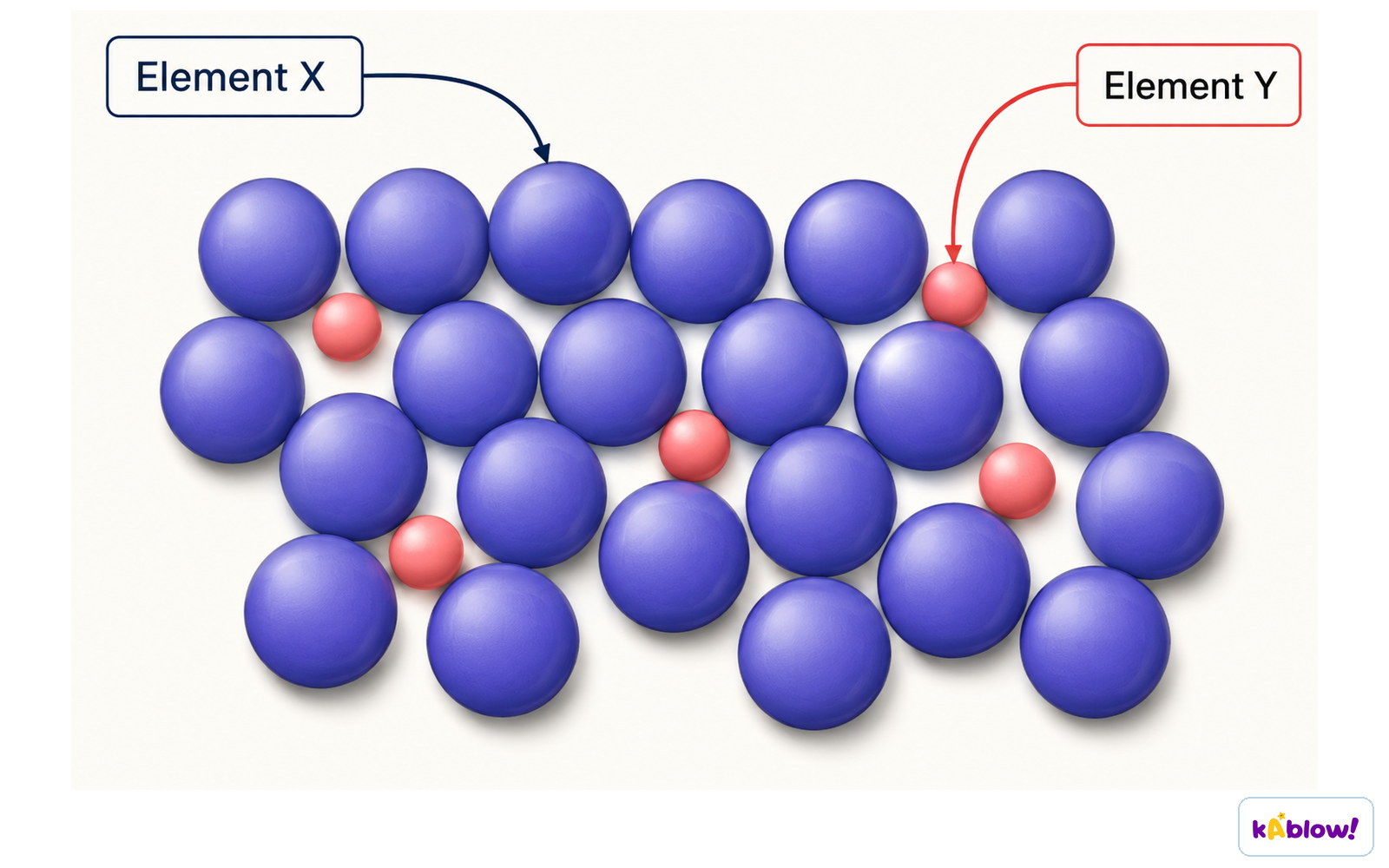
- An alloy is a mixture of metals, or a metal mixed with a non-metal such as carbon.
- The elements are physically combined but not chemically bonded; atoms of different elements are spread throughout the metallic lattice.
- Atoms are held together by delocalised electrons, as in pure metals; metallic bonds are non-directional, allowing atoms of different sizes to occupy the lattice.
- In a pure metal, metal cations are arranged in regular layers, allowing them to slide past one another easily, making the metal malleable.
- In alloys, atoms of different sizes disrupt this regular pattern; the distorted lattice makes it harder for the layers to slide.
- This gives alloys increased hardness and strength compared to pure metals.
- Alloys may also be more corrosion resistant or resistant to extreme temperatures.
- Examples: brass (copper and zinc), steel (iron with carbon), stainless steel (iron, chromium, nickel, carbon), solder (lead and tin), bronze (copper and tin).
Structure of an alloy
Polymers
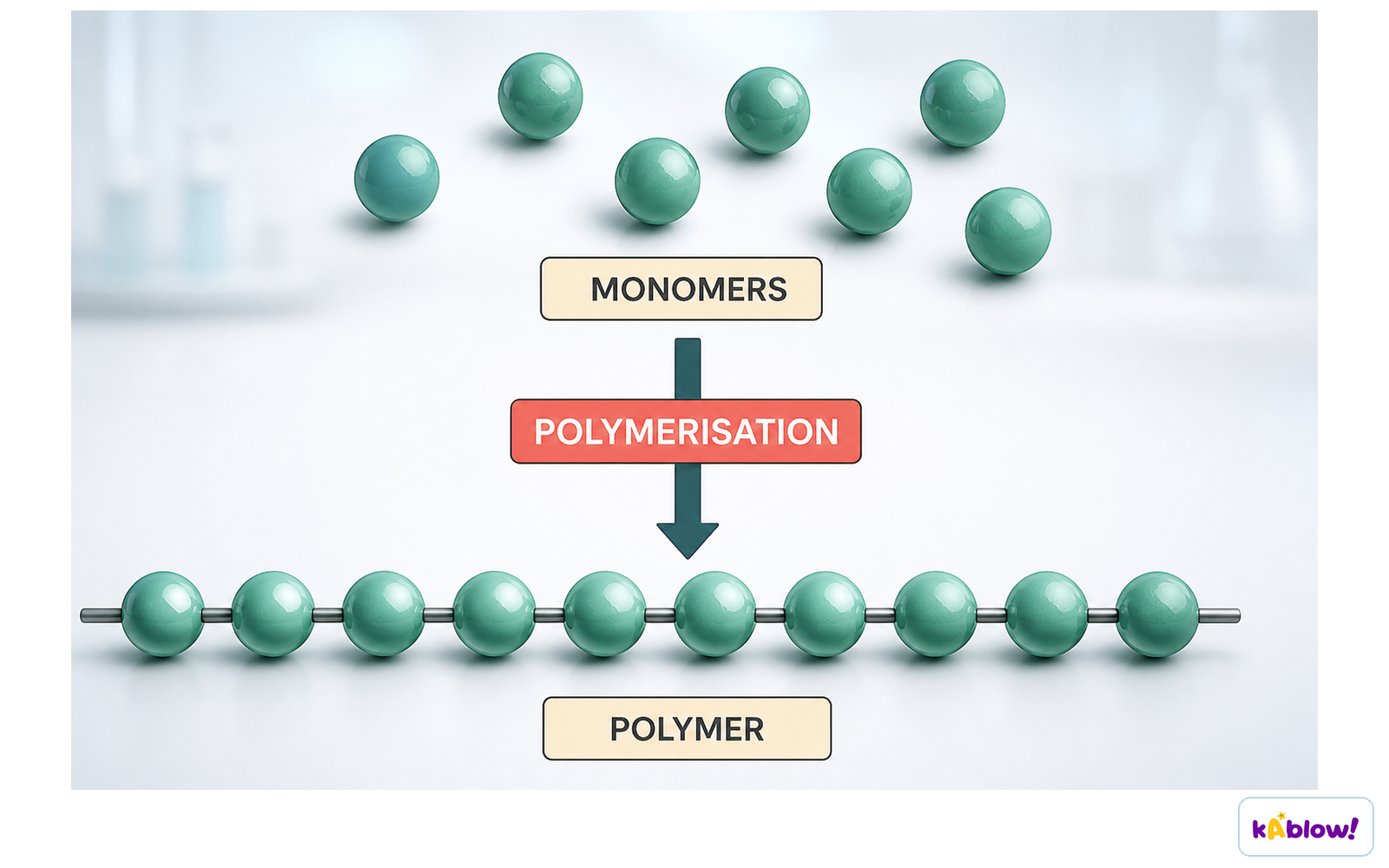
- Polymers are large molecules made by chemically linking many small molecules called monomers.
- A polymer must contain at least 50 repeating units; each unit is joined to the next by strong covalent bonds.
- Polymers are also known as macromolecules due to their large size compared with simple molecules.
- Some polymers contain just one type of monomer unit, e.g. poly(ethene) and poly(chloroethene) (PVC).
- Others contain two or more different types of monomer units and are called copolymers, e.g. nylon and biological proteins.
- Natural polymers include proteins, starch and DNA; DNA forms a double helix with millions of linked nucleotides.
- Synthetic polymers include plastics like poly(ethene) and nylon; they are man-made and widely used due to durability, low reactivity and water resistance.
- Synthetic polymers are generally non-biodegradable because of their chemical stability, leading to long-lasting pollution.
Monomers joining to form a polymer
Addition Polymers
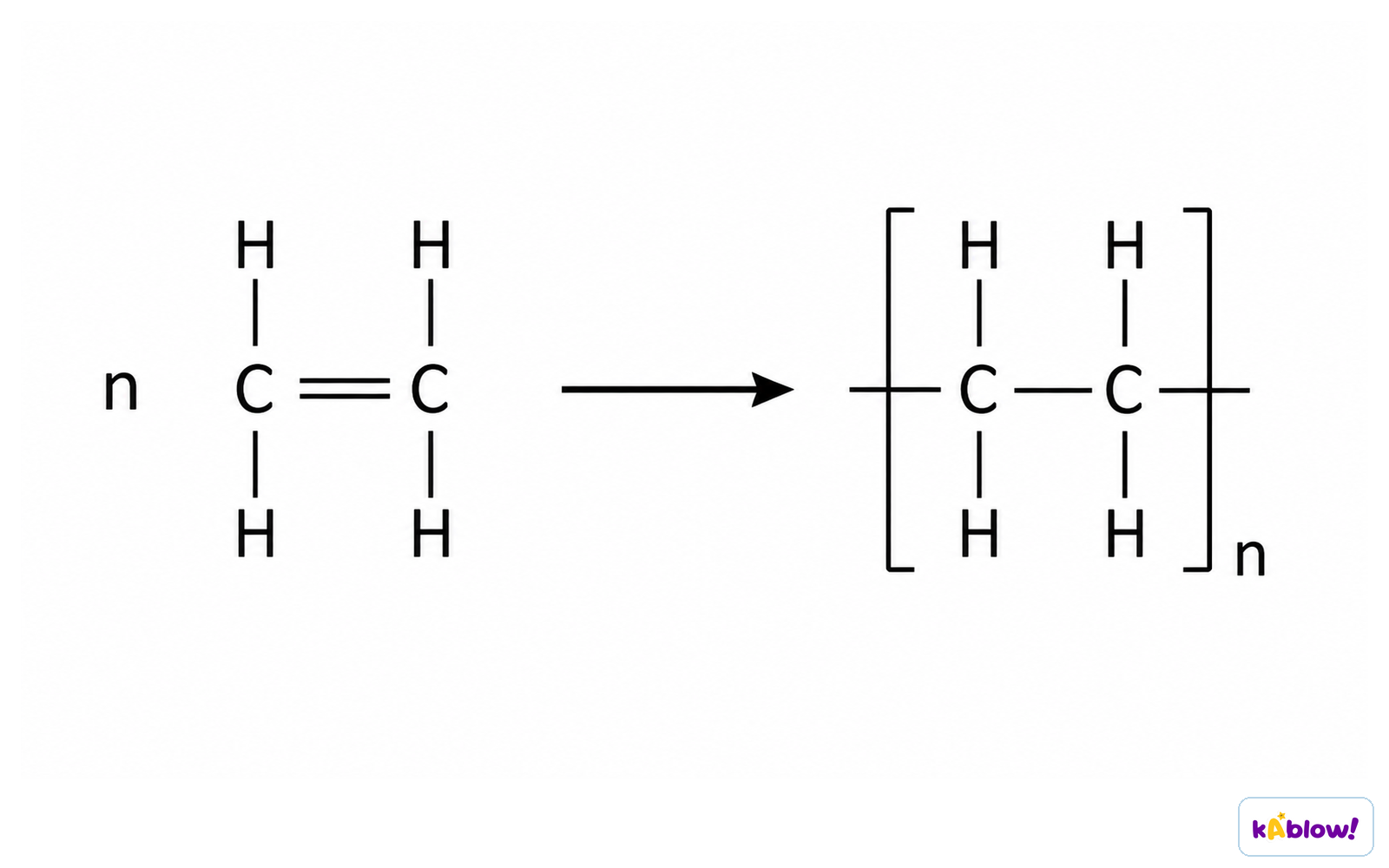
- Addition polymerisation involves monomers containing at least one C=C double bond joining together to form a long-chain polymer.
- The only product is the polymer; no by-products are formed.
- The π-bond in each C=C bond breaks and allows monomers to link by forming new C–C single bonds.
- Examples: poly(ethene) from ethene monomers; poly(chloroethene) or PVC from chloroethene monomers.
- A repeat unit is the smallest group of atoms that repeats to form the polymer chain; it is shown inside square brackets [ ] with an 'n' outside.
- In poly(alkenes), the repeat unit is the same as the monomer except the C=C becomes a C–C bond.
- The structure inside square brackets is the repeat unit – not the monomer; the monomer is the same as the repeat unit but with C=C bonds instead of C–C bonds.
- Properties of polymers: low density (chains loosely packed), unreactive (chemically stable chains), water-resistant (repel water), strong (held by strong covalent bonds).
Addition polymerisation
Condensation Polymers (HL)
- In condensation polymerisation, monomers join together and release a small molecule as a by-product, most commonly water or hydrogen chloride.
- Condensation polymers often contain either ester links (–COO–) or amide links (–CONH–).
- Ester links are formed between a carboxylic acid and an alcohol group; commonly found in polyesters.
- Amide links are formed between a carboxylic acid and an amine group; commonly found in polyamides such as proteins and nylon.
- A polyester is formed from diols and dicarboxylic acids, or from hydroxycarboxylic acids; e.g. PET (Terylene or Dacron).
- A polyamide is formed from diamines and dicarboxylic acids, diamines and dioyl dichlorides, or amino acids; e.g. nylon-6,6.
- The amide link (–CONH–) is called a peptide bond when formed between amino acids.
- Polyesters and polyamides can be broken by hydrolysis because ester/amide bonds are susceptible to water attack; this is a major advantage over addition polymers.
Comparing Addition and Condensation Polymerisation
- Addition polymerisation uses monomers with carbon–carbon double bonds and forms no by-products.
- Addition polymers like poly(ethene) have saturated carbon backbones and cannot be hydrolysed, so they persist in the environment.
- Condensation polymerisation uses monomers with two different functional groups (e.g. –COOH and –NH2) and releases a small molecule like water as a by-product.
- Condensation polymers like nylon and proteins contain amide or ester links between the monomers.
- Condensation polymers are strong, biodegradable (some can break down over time) and versatile – can be tailored for flexibility, toughness or water resistance.
- Hydrolysis adds water and causes the polymer to break down into the original monomers; both condensation and hydrolysis reactions are controlled by enzymes.
Slides
Sign up free to view the lesson slides
Step through every slide for this topic — plus flashcards and revision notes — with a free account.
Practice questions
Free preview — 8 of 63 questions. Sign up to see them all.
1.Which type of bonding is found at the apex (top) of a triangular bonding diagram?
Easy- AIonic bonding
- BCovalent bonding
- CMetallic bonding
- DPolar covalent bonding
2.What is represented on the x-axis of a standard triangular bonding diagram?
Easy- ADifference in electronegativity (Δχ)
- BAverage electronegativity (χ̄)
- CIonic character (%)
- DMelting point
3.An alloy is a mixture of a metal with another element. Which statement about alloys is correct?
Easy- AAlloys contain atoms of all the same size
- BAlloys are softer than the pure metal they originate from
- CAlloys are harder than the pure metal they originate from
- DAlloys have a regular lattice that allows layers to slide easily
4.In addition polymerisation, a small molecule such as water is released as a by-product.
EasyTrue or false?
5.A polymer must contain at least 50 repeating units.
EasyTrue or false?
6.Which of the following statements about alloys are correct? (select all that apply)
Medium- AAlloys contain atoms of all the same sizes
- BAn alloy is a mixture of a metal with another element
- CAlloys are harder than the pure metal they originate from
- DAlloys have a regular lattice that allows layers to slide easily
- EAlloys are held together by delocalized electrons
7.Which pair of monomers is used to form a polyester?
Medium- AA diamine and a dicarboxylic acid
- BA diol and a dicarboxylic acid
- CTwo amino acids
- DA dioyl dichloride and a diamine
8.Which linkage is formed in a polyamide?
Medium- AEster link (–COO–)
- BAmide link (–CONH–)
- CPeptide link (–COO–)
- DEther link (–O–)
Unlock all 63 questions & more
Create a free account to see every question, the slides, flashcards and revision notes for this topic.