Introduction To The Particulate Nature Of Matter
Learn it by playing
Answer these questions to earn energy, then fish and explore. No account needed.
Lesson notes
Elements and Compounds
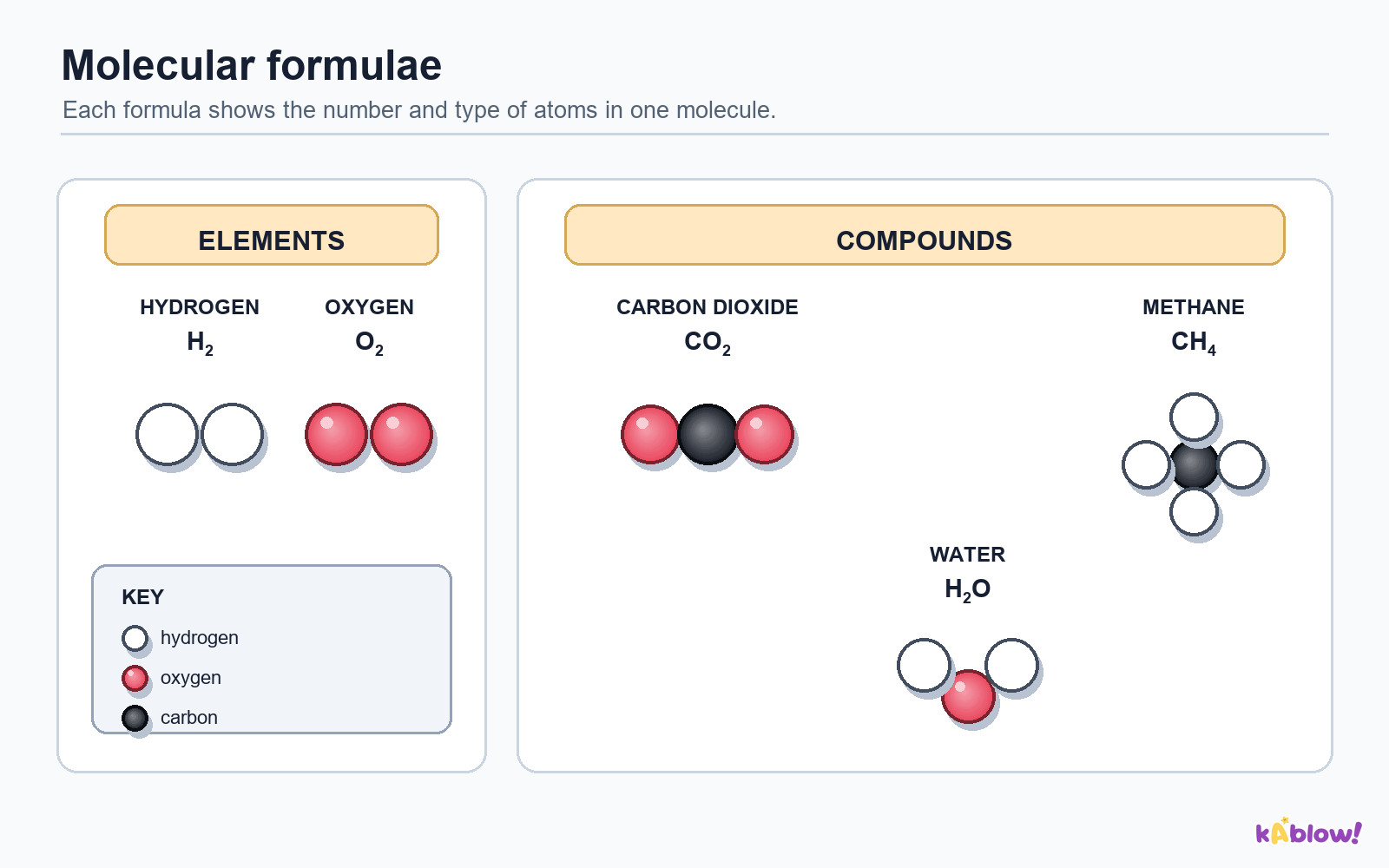
- Elements are substances made from one kind of atom and cannot be chemically broken down into simpler substances.
- Elements take part in chemical reactions, often with an energy change, to form new substances.
- In chemical reactions, atoms combine in fixed ratios to give them full outer shells of electrons, producing compounds.
- Compounds are made from two or more elements chemically bonded together.
- The properties of a compound can be quite different from the properties of the elements that form it, e.g. sodium chloride is different from sodium and chlorine.
Ball-and-stick models of common elements and compounds
Mixtures
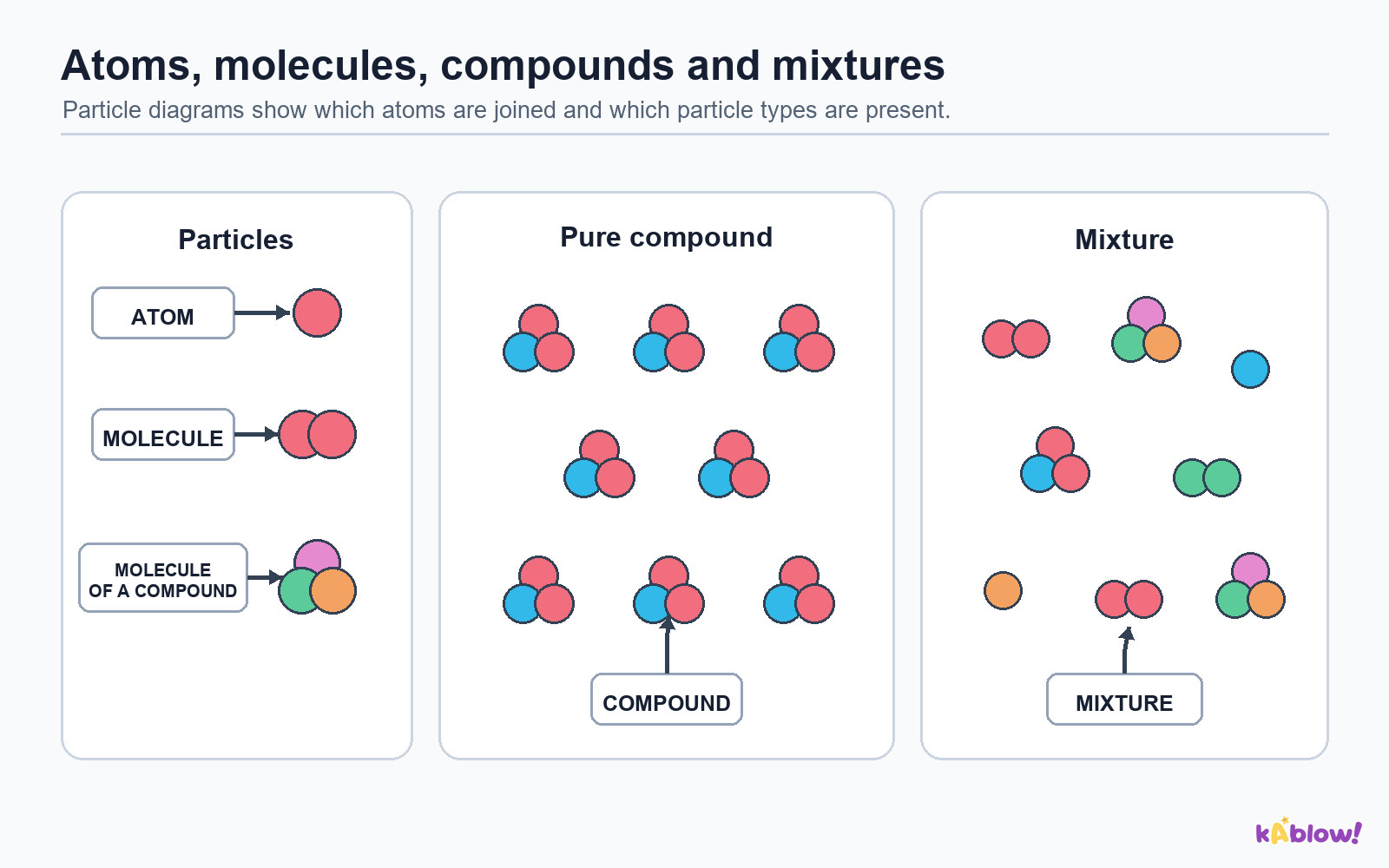
- Mixtures contain more than one element or compound in no fixed ratio.
- The components of a mixture are interspersed but not chemically combined.
- Each component in a mixture retains its own characteristic properties, e.g. nitrogen and oxygen in air keep their properties.
- A homogeneous mixture has uniform composition and properties throughout, e.g. air, bronze (an alloy).
- A heterogeneous mixture has non-uniform composition, so its properties are not the same throughout, e.g. concrete, orange juice with pulp.
- It is often possible to see the separate components in a heterogeneous mixture, but not in a homogeneous mixture.
Particle diagram showing elements, compounds and mixtures
Separating Mixtures: Solubility and Filtration
- Separation techniques take advantage of differences in physical properties such as boiling point, solubility, magnetism, or density.
- Solvation is the process where a solute dissolves because solvent particles surround and attract the solute particles; in water it is called hydration.
- To separate a mixture of salt and sand, add water: only the salt dissolves, then filter.
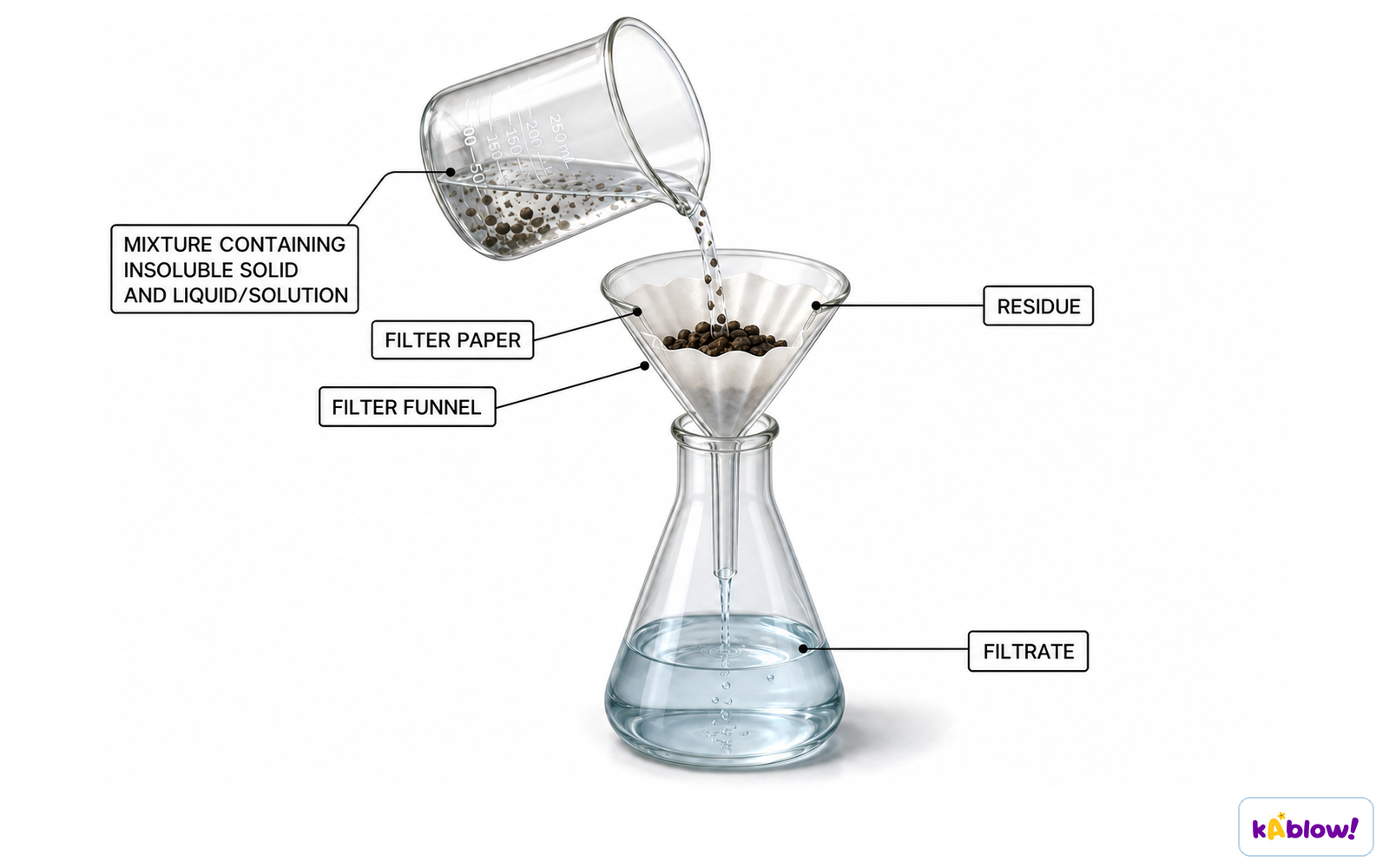
- Filtration separates an insoluble solid from a liquid using filter paper: the liquid (filtrate) passes through, and the solid (residue) remains on the paper.
- Filtration works because solid particles are too large to pass through the pores in the filter paper.
- Vacuum filtration can be used for very fine solids that clog filter paper under gravity filtration; centrifugation can also separate solid–liquid mixtures.
Filtration apparatus
Separating Mixtures: Crystallisation and Distillation
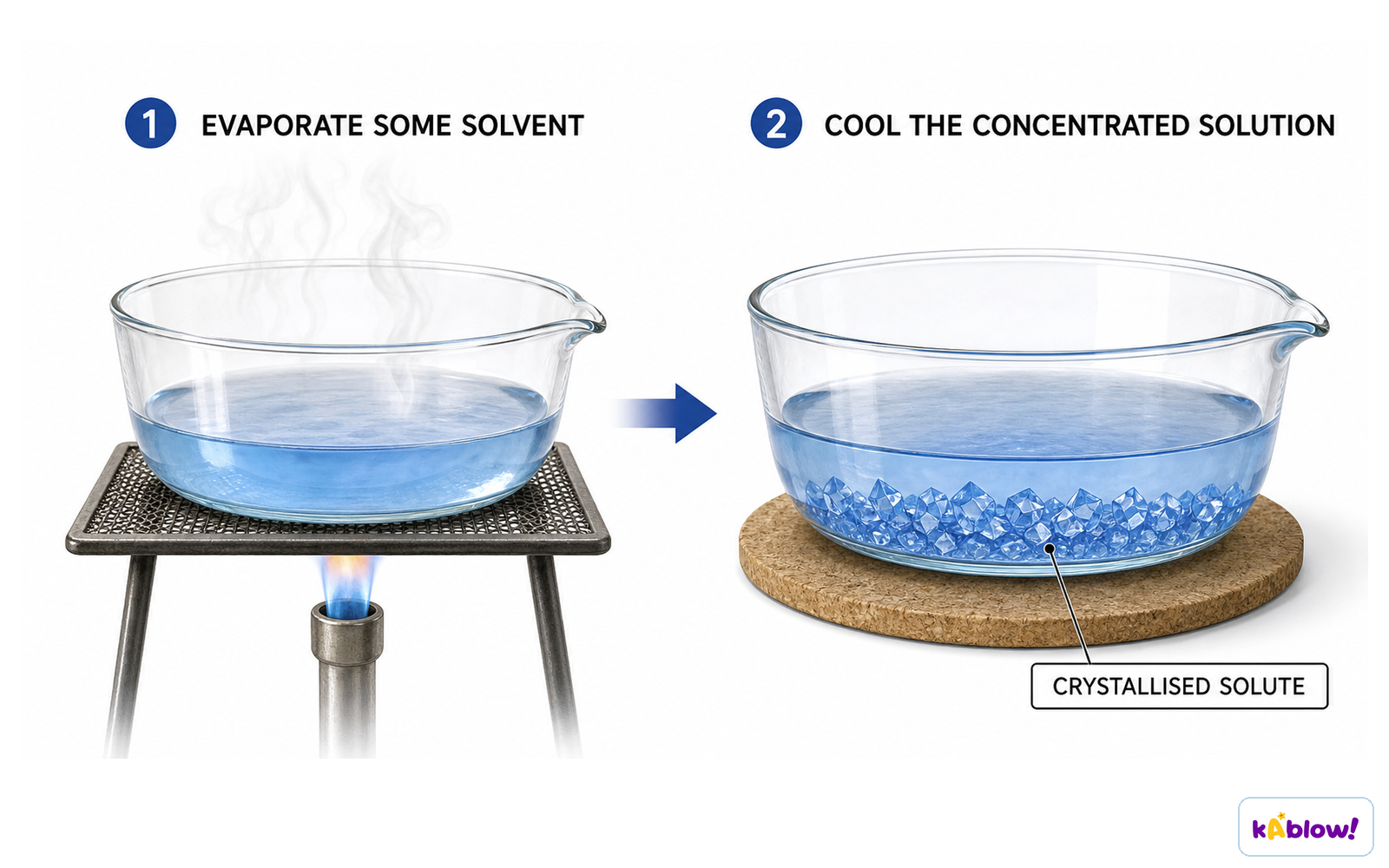
- Crystallisation separates a dissolved solid from a solution when the solid is more soluble in hot solvent than cold, e.g. recovering copper(II) sulfate crystals.
- Steps for crystallisation: heat gently to evaporate some solvent, cool until saturated, allow crystals to form, then filter, wash with distilled water, and dry.
- Recrystallisation purifies an impure solid by dissolving it in hot solvent and allowing it to crystallise as the solution cools.
- Simple distillation separates a solvent from a solute or a pure liquid from a mixture based on differences in boiling point, e.g. separating water from salt solution.
- Fractional distillation separates two or more miscible liquids with similar boiling points using a fractionating column, e.g. ethanol and water, or crude oil.
- For ethanol (78 °C) and water (100 °C), heat to 78 °C to distil the ethanol first; use an electric heater when flammable liquids are present.
Crystallisation by evaporation and cooling
Separating Mixtures: Chromatography and Other Techniques
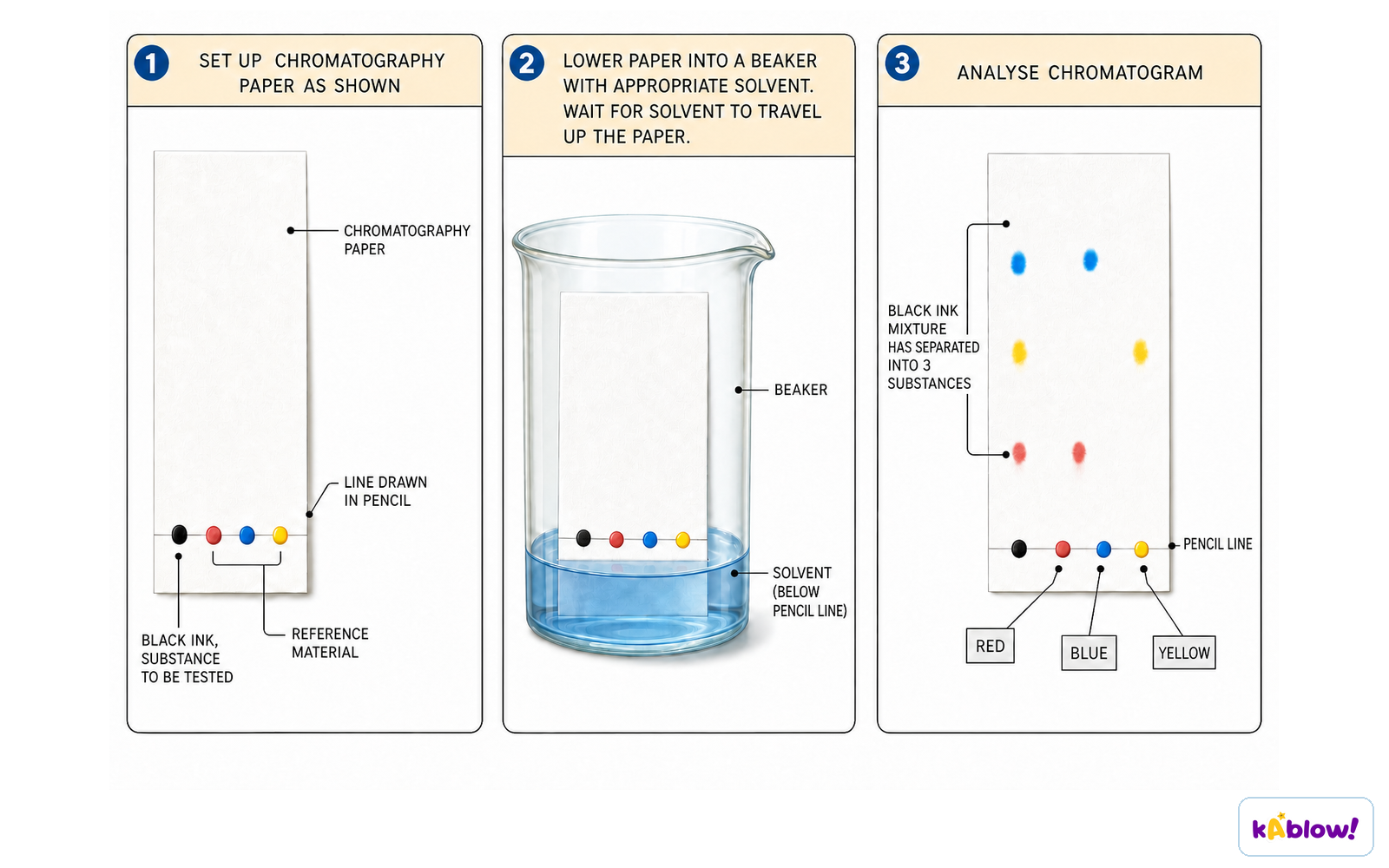
- Paper chromatography separates dissolved substances based on differences in solubility and adsorption to the paper.
- In chromatography, a pencil line is used because pencil does not dissolve in the solvent; the spots must stay above the solvent level.
- Substances that are more soluble in the solvent travel further; substances more strongly adsorbed to the paper move more slowly.
- The resulting chromatogram shows a pattern of spots representing different components in the mixture.
- Magnetic separation uses differences in magnetic properties, e.g. removing iron filings from a mixture.
- Summary: filtration (insoluble solid from liquid), crystallisation (dissolved solid), recrystallisation (purify solid), simple distillation (solvent from solute), fractional distillation (miscible liquids), chromatography (dissolved substances).
Paper chromatography
The Three States of Matter
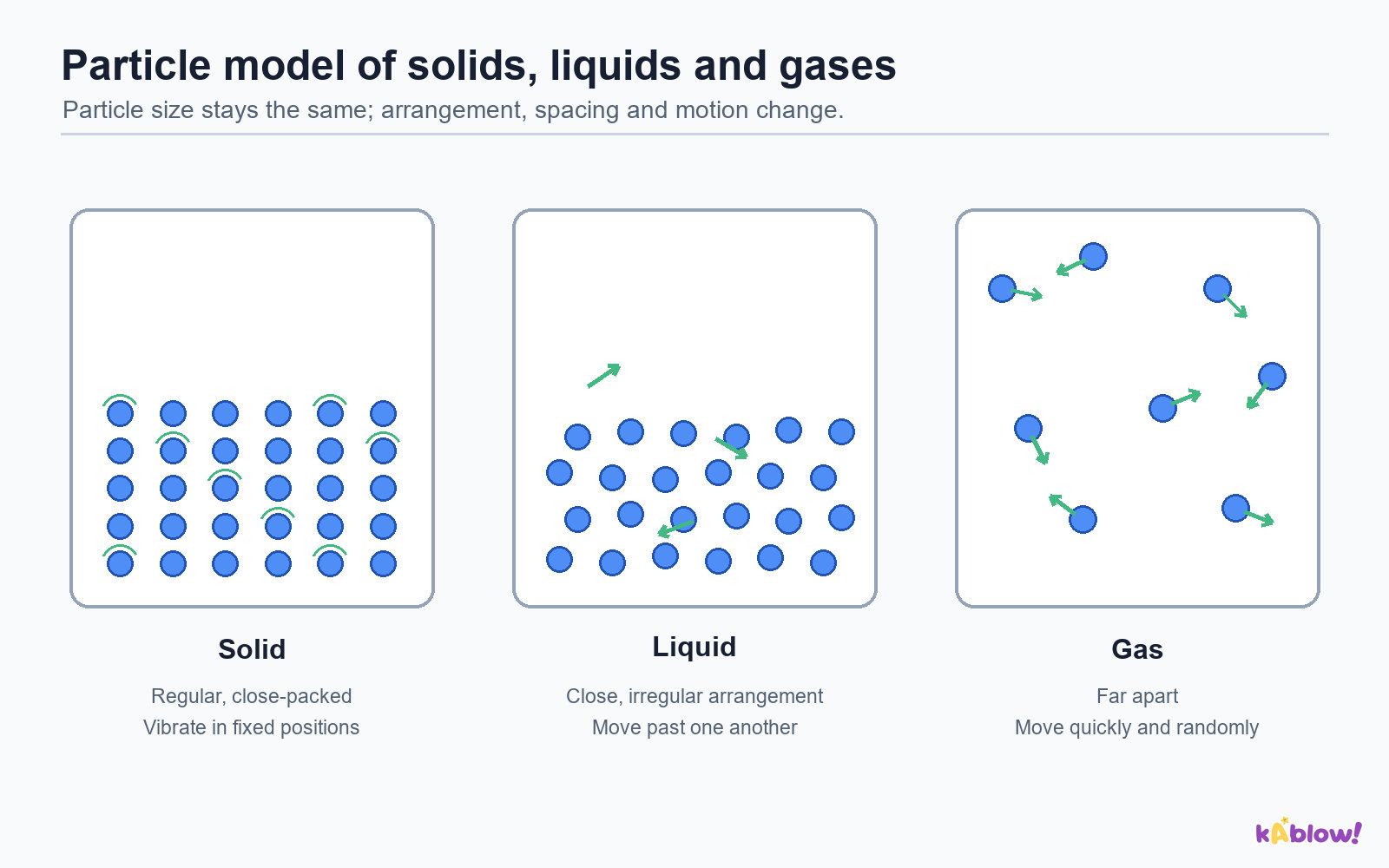
- Solids have a fixed shape and volume; particles are closely packed in a regular, ordered pattern and can only vibrate in place.
- Solids have a high density and the lowest particle energy compared to liquids and gases.
- Liquids have a fixed volume but take the shape of their container; particles are close together but randomly arranged and can slide past one another.
- Liquids have a medium density and particles have more energy than in solids but less than in gases.
- Gases have no fixed shape or volume and expand to fill the container; particles are widely spaced, randomly arranged, and move quickly in all directions.
- Gases can be compressed easily, have very low density, and particle collisions generate pressure; particles have the highest energy.
Particle arrangements in solids, liquids and gases
Changes of State
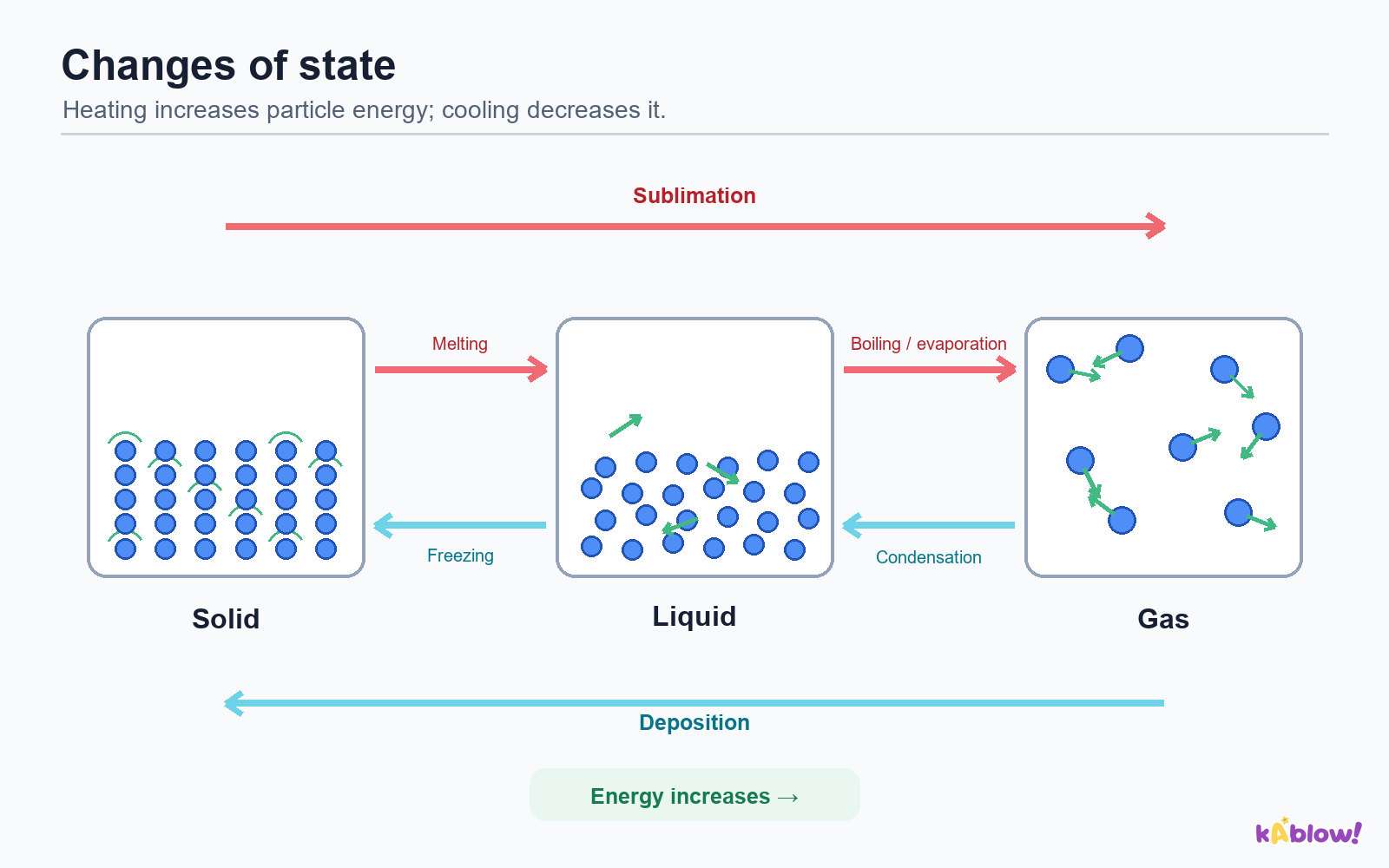
- State changes are physical changes and are reversible; they involve energy transfer but do not alter the chemical identity of the substance.
- Names of state changes: melting (solid→liquid), freezing (liquid→solid), vaporisation (liquid→gas), condensation (gas→liquid), sublimation (solid→gas), deposition (gas→solid).
- Boiling occurs throughout the liquid at a specific temperature when vapour pressure reaches external atmospheric pressure; evaporation occurs only at the surface below the boiling point.
- State symbols: (s) solid, (l) liquid, (g) gas, (aq) aqueous (dissolved in water).
- Energy is always required to overcome intermolecular forces, so melting, vaporisation, and sublimation are endothermic.
- Energy is released when particles come closer, so freezing, condensation, and deposition are exothermic.
Changes of state
Average Kinetic Energy and Temperature
- Temperature is a measure of the average kinetic energy (Ek) of the particles in a substance.
- The Kelvin (K) is the SI unit of temperature; temperature in Kelvin is directly proportional to average kinetic energy.
- The higher the temperature, the faster the particles move on average.
- At the same temperature, all gases have the same average kinetic energy, but lighter gases move faster and heavier gases move slower.
- Conversion: Temperature in K = Temperature in °C + 273.15; Temperature in °C = Temperature in K − 273.15.
- 0 K (absolute zero) is the temperature at which particles have no kinetic energy; a change of 1 K equals a change of 1 °C.
Interpreting State Change Graphs
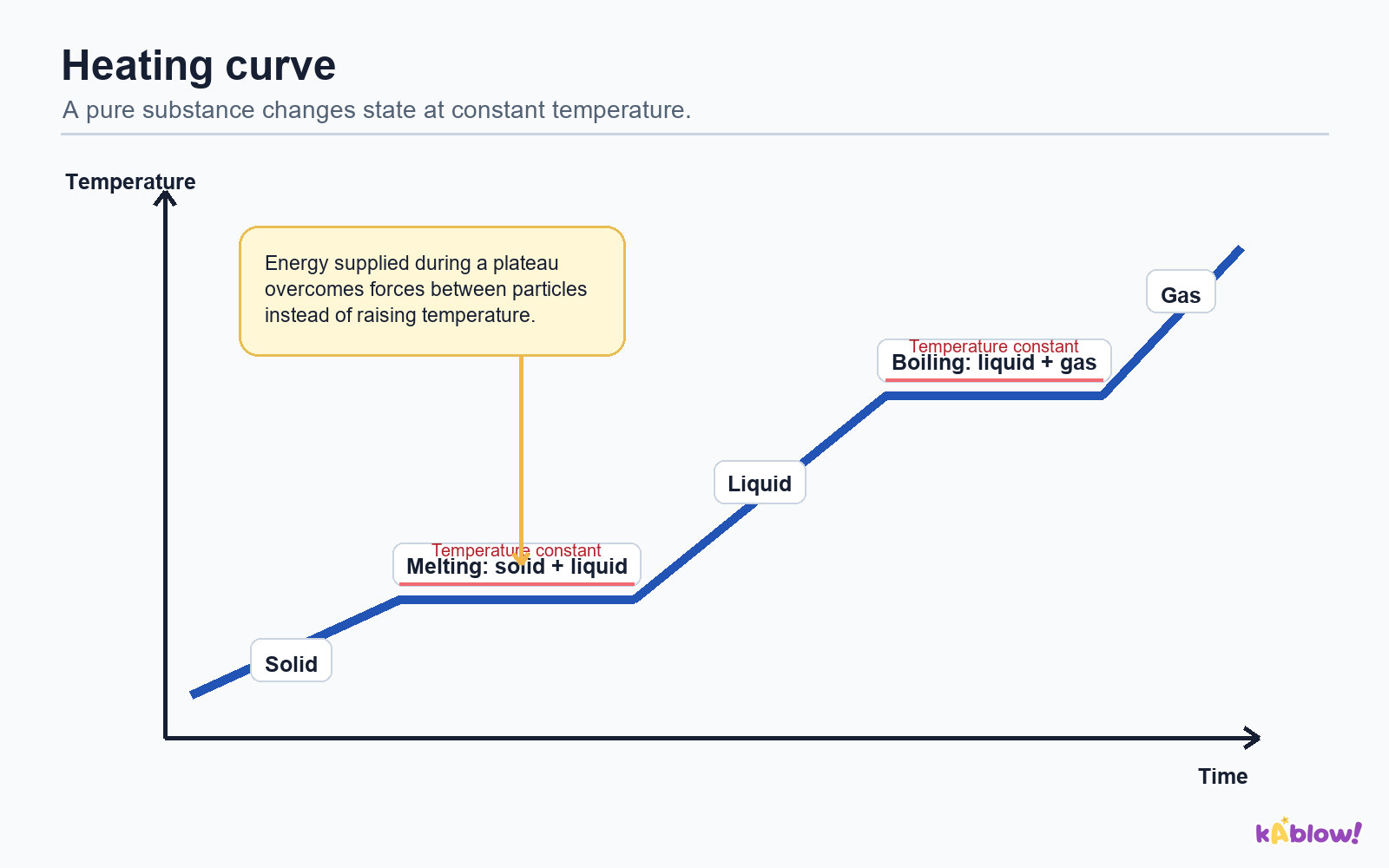
- A heating curve shows the relationship between temperature and energy during changes of state.
- While a substance is heating in the solid state, particles vibrate more as they gain kinetic energy, so temperature increases.
- During melting (solid→liquid), energy is used to overcome intermolecular forces, not increase kinetic energy, so temperature remains constant.
- While heating in the liquid state, particles move more freely and gain kinetic energy, so temperature rises again.
- During boiling (liquid→gas), energy goes into overcoming intermolecular forces, so temperature remains constant.
- In the gas state, particles move rapidly and have the highest average kinetic energy, so temperature increases.
- Observations: melting (solid becomes liquid, shape lost but volume constant), boiling (bubbles form throughout liquid), condensation (gas forms droplets on cooler surfaces), freezing (liquid becomes rigid), sublimation (solid disappears directly into vapour).
A heating curve
Slides
Sign up free to view the lesson slides
Step through every slide for this topic — plus flashcards and revision notes — with a free account.
Practice questions
Free preview — 8 of 63 questions. Sign up to see them all.
1.What is the name of the process that occurs when a gas turns into a liquid?
Easy- ACondensation
- BFreezing
- CDeposition
- DSublimation
2.What is the name of the process that occurs when a solid turns into a gas without first forming a liquid?
Easy- ASublimation
- BEvaporation
- CCondensation
- DMelting
3.A compound is made from two or more elements chemically bonded together.
EasyTrue or false?
4.Which of the following are heterogeneous mixtures? (select all that apply)
Easy- AConcrete
- BOrange juice with pulp
- CAir
- DBronze
- ESalt solution
5.Match each change of state with its correct description.
Medium- Melting
- Freezing
- Condensation
- Deposition
- Solid to liquid
- Liquid to solid
- Gas to liquid
- Gas to solid
6.In the kinetic molecular theory, which statement correctly describes the motion of particles in a liquid?
Medium- AParticles vibrate about fixed positions and cannot move past one another.
- BParticles are closely packed but can slide past one another, allowing the liquid to flow.
- CParticles are widely spaced and move randomly at high speeds.
- DParticles are fixed in a regular lattice and only rotate.
7.A student separates a mixture of propanone (boiling point 56 °C) and water (boiling point 100 °C) by distillation. Which liquid is collected first as the distillate?
Medium- APropanone, because it has the lower boiling point.
- BWater, because it has the higher boiling point.
- CA mixture of both in equal amounts.
- DNeither; distillation cannot separate them.
8.Temperature is a measure of the average kinetic energy of the particles in a substance.
EasyTrue or false?
Unlock all 63 questions & more
Create a free account to see every question, the slides, flashcards and revision notes for this topic.