The Covalent Model
Learn it by playing
Answer these questions to earn energy, then fish and explore. No account needed.
Lesson notes
Covalent Bonds
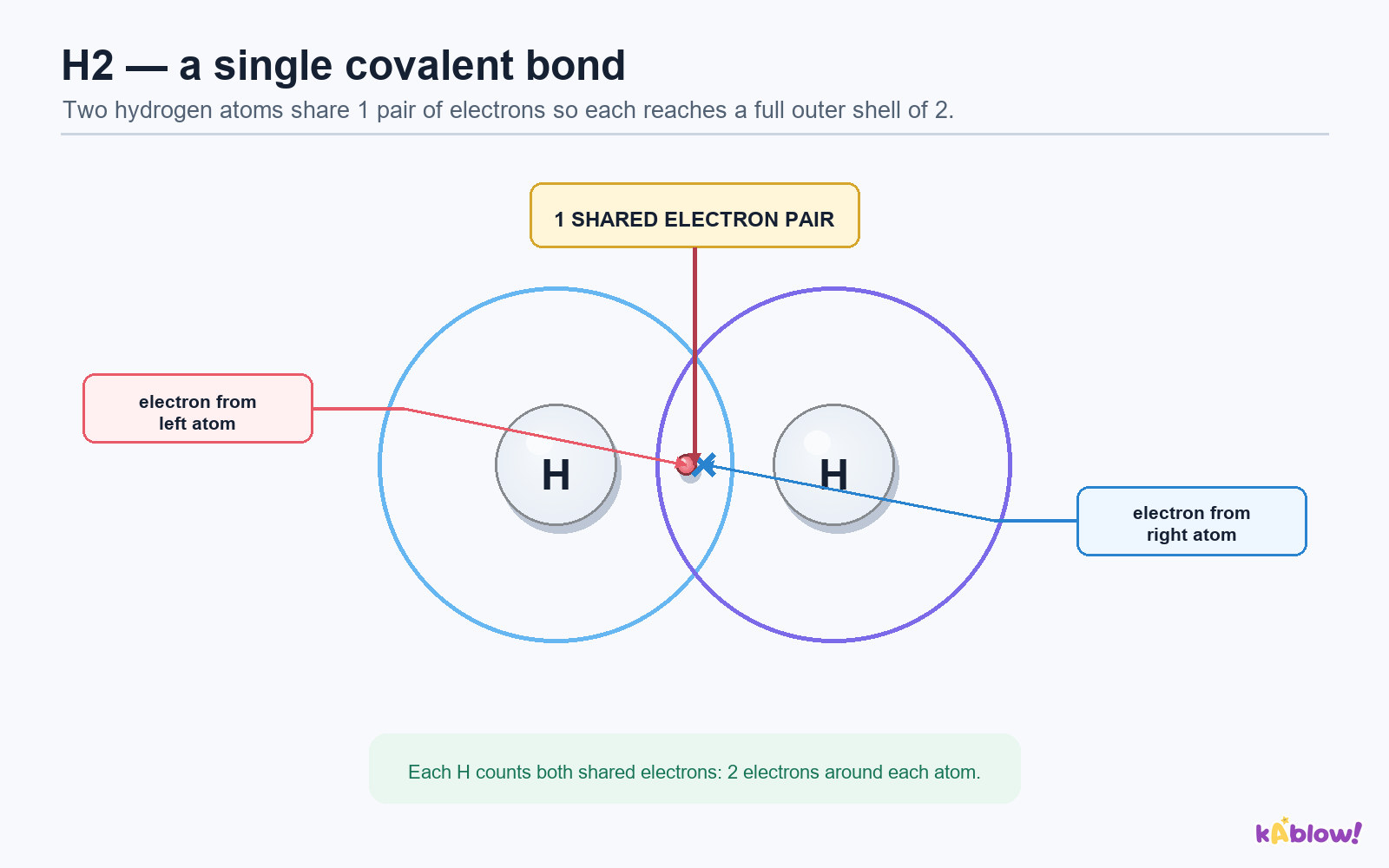
- A covalent bond is the electrostatic attraction between a shared pair of electrons and the positively charged nuclei of two atoms.
- Covalent bonding occurs between two non-metals; electrons are shared, not transferred.
- When a covalent bond forms, two atomic orbitals overlap to form a molecular orbital.
- In a typical covalent bond, each atom contributes one electron to the shared pair.
- A single covalent bond is represented by a short straight line, e.g. H–H, Cl–Cl, H–Br.
- Shared electrons are constantly moving and are best represented as charge clouds.
- By sharing electrons, both atoms achieve a noble gas configuration, making them more stable.
- The octet rule refers to the tendency of atoms to gain a valence shell with a total of 8 electrons; exceptions include electron-deficient (e.g. Be, B) and expanded octet species.
A single covalent bond
Lewis Formulas
- Lewis formulas (electron dot diagrams) show all valence electrons in a covalently bonded species, including bonding pairs and lone pairs.
- Electron pairs can be represented by dots, crosses, a combination of both, or a line.
- Steps to draw a Lewis formula: 1) Count total valence electrons; 2) Draw skeletal positions with the central atom (usually least electronegative) in the middle; 3) Add bonding pairs then lone pairs to complete octets (duets for H); 4) Check all valence electrons are used and octets/duets are satisfied.
- For example, methane (CH₄) has 8 valence electrons, four C–H bonding pairs, and no lone pairs on carbon.
- Ammonia (NH₃) has 8 valence electrons, three N–H bonding pairs, and one lone pair on nitrogen.
- Water (H₂O) has 8 valence electrons, two O–H bonding pairs, and two lone pairs on oxygen.
- Carbon dioxide (CO₂) has 16 valence electrons, two C=O double bonds, and two lone pairs on each oxygen.
- Some molecules have incomplete octets, e.g. BeCl₂ (Be has 4 electrons) and BF₃ (B has 6 electrons), but they are still stable.
Multiple Bonds
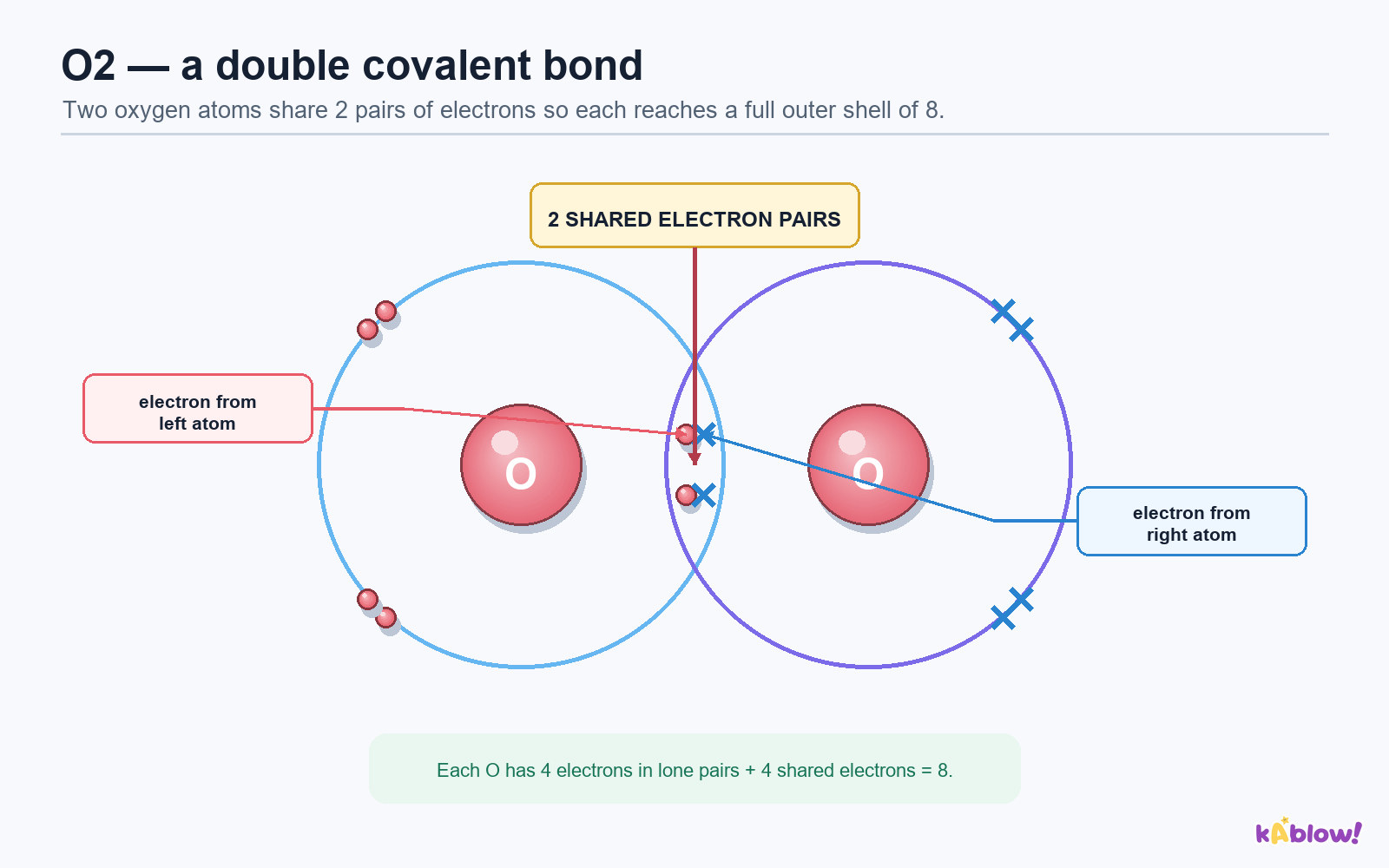
- Non-metal atoms can share more than one pair of electrons to form single, double, or triple covalent bonds.
- A single bond (C–C) has 2 shared electrons; a double bond (C=C) has 4; a triple bond (C≡C) has 6.
- Quadruple covalent bonds are not possible because the repulsion between 8 electrons between the two nuclei is too great.
- Bond energy is the amount of energy required to break one mole of a covalent bond in the gaseous state, with units kJ mol⁻¹.
- The higher the bond energy, the stronger the bond.
- Bond length is the distance between the nuclei of two covalently bonded atoms.
- As more electrons are shared, electron density between atoms increases, pulling atoms closer: bond length decreases and bond strength increases.
- Triple bonds are the shortest and strongest covalent bonds; single bonds are the longest and weakest.
A double covalent bond
Coordinate Bonds
- In a coordinate bond (dative covalent bond), both electrons in the shared pair come from the same atom.
- This typically occurs when one atom has a lone pair and the other is electron-deficient (has an unfilled outer shell).
- Example: in the ammonium ion (NH₄⁺), the nitrogen atom in ammonia donates its lone pair to an H⁺ ion.
- The H⁺ ion is electron-deficient and accepts the pair of electrons, forming a coordinate bond.
- Coordinate bonds are also found in transition metal complexes, e.g. [Al(H₂O)₆]³⁺, where water molecules donate lone pairs to the metal ion.
- SL students should recognise that coordinate bonding can involve species beyond simple molecules like NH₄⁺.
Shapes of Molecules
- VSEPR theory: electron pairs around a central atom repel each other and arrange as far apart as possible to minimise repulsion.
- Rules: all electron pairs spread out; lone pairs repel more strongly than bonding pairs; multiple bonds behave like a single bond.
- Each region of electron density is an electron domain; it may contain one, two, or three pairs of electrons.
- Two domains → linear geometry, bond angle 180° (e.g. BeCl₂, CO₂, HC≡CH).
- Three domains → trigonal planar geometry, bond angle 120° (e.g. BF₃, CH₂=CH₂, CH₂O); with one lone pair, shape is bent with angle ~118° (e.g. SO₂).
- Four domains → tetrahedral geometry, bond angle 109.5° (e.g. CH₄, NH₄⁺); with one lone pair, shape is trigonal pyramidal with angle ~107° (e.g. NH₃); with two lone pairs, shape is bent with angle ~104.5° (e.g. H₂O).
- Order of electron pair repulsion: lone pair–lone pair > lone pair–bonding pair > bonding pair–bonding pair.
- Always draw the Lewis structure first to identify lone pairs before determining shape and bond angles.
Bond Polarity
- Electronegativity is the ability of an atom to attract the shared pair of electrons in a covalent bond.
- Electronegativity values are on the Pauling scale and are listed in Section 9 of the IB Chemistry Data Booklet.
- In diatomic molecules like H₂, O₂, Cl₂, the atoms have equal electronegativity, so electrons are shared equally → nonpolar covalent bond.
- When atoms have different electronegativities, bonding electrons are drawn closer to the more electronegative atom, creating a polar covalent bond.
- The less electronegative atom gains a partial positive charge (δ⁺); the more electronegative atom gains a partial negative charge (δ⁻).
- A dipole forms when there is a separation of charge across a covalent bond; the dipole moment measures how polar the bond is.
- The greater the difference in electronegativity, the greater the dipole moment and the more polar the bond.
- Dipole direction is shown by an arrow with a crossed tail near δ⁺ and arrowhead pointing toward δ⁻.
Molecular Polarity
- To determine if a molecule with more than two atoms is polar, consider both bond polarity and molecular geometry.
- Molecules with only nonpolar bonds cannot be polar because there is no bond dipole.
- Molecules with polar bonds can be nonpolar overall if the bond dipoles are arranged symmetrically and cancel out (e.g. CO₂, CCl₄).
- Molecules with polar bonds are polar overall if the bond dipoles are arranged asymmetrically and do not cancel (e.g. H₂O, NH₃, CH₃Cl).
- CO₂ has two C=O dipoles pulling in opposite directions, so they cancel → nonpolar.
- CCl₄ has four polar C–Cl dipoles arranged symmetrically in a tetrahedral shape → nonpolar.
- H₂O has a bent shape causing dipoles to reinforce → polar; NH₃ has a trigonal pyramidal shape creating a net dipole → polar.
- CH₃Cl has four polar bonds but asymmetrical arrangement, so dipoles do not cancel → polar.
Giant Covalent Structures
- Giant covalent structures (covalent network lattices) are large networks of atoms joined by strong covalent bonds extending throughout the lattice.
- Examples include silicon, silicon dioxide, diamond, graphite, buckminsterfullerene (C₆₀), and graphene.
- In diamond, each carbon is covalently bonded to four others in a tetrahedral arrangement (109.5°); it is extremely hard and does not conduct electricity.
- In graphite, each carbon is bonded to three others in hexagonal rings (120°); layers are held by weak intermolecular forces, and delocalised electrons make it a good conductor.
- Graphene is a single layer of graphite; each carbon bonded to three others (120°), with delocalised electrons making it a very good conductor; it is strong, thin, and flexible.
- Buckminsterfullerene (C₆₀) is a molecular form of carbon with 60 atoms in a spherical structure of hexagons and pentagons; each carbon bonds to three others; it is a semiconductor.
- Silicon dioxide has each silicon bonded to four oxygen atoms and each oxygen bonded to two silicon atoms in a tetrahedral network; empirical formula SiO₂.
- Giant covalent structures have very high melting and boiling points, are generally hard (except graphite), and are usually insoluble in water.
Intermolecular Forces
- Intermolecular forces act between molecules and are much weaker than covalent or ionic bonds; they determine melting/boiling point, volatility, and solubility.
- London (dispersion) forces arise from temporary dipoles and induced dipoles; they are present between all atoms and molecules and are the only intermolecular forces in nonpolar substances.
- Strength of London forces increases with more electrons and larger surface area; they range from 1–50 kJ mol⁻¹.
- Dipole–dipole attractions occur between polar molecules with permanent dipoles, between the δ⁺ end of one and the δ⁻ end of another.
- Dipole–induced dipole attractions occur when a polar molecule distorts the electron cloud of a nonpolar molecule, creating a temporary dipole.
- Hydrogen bonding is the strongest intermolecular force; it requires a H atom covalently bonded to O, N, or F, and a lone pair on an O, N, or F atom in a neighbouring molecule.
- Each water molecule can form two hydrogen bonds (two lone pairs, two H atoms); each ammonia molecule can form one hydrogen bond (one lone pair, one N–H bond).
- Van der Waals forces is a collective term for London (dispersion) forces, dipole–dipole attractions, and dipole–induced dipole attractions.
Physical Properties of Covalent Substances
- When molecular covalent substances change state, intermolecular forces are overcome, not covalent bonds.
- Stronger intermolecular forces → higher melting and boiling points; substances with low boiling points are volatile.
- Strength of intermolecular forces depends on molecular size (molar mass), polarity, and type: London < dipole–dipole < hydrogen bonding.
- Solubility rule: 'like dissolves like' — nonpolar substances dissolve in nonpolar solvents; polar substances dissolve in polar solvents.
- Small alcohols (e.g. ethanol) are highly soluble in water due to hydrogen bonding; solubility decreases as the nonpolar hydrocarbon chain lengthens (e.g. hexanol is much less soluble).
- Most covalent substances do not conduct electricity because they lack free-moving charged particles.
- Some polar covalent substances conduct in solution because they ionise to produce ions (e.g. HCl forms H⁺ and Cl⁻ in water).
- Giant covalent structures are generally insoluble and non-conducting, except graphite and graphene which have delocalised electrons.
Chromatography
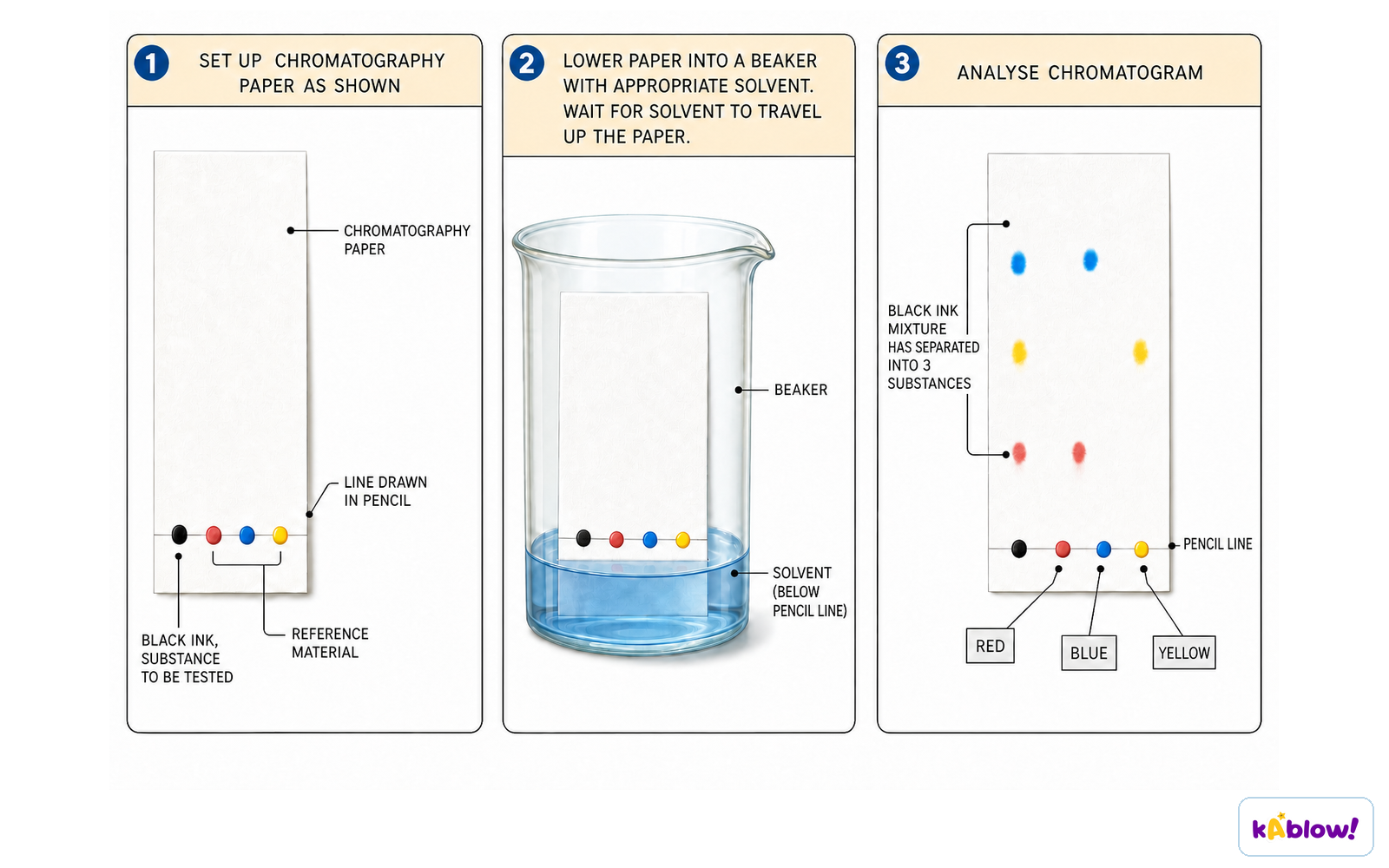
- Chromatography separates components of a mixture by passing a liquid mobile phase over a solid stationary phase.
- Separation depends on differences in solubility in the mobile phase and attraction to the stationary phase.
- In paper chromatography, the stationary phase is paper (cellulose with polar –OH groups) and the mobile phase is a solvent (e.g. water or ethanol).
- Polar substances interact strongly with the paper, travel slower, and do not travel as far; nonpolar substances interact less, are more soluble in the solvent, and travel further.
- Thin-layer chromatography (TLC) uses a thin layer of an inert solid (silica or alumina) on a flat surface as the stationary phase; the mobile phase is a solvent.
- The retardation factor (Rf) is calculated as: Rf = distance travelled by component / distance travelled by solvent front.
- Rf values are decimals, have no units, and are always less than 1.
- If a component does not travel with the solvent, it is insoluble in that solvent and a different solvent should be used.
Paper chromatography
Slides
Sign up free to view the lesson slides
Step through every slide for this topic — plus flashcards and revision notes — with a free account.
Practice questions
Free preview — 8 of 60 questions. Sign up to see them all.
1.Which statement best defines a covalent bond?
Easy- AThe electrostatic attraction between a shared pair of electrons and the positively charged nuclei of two atoms
- BThe transfer of electrons from a metal atom to a non-metal atom
- CThe electrostatic attraction between oppositely charged ions in a lattice
- DThe attraction between a metal cation and a sea of delocalised electrons
2.In a typical covalent bond, each atom contributes one electron to the shared pair.
EasyTrue or false?
3.Which of the following are exceptions to the octet rule? (select all that apply)
Medium- ABeryllium chloride, BeCl₂, where beryllium has only 4 electrons around it
- BBoron trifluoride, BF₃, where boron has only 6 electrons around it
- CSulfur dioxide, SO₂, where sulfur has 10 electrons in its valence shell
- DMethane, CH₄, where carbon has 8 electrons around it
- EWater, H₂O, where oxygen has 8 electrons around it
4.Which of the following molecules has a linear shape?
Medium- ABeCl₂
- BBF₃
- CCH₄
- DH₂O
5.According to VSEPR theory, which statement about electron pair repulsion is correct?
Medium- ALone pairs repel more strongly than bonding pairs
- BBonding pairs repel more strongly than lone pairs
- CLone pairs and bonding pairs repel equally
- DMultiple bonds repel more strongly than single bonds
6.In a molecule with polar bonds arranged symmetrically, the bond dipoles cancel and the molecule is nonpolar overall.
EasyTrue or false?
7.Match each molecule to its correct molecular geometry.
Medium- CH₄
- NH₃
- H₂O
- BF₃
- tetrahedral
- trigonal pyramidal
- bent
- trigonal planar
8.Place the following carbon–carbon bonds in order of increasing bond length.
Medium- C≡C (triple bond)
- C=C (double bond)
- C–C (single bond)
Unlock all 60 questions & more
Create a free account to see every question, the slides, flashcards and revision notes for this topic.