Fusion & Stars
Learn it by playing
Answer these questions to earn energy, then fish and explore. No account needed.
Lesson notes
Fusion Reactions in Stars
- Nuclear fusion is the joining of two small nuclei to produce a larger nucleus, releasing energy.
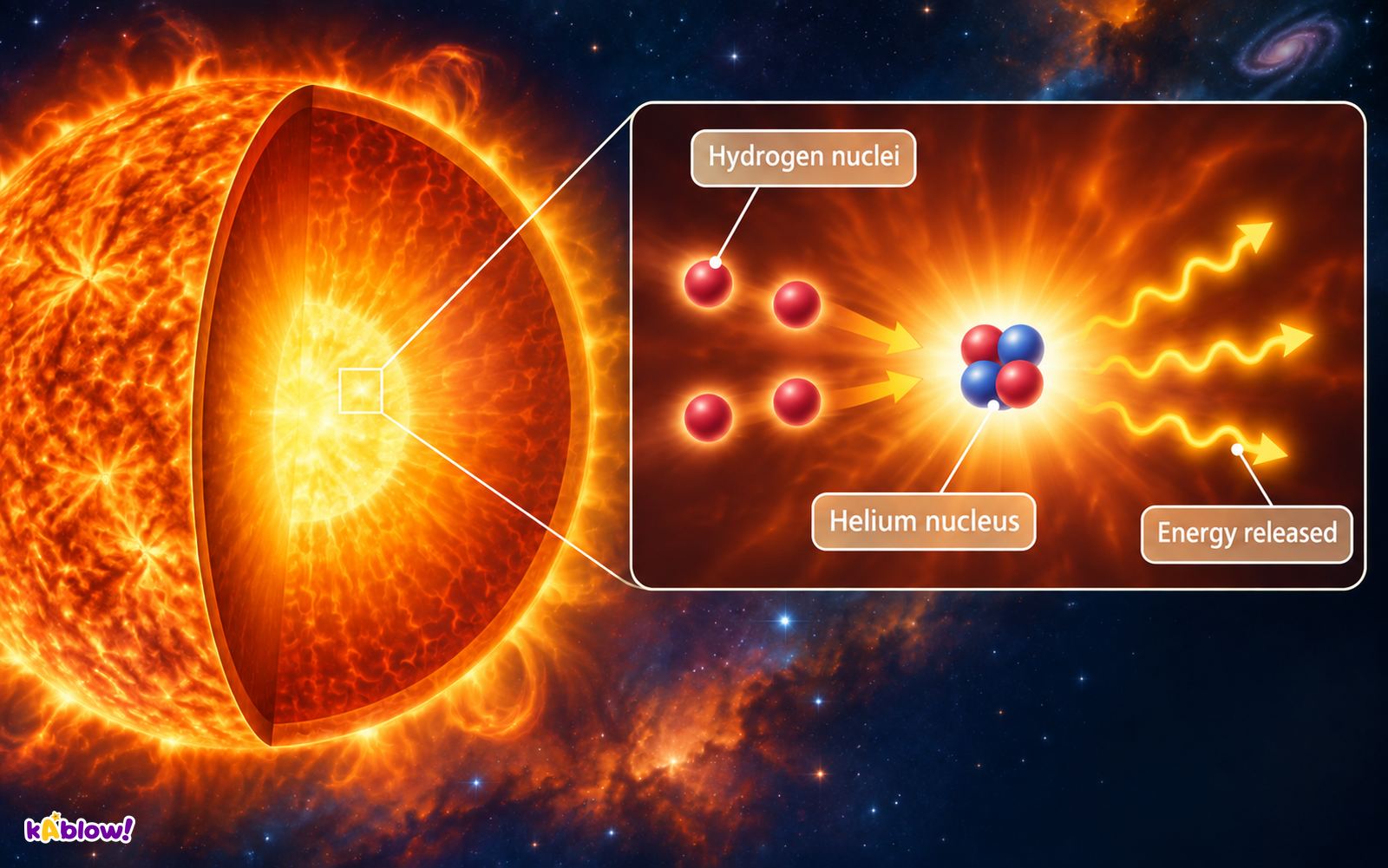
- In stars, four hydrogen nuclei (protons) fuse to produce one helium nucleus, releasing a huge amount of energy.
- The proton-proton chain is a series of reactions that produces helium from hydrogen; it powers stars like the Sun.
- For fusion to occur, nuclei must have high kinetic energy to overcome electrostatic repulsion between protons.
- The strong nuclear force binds nucleons together but has a very short range, so nuclei must get very close to fuse.
- Fusion requires extremely high temperature and pressure/density, such as in the core of a star.
- On Earth, research focuses on the deuterium-tritium (D-T) reaction: ²₁H + ³₁H → ⁴₂He + ¹₀n.
Hydrogen fusion in a star
Energy Released in Fusion Reactions
- The larger nucleus produced by fusion has a higher binding energy per nucleon than the original nuclei.
- A mass defect occurs because the total mass of the products is less than the total mass of the reactants.
- The energy released equals the difference in binding energy, according to ΔE = Δmc².
- For example, fusing two deuterium nuclei into helium releases about 28 − 4 = 24 MeV.
- In the proton-proton chain, the overall reaction is: 4¹₁H → ⁴₂He + 2e⁺ + 2νₑ + energy.
- Neutrinos carry away a small fraction of the energy released in the first step of the proton-proton chain.
Star Formation
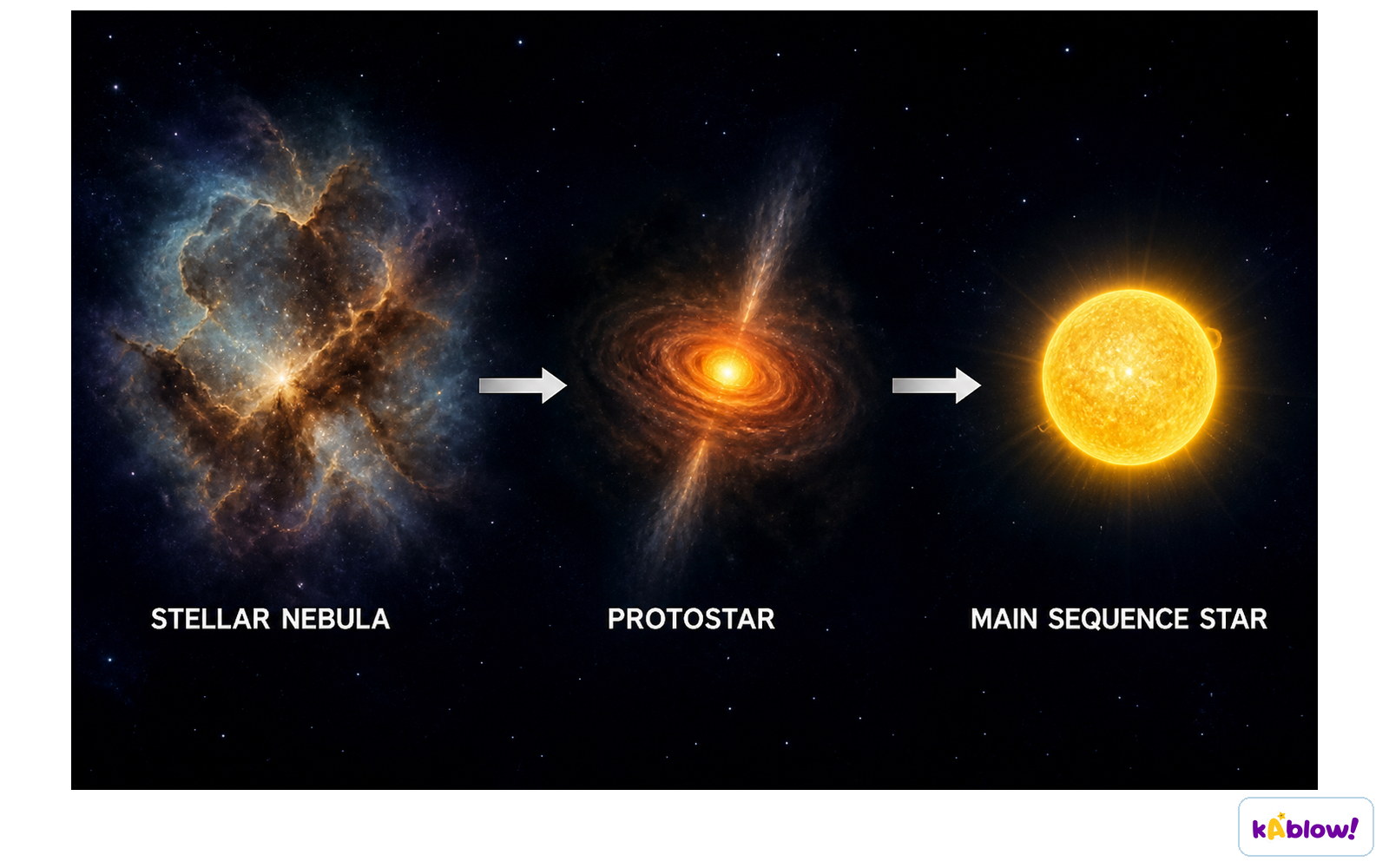
- Stars form from a nebula, a giant cloud of hydrogen gas and dust.
- Gravitational attraction causes denser clumps to form, leading to gravitational collapse.
- The collapsing gas heats up and glows, forming a protostar.
- Protostars can be detected by their infrared radiation.
- When the core reaches millions of kelvin, hydrogen fusion begins, and the star becomes a main sequence star.
- A star remains stable when outward radiation and gas pressure balance the inward gravitational force.
Star formation stages
Life Cycle of a Star
- All stars begin with the same stages: nebula → protostar → main sequence star.
- Low-mass stars (like the Sun) evolve: red giant → planetary nebula → white dwarf.
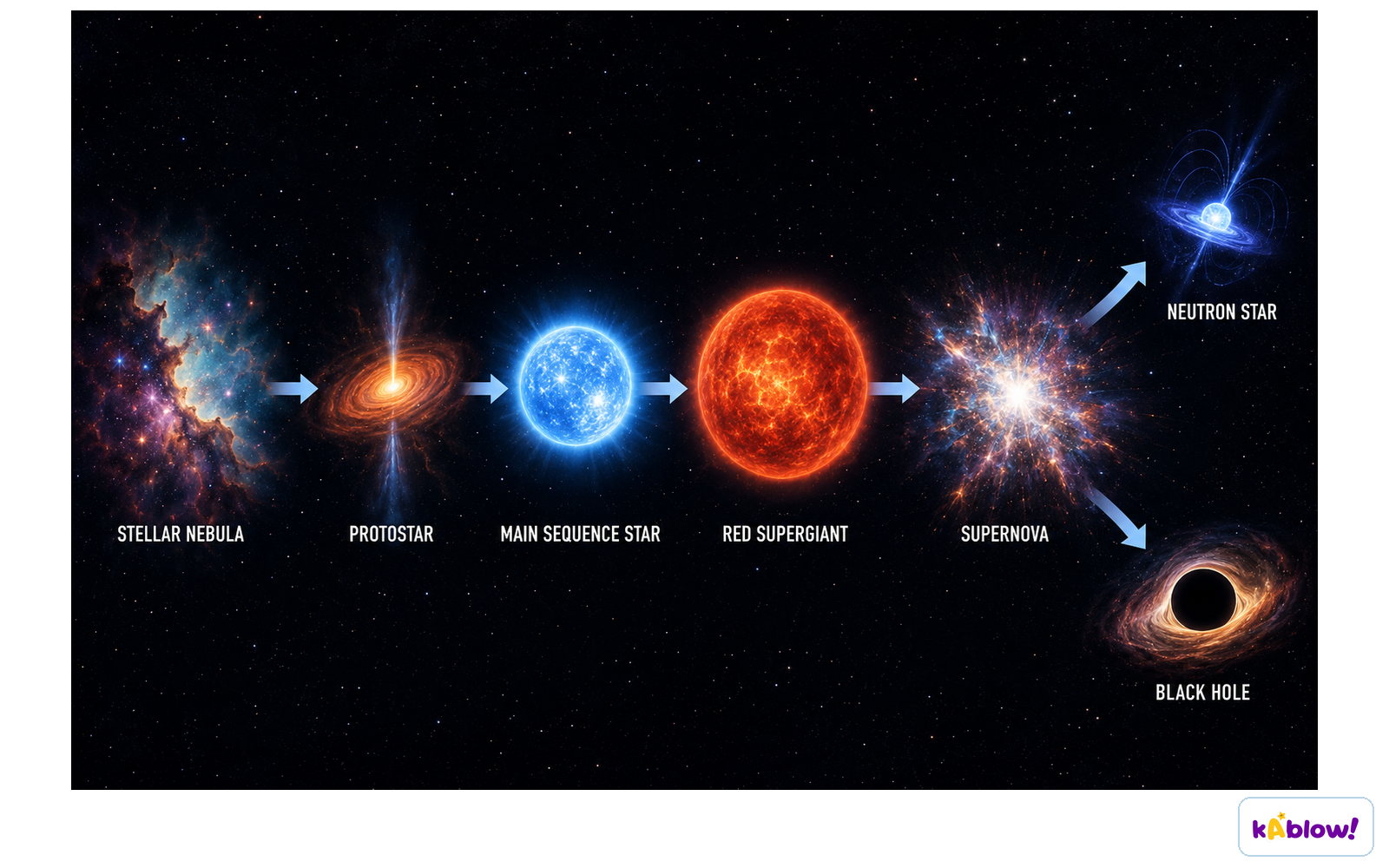
- High-mass stars evolve: red supergiant → supernova → neutron star or black hole.
- A red giant forms when hydrogen in the core runs out and the outer layers expand and cool.
- A planetary nebula is formed when the outer layers of a low-mass star are ejected.
- A white dwarf is the hot, dense remnant core left behind.
- A supernova occurs when the iron core of a massive star collapses and the outer layers explode.
- If the remnant core after a supernova exceeds about 3 solar masses, it collapses into a black hole.
Life cycle of a large mass star
The Hertzsprung–Russell (HR) Diagram
- The HR diagram plots luminosity (y-axis) against surface temperature (x-axis).
- Temperature increases from right to left on the HR diagram.
- Most stars lie in a diagonal band called the main sequence.
- For main sequence stars, luminosity increases with surface temperature.
- Red giants and red supergiants are above the main sequence, with high luminosity at cooler temperatures.
- White dwarfs are below and to the left of the main sequence: hot but low luminosity.
- The HR diagram only shows stars in stable phases; black holes cannot be seen as they emit no light.
Emission & Absorption Spectra in Stars
- A continuous spectrum contains all wavelengths and is produced by hot, dense sources like stellar cores.
- An emission line spectrum consists of discrete bright lines on a black background, produced by hot, low-pressure gases.
- An absorption line spectrum consists of dark lines on a continuous spectrum, produced when white light passes through a cool, low-pressure gas.
- Stars emit an absorption line spectrum because their outer atmospheres are cooler than the core.
- Each element produces a unique pattern of spectral lines, acting as a fingerprint for chemical composition.
- The chemical composition of a star can be determined by comparing its absorption spectrum with known emission spectra.
- The Sun is predominantly made of hydrogen and helium, confirmed by its absorption spectrum.
Stellar Parallax
- Stellar parallax is the apparent shift in position of a nearby star against distant background stars as Earth orbits the Sun.
- The parallax angle p is measured in arcseconds (").
- The distance d to a star in parsecs is given by p = 1/d, where p is in arcseconds.
- This equation is accurate for distances up to about 100 pc.
- 1 parsec (pc) is the distance at which 1 AU subtends an angle of 1 arcsecond.
- 1 pc ≈ 3.1 × 10¹⁶ m ≈ 3.26 light-years.
- 1 light-year (ly) is the distance light travels in one year ≈ 9.5 × 10¹⁵ m.
- 1 astronomical unit (AU) is the mean Earth-Sun distance ≈ 1.5 × 10¹¹ m.
Determination of Stellar Radii
- The radius of a star can be estimated using Wien's displacement law and the Stefan-Boltzmann law.
- Wien's displacement law: λmax T = 2.9 × 10⁻³ m K, gives the surface temperature from the peak wavelength.
- The Stefan-Boltzmann law: L = 4πr²σT⁴, relates luminosity, radius, and temperature.
- By combining these laws, the stellar radius r can be calculated if luminosity and temperature are known.
- The inverse square law of flux can be used to find luminosity from radiant flux and distance.
- For example, Betelgeuse has a radius about 1000 times larger than the Sun's.
Slides
Sign up free to view the lesson slides
Step through every slide for this topic — plus flashcards and revision notes — with a free account.
Practice questions
Free preview — 8 of 63 questions. Sign up to see them all.
1.Which statement about nuclear fusion is correct?
Easy- AIt is the joining of two small nuclei to produce a larger nucleus
- BIt is the splitting of a large nucleus into smaller nuclei
- CIt absorbs energy from the surroundings
- DIt only occurs in particle accelerators
2.Which row shows the conditions required for fusion to be sustained in the core of a star?
Easy- ADensity: moderate, Temperature: very high
- BDensity: moderate, Temperature: moderate
- CDensity: very high, Temperature: very high
- DDensity: very high, Temperature: moderate
3.Which of the following is part of a possible evolutionary path of a star?
Easy- AW → Y
- BX → Y
- CY → W
- DY → Z
4.Which of the following describes the sequence for the evolution of a star of about 10 solar masses?
Easy- Anebula → supernova → protostar → main sequence star → red supergiant → neutron star
- Bnebula → planetary nebula → main sequence star → red giant → supernova → white dwarf
- Cnebula → protostar → main sequence star → red giant → planetary nebula → white dwarf
- Dnebula → protostar → main sequence star → red supergiant → supernova → neutron star
5.Astronomers measure the parallax angle of two nearby stars. The parallax angle of star X is 3.9 × 10⁻⁶ rad and the parallax angle of star Y is 1.6 × 10⁻⁷ rad. What can be deduced about the relative distances of the two stars from these measurements?
Medium- AStar X is closer to Earth than Star Y.
- BStar Y is closer to Earth than Star X.
- CStar X and Star Y are both at a similar distance from Earth.
- DNothing can be deduced from these measurements alone.
6.The following fusion reaction occurs in stars: ²₁H + ³₁H → ⁴₂He + ¹₀n. The binding energies are: deuterium ²₁H = 2.2 MeV, tritium ³₁H = 8.5 MeV, helium-4 ⁴₂He = 28.3 MeV. How much energy is released in this fusion process?
Medium- A2.2 MeV
- B10.7 MeV
- C17.6 MeV
- D28.3 MeV
7.Five regions are labelled on the Hertzsprung-Russell diagram shown. Which sequence could show part of the evolution of a star like the Sun?
Medium- A1 → 5 → 3
- B2 → 3 → 4
- C3 → 5 → 1
- D4 → 3 → 2
8.Which of the following statements about stars in positions P, Q, R and S is correct?
Medium- AP and R have the same mass.
- BP has a lower surface temperature than S.
- CR is more massive than P.
- DR has a lower surface temperature than Q.
Unlock all 63 questions & more
Create a free account to see every question, the slides, flashcards and revision notes for this topic.