Galilean & Special Relativity
Learn it by playing
Answer these questions to earn energy, then fish and explore. No account needed.
Lesson notes
Reference Frames
- A reference frame is a set of coordinates used to record the position and time of events.
- In your own reference frame you are always at rest, even though you may be moving relative to other objects.
- Different observers in different frames interpret the direction and speed of a moving object differently, and both can be correct.
- An inertial reference frame is a non-accelerating frame; all inertial frames move at constant velocity relative to each other.
- There is no absolute reference frame in the Universe — everything is always moving relative to everything else.
- Exam questions use phrases like 'relative to...' or 'from the reference frame of...' to tell you which frame is measuring the event.
Galilean Relativity
- Galilean relativity states that Newton's laws of motion are the same in all inertial reference frames.
- An object moving with constant velocity in one frame will have a constant (but different) velocity in another frame.
- Galilean transformation equations convert coordinates between frames: x' = x − vt and x = x' + vt.
- The y and z coordinates and the time t are the same in both frames because relative motion is only along the x direction.
- The prime notation (') denotes the moving reference frame; v is the velocity of the moving frame.
- Time is absolute in Galilean relativity: t = t' in all inertial frames.
Galilean Velocity Addition
- For objects moving in the same direction as the moving frame, the velocities add: u = u' + v.
- For objects moving in the opposite direction, subtract: u = v − u' (or u = u' + (−v)).
- To find the velocity measured in the moving frame: u' = u − v.
- Velocities are vectors, so always account for direction — set a positive direction based on the velocity v of the moving frame.
- This velocity addition works only for speeds much less than the speed of light.
- A quick sketch labelling stationary frame S, moving frame S', and the velocities helps avoid sign errors.
Postulates of Special Relativity
- First postulate: The laws of physics are the same in all inertial frames of reference.
- Second postulate: The speed of light c in a vacuum is the same in all inertial frames of reference.
- Both a moving and a stationary observer will always measure the same speed of light, c.
- Galilean relativity treats space and time as fixed and absolute, but this fails near the speed of light.
- At speeds close to c, space and time become relative — lengths and time intervals depend on the frame of reference.
- Galilean velocity addition predicts speeds greater than c (e.g. 0.7c + 0.5c = 1.2c), which is impossible.
Lorentz Transformations
- The Lorentz factor is γ = 1 / √(1 − v²/c²); since v < c, γ is always greater than 1.
- Lorentz transformation equations correct Galilean transformations for speeds close to c.
- From frame S to S': x' = γ(x − vt) and t' = γ(t − vx/c²).
- From frame S' to S: x = γ(x' + vt') and t = γ(t' + vx'/c²).
- Unlike Galilean transformations, time is not absolute: t ≠ t' when speeds are close to c.
- When v is given as a fraction of c, the c cancels in the γ calculation — no need to substitute 3 × 10⁸ m s⁻¹.
Relativistic Velocity Addition
- For relativistic speeds, use the Lorentz velocity addition equations instead of simple addition.
- u = (u' + v) / (1 + u'v/c²) gives the velocity measured from the stationary frame.
- u' = (u − v) / (1 − uv/c²) gives the velocity measured from the moving frame.
- The signs in the numerator and denominator must match — be careful with direction.
- Relativistic velocity addition ensures no object can be measured to travel faster than c.
- Answers for relativistic velocities are often best given in terms of c.
Space-Time Interval
- Some quantities are invariant — the same in all inertial frames: proper time, proper length, and the space-time interval.
- The space-time interval is defined as (Δs)² = (cΔt)² − (Δx)².
- Although Δt and Δx differ between frames, Δs is the same in all inertial reference frames.
- Space and time are connected as four coordinates (x, y, z, t) for an event.
- cΔt is a distance in metres, so Δs is also measured in metres.
- The space-time interval is used in space-time diagrams.
Proper Time and Proper Length
- Proper time Δt₀ is the time interval between two events measured in the frame where the events occur at the same place.
- Proper length L₀ is the length measured in the frame where the object is at rest relative to the observer.
- Proper time and proper length are invariant quantities.
- An observer at rest relative to an object measures its proper length.
- An observer moving relative to an event measures a longer time interval than the proper time.
- Proper quantities can be measured in either the moving or stationary frame — it depends on which frame is at rest relative to the object or event.
Time Dilation and Length Contraction
- Time dilation: a stationary observer sees clocks in a moving frame run slower.
- The dilated time is given by Δt = γΔt₀, where Δt₀ is the proper time.
- Length contraction: a moving object is measured to be shorter in the direction of motion.
- The contracted length is L = L₀/γ, where L₀ is the proper length.
- Both effects become significant only at speeds close to the speed of light.
- The muon experiment demonstrates both effects: muons reach the ground because their lifetime is dilated from Earth's frame and the distance is contracted from the muon's frame.
Light clock and time dilation
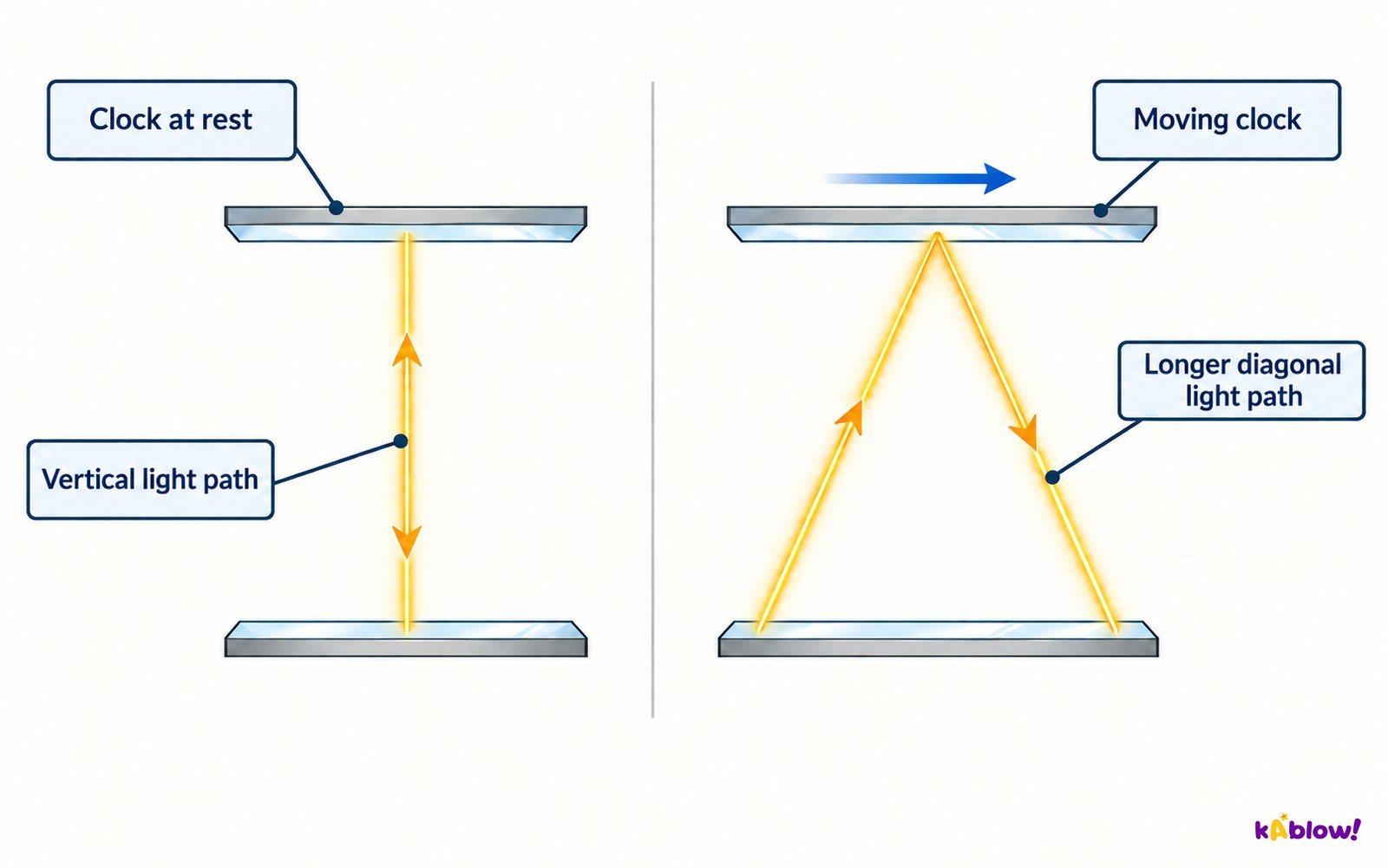
Simultaneity and Space-Time Diagrams
- Events that are simultaneous in one inertial frame may not be simultaneous in another moving relative to it.
- This is a direct consequence of the second postulate — the constancy of the speed of light.
- Space-time diagrams represent events with space on one axis and time (often ct) on the other.
- The space-time interval between two events is the same for all inertial observers on a space-time diagram.
- The sign of cΔt' in space-time interval calculations determines the temporal ordering of events.
Slides
Sign up free to view the lesson slides
Step through every slide for this topic — plus flashcards and revision notes — with a free account.
Practice questions
Free preview — 8 of 65 questions. Sign up to see them all.
1.Which of the following best defines a reference frame?
Easy- AA set of coordinates to record the position and time of events
- BThe speed of light in a vacuum
- CA device used to measure time dilation
- DThe length of an object measured at rest
2.What is an inertial reference frame?
Easy- AA frame that is accelerating
- BA non-accelerating reference frame
- CA frame where the speed of light is zero
- DA frame that is always stationary
3.State the two postulates of Special Relativity.
Easy- AThe laws of physics are the same in all inertial frames, and the speed of light in a vacuum is constant in all inertial frames.
- BThe laws of physics change with velocity, and the speed of light depends on the observer's motion.
- CTime and space are absolute, and the speed of light is infinite.
- DThe laws of physics are the same in all frames, and the speed of light varies with the source's velocity.
4.Proper length is the length of an object measured in a reference frame where the object is at rest.
EasyTrue or false?
5.A car travels at 25 m s⁻¹ relative to the road. Another car, B, travels in the opposite direction at 30 m s⁻¹ relative to the road. What is the velocity of Car A relative to Car B?
Medium- A55 m s⁻¹
- B-5 m s⁻¹
- C5 m s⁻¹
- D-55 m s⁻¹
6.Which of the following quantities are invariant in all inertial reference frames? (Select all that apply)
Medium- AProper time
- BProper length
- CSpace-time interval
- DVelocity of light in vacuum
- ETime interval between two events
7.What is the Lorentz factor γ for a speed of 0.5c?
Easy- A1.15
- B1.20
- C1.10
- D1.25
8.Match each term with its correct definition.
Medium- Proper time
- Proper length
- Inertial reference frame
- Space-time interval
- The time interval between two events measured in the frame where they occur at the same place
- The length measured in the frame where the object is at rest
- A non-accelerating reference frame
- An invariant quantity in all inertial frames
Unlock all 65 questions & more
Create a free account to see every question, the slides, flashcards and revision notes for this topic.