Fission
Learn it by playing
Answer these questions to earn energy, then fish and explore. No account needed.
Lesson notes
Spontaneous & Induced Fission
- Nuclear fission is the splitting of a large, unstable nucleus into two smaller nuclei.
- Isotopes of uranium and plutonium undergo fission and are used as fuels in nuclear power stations to convert nuclear energy into electrical energy.
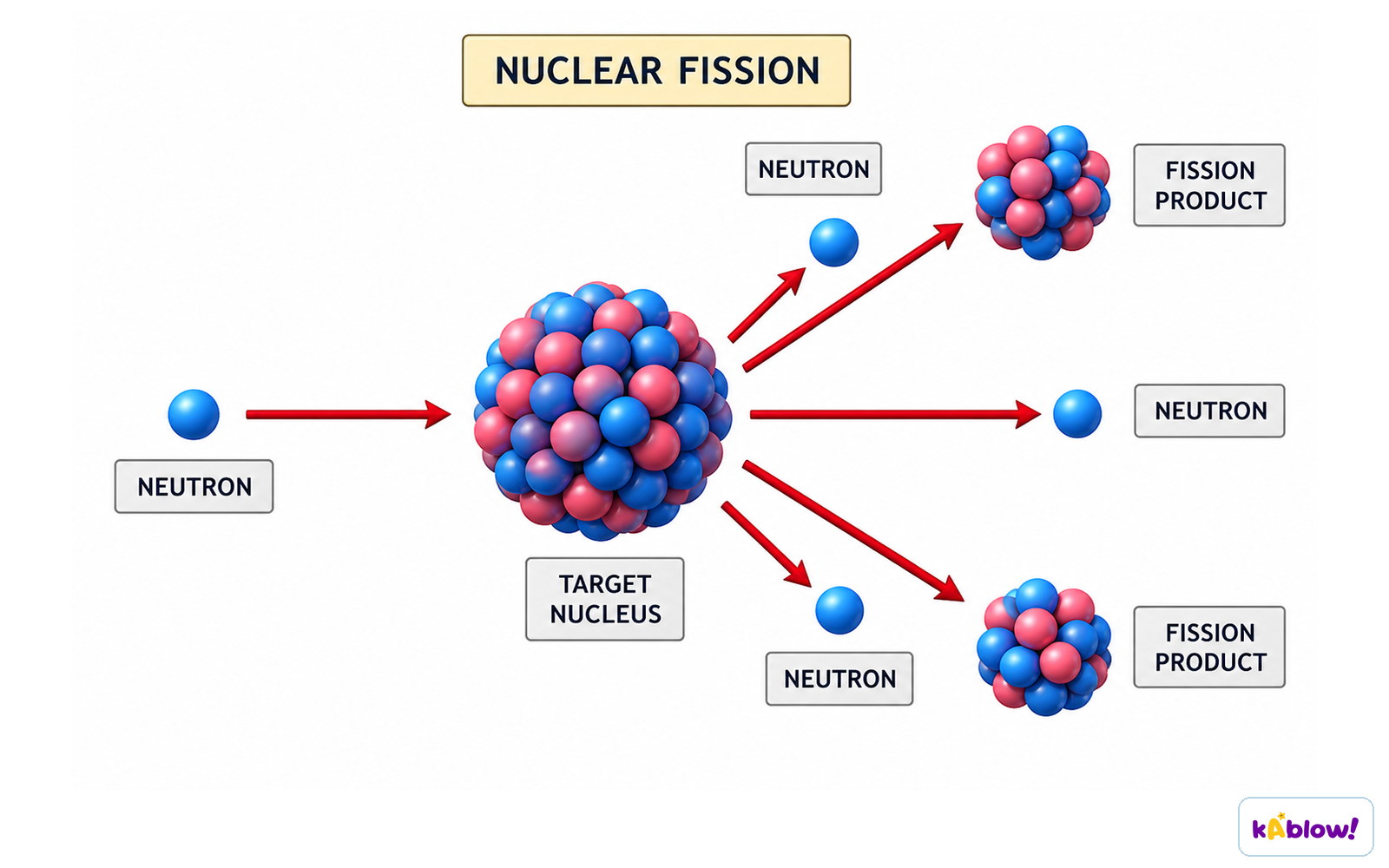
- During fission, when a neutron collides with an unstable nucleus, the nucleus splits into two smaller nuclei (called daughter nuclei) as well as two or three neutrons; gamma rays are also emitted.
- Large nuclei can decay by fission to produce smaller nuclei and neutrons with a lot of kinetic energy; the products of fission move away very quickly because energy is transferred from the nuclear potential energy store of a nucleus to the kinetic energy store of the fission fragments, and this energy is then carried away as heat.
- Spontaneous fission is rare: it occurs when a nucleus undergoes fission without additional energy being put into the nucleus.
- Induced fission usually requires the unstable nucleus to first absorb a neutron; this neutron is slow moving, often called a 'thermal' neutron.
- For example, uranium-235 has a very long half-life of 700 million years, meaning it would have low activity and energy would be released only if additional neutrons were added.
- During induced fission, a neutron is absorbed by the uranium-235 nucleus to make uranium-236, which is very unstable and splits by nuclear fission almost immediately.
Nuclear fission
Energy Released in Fission Reactions
- When a large (parent) nucleus, such as uranium-235, undergoes a fission reaction, the daughter nuclei produced have a higher binding energy per nucleon than the parent nucleus.
- As a result of the mass defect between the parent nucleus and the daughter nuclei, energy is released.
- Energy can be extracted from fission reactions due to the mass defect between parent and daughter nuclei.
- Nuclear fission is well-regarded as having the fuel source with the highest energy density of any fuel currently available (until fusion reactions become feasible).
- Calculations involving energy released in fission reactions often require equations such as: density (kg m⁻³) = energy density (J m⁻³) / specific energy (J kg⁻¹); number of nuclei = mass (g) × Avogadro's number NA (mol⁻¹) / molar mass (g mol⁻¹).
- Worked example: For the reaction ²³⁵U + ¹n → ¹¹²Tc + ¹²²In + 2¹n, with binding energies per nucleon: U-235 = 7.59 MeV, Tc-112 = 8.36 MeV, In-122 = 8.51 MeV. Binding energy before = 235 × 7.59 = 1784 MeV; binding energy after = (112 × 8.36) + (122 × 8.51) = 1975 MeV; energy released per fission = 1975 – 1784 = 191 MeV.
- Worked example (continued): To find the mass of uranium-235 required per day to run a 500 MW power plant at 35% efficiency: number of nuclei in 1 kg of U-235 = (1000 × 6.02 × 10²³) / 235 = 2.562 × 10²⁴ atoms kg⁻¹; specific energy = (2.562 × 10²⁴) × 191 MeV = 4.893 × 10²⁶ MeV kg⁻¹ = 7.83 × 10¹³ J kg⁻¹; input power = 500 / 0.35 = 1429 MW; mass per second = (1429 × 10⁶) / (7.83 × 10¹³) = 1.82 × 10⁻⁵ kg s⁻¹; mass per day = 1.82 × 10⁻⁵ × 86 400 = 1.58 kg.
- Worked example (continued): The ratio of mass of coal required per day to mass of U-235 required per day = (7.83 × 10¹³) / (35 × 10⁶) = 2.24 × 10⁶, meaning over 2 million times more coal is required than uranium-235 to achieve the same power output.
Chain Reactions from Fission
- Neutrons involved in induced fission are known as thermal neutrons; they have low energy and speed, meaning they can induce fission.
- This is important because neutrons with too much energy will rebound away from the uranium-235 nucleus and fission will not take place.
- Only one extra neutron is required to induce a uranium-235 nucleus to split by fission.
- During fission, two or three neutrons are produced which move away at high speed; each of these new neutrons can start another fission reaction, which again creates further excess neutrons.
- This process is called a chain reaction.
- The products of fission are two daughter nuclei and at least one neutron.
- The neutrons released during fission go on to cause more fission reactions, leading to a chain reaction where each fission goes on to cause at least one more fission.
- Only one thermal neutron is used to create another fission reaction in a controlled chain reaction; nuclear reactions are designed to be self-sustaining yet very controlled, achieved by using a precise amount of uranium fuel known as the critical mass.
- The critical mass is the minimum mass of fuel required to maintain a steady chain reaction; using exactly the critical mass means a single fission reaction follows the last.
- Using less than the critical mass (subcritical mass) would lead the reaction to eventually stop; using more than the critical mass (supercritical mass) would lead to a runaway reaction and eventually an explosion.
Operation of a Nuclear Reactor
- In a nuclear reactor, a chain reaction is required to keep the reactor running; when the reactor is producing energy at the required rate, two factors must be controlled: the number of free neutrons in the reactor and the energy of the free neutrons.
- The main components of a nuclear reactor are: control rods, moderators, heat exchangers, and shielding.
- The overall purpose of a nuclear reactor is to collect the heat energy produced from nuclear reactions.
- Control rods: purpose is to absorb neutrons; made of a material which absorbs neutrons without becoming dangerously unstable themselves; the number of neutrons absorbed is controlled by varying the depth of the control rods in the fuel rods.
- Lowering the control rods further decreases the rate of fission, as more neutrons are absorbed; raising the rods increases the rate of fission, as fewer neutrons are absorbed; this is adjusted automatically so that exactly one fission neutron produced by each fission event goes on to cause another fission.
- In the event the nuclear reactor needs to shut down, the control rods can be lowered all the way so no reaction can take place.
- Moderator: purpose is to slow down neutrons; it is a material that surrounds the fuel rods and control rods inside the reactor core; moderators are made from materials that are poor absorbers of neutrons, such as water.
- The fast-moving neutrons produced by fission reactions slow down by colliding with the molecules of the moderator, causing them to lose some momentum; the neutrons are slowed down so that they are in thermal equilibrium with the moderator, hence the term 'thermal neutron'; this ensures neutrons can react efficiently with the uranium fuel.
- Heat exchanger: purpose is to transfer thermal energy efficiently between the water systems of a nuclear power plant; there are multiple water systems: the coolant (usually water) used in the reactor vessel, the water and steam that drives the turbine, and the condenser that cools the steam.
- The coolant is a substance, such as water, that is pumped into the reactor at a cold temperature to extract the heat released by the fission reactions; in the heat exchanger, the coolant transfers the heat to water that is pumped in externally to produce steam; this steam then goes on to power electricity-generating turbines.
- Shielding: purpose is to house the reactor and absorb hazardous radiation; the entire nuclear reactor is surrounded by shielding materials; the daughter nuclei formed during fission, and the neutrons emitted, are radioactive.
- The reactor is surrounded by a steel and concrete wall that can be nearly 2 metres thick; this absorbs the emissions from the reactions and ensures that the environment around the reactor is safe.
Radioactive Waste Management
- There are three main types of nuclear waste: low-level waste, intermediate-level waste, and high-level waste.
- Low-level waste includes clothing, gloves and tools which may be lightly contaminated; this type of waste will be radioactive for a few years, so it must be encased in concrete and stored a few metres underground until it can be disposed of with regular waste.
- Intermediate-level waste includes everything between the daily used items and the fuel rods themselves; usually, this is the waste produced when a nuclear power station is decommissioned and taken apart; this waste will have a longer half-life than the low-level waste, so it must be encased in cement in steel drums and stored securely underground.
- High-level waste refers to the unusable fission products from the fission of uranium-235 or from spent fuel rods; this is by far the most dangerous type of waste, as it will remain radioactive for thousands of years; as well as being highly radioactive, the spent fuel rods are extremely hot and must be handled and stored much more carefully than the other types of waste.
- Within the fuel rods, nuclei of uranium-238 quickly decay into nuclei of plutonium-239; plutonium-239 is classified as high-level radioactive waste because its nuclei are extremely radioactive and have a very long half-life of 24 000 years; this presents a long-term risk of contamination.
- The treatment of high-level waste: the waste is initially placed in cooling ponds of water close to the reactor for a number of years; isotopes of plutonium and uranium are harvested to be used again; waste is mixed with molten glass and made solid (known as vitrification); then it is encased in containers made from steel, lead, or concrete; this type of waste must be stored very deep underground.
- Depending on the activity of radioactive waste, it is buried in different ways.
Advantages & Disadvantages of Nuclear Power
- Advantages: Climate change friendly – nuclear power stations produce no greenhouse gases during their operation.
- Advantages: High energy density – uranium provides far more energy per kg compared to coal and other fossil fuels.
- Advantages: Availability of fuel – the reserves of fissionable materials are much higher compared to fossil fuel reserves.
- Advantages: High reliability & safety – despite some serious incidents in the past, nuclear power is now regarded as one of the safest and most reliable processes for the production of electricity.
- Disadvantages: Hazardous waste products – the production of radioactive waste is very dangerous and expensive to deal with, and stays at hazardous levels of activity for a very long time (>1000s of years).
- Disadvantages: Potential for catastrophic accidents – a nuclear meltdown, such as at Chernobyl, could have catastrophic consequences on the environment and for the people living in the surrounding area.
- Disadvantages: Potential for misuse – there is a danger of misuse of nuclear material and infrastructure in nuclear weapons and terrorist attacks.
- Disadvantages: Dangers with mining fuel – there are many issues associated with mining uranium, from the people handling it to the detrimental effects it can have on the environment.
Environmental Considerations & Safety Measures
- Isotopes with long half-lives must not enter our water and food supplies.
- Burial locations must be geologically stable, secure from attack, and designed for safety; space for such locations is limited.
- Several measures must be put in place to reduce the workers' exposure to radiation: the fuel rods are handled remotely i.e. by machines.
- The nuclear reactor is surrounded by a very thick lead or concrete shielding to limit exposure to radiation.
- In an emergency, the control rods are fully lowered into the reactor core to stop fission reactions by absorbing all the free neutrons in the core; this is known as an emergency shutdown.
- Nuclear energy in society: nuclear power can scare people if they do not understand it; it is dangerous if not handled properly, yet it is invisible, which can be difficult for some people to comprehend.
- However, with increased education on nuclear energy, society can use this knowledge to inform their own decisions and opinions.
Slides
Sign up free to view the lesson slides
Step through every slide for this topic — plus flashcards and revision notes — with a free account.
Practice questions
Free preview — 8 of 57 questions. Sign up to see them all.
1.Which statement defines nuclear fission?
Easy- AThe splitting of a large, unstable nucleus into two smaller nuclei
- BThe joining of two small nuclei to produce a larger nucleus
- CThe emission of an α particle from a nucleus
- DThe capture of a neutron by a stable nucleus without splitting
2.Which of the following is the correct equation for the induced fission of uranium-235?
Easy- A92 235U + 0 1n → 46 116Pd + 4 0 1n
- B92 235U → 90 231Th + 2 4He
- C1 2H + 1 3H → 2 4He + 0 1n
- D92 235U + 0 1n → 56 142Ba + 36 91Kr + 3 0 1n
3.Which statement about the moderator in a nuclear reactor is incorrect?
Easy- AThe purpose of a moderator is to slow down neutrons
- BThe moderating material is usually fissionable
- CThe moderating material encourages further fission reactions with uranium fuel
- DThe moderator is usually water or graphite
4.When uranium-235 undergoes fission in a nuclear reactor, about 180 MeV of energy is released. In which form is this energy released?
Easy- Apotential energy
- Bthermal energy
- Celectrical energy
- Dnuclear energy
5.For a nuclear reactor in which the fission rate is constant, which of the following statements is correct?
Medium- AOne neutron is released per fission reaction
- BThere is a critical mass of fuel in the reactor
- CAll neutrons remain in the reactor
- DFor every fission reaction, there is, on average, one further fission reaction
6.Which of the following isotopes releases the least amount of potential energy during nuclear fission?
Medium- AUranium-235
- BThorium-231
- CRadon-222
- DOsmium-190
7.Which statement is correct regarding nuclear fission?
Medium- AThe daughter nucleus has a greater nucleon number than the original nucleus
- BEnergy is absorbed during nuclear fission
- CThe combined mass of the daughter nuclei is less than the mass of the original nucleus
- DNuclear fission is the joining of two small nuclei to produce a larger nucleus
8.Boron and cadmium are good absorbers of neutrons. Graphite and water are poor absorbers of neutrons. Which row shows the ideal substances that could be used for controlling and moderating in a nuclear reactor?
Medium- AIdeal controlling substance: boron; Ideal moderating substance: water
- BIdeal controlling substance: boron; Ideal moderating substance: cadmium
- CIdeal controlling substance: carbon; Ideal moderating substance: cadmium
- DIdeal controlling substance: carbon; Ideal moderating substance: water
Unlock all 57 questions & more
Create a free account to see every question, the slides, flashcards and revision notes for this topic.