Kinematics
Learn it by playing
Answer these questions to earn energy, then fish and explore. No account needed.
Lesson notes
Distance & Displacement
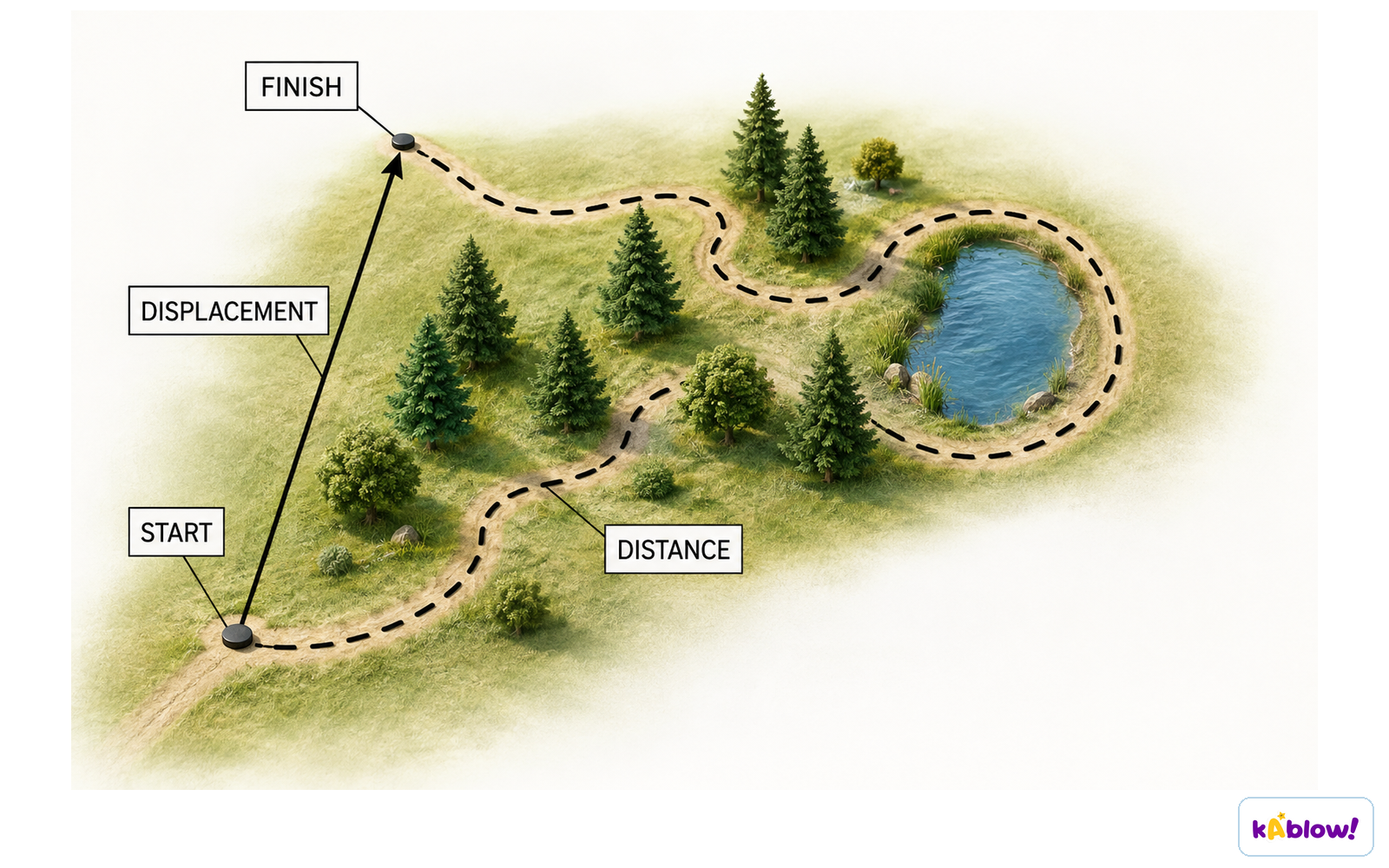
- Distance is a measure of how far an object travels, and it is a scalar quantity (direction is not important).
- Displacement is a measure of how far something is from its starting position, along with its direction; it is a vector quantity.
- Displacement describes the change in position and includes both magnitude and direction.
- For a journey that returns to the starting point, the total distance is non-zero but the displacement is zero.
- When travelling to school, the distance includes all the twists and turns of the roads, while the displacement is the straight-line distance from home to school.
Distance vs displacement
Speed & Velocity
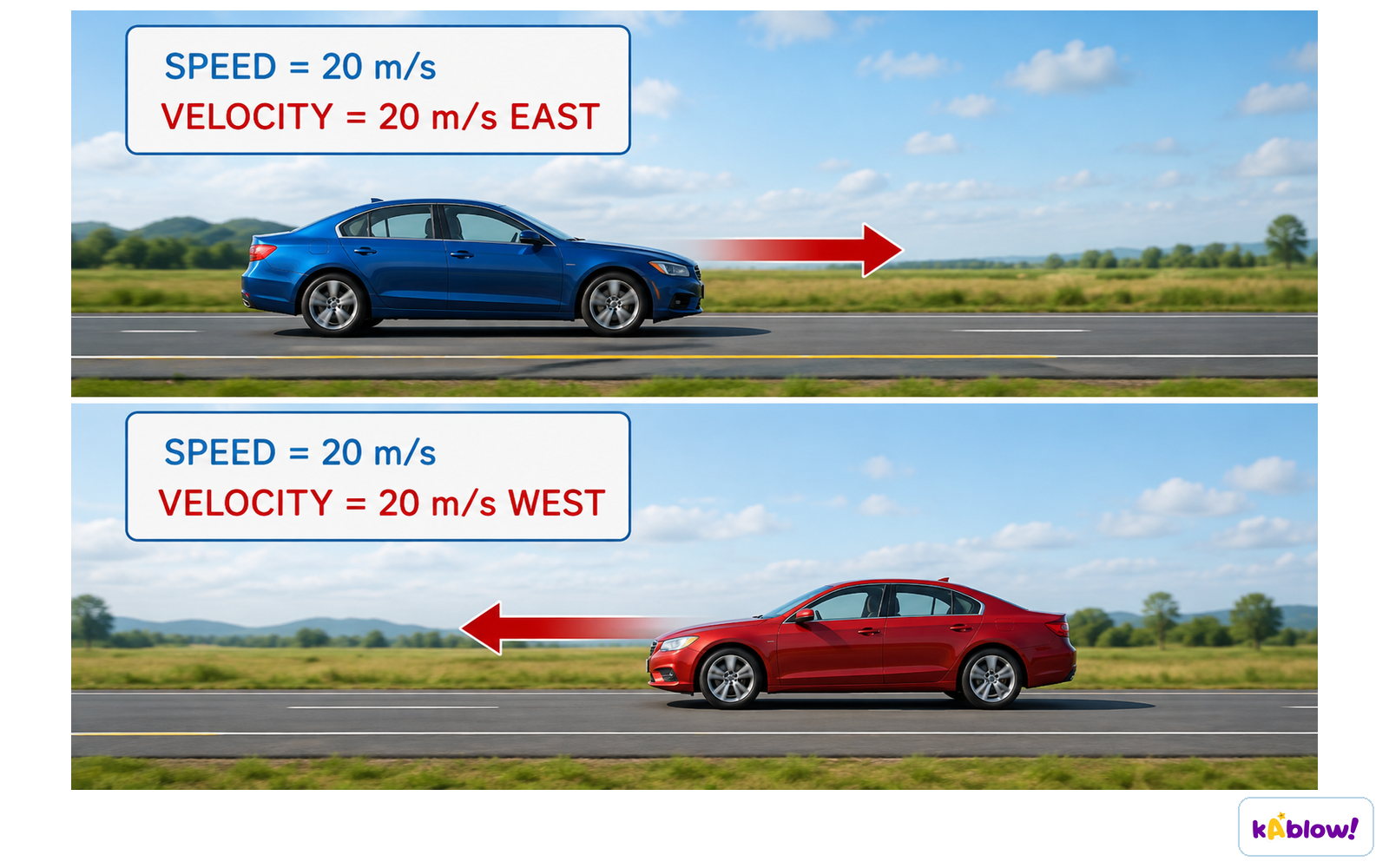
- Speed is the distance travelled per second; it is a scalar quantity.
- Average speed = total distance ÷ time taken.
- Velocity is the rate of change of displacement; it is a vector quantity.
- Velocity is speed in a given direction, so it can be positive or negative.
- Instantaneous speed (or velocity) is the speed (or velocity) at a particular moment in time.
- On a displacement–time graph, the gradient gives velocity; for a curved line, draw a tangent at the required time and calculate its gradient.
- Average velocity = total displacement ÷ total time taken.
- If acceleration is constant, average velocity can also be calculated as (u + v)/2.
Comparing speed and velocity
Acceleration
- Acceleration is defined as the rate of change of velocity.
- Acceleration is a vector quantity measured in metres per second squared (m s⁻²).
- Average acceleration = change in velocity ÷ time taken, or a = Δv/Δt.
- Change in velocity = final velocity − initial velocity, or Δv = v − u.
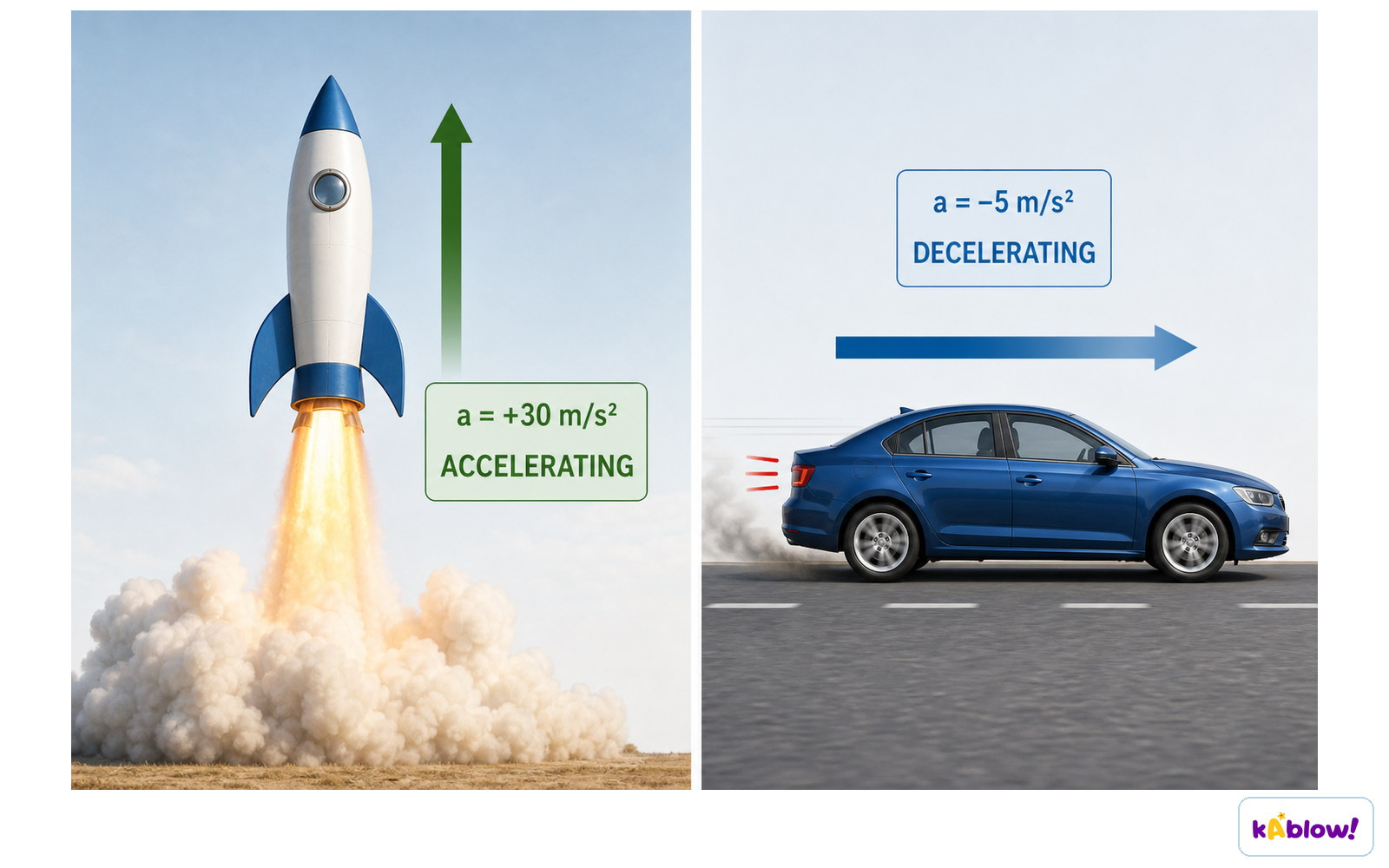
- If an object is speeding up, acceleration is positive; if slowing down, acceleration is negative (deceleration).
- Acceleration can also be negative if the object is accelerating in the negative direction.
- Instantaneous acceleration is the acceleration at a particular point in time; it is shown by a curved line on a velocity–time graph.
Illustration of positive and negative acceleration with a rocket and a car.
Kinematic Equations
- The kinematic equations (SUVAT equations) describe motion with constant (uniform) acceleration.
- The five variables are: s = displacement, u = initial velocity, v = final velocity, a = acceleration, t = time interval.
- The four equations are: v = u + at; s = ut + ½at²; v² = u² + 2as; s = (u + v)t / 2.
- These equations are given in the data booklet, so you do not need to memorise them.
- 'Starts from rest' means u = 0 and t = 0.
- 'Falling due to gravity' means a = g = 9.8 m s⁻²; choose a positive direction and keep it consistent.
- To solve problems: list known and unknown quantities, choose the equation containing those quantities, convert units to SI, then substitute and solve.
Motion Graphs
- On a displacement–time graph: slope equals velocity; a straight diagonal line represents constant velocity; a curved line represents acceleration.
- On a displacement–time graph, a positive slope means motion in the positive direction, a negative slope means motion in the negative direction, and a zero slope means the object is at rest.
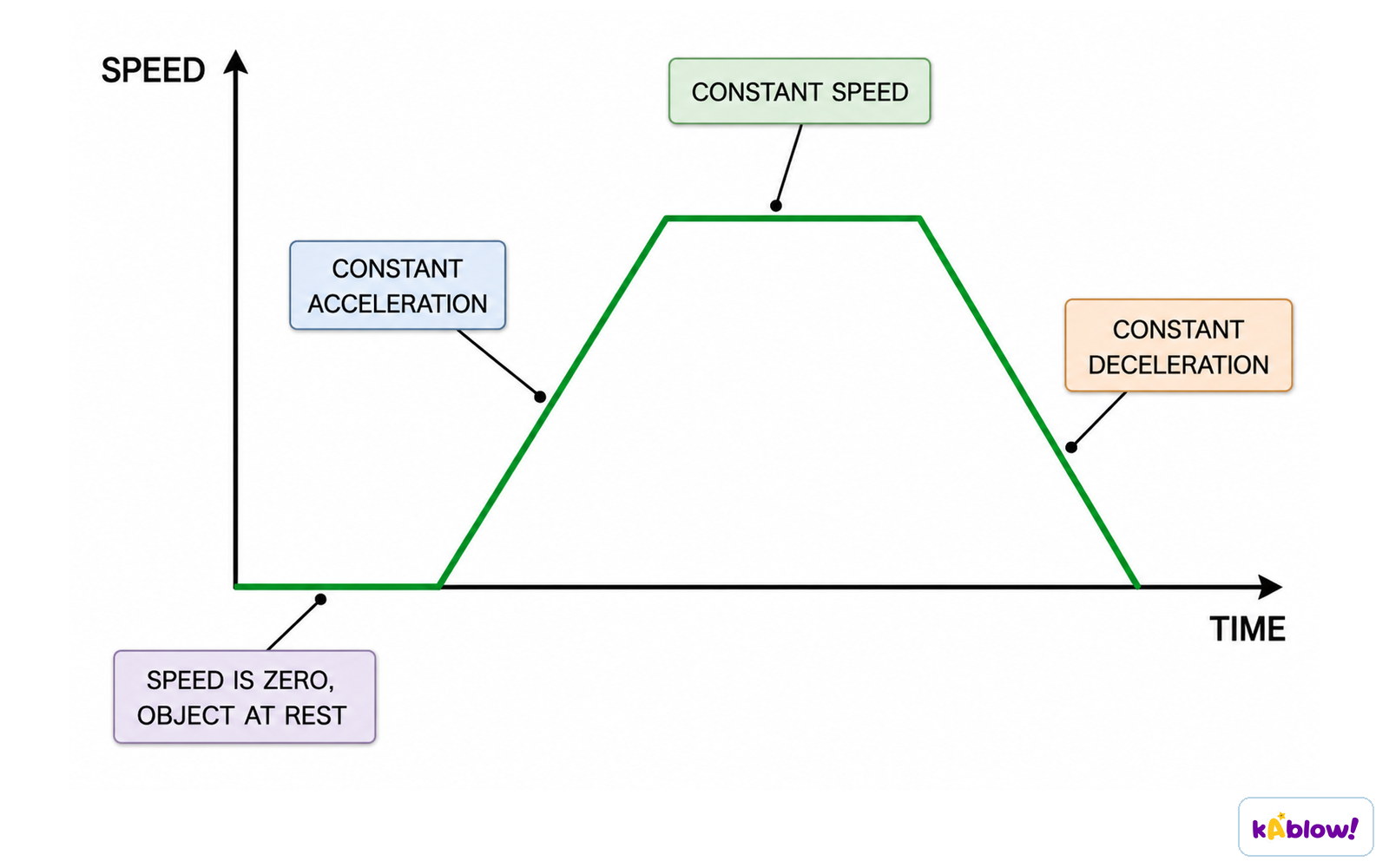
- On a velocity–time graph: slope equals acceleration; a straight diagonal line represents uniform acceleration; a curved line represents non-uniform acceleration.
- On a velocity–time graph, the area under the curve equals the change in displacement.
- On an acceleration–time graph: the area under the curve equals the change in velocity; a horizontal line represents constant acceleration.
- For a bouncing ball, acceleration due to gravity is always directed downwards; at the highest point the velocity is momentarily zero and changes direction.
Motion on a speed–time graph
Projectile Motion
- A projectile is a particle moving freely under gravity in a two-dimensional plane, with negligible fluid resistance and constant g.
- The horizontal and vertical components of motion are independent of each other and must be analysed separately using the SUVAT equations.
- Horizontal motion: velocity is constant, acceleration is zero.
- Vertical motion: acceleration is g (9.8 m s⁻²), acting downwards.
- If a projectile is launched with speed u at angle θ to the horizontal, its initial horizontal component is u cosθ and its initial vertical component is u sinθ.
- Time of flight is the total time in the air; for level ground, the time to maximum height is half the total time.
- Maximum height is reached when the vertical velocity component is zero.
- Range is the horizontal distance travelled by the projectile.
Fluid Resistance
- Fluid resistance refers to the resistive forces (viscous drag) acting on an object moving through a gas or liquid.
- Viscous drag is a type of friction that always acts in the opposite direction to motion and increases with the object's speed.
- Lift is an upward force perpendicular to the fluid flow, often arising from Newton's Third Law.
- In projectile motion, air resistance decreases the horizontal velocity, range, maximum height and time of flight.
- With air resistance, the trajectory is no longer a parabola; it is steeper on the way down than on the way up.
- For sports like long jump or javelin, an optimum angle is used to maximise range against air resistance.
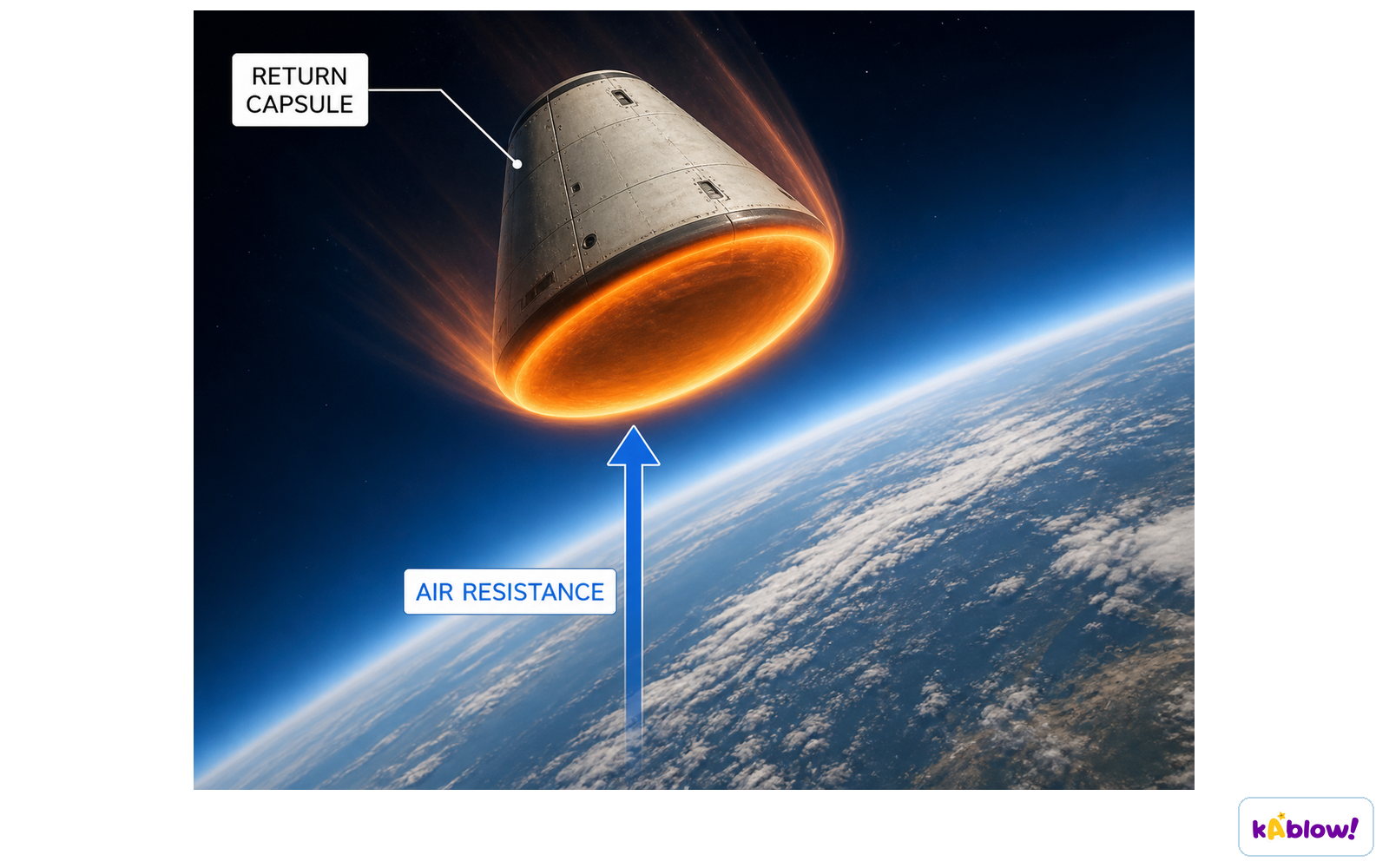
Air resistance is a type of drag: it opposes motion through a fluid and heats the object.
Terminal Speed
- For a body falling in a vacuum, the only force is weight, so acceleration is g.
- As a body falls through a fluid, viscous drag increases with speed, reducing the resultant force and therefore the acceleration.
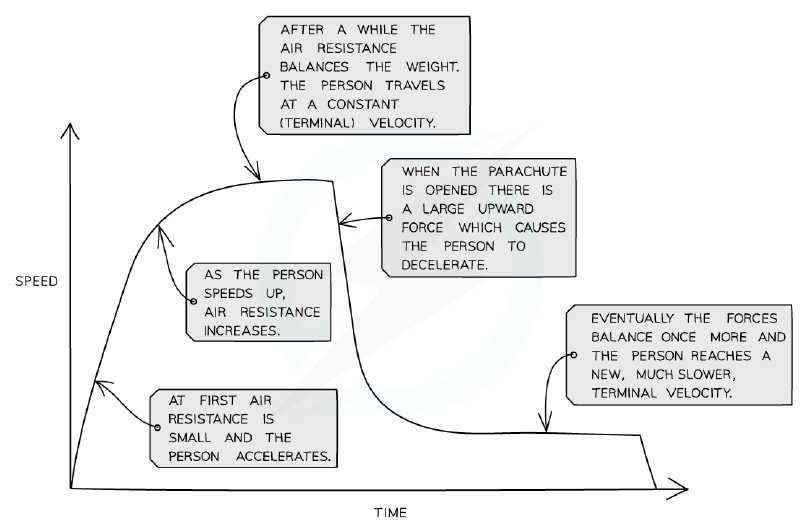
- Terminal velocity is reached when the viscous drag force equals the weight, so the resultant force is zero and the body falls at a constant velocity.
- On a velocity–time graph for a skydiver, the gradient (acceleration) decreases until it becomes zero at terminal velocity.
- A heavier skydiver reaches a higher terminal velocity and reaches it faster than a lighter skydiver with the same surface area.
- After a parachute is deployed, the skydiver decelerates to a lower terminal velocity; they do not move upwards.
A speed-time graph for a skydiver: air resistance builds as speed increases until it balances weight and a constant (terminal) velocity is reached.
Slides
Sign up free to view the lesson slides
Step through every slide for this topic — plus flashcards and revision notes — with a free account.
Practice questions
Free preview — 8 of 62 questions. Sign up to see them all.
1.What is the definition of acceleration?
Easy- AThe rate of change of velocity
- BThe rate of change of displacement
- CThe length between two points
- DThe length between two points in a certain direction
2.Which of the following correctly describes distance and displacement?
Easy- ADistance is a scalar and displacement is a vector
- BDistance is a vector and displacement is a scalar
- CBoth distance and displacement are scalars
- DBoth distance and displacement are vectors
3.A sprint walker completes a 200 m race in 40 s. What is their average speed during the race?
Easy- A5 m s⁻¹
- B6 m s⁻¹
- C7 m s⁻¹
- D8 m s⁻¹
4.Velocity is a vector quantity.
EasyTrue or false?
5.What does the gradient of a displacement-time graph represent?
Easy- AVelocity
- BDistance
- CSpeed
- DAcceleration
6.A velocity-time graph is shown for an object. Which property of the graph represents the total displacement of the object?
Easy- AThe total area between the line and the axis
- BThe gradient of the line
- CThe y-intercept
- DThe x-intercept
7.A car accelerates from rest to a speed of 40 m s⁻¹ in 5 seconds. What is the car's acceleration?
Medium- A8 m s⁻²
- B5 m s⁻²
- C20 m s⁻²
- D35 m s⁻²
8.Which of the following quantities are vectors? (Select all that apply.)
Medium- ADisplacement
- BVelocity
- CAcceleration
- DDistance
- ESpeed
Unlock all 62 questions & more
Create a free account to see every question, the slides, flashcards and revision notes for this topic.